
Torn Meniscus: Symptoms, Causes, Treatment, and Recovery — Complete Guide

Updated: 2 days ago
Medically reviewed by Dr. Baraa Alnahhal, MD · Last reviewed: September 2026
Editorial note: This article is for general education only and is not a substitute for professional medical advice. It was compiled from authoritative clinical sources listed in the References section. Always consult a licensed healthcare provider for diagnosis and treatment decisions.
TL;DR
A torn meniscus is a tear in one of the two C-shaped cartilage pads that cushion the knee between the thighbone and shinbone. Most tears come from twisting or pivoting on a weight-bearing knee in younger people, or from age-related wear in older adults. Pain, swelling, stiffness, catching or locking, and a "popping" sensation are the hallmark signs. Treatment usually starts conservatively — rest, ice, and medication — and surgery is only considered if the knee keeps locking or pain persists despite rehabilitation.
Quick Answer
What is a torn meniscus, and does it need surgery? A torn meniscus is a tear in the C-shaped cartilage that cushions the knee joint. It most often happens when you twist or rotate your knee while bearing weight on it, though in older adults it can occur with little or no trauma due to wear and tear [1]. Surgery is not always needed: rest, ice, elevation, and over-the-counter pain medication are enough for many tears, and tears associated with arthritis often improve as the arthritis is treated. Surgery is considered when the knee keeps locking or stays painful after physical therapy [2].
What Is a Torn Meniscus?
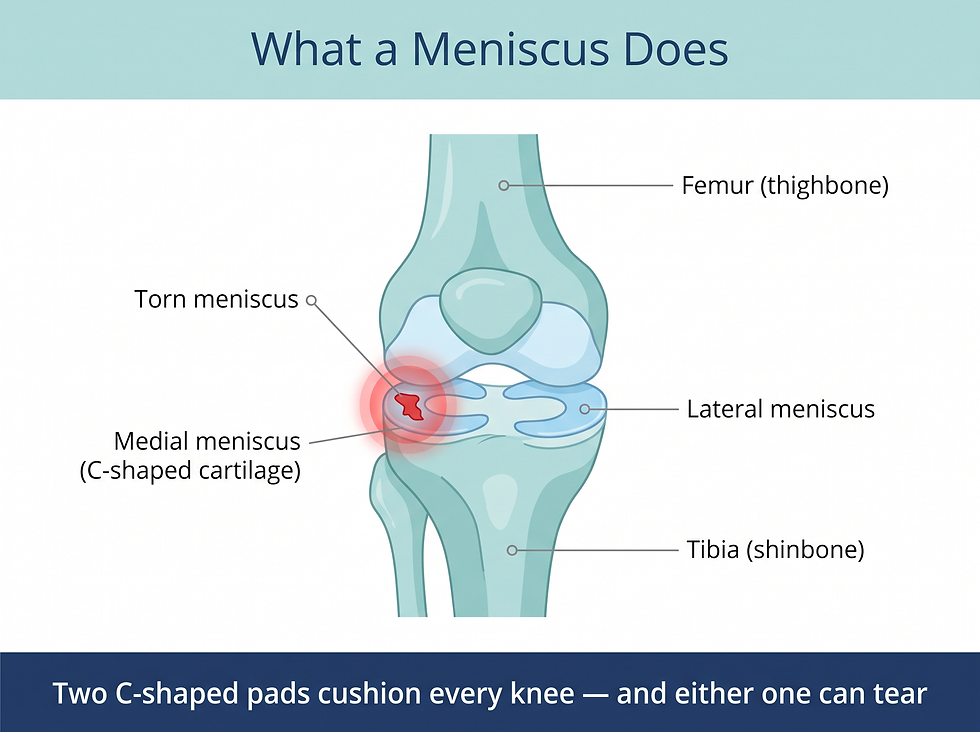
A torn meniscus is one of the most common knee injuries [1]. Each knee contains two C-shaped pieces of tough, rubbery cartilage called menisci. They sit between the shinbone and the thighbone and act like shock absorbers, cushioning the joint and spreading load across the knee [1].
When the cartilage tears, the knee responds with pain, swelling, and stiffness. The tear can also create a mechanical problem: a block to knee motion and difficulty straightening the leg fully [1].
Quick facts
Fact | Detail |
|---|---|
What it is | A tear in one of the two C-shaped cartilage pads (menisci) of the knee |
How common | One of the most common knee injuries; roughly 61 new tears per 100,000 people per year [3] |
Typical causes | Forceful twisting or pivoting on a bent, weight-bearing knee; age-related wear |
Hallmark signs | Popping sensation, swelling, pain with rotation, catching, locking, giving way |
First treatment | Usually conservative: rest, ice, OTC pain medication |
When surgery is considered | Knee keeps locking or pain persists despite physical therapy |
What Does a Torn Meniscus Feel Like?
The symptoms can be surprisingly slow to arrive. If the tear is small, pain and swelling might not begin for 24 hours or more after the injury [1].
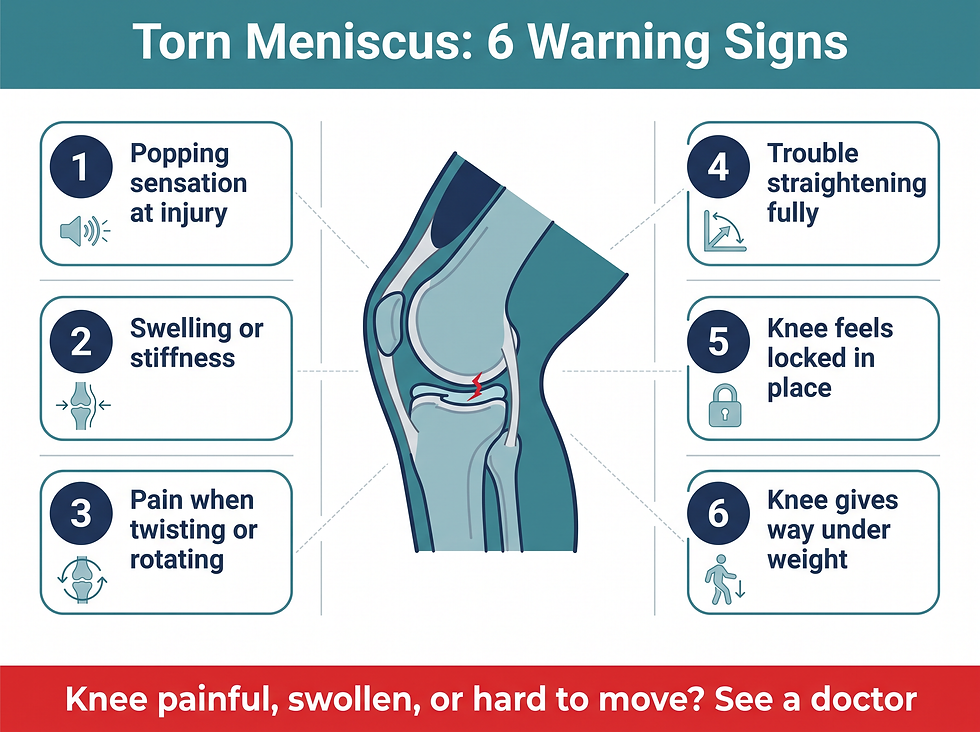
The six classic signs and symptoms are [1]:
# | Sign or symptom | What you experience |
|---|---|---|
1 | Popping sensation | A pop felt or heard in the knee at or around the time of injury |
2 | Swelling or stiffness | The knee puffs up and feels tight |
3 | Pain with twisting | Pain is worst when twisting or rotating the knee |
4 | Trouble straightening | Difficulty extending the knee fully |
5 | Locking | The knee feels blocked in place when you try to move it |
6 | Giving way | The knee feels unstable, as though it cannot support your weight |
The last two — locking and giving way — matter most. They suggest a piece of torn cartilage is catching inside the joint, and they are the symptoms that most often push treatment toward surgery [2].
When Should You See a Doctor?
The guidance is simple: contact your doctor if your knee is painful or swollen, or if you cannot move your knee in the usual ways [1]. You do not need to wait for symptoms to worsen — an early exam establishes a baseline and can rule out more serious injuries.
What Causes a Meniscus Tear?
Two different mechanisms produce the same result, and knowing which one applies to you shapes both treatment and expectations [1].
Cause type | How it happens | Typical patient |
|---|---|---|
Acute (injury-related) | Forceful twisting or rotating of the knee while bearing full weight — aggressive pivoting, sudden stops and turns. Even kneeling, deep squatting, or lifting something heavy can do it | Athletes and active adults |
Degenerative (wear-related) | Gradual breakdown of the cartilage with age; a simple movement, with little or no trauma, completes the tear | Older adults |
Research confirms the age pattern: the incidence of meniscal tears rises by roughly 61% with each five-year increase in age [4]. In people aged 65–80, between about 32% and 48% show a medial meniscus tear on imaging, depending on the age band [6].
Who Is at Risk?
Risk comes from two directions: the activities you do and the knee you have [1].
Risk factor | Why it matters |
|---|---|
Contact sports | Football and similar sports involve forceful knee contact |
Pivoting sports | Tennis and basketball demand aggressive twists and turns |
Age | Wear and tear on the knee increases with each decade [1][4] |
Obesity | Extra body weight adds constant load to the knee cartilage |
One large injury-surveillance study found meniscal tears accounted for 8.8% of all knee injuries and 0.8% of all athletic injuries among collegiate athletes [5] — a meaningful share of every injury seen on the field.
What Happens If a Torn Meniscus Is Left Untreated?
The complications are mechanical at first, then long-term [1]:
Complication | Description |
|---|---|
Giving way | The knee repeatedly fails to support your weight |
Loss of normal motion | You cannot move the knee as usual |
Persistent pain | The pain does not settle with self-care |
Osteoarthritis | An injured knee is more likely to develop osteoarthritis over time |
That last row deserves attention. Among knee injuries, a meniscal tear carries one of the highest increases in later osteoarthritis risk — an absolute risk difference of roughly 19.6 percentage points compared with uninjured knees, the greatest increase observed for any knee injury type in one large cohort study [7]. That number is a reason to treat even a "minor" tear seriously.
How Is a Torn Meniscus Diagnosed?
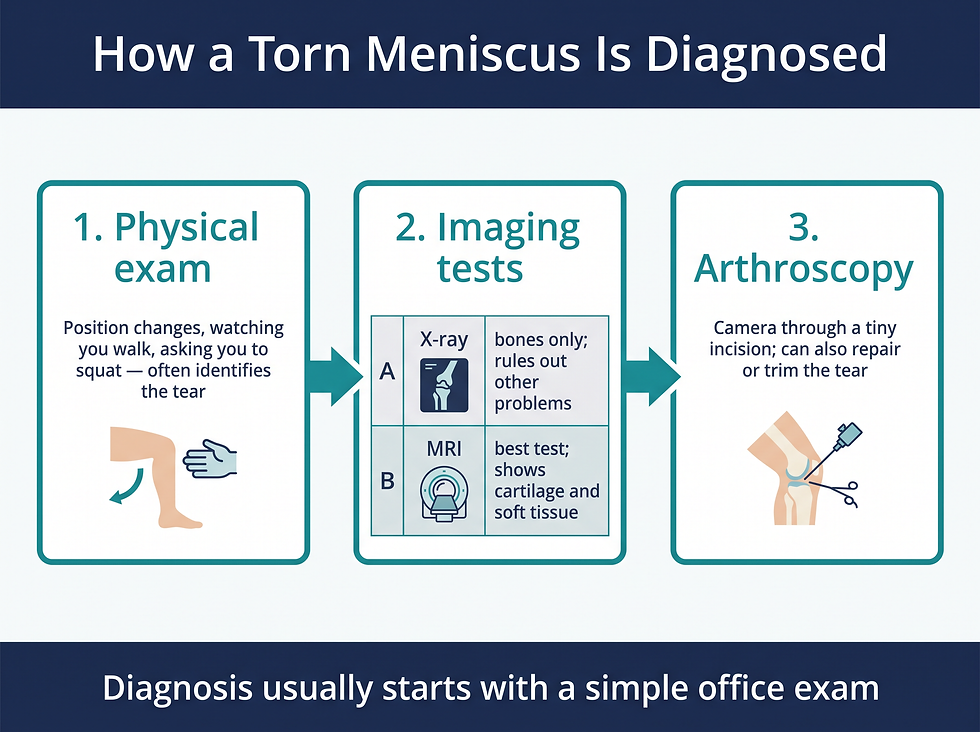
Diagnosis usually begins and often ends with the physical exam. The doctor moves your knee and leg into different positions, watches you walk, and asks you to squat to pinpoint the source of the problem [2].
Imaging supports or refines the clinical picture [2]:
Test | What it does | Role in meniscus diagnosis |
|---|---|---|
Physical exam | Position changes, walking observation, squatting | Often identifies the tear on its own |
X-ray | Images the bones | Cartilage does not show on X-ray; used to rule out other knee problems |
MRI | Detailed images of hard and soft tissues | The best imaging study for detecting a torn meniscus |
Arthroscopy | Camera inserted through a tiny incision | Used in some cases; allows repair or trimming at the same time |
How Is a Torn Meniscus Treated?
Treatment almost always begins conservatively. The right plan depends on the type, size, and location of the tear [2].
Conservative treatment (first line for most tears)
Step | What to do | Details |
|---|---|---|
Rest | Avoid aggravating activities | Especially anything that twists, rotates, or pivots the knee; crutches if pain is severe |
Ice | Cold therapy | A cold pack, a bag of frozen vegetables, or ice cubes in a towel, about 15 minutes at a time with the knee elevated; every 4 to 6 hours the first day or two, then as needed |
Medication | OTC pain relievers | Ease knee pain and swelling |
Physical therapy | Strengthening | Builds the muscles around the knee and in the legs to stabilize and support the joint |
Two important notes from the clinical guidance: tears associated with arthritis often improve over time with treatment of the arthritis itself, so surgery is usually not indicated for them. Many tears that are not associated with locking or a motion block also become less painful over time and never need surgery [2].
Surgical treatment (when conservative care fails)
Option | When it applies | Notes |
|---|---|---|
Meniscus repair | Tear is repairable, especially in children and younger adults | Preserves the cartilage |
Partial meniscectomy (trimming) | Tear cannot be repaired | Often done arthroscopically through tiny incisions; exercises afterward restore strength and stability |
Knee replacement | Advanced, degenerative arthritis | Addresses the whole diseased joint |
Meniscus transplant | Younger patients with ongoing symptoms after surgery but no advanced arthritis | Uses a donor meniscus |
Recovery timelines differ sharply by procedure: rehabilitation after a meniscus repair takes about three to six months, while a partial meniscectomy needs roughly three to six weeks [8].
Self-care after a tear
Until the pain disappears, avoid activities that aggravate the knee — especially sports involving pivoting or twisting. Ice and over-the-counter pain relievers can help along the way [2].
How Can You Prepare for Your Appointment?
People with a torn meniscus often start with emergency care or their family doctor, and may be referred to a sports medicine doctor or an orthopedic (bone and joint) surgeon depending on severity [2]. Coming prepared speeds the visit up.
Question the doctor will likely ask | How to prepare |
|---|---|
When did the injury occur? | Note the date and what you were doing |
Did you hear or feel a "pop"? | Describe any popping sensation |
How much swelling followed? | Estimate how quickly and how far swelling spread |
Have you injured this knee before? | List prior injuries and treatments |
Are symptoms continuous or occasional? | Track patterns over the days since injury |
Do movements improve or worsen symptoms? | Note what helps and what hurts |
Does the knee ever "lock" or feel blocked? | This single answer often shapes the treatment plan |
Does the knee feel unstable under weight? | Mention any giving-way episodes |
Conclusion: What to Do About a Torn Meniscus
Two anchor truths frame every meniscus-tear decision. First, most tears do not need surgery — rest, ice, pain medication, and physical therapy resolve or quiet many tears, particularly those tied to arthritis or lacking a locking symptom [2]. Second, ignoring a tear is not free: persistent mechanical symptoms and lost motion raise the long-term risk of osteoarthritis [1][7].
Treat it now. Rest from pivoting and twisting, ice the knee 15 minutes every 4–6 hours for the first day or two, and use over-the-counter pain relief as directed.
See a doctor if the knee is painful, swollen, or hard to move — and go sooner, not later, if the knee locks or gives way repeatedly.
Ask about an MRI if symptoms persist; it is the best imaging study for this injury.
Ask about physical therapy even if surgery is never discussed — stronger muscles are the knee's best long-term insurance.
Frequently Asked Questions
What are the first signs of a torn meniscus? The earliest sign is often a popping sensation in the knee, followed by swelling or stiffness that may take 24 hours or more to appear. Pain is worst when twisting or rotating the knee, and you may notice difficulty straightening the leg fully [1].
Can a torn meniscus heal on its own? Many tears become less painful over time and never need surgery — especially tears without locking or a block to motion, and tears associated with arthritis, which improve as the arthritis is treated. But a torn meniscus is cartilage with limited blood supply, so "healing on its own" usually means the symptoms settle rather than the tear closing up [2].
Does every torn meniscus need surgery? No. Treatment usually begins conservatively with rest, ice, and medication. Surgery is recommended when the knee keeps locking or remains painful despite rehabilitative therapy [2].
How long does recovery take? It depends on the procedure. Rehabilitation after a meniscus repair takes about three to six months, while a partial meniscectomy (trimming) requires roughly three to six weeks [8].
Is a torn meniscus the same as a torn ACL? No. The meniscus is C-shaped cartilage that cushions the joint; the ACL is a ligament that stabilizes it. They can be injured together, but they are different structures with different treatments.
Can you still walk with a torn meniscus? Usually yes — many people keep walking, though with pain. A feeling of the knee giving way, locking, or an inability to fully straighten the leg suggests you should be evaluated rather than pushing through [1].
Does a torn meniscus cause arthritis later? An injured knee is more likely to develop osteoarthritis over time [1]. One cohort study found meniscal tears carried the highest increase in osteoarthritis risk of any knee injury type studied — about a 19.6 percentage point absolute increase [7].
Should I ice my knee, and for how long? Yes. Apply a cold pack, a bag of frozen vegetables, or ice cubes in a towel for about 15 minutes at a time with the knee elevated — every 4 to 6 hours during the first day or two, then as often as needed [2].
References
1. Torn meniscus — Symptoms & causes — Mayo Clinic (updated January 6, 2022)
2. Torn meniscus — Diagnosis & treatment — Mayo Clinic (updated January 6, 2022)
4. Incidence and Risk Factors Associated With Meniscal Injuries — American Journal of Sports Medicine (2012)
6. Prevalence and effect of medial meniscus tear in elderly persons — Osteoarthritis and Cartilage30530-6/fulltext) (2020)
Comments