Arthroscopy: Joint Surgery Procedure, Uses and Recovery

Updated: 2 days ago
Written and medically reviewed by Dr. Baraa Alnahhal, MD · Last reviewed: November 2026 · How we review
Quick Answer
Arthroscopy is a minimally invasive surgery that lets a surgeon see, diagnose and treat problems inside a joint through small incisions, using a thin tube with a light and camera. It's used on the knee, shoulder, hip, ankle, elbow and wrist. Most people go home the same day. It causes less pain and scarring than open surgery.
What the research says
It doesn't help knee arthritis: in 180 people with knee osteoarthritis, arthroscopic washing or cleaning of the joint relieved pain and improved function no more than placebo surgery over 2 years (Moseley JB et al., New England Journal of Medicine, 2002) [2]
Or wear-and-tear meniscus tears: in 146 people aged 35 to 65 with a degenerative meniscus tear, arthroscopic partial meniscectomy gave no more improvement than sham surgery at 12 months (Sihvonen R et al., New England Journal of Medicine, 2013) [3]
Key takeaways
Arthroscopy treats joint problems through small incisions using a camera.
It's used on the knee, shoulder, hip, ankle, elbow and wrist.
Most people go home the same day.
Recovery is usually faster and less painful than open surgery.
It isn't recommended for knee arthritis or wear-and-tear meniscus tears alone.
What is arthroscopy?
Arthroscopy is a type of endoscopy for joints. The entry incision is half an inch or smaller, and other incisions are about the size of a dime. It's now the standard of care for many routine procedures on major joints. Sources: [1]
Why it's done
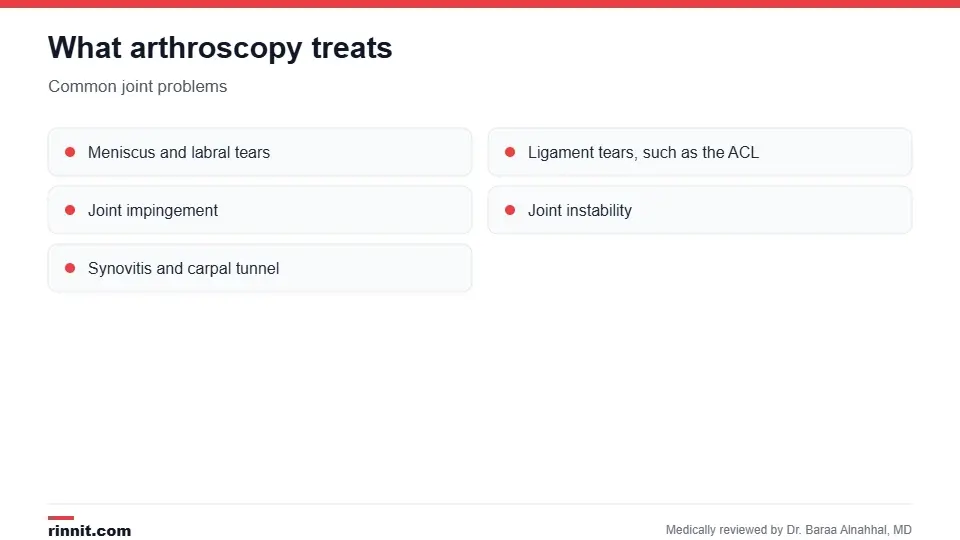
Your surgeon may diagnose and treat the problem in the same procedure.
Cartilage tears, such as a torn meniscus or labral tear.
Ligament tears, such as an ACL tear.
Joint impingement in the shoulder, hip or ankle.
Joint instability.
Synovitis, inflammation of the joint lining.
Nerve compression, such as carpal tunnel syndrome. Sources: [1]
Types of arthroscopy

Knee and shoulder arthroscopy are among the most common.
Joint | Common uses |
Knee | Meniscus repair or trimming, ACL reconstruction |
Shoulder | Rotator cuff tears, labral tears, impingement |
Hip | |
Ankle | Impingement, instability, loose fragments |
Elbow and wrist | Ligament tears, loose fragments, nerve release |
Sources: [1]
What happens during arthroscopy

Surgery usually takes one to two hours.
You get local anesthesia to numb the joint or general anesthesia to sleep.
The surgeon makes a half-inch incision and inserts the arthroscope.
Sterile saline expands the joint for a clearer view.
The surgeon examines the joint on a video screen.
Small tools inserted through other tiny incisions remove or repair damaged tissue.
The incisions are closed with stitches or tape. Sources: [1]
You'll spend another one to two hours in the recovery room and need someone to drive you home. Sources: [1]
Benefits and risks
Benefits | Possible risks (rare) |
Faster return to activities | Blood clots |
Less pain | Bleeding |
Minimal blood loss and scarring | Infection |
Fewer complications than open surgery | Nerve injury, usually temporary; joint stiffness |
Sources: [1]
When it isn't the right choice
Large trials found that arthroscopy to clean out an arthritic knee or trim a wear-and-tear meniscus tear worked no better than placebo surgery. Ask your provider about other treatments, such as physical therapy. Sources: [2, 3]
Recovery
You may need a brace, sling or splint, and crutches after leg surgery.
Use rest, ice, compression and elevation (RICE) and over-the-counter pain relievers.
Incisions usually heal within a week or two.
Early movement exercises help prevent stiffness.
Physical therapy may last several weeks to months. Sources: [1]
Conclusion
Arthroscopy lets surgeons repair many joint problems with small incisions, less pain and a quicker recovery than open surgery. Ask your surgeon whether it's the best option for your specific problem.
Keep learning: read about meniscus surgery and hip arthroscopy.
Frequently asked questions
What is arthroscopy?
Minimally invasive joint surgery using a small camera.
Which joints can be treated?
The knee, shoulder, hip, ankle, elbow and wrist.
How long does arthroscopy take?
Usually one to two hours.
Will I go home the same day?
Most people do.
Is arthroscopy painful?
It causes less pain than open surgery.
How big are the incisions?
About half an inch or smaller.
How long is recovery?
Incisions heal in a week or two; therapy may take weeks to months.
What are the risks?
Rare blood clots, bleeding, infection, nerve injury and stiffness.
Does arthroscopy help knee arthritis?
Studies show it works no better than placebo surgery for arthritis alone.
Will I need physical therapy?
Often, to restore strength and movement.
Related Reading
Ankle Arthroscopy: Procedure, Risks and Recovery explains ankle arthroscopy and recovery.
SLAP Tear Surgery: Procedure, Recovery and Success Rate explains SLAP tear surgery and recovery.
Orthopaedic Surgery: Common Types, Risks and Recovery explains the main types of bone and joint surgery.
Meniscus Surgery: Types, Recovery Time, Risks, and What to Expect a common type of knee arthroscopy.
Hip Arthroscopy: Procedure, Recovery Time, Risks and Results arthroscopy for the hip.
Rotator Cuff Tear: Symptoms, Causes, and Recovery Guide a shoulder injury treated with arthroscopy.
Torn Meniscus: Symptoms, Causes, Treatment, and Recovery — Complete Guide a common knee injury.
ACL Tear: What It Is, How It Happens, and How It Is Treated a ligament injury repaired arthroscopically.
References
Cleveland Clinic. Arthroscopy: What It Is, How It's Performed & Recovery. Cleveland Clinic. Last updated August 4, 2025. https://my.clevelandclinic.org/health/treatments/21801-arthroscopy
Moseley JB, O'Malley K, Petersen NJ, et al. A controlled trial of arthroscopic surgery for osteoarthritis of the knee. New England Journal of Medicine. 2002;347(2):81-88. PMID 12110735. https://doi.org/10.1056/NEJMoa013259
Sihvonen R, Paavola M, Malmivaara A, et al. Arthroscopic partial meniscectomy versus sham surgery for a degenerative meniscal tear. New England Journal of Medicine. 2013;369(26):2515-2524. PMID 24369076. https://doi.org/10.1056/NEJMoa1305189
Medical disclaimer
This article is for general education only and does not replace advice from a qualified healthcare professional. Talk to your doctor about your own diagnosis and treatment, and seek emergency care right away for severe or sudden symptoms.



Comments