Hip Arthroscopy: Procedure, Recovery Time, Risks and Results

Updated: 6 days ago
Written and medically reviewed by Dr. Baraa Alnahhal, MD · Last reviewed: October 2026 · How we review
Quick Answer: What is hip arthroscopy?
Hip arthroscopy is a minimally invasive surgery in which a surgeon inserts a small camera and tiny tools through a few buttonhole-sized cuts to find and repair damage inside the hip joint. It treats hip impingement, labral tears, loose fragments and tendon problems, usually as same-day surgery, with most people recovering in about six weeks. [1]
What the research says
Surgery outperformed targeted physiotherapy for hip impingement at 8 and 12 months. A pooled review of 4 randomized trials with 749 patients found that people treated with hip arthroscopy reported better hip function and quality-of-life scores than those given a targeted physiotherapy program at 8- and 12-month follow-up. (Mahmoud et al., Journal of Hip Preservation Surgery, 2022) [2]
The extra benefit over non-surgical care may be modest. A meta-analysis of 6 randomized trials (839 patients) found no significant difference at 6 months; at 12 months, arthroscopy scored about 10.7 points higher on a hip function and quality-of-life questionnaire (iHOT-33), but the gain did not reach the threshold patients usually notice, and numbness was more common after surgery. (Lamo-Espinosa et al., Scientific Reports, 2025) [3]
Most people return to work, on average about 4 months after surgery. Across 12 studies with 1,124 patients, 71% returned to work at an average of 115 days, about 51% went back to their full previous duties, and people in light or mostly seated jobs returned more often than those in strenuous jobs. (Blaeser et al., The American Journal of Sports Medicine, 2023) [4]
Key takeaways
Hip arthroscopy repairs problems inside the hip through a few small incisions, using a camera called an arthroscope. [1]
It is usually offered when hip pain has not improved with non-surgical treatment such as physical therapy or steroid injections. [1]
Most procedures take about 90 minutes, and most people go home the same day. [1]
Expect crutches for a week or two, a brace for about three weeks, recovery in about six weeks, and a return to sports in about 12 weeks. [1]
People with severe arthritis or major cartilage damage usually need a total hip replacement instead. [1]
Hip arthroscopy at a glance
What you want to know | Typical answer |
Type of surgery | Minimally invasive (keyhole) |
Incisions | A few small cuts, about the size of a buttonhole |
Anesthesia | Regional (numbs the hip area) or general (you sleep) |
Length of surgery | About 90 minutes |
Hospital stay | Usually none — same-day (outpatient) surgery |
Weight on the hip | None for at least the first week |
Crutches | Usually for the first week or two |
Hip brace | About three weeks |
Most people recovered | About six weeks |
Desk work or school | Often after one to two weeks |
Heavy exercise and sports | Around 12 weeks |
Times vary with the reason for surgery. Your surgeon will give you a personal plan. [1]
What is hip arthroscopy?
Hip arthroscopy is a minimally invasive operation that lets a surgeon see and repair damage inside your hip joint without opening it up. The surgeon makes a few small incisions in the skin over your hip and inserts an arthroscope — a thin tool with a camera and a light — into the joint. [1]
The camera sends images to a screen, so the surgeon can find the problem. Other small instruments go in through the remaining incisions to repair bone or connective tissue. [1]
Because the cuts are much smaller than in open surgery, the operation puts less stress on your body. You will still need physical therapy afterward to rebuild strength and movement. [1]

Who needs hip arthroscopy?
Hip arthroscopy is mainly for people whose hip pain has not responded to other treatments. It can also help people who have trouble moving normally because of a problem inside the hip joint. [1]
Before recommending surgery, your healthcare provider will usually:
Find the exact cause of your pain.
Try non-surgical treatments first, such as physical therapy or steroid injections.
Suggest arthroscopy only if those treatments have not fully worked. [1]
What conditions does hip arthroscopy treat?
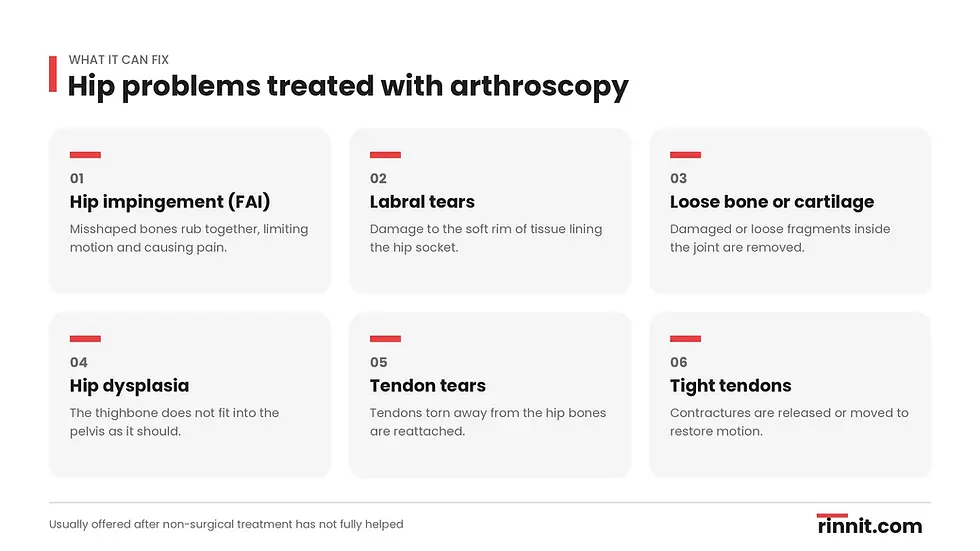
Hip arthroscopy treats a wide range of problems inside the hip joint, from misshaped bones to torn soft tissue. [1]
Condition | What is happening | What the surgeon can do |
An unusually shaped joint makes the top of the thighbone rub against the hip socket, causing pain and limited motion | Correct the friction between the bones | |
The labrum — the soft tissue lining the socket — is damaged by injury, structural problems or wear | Repair the torn tissue | |
Loose or damaged bone or cartilage | Fragments inside the joint cause pain | Remove the damaged or loose pieces |
The thighbone does not fit into the pelvis as it should | Address the joint problem through the arthroscope | |
Tendon tear | A tendon has torn away from the hip bone during an injury | Reattach the tendon |
Tight tendons (contractures) | Tendons are too tight and restrict movement | Release or move the tendon |
Source for table: [1]
How common is hip arthroscopy?
Hip arthroscopy is becoming one of the most common ways to treat hip problems, and surgeons can now treat more conditions with it than they could five or 10 years ago. [1]
Arthroscopy was used for years in the knee, shoulder and ankle before it spread to the hip. Better technology and surgical techniques have made it an option for more people. Some experts estimate that the number of hip arthroscopies in the U.S. rose by more than 600% over 15 years. [1]
How do you prepare for hip arthroscopy?
Preparing for hip arthroscopy means adjusting medicines and habits in the days before surgery, following your surgeon's instructions. [1]
Review your medicines. Tell your provider about everything you take, including over-the-counter medicines and herbal supplements. This matters most for medicines that prevent blood clots. Your surgeon will tell you what to stop and when.
Stop smoking. Smoking and other tobacco products make it harder for your body to heal after surgery.
Cut back on alcohol. Alcohol thins the blood, which can be dangerous before and after surgery.
Fast if told to. You may need to avoid food and drinks other than water for up to 12 hours before surgery. [1]
What happens during hip arthroscopy?
During hip arthroscopy, the surgeon makes a few buttonhole-sized cuts over your hip, inserts the arthroscope, and uses other small tools to repair the damage. [1]
You will receive one of two types of anesthesia:
Regional anesthesia numbs the area around your hip so you feel no pain.
General anesthesia puts you to sleep for the operation. [1]
Most hip arthroscopies take around 90 minutes, though the exact time depends on what needs repairing. [1]
What happens after hip arthroscopy?
After hip arthroscopy, most people go home the same day with a hip brace, crutches and a personal recovery plan. [1]
You will usually wear the brace for about three weeks and keep weight off the hip for at least the first week. Your surgeon will also go over the results of your surgery with you. [1]
At home, you may be asked to:
Avoid putting weight or pressure on your hip, including while you sleep.
Ice and elevate the area.
Keep the incision clean and covered.
Take non-steroidal anti-inflammatory drugs (NSAIDs) for pain.
Shower instead of bathing until the incision heals. [1]
What are the benefits of hip arthroscopy?
Hip arthroscopy's main benefit is that it fixes the problem through a few small incisions instead of a large open wound. [1] That usually means:
A faster recovery.
Less pain after surgery.
Minimal blood loss and scarring.
A lower risk of complications than more invasive surgery. [1]
What are the risks of hip arthroscopy?
Hip arthroscopy is less invasive than open surgery, but it still carries the risks of any operation. Possible complications include: [1]
Risk | What it means |
Allergic reaction | A reaction to the anesthesia |
Blood clots | Including deep vein thrombosis (DVT) in the leg |
Tissue or nerve damage | Injury to structures around the joint |
Bleeding or swelling | More than expected |
Infection | At the incision or inside the joint |
Numbness or tingling | In the groin, thigh or foot |
Further surgery | Needed if the original problem does not improve |
Source for table: [1]
Research comparing surgery with physiotherapy also found that numbness was reported more often after arthroscopy. [3]
How long does hip arthroscopy recovery take?
Hip arthroscopy recovery takes about six weeks for most people, although the exact time depends on why you needed surgery. [1]

Time after surgery | What to expect |
Day of surgery | Most people go home the same day |
Week 1 | No weight on the hip; ice, elevation and wound care |
Weeks 1–2 | Crutches, then walking with more weight on the hip; desk work or school often resumes |
About week 3 | The hip brace usually comes off |
About week 6 | Most people have recovered |
Weeks to months | Physical therapy continues, from a few weeks to a few months |
About week 12 | Return to heavy exercise and sports |
Source for table: [1]. Ask your surgeon for your own timeline.
When can you go back to work after hip arthroscopy?
People with desk-based jobs or schoolwork are often cleared to return one to two weeks after hip arthroscopy. [1] Check with your surgeon before going back to any activity that puts stress on your hip.
Across larger studies, the average time back to work was about 115 days, and people in light or mostly seated jobs returned more often than those in physically demanding work. [4]
Hip arthroscopy vs. total hip replacement: what is the difference?
Hip arthroscopy is a much less invasive operation than a total hip replacement (hip arthroplasty), and for many people it solves the pain or movement problem on its own. [1]
Hip arthroscopy | Total hip replacement | |
How invasive | Much less invasive — a few small incisions | More invasive |
Typically used for | Impingement, labral tears, loose fragments, tendon problems | Significant cartilage damage or severe arthritis |
When it is considered | After non-surgical treatment has not fully worked | When arthroscopy has not succeeded or symptoms are severe |
Source for table: [1]
If you have advanced hip arthritis, your provider is more likely to discuss a replacement than an arthroscopy. [1]
When should you call your doctor after hip arthroscopy?
Call your healthcare provider after hip arthroscopy if you notice any of these warning signs: [1]
Intense pain or bleeding at the incision site.
Nausea and vomiting.
Signs of infection, such as fever or discoloration around the incision.
Conclusion
Hip arthroscopy gives surgeons a way to repair impingement, labral tears, loose fragments and tendon problems through a few small incisions, usually with a same-day discharge. Most people are recovered in about six weeks and back to sport in about three months, though your own timeline depends on what was repaired. Research shows better results than physiotherapy alone at one year for hip impingement, while also showing that the extra benefit can be modest — which is why the decision is best made with your surgeon after non-surgical options have been tried.
Next step: If hip pain is limiting your day and treatment so far has not helped, book a review with an orthopedic or sports medicine specialist and ask whether hip arthroscopy fits your diagnosis. To understand the conditions behind hip pain first, read our guides to hip impingement, hip labral tears and hip dysplasia.
FAQ
What is hip arthroscopy?
Hip arthroscopy is a minimally invasive surgery that uses a small camera and tiny tools, inserted through a few small cuts, to find and repair damage inside the hip joint. It is used for problems such as hip impingement, labral tears and tendon injuries.
Is hip arthroscopy a major surgery?
Hip arthroscopy is a minimally invasive procedure rather than major open surgery. It uses a few buttonhole-sized incisions, usually takes about 90 minutes, and most people go home the same day.
How long does hip arthroscopy recovery take?
Hip arthroscopy recovery takes about six weeks for most people. Physical therapy can continue for a few weeks to a few months, and a return to heavy exercise and sports usually comes around 12 weeks.
How long will I need crutches after hip arthroscopy?
Crutches are usually needed for the first week or two after hip arthroscopy. You should not put any weight on the hip for at least the first week, and most people also wear a hip brace for about three weeks.
When can I go back to work after hip arthroscopy?
Return to work after hip arthroscopy is often possible after one to two weeks for people with desk-based jobs. Jobs that put stress on the hip take longer, so check with your surgeon before going back.
What are the risks of hip arthroscopy?
The risks of hip arthroscopy include an allergic reaction to anesthesia, blood clots such as deep vein thrombosis, nerve or tissue damage, bleeding, infection, and numbness or tingling in the groin, thigh or foot. Some people need further surgery if the problem does not improve.
Is hip arthroscopy better than a hip replacement?
Hip arthroscopy is much less invasive than a total hip replacement, but the two treat different problems. Arthroscopy suits problems like impingement or labral tears, while people with severe arthritis or significant cartilage damage usually need a hip replacement.
When should I call my doctor after hip arthroscopy?
Call your doctor after hip arthroscopy if you have intense pain or bleeding at the incision, nausea and vomiting, or signs of infection such as fever or discoloration around the incision.
Can hip arthroscopy help if I have arthritis?
Usually not for severe arthritis. People with severe arthritis or major cartilage damage usually need a total hip replacement instead, so your surgeon will check how much damage your joint has.
Will I need physical therapy after hip arthroscopy?
Yes. Physical therapy is a key part of recovery and helps rebuild strength and movement in your hip. It usually continues for a few weeks to a few months.
Related Reading
Arthroscopy: Joint Surgery Procedure, Uses and Recovery explains how arthroscopy repairs joints through small incisions.
References
Cleveland Clinic. Hip Arthroscopy: What It Is, Technique & Recovery. Cleveland Clinic. Last updated September 25, 2026. https://my.clevelandclinic.org/health/treatments/22195-hip-arthroscopy
Mahmoud SSS, Takla A, Meyer D, et al. Arthroscopic hip surgery offers better early patient-reported outcome measures than targeted physiotherapy programs for the treatment of femoroacetabular impingement syndrome: a systematic review and meta-analysis of randomized controlled trials. J Hip Preserv Surg. 2022;9(2):107-118. PMID 35854801. https://doi.org/10.1093/jhps/hnac012
Lamo-Espinosa JM, Mariscal G, Gómez-Álvarez J, et al. Efficacy and safety of arthroscopy in femoroacetabular impingement syndrome: a systematic review and meta-analysis of randomized clinical trials. Sci Rep. 2025;15(1):7775. PMID 40044717. https://doi.org/10.1038/s41598-025-91788-1
Blaeser AM, Mojica ES, Mannino BJ, et al. Return to Work After Primary Hip Arthroscopy: A Systematic Review and Meta-analysis. Am J Sports Med. 2023;51(5):1340-1346. PMID 35384746. https://doi.org/10.1177/03635465211064271
Medical disclaimer
This article is for general education and does not replace advice from your own doctor or surgeon. Recovery times and suitability for hip arthroscopy differ from person to person. If you have severe pain, signs of infection or any concern after surgery, contact your healthcare provider promptly.



Comments