Hip Arthritis: Understanding Symptoms, Causes, and Modern Treatments

Updated: 2 days ago
Medically reviewed by Dr. Baraa Alnahhal, MD · Last reviewed: October 2026
Quick Answer
Hip arthritis is joint damage in the hip, most often osteoarthritis from wear and tear, which may affect up to 25% of people older than 55. Pain is often felt in the groin, thigh, buttocks or knee, with stiffness and grinding. Treatment begins with lifestyle changes, physical therapy and pain relievers, then injections or joint replacement. [1]
What the research says
Hip osteoarthritis is common worldwide and rises with age. A meta-analysis of 31 studies and 326,463 participants found a pooled worldwide prevalence of 8.55% (using the Kellgren-Lawrence grade 2 or higher criterion). Prevalence varied by region, from 1.20% in Africa to 12.59% in Europe, and did not differ significantly between men (9.42%) and women (7.94%). (Fan et al., Arthritis Res Ther, 2023)
Adding hands-on therapy to exercise helps pain only in the short term. A meta-analysis of 19 trials in hip or knee osteoarthritis found very low to moderate certainty evidence that adding manual therapy to exercise gave extra short-term benefit for pain. There was high certainty evidence of no added long-term benefit for pain or function. (Runge et al., J Orthop Sports Phys Ther, 2022)
For pain medicines, opioids do not clearly pay off. A network meta-analysis of 192 trials with 102,829 participants with knee or hip osteoarthritis found that the clinical benefit of opioids does not outweigh their harm. It found oral NSAIDs such as etoricoxib 60 mg/day and diclofenac 150 mg/day to be the most effective, but with a slight increase in adverse events, so they may not suit people with other conditions or long-term use. (da Costa et al., BMJ, 2021)
What Is Hip Arthritis?
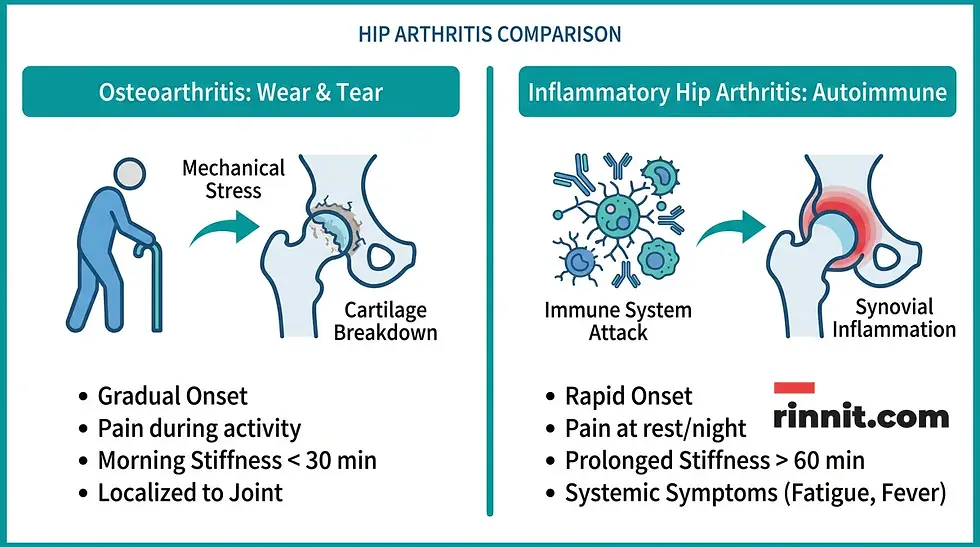
Hip arthritis is pain and stiffness in your hip joint, related to the soft tissues in the joint. It usually affects the cartilage that cushions your joint, and sometimes the synovial membrane that lubricates it. Arthritis causes inflammation and swelling in these tissues, or it wears them down, or both. If they wear down, your joint does not have enough padding or lubrication when it moves, and swelling may make it stiff. [1]
Types of Hip Arthritis
Most of the time, arthritis of the hip is osteoarthritis, which is simple wear and tear on the joint. Less commonly, inflammatory types of arthritis may affect your hips. Typically, inflammatory arthritis affects many parts of your body at once, not just large joints like the hips. [1] Types that may affect your hip include: [1]
Rheumatoid arthritis
Spondyloarthritis
Juvenile idiopathic arthritis
Gout
Pseudogout
Septic arthritis
Lupus-related arthritis
Lyme disease-related arthritis
Feature | Osteoarthritis | Inflammatory arthritis |
Cause | Mostly normal wear and tear on the joint. | Often an autoimmune disorder in which the immune system attacks your own tissues. |
Joints affected | Often just one hip at a time. | Often both hips, and other joints too. |
Timing | Average age for developing it is 65. | More likely to appear earlier. |
Hip osteoarthritis may affect up to 25% of people older than 55, and the hip is the second most common joint osteoarthritis affects. [1]
Symptoms of Hip Arthritis

Arthritis in your hip can cause: [1]
Pain and stiffness when your hip joint moves
Limited range of motion in your hip
Difficulty bending at the waist, or walking with a limp
A grinding or locking sensation when you move your hip
A crackling or clicking sound when it moves, called crepitus
Referred Pain
You might feel hip arthritis pain in areas around your hip joint. This is called referred pain, and sometimes it seems to move from one area to another. Many people feel it in the groin, thigh, buttocks or knee. [1]
What Causes Hip Arthritis?
Osteoarthritis of the hip is mostly the result of normal wear and tear. Our hips bear a lot of weight and stress throughout life, and as we age it is common for the cartilage to wear down. Some people have more wear and tear, and at earlier ages, because of lifestyle factors, genetics, injuries and diseases. [1]
Risk Factors for Osteoarthritis of the Hip
Increasing age
Occupations or sports that put repetitive stress on your hip joint
Carrying extra weight on your body when you walk
Previous injury or surgery in your hip joint (post-traumatic arthritis)
A poorly aligned hip joint, such as hip dysplasia or hip impingement
Family history of osteoarthritis
Inflammatory arthritis is not due to wear and tear, although inflammation can trigger degenerative changes. Most inflammatory conditions are autoimmune disorders, and risk factors include certain genetic mutations, certain autoimmune antibodies, and a family or personal history of autoimmune disease. [1]
How Is Hip Arthritis Diagnosed?
Diagnosis begins with a survey of your symptoms and a physical exam of your hip joint. A healthcare provider will test your range of motion and pain levels and watch how you walk. Then they take X-rays to look for signs of swelling, erosion or other degenerative changes. If they suspect inflammatory arthritis, you might have blood tests to check for certain indicators. [1]
How Is Hip Arthritis Treated?

The best treatment depends on the type and how severe it is. Regardless of the type, providers usually start with conservative therapies and lifestyle changes. [1]
Conservative Treatment
Lifestyle changes to reduce stress on the joint, such as losing weight, changing jobs or stopping certain activities. An assistive walking device such as a cane may help.
Heat and cold therapy: Ice or gel packs reduce inflammation, and heat pads or baths relax a stiff joint.
Physical therapy: Gentle exercise maintains flexibility and strength, and a physical therapist can advise you.
Over-the-counter pain relievers, especially NSAIDs, which reduce both inflammation and pain. Topical pain relief products can also help.
Prescription Treatments
As arthritis progresses, your provider might suggest injections or medicines to slow it down: [1]
Cortisone shots: Powerful, temporary pain relief and inflammation control directly in the hip.
Platelet-rich plasma (PRP) injections: An alternative pain relief option, and the evidence that it helps is limited, and the American College of Rheumatology recommends against it for hip osteoarthritis.
Oral corticosteroids: Anti-inflammatory drugs that suppress the immune system, used for inflammatory types.
DMARDs: Disease-modifying antirheumatic drugs that treat inflammatory types by reducing inflammation throughout the body.
Surgery
When other treatments are no longer effective, joint replacement surgery can offer relief: [1]
Hip resurfacing: A surgeon trims damaged bone and cartilage from the ball and socket and replaces the surfaces with a metal cap and shell.
Total hip replacement: The hip socket and the head of the femur are replaced with a prosthesis, which commonly lasts several decades.
Outlook
There is no cure for osteoarthritis, but conservative treatments can help manage symptoms. When they fail, hip replacement surgery can reliably eliminate the symptoms of hip osteoarthritis. Depending on your age, a hip replacement may last the rest of your life, while younger people may need another surgery after several decades as the prosthesis wears out. [1]
What Worsens Hip Arthritis
High-impact exercise, like running and jumping
Lifting or carrying too much weight while standing
Repetitive squats, twists or lunges
Too much sitting, or crossing your legs while you sit
Conclusion
Hip arthritis is common, but it does not have to mean losing your independence. Knowing that hip pain can show up in the groin, thigh or knee helps you spot it early. With exercise, lifestyle changes and the right treatment, most people keep their mobility, and surgery can restore it when needed.
Looking for clear answers on tough health questions? Browse plain-language health guides at Rinnit.com.
Frequently Asked Questions
Where is hip arthritis pain usually felt?
You may feel it in the hip, but many people feel it in the groin, thigh, buttocks or knee. This is called referred pain, and it can seem to move from one area to another. [1]
Can hip arthritis be cured?
There is no cure for osteoarthritis, but conservative treatments can help manage symptoms. When they fail, hip replacement surgery can reliably eliminate the symptoms of hip osteoarthritis. [1]
Is exercise good for hip arthritis?
Gentle exercise is important for keeping your joint flexible and strong. Activities to avoid include high-impact exercise such as running and jumping, and repetitive squats, twists or lunges. [1]
What makes hip arthritis worse?
Cleveland Clinic lists high-impact exercise, lifting or carrying too much weight while standing, repetitive squats, twists or lunges, and too much sitting or crossing your legs while you sit. [1]
Will I get arthritis in both hips?
Osteoarthritis often affects just one hip at a time, and having it in one hip does not mean you will get it in the other. Inflammatory arthritis often affects both hips and other joints. [1]
What is crepitus?
Crepitus is a crackling or clicking sound when the hip moves. Some people also feel a grinding or locking sensation. [1]
Can younger people get hip arthritis?
Inflammatory types of arthritis are more likely to appear earlier. Juvenile idiopathic arthritis is one of the types that can affect the hip. [1]
What is the average age for hip osteoarthritis?
The average age for developing it is 65, and it may affect up to 25% of people older than 55. [1]
Are cortisone shots helpful?
Steroid injections provide powerful, temporary pain relief and control inflammation directly in the hip. They are a standard treatment for inflammatory hip arthritis. [1]
What are DMARDs?
Disease-modifying antirheumatic drugs are medicines that treat inflammatory types of arthritis by reducing inflammation throughout the body. [1]
Should I use heat or cold?
Both can reduce arthritis pain in different ways. Ice or gel packs help reduce inflammation, and heat pads or baths can help relax a stiff joint. [1]
Is hip arthritis hereditary?
A family history of osteoarthritis is a risk factor. Inflammatory arthritis is also linked to certain genetic mutations and a family or personal history of autoimmune disease. [1]
Related Reading
Pelvis X-Ray: What It Shows, What to Expect and When You Need More Imaging explains the X-ray of the pelvic bones used for fractures and arthritis.
Hip X-Ray: What It Shows, Views Taken and What to Expect explains the X-ray views used to check the hip joint.
References
Cleveland Clinic. Hip Arthritis. Cleveland Clinic. Last updated September 24, 2024. https://my.clevelandclinic.org/health/diseases/hip-arthritis
Fan Z, Yan L, Liu H, et al. The prevalence of hip osteoarthritis: a systematic review and meta-analysis. Arthritis Res Ther. 2023;25(1):51. PMID 36991481. https://doi.org/10.1186/s13075-023-03033-7
Runge N, Aina A, May S. The Benefits of Adding Manual Therapy to Exercise Therapy for Improving Pain and Function in Patients With Knee or Hip Osteoarthritis: A Systematic Review With Meta-analysis. J Orthop Sports Phys Ther. 2022;52(10):675-A13. PMID 35881705. https://doi.org/10.2519/jospt.2022.11062
da Costa BR, Pereira TV, Saadat P, et al. Effectiveness and safety of non-steroidal anti-inflammatory drugs and opioid treatment for knee and hip osteoarthritis: network meta-analysis. BMJ. 2021;375:n2321. PMID 34642179. https://doi.org/10.1136/bmj.n2321
This article is for general educational purposes only and is not a substitute for professional medical advice, diagnosis, or treatment. Always seek the advice of your physician or other qualified healthcare provider with any questions you may have about a medical condition. Never disregard professional medical advice or delay seeking care because of something you have read here. If you think you may have a medical emergency, call your doctor or emergency services immediately.



Comments