Hip Dysplasia: Symptoms, Causes, Diagnosis & Treatment — Complete Guide

Updated: 3 days ago
Medically reviewed by Dr. Baraa Alnahhal, MD · Last reviewed: October 2026
Quick Answer
Hip dysplasia is a condition, present from birth, in which the hip socket does not fully cover the ball of the thighbone, so the joint can partly or fully dislocate. Most cases are caught at newborn exams and corrected with a Pavlik harness. Milder cases may appear later as groin pain or early osteoarthritis, sometimes needing surgery.
What the research says
Starting a hip brace before 3 months of age led to fewer complications. A systematic review of 22 studies of hip orthoses (such as the Pavlik harness) in infants with developmental dysplasia of the hip found a pooled success rate of 88.79% when treatment began before 3 months versus 87.78% at 3 to 6 months. Avascular necrosis occurred in 0.89% versus 9.66%, and residual dysplasia in 1.80% versus 20.27%. (Marletta et al., J Clin Orthop Trauma, 2025) [3]
Breech position, family history, and female sex raised the risk in newborns. A meta-analysis of 20 studies (64,543 infants younger than 3 months, with hip dysplasia confirmed by ultrasound) found higher odds with breech presentation (odds ratio 4.15, 95% CI 2.62–6.57), family history (OR 3.83, 95% CI 2.05–7.15), female sex (OR 2.50, 95% CI 1.74–3.59), and high birth weight (OR 2.00, 95% CI 1.60–2.49). Primiparity (a first pregnancy) was not associated with hip dysplasia risk in this analysis. (Tirta et al., JAMA Netw Open, 2025) [4]
Periacetabular osteotomy preserved the native hip for many people. In a meta-analysis of 24 studies (3,471 patients, 3,655 hips), 6.03% of hips were converted to total hip replacement at a mean of 4.71 years, estimated native-hip survivorship was about 75.9% at 10 years and 36.5% at 20 years, and the complication rate was 23.5%. Outcomes were best in patients younger than 40 with a preoperative Tönnis grade of 0 or 1. (Tan et al., Orthop Traumatol Surg Res, 2022) [5]
At a Glance
Aspect | Key Facts |
Also known as | Developmental dysplasia of the hip (DDH) |
What happens | Hip socket doesn't fully cover the thighbone ball; joint can partially or fully dislocate |
Present from birth? | Most people are born with it |
Common in | Girls; babies in breech position; first babies; larger babies |
Infant signs | One leg longer than the other; one hip less flexible |
Older signs | Limp, activity-related groin pain, hip instability, labral tear, osteoarthritis |
Diagnosis | Newborn exam, hip ultrasound, X-ray, MRI |
Treatments | Pavlik harness, repositioning + spica cast, periacetabular osteotomy, hip replacement |
Prognosis | Excellent with early infant diagnosis; untreated cases risk cartilage damage and arthritis |
What Is Hip Dysplasia?
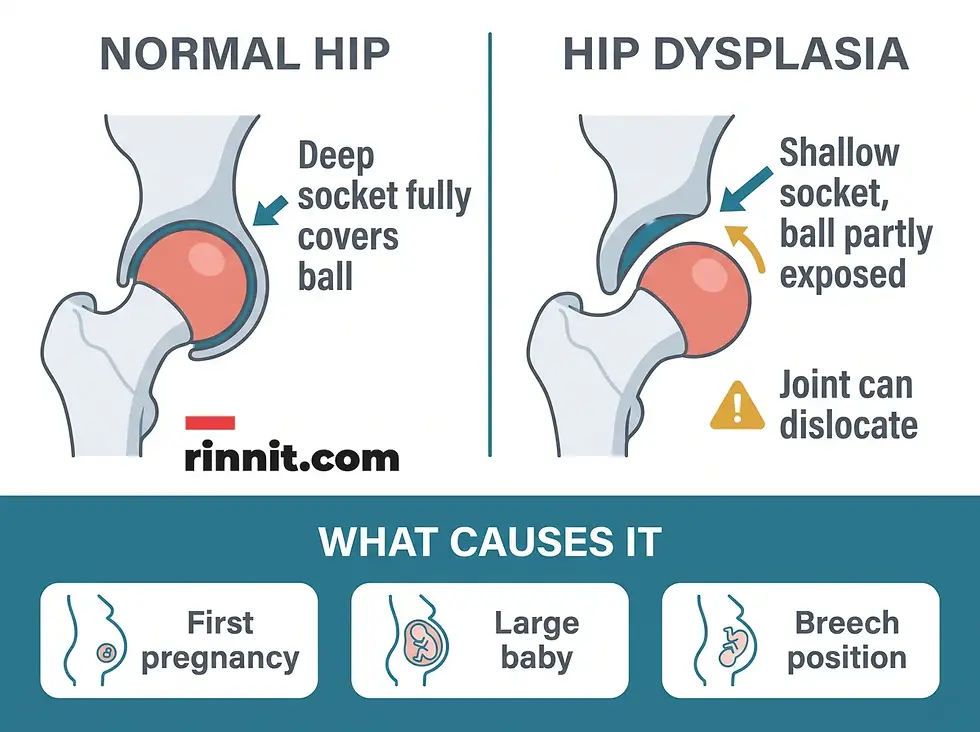
Hip dysplasia is the medical term for a hip socket that doesn't fully cover the ball portion of the upper thighbone. This mismatch allows the hip joint to become partially or completely dislocated. Most people with hip dysplasia are born with the condition — it is not an injury or something acquired through exercise or lifestyle.
The good news: healthcare professionals check your baby for signs of hip dysplasia shortly after birth and during well-baby visits. If it is diagnosed in early infancy, a soft brace can usually correct the problem.
Mild hip dysplasia is the tricky kind. It might not start causing symptoms until a person is a teenager or young adult. Over time it can damage the cartilage lining the joint, and it can hurt the labrum — the soft cartilage that rims the socket portion of the hip joint. Damage to this rim is called a hip labral tear. In older children and young adults, surgery may be needed to move the bones into the proper positions for smooth joint movement.
Symptoms: What to Look for at Every Age
Symptoms vary significantly by age group, which is why both parents of infants and adults with groin pain should know the warning signs.
Infant signs
In infants, you might notice that one leg is longer than the other. During diaper changes, one hip may be less flexible than the other. These are the classic clues that prompt further examination.
Toddler signs
Once a child begins walking, a limp may develop as the poorly seated joint struggles to bear weight normally.
Teen and young adult signs
In teenagers and young adults, hip dysplasia shows up through painful complications such as osteoarthritis or a hip labral tear. This may cause activity-related groin pain. Sometimes, there might be a sensation of instability in the hip — a feeling that the joint might slip.
Age group | Signs to watch |
Infants | One leg longer than the other; one hip less flexible during diaper changes |
Toddlers | Developing limp after learning to walk |
Teens & young adults | Activity-related groin pain; hip instability; osteoarthritis; hip labral tear |
How a Normal Hip Works — and What Goes Wrong
At birth, the hip joint is made of soft cartilage that gradually hardens into bone. The ball and socket need to fit together well because they act as molds for each other — the socket shapes itself around the seated ball as both grow. If the ball isn't seated firmly into the socket, the socket will not fully form around the ball and will become too shallow.
During the final month before birth, the space within the womb can become so crowded that the ball of the hip joint moves out of its proper position, resulting in a shallower socket. Factors that may reduce the amount of space in the womb include a first pregnancy, a large baby, and a breech presentation (when the baby is positioned bottom-first).

Risk Factors
Hip dysplasia tends to run in families and is more common in girls. The risk is also higher in babies born in the breech position and in babies who are swaddled tightly with the hips and knees straight. If any of these apply to your baby, make sure the well-baby exams pay close attention to the hips — and mention your family history.
Risk factor | Why it matters |
Family history | Hip dysplasia tends to run in families |
Female sex | More common in girls |
Breech position | Crowds the womb space in the final month |
First pregnancy | Less womb room for a first baby |
Large baby | More crowding in the final month |
Tight swaddling | Hips and knees held straight add risk |
Complications of Untreated Hip Dysplasia
Later in life, hip dysplasia can damage the labrum — the soft cartilage rimming the socket — producing a hip labral tear. Hip dysplasia also makes the joint more likely to develop osteoarthritis.
Osteoarthritis happens because of higher contact pressures over a smaller surface of the socket. Over time, this wears away the smooth cartilage on the bones that helps them glide against each other as the joint moves.
Diagnosis: How Hip Dysplasia Is Detected
Detection depends on age, and newborn screening is the backbone of early diagnosis.
During well-baby visits, healthcare professionals typically check for hip dysplasia by moving an infant's legs into a variety of positions that help indicate whether the hip joint fits together well. If hip dysplasia is suspected, a hip ultrasound might be ordered to check the hip joint for signs of dysplasia.
Mild cases of hip dysplasia can be difficult to diagnose and might not start causing problems until you're a young adult. If your healthcare team suspects hip dysplasia, they might suggest imaging tests such as X-rays or magnetic resonance imaging (MRI).
Test | Used for |
Newborn leg-movement exam | Checks whether the hip joint fits together well |
Hip ultrasound | Ordered when dysplasia is suspected in infants |
X-ray | Imaging for older children, teens, and adults |
MRI | Detailed imaging when dysplasia is suspected later in life |
Treatment by Age: From Pavlik Harness to Hip Replacement
Hip dysplasia treatment depends on the age of the affected person and the extent of the hip damage.
Infants: the Pavlik harness
Infants are usually treated with a soft brace called a Pavlik harness. It holds the ball portion of the joint firmly in its socket for several months, which helps the socket mold to the shape of the ball. This is why early diagnosis matters so much — a soft brace can usually correct the problem when the diagnosis comes in early infancy.
Babies older than 6 months: repositioning plus a spica cast
The brace doesn't work as well for babies older than 6 months. Instead, the healthcare professional may move the bones into the proper position and then hold them there for several months with a full-body cast called a spica cast. Sometimes surgery is needed to fit the joint together properly.
Older children and young adults: periacetabular osteotomy
If the dysplasia is more serious, the position of the hip socket also can be corrected. In a periacetabular (per-e-as-uh-TAB-yoo-lur) osteotomy, the socket is repositioned in the pelvis so that it matches up better with the ball.
Older adults with severe damage: hip replacement
Hip replacement surgery might be an option for older people whose dysplasia has severely damaged their hips over time, resulting in debilitating arthritis.
Age group | Treatment | How it works |
Infants | Pavlik harness (soft brace) | Holds the ball in the socket for months so the socket molds around it |
Babies over 6 months | Bone repositioning + spica cast | Bones moved into position and held by a full-body cast; surgery sometimes needed |
Older children & young adults | Periacetabular osteotomy | Socket repositioned in the pelvis to match the ball |
Older adults with arthritis | Hip replacement | For hips severely damaged over time |
Researchers continue to study new treatments and interventions through clinical trials, so newer options may become available over time.
Preparing for Your Appointment
You'll probably first bring your concerns to your family healthcare professional, who might refer you to an orthopedic surgeon.
What you can do
Before your appointment, take these five steps to make the visit count:
Write down any signs and symptoms you or your child are experiencing, including any that may seem unrelated to the reason for which you scheduled the appointment.
Make a list of any medicines, vitamins or supplements that you or your child are taking.
Consider taking a family member or friend along. Sometimes it can be difficult to remember all the information provided during an appointment, and a companion may remember something you missed or forgot.
Request that a copy of previous medical records be forwarded to your current healthcare professional if you are changing care teams.
Write down questions to ask the healthcare team.
Questions to ask your healthcare team
Your time with the healthcare professional is limited, so preparing a list of questions helps you make the most of the visit together. Some basic questions to ask include:
What's the most likely cause of the symptoms?
What kinds of tests are needed, and do these tests require any special preparation?
What treatments are available, and which do you recommend?
What are the possible side effects from treatment?
Are there any brochures or other printed material that I can take home with me?
Can you recommend any websites for more information on hip dysplasia?
What to expect from your doctor
Your healthcare professional is likely to ask you a number of questions. Being ready to answer them may reserve time to go over the points you want to spend more time on:
When did you or your child first begin experiencing symptoms?
Have the symptoms been continuous or occasional?
Does anything seem to improve the symptoms?
What, if anything, appears to worsen the symptoms?
If you or your child has already been diagnosed with hip dysplasia, when and where was the diagnosis made?
Frequently Asked Questions
What is hip dysplasia in simple terms?
Hip dysplasia means the hip socket is too shallow to fully cover the ball of the upper thighbone, which can let the joint partially or completely dislocate. Most people are born with the condition, and it is usually detected at newborn and well-baby exams.
Can adults have hip dysplasia if they were never diagnosed as babies?
Yes. Mild hip dysplasia might not start causing symptoms until the teenage or young adult years, when it can produce groin pain during activity or a sensation of hip instability. At that point it is typically found through X-rays or MRI.
What causes a baby to develop hip dysplasia?
During the final month before birth, a crowded womb can push the hip ball out of its proper position, so the socket forms too shallowly. First pregnancy, a large baby, and breech position all reduce womb space, and the condition also tends to run in families.
How is hip dysplasia diagnosed in newborns?
Healthcare professionals check by moving an infant's legs into a variety of positions that show whether the hip joint fits together well. If dysplasia is suspected, a hip ultrasound is typically ordered to confirm it.
What is a Pavlik harness and does it work?
A Pavlik harness is a soft brace that holds the ball portion of the hip joint firmly in its socket for several months, helping the socket mold to the shape of the ball. When hip dysplasia is diagnosed in early infancy, this soft brace can usually correct the problem.
What happens if hip dysplasia is never treated?
Untreated hip dysplasia can damage the labrum (the soft cartilage rimming the socket) and raise the risk of osteoarthritis. The shallow socket concentrates pressure on a smaller surface, wearing away the smooth cartilage that lets the joint glide over time.
Is swaddling related to hip dysplasia?
Swaddling babies tightly with the hips and knees straight raises the risk of hip dysplasia. Parents concerned about hips can swaddle in ways that allow the legs to bend and spread naturally.
Conclusion
If you take away only three lessons from this guide, make them these:
Hip dysplasia is present from birth, and early detection changes everything. Newborn exams and hip ultrasounds catch it when a soft Pavlik harness can usually correct it.
Age determines the treatment. From the harness for infants to the spica cast, periacetabular osteotomy for older patients, and hip replacement for adults with severe arthritis, the right option depends on how old the joint is and how much it has been damaged.
Silent does not mean harmless. Mild cases can wait years to appear as groin pain, labral tears, and osteoarthritis — so persistent activity-related hip pain in a young adult deserves a proper workup.
This guide has walked you through every stage of hip dysplasia — the signs at each age, the womb-crowding causes, the diagnosis pathway, and the full treatment ladder from brace to replacement. If you or your child has ever had a shallow hip socket or unexplained groin pain, understanding these steps is the first move toward keeping the joint healthy for life.
Disclaimer: This article is for general information only and is not a substitute for professional medical advice, diagnosis, or treatment. Always consult a qualified healthcare professional about your specific medical condition.
Related Reading
Pelvis X-Ray: What It Shows, What to Expect and When You Need More Imaging explains the X-ray of the pelvic bones used for fractures and arthritis.
References
Mayo Clinic Staff. Hip dysplasia - Symptoms and causes. Mayo Clinic. March 5, 2024. https://www.mayoclinic.org/diseases-conditions/hip-dysplasia/symptoms-causes/syc-20350209
Mayo Clinic Staff. Hip dysplasia - Diagnosis and treatment. Mayo Clinic. March 5, 2024. https://www.mayoclinic.org/diseases-conditions/hip-dysplasia/diagnosis-treatment/drc-20350214
Marletta DA, et al. Impact of age and timing of hip orthosis on treatment outcomes in infants with developmental dysplasia of the hip: A systematic review and meta-analysis. J Clin Orthop Trauma. 2025;64:102944. PMID 40109511. https://doi.org/10.1016/j.jcot.2025.102944
Tirta M, et al. Risk Factors for Developmental Dysplasia of the Hip Before 3 Months of Age: A Meta-Analysis. JAMA Netw Open. 2025;8(1):e2456153. PMID 39853978. https://doi.org/10.1001/jamanetworkopen.2024.56153
Tan JHI, et al. Hip survivorship following the Bernese periacetabular osteotomy for the treatment of acetabular dysplasia: A systematic review and meta-analysis. Orthop Traumatol Surg Res. 2022;108(4):103283. PMID 35470119. https://doi.org/10.1016/j.otsr.2022.103283



Comments