Ankle Arthroscopy: Procedure, Risks and Recovery

Updated: 2 days ago
Written and medically reviewed by Dr. Baraa Alnahhal, MD · Last reviewed: November 2026 · How we review
Quick Answer
Ankle arthroscopy is a minimally invasive surgery to diagnose and fix problems inside the ankle joint using an arthroscope, a thin tool with a camera and light, inserted through small cuts. It treats ankle instability, impingement and torn ligaments. You usually go home the same day. Full recovery typically takes a few months.
What the research says
Infection after arthroscopy is rare: a meta-analysis of 125 studies found the overall infection risk after joint arthroscopy was 0.84%, with limited data suggesting 0.27% for ankle procedures; risk was higher with steroid injections, diabetes, a BMI over 40 and smoking (Saraf A et al., American Journal of Sports Medicine, 2026) [2]
Arthroscopic ankle fusion healed better than open surgery: an umbrella review of 4,631 procedures found arthroscopic ankle fusion healed in 88.7% to 95.1% of cases versus 78.5% to 85.0% with open surgery, with fewer complications and hospital stays 1.2 to 1.8 days shorter (Fiore PI et al., European Review for Medical and Pharmacological Sciences, 2025) [3]
Key takeaways
Ankle arthroscopy uses a tiny camera to see and repair the inside of the ankle.
It treats instability, impingement, torn ligaments and loose fragments.
Most procedures take about an hour.
You usually go home the same day.
Full recovery usually takes a few months.
What is ankle arthroscopy?
Ankle arthroscopy is a very common type of arthroscopy. Through small cuts, your surgeon can see inside the ankle joint on a screen and fix problems without a large incision. Sources: [1]
Why it's done
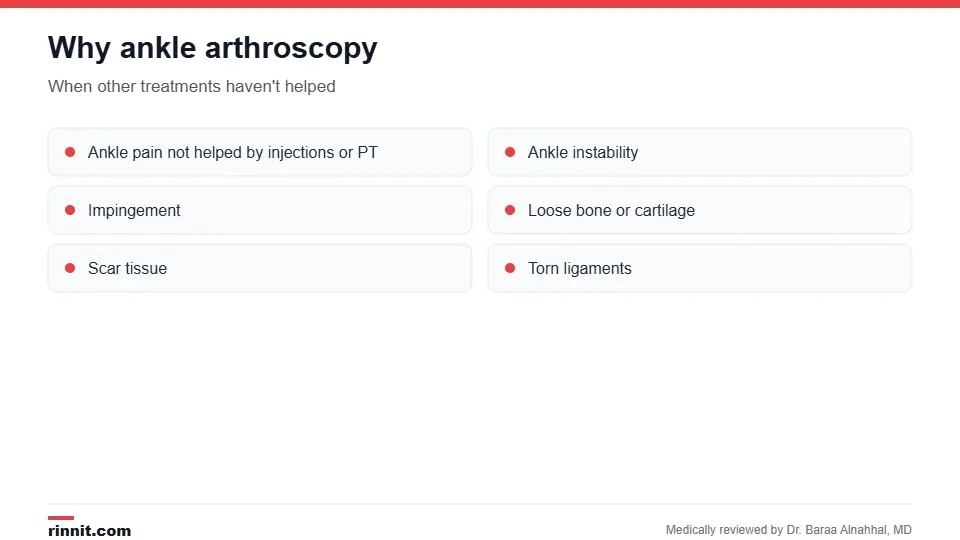
It's used when nonsurgical treatments haven't helped.
It's used when pain or trouble moving doesn't improve with steroid injections or physical therapy. Sources: [1]
How to prepare
Ask your surgeon which medicines, such as blood thinners, to stop or adjust.
Tell your surgeon about over-the-counter medicines and supplements.
Quit smoking at least 4 weeks before surgery.
Avoid alcohol, which thins your blood.
Follow fasting instructions; you may be allowed only water up to 12 hours before. Sources: [1]
What happens during surgery

Most procedures take about an hour.
You get regional anesthesia near the ankle or general anesthesia.
The surgeon makes small cuts, usually under half an inch, around your ankle.
The arthroscope is inserted to view the joint.
Tiny tools repair bones or connective tissue, or clean out damaged tissue (debridement).
The cuts are closed, and a splint is applied. Sources: [1]
Benefits and risks
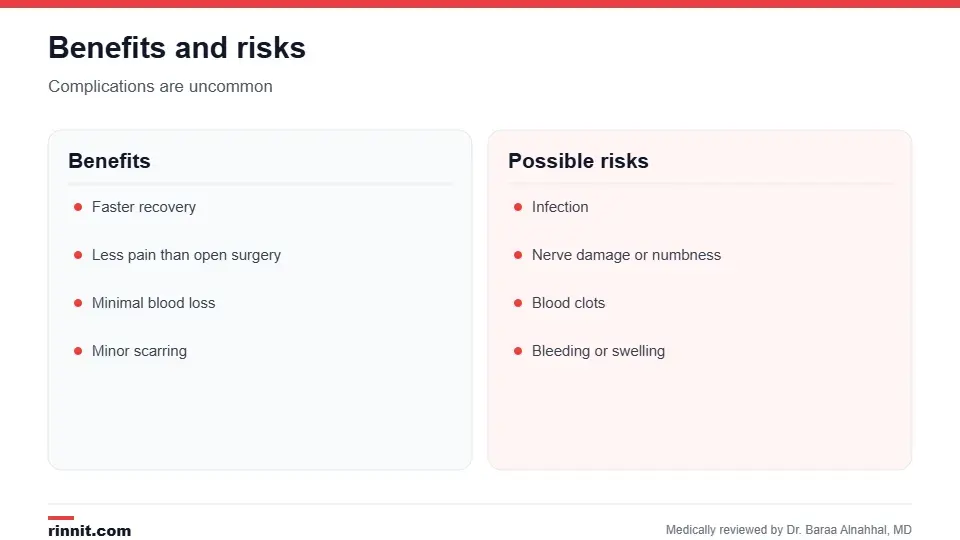
Complications are much less common than with open surgery.
Benefits | Possible risks |
Faster recovery | Infection |
Less pain than open surgery | Nerve damage or numbness |
Minimal blood loss | Blood clots, including DVT |
Minor scarring | Bleeding or swelling |
Lower complication risk | Need for more surgery |
Sources: [1, 2]
Recovery
Keep weight off your ankle, and use ice and elevation.
Keep the incisions clean and covered; shower instead of bathing until healed.
Expect a splint and crutches for a few weeks, then a walking boot.
Physical therapy helps you regain strength and movement.
If you work seated, you may return in a few weeks.
Wait a few months before intense exercise or sports. Sources: [1]
Full recovery usually takes a few months, sometimes as little as a few weeks. Sources: [1]
Outlook
Ankle arthroscopy is safe, effective and one of the least invasive ways to treat ankle joint problems. If more is needed, options include ankle fusion or ankle replacement. Sources: [1, 3]
When to call your provider
Intense pain or bleeding.
Nausea and vomiting.
Fever or discoloration at an incision, which may be signs of infection. Sources: [1]
Conclusion
Ankle arthroscopy can relieve ankle pain and restore movement with small cuts and a fast recovery. Following your weight-bearing and physical therapy plan helps you return to activity sooner.
Keep learning: read about ankle surgery options and arthroscopy.
Frequently asked questions
What is ankle arthroscopy?
A minimally invasive surgery to see and repair the inside of the ankle.
What does ankle arthroscopy treat?
Instability, impingement, torn ligaments and loose bone or cartilage.
How long does surgery take?
Usually about an hour.
Will I go home the same day?
Almost always.
How big are the incisions?
Usually under half an inch.
Is it better than open surgery?
It usually means less pain, less scarring and faster recovery.
How long is recovery?
Typically a few months.
When can I walk?
After a few weeks on crutches, you'll move to a walking boot.
When can I play sports again?
Usually a few months after surgery.
What are the risks?
Infection, nerve damage, blood clots and swelling.
Related Reading
Arthroscopy: Joint Surgery Procedure, Uses and Recovery an overview of arthroscopic surgery.
Ankle Surgery: Procedures, Recovery, and Treatment Options other ankle surgeries.
Understanding the Ankle Joint: Anatomy, Function, and Common Conditions how the ankle works.
Sprained Ankle: Symptoms, Causes, Treatment & Complete Guide a common ankle injury.
Ankle Fusion (Ankle Arthrodesis): Procedure, Risks, and Recovery fusing the ankle joint.
References
Cleveland Clinic. Ankle Arthroscopy: Procedure, Surgery & Recovery. Cleveland Clinic. Last updated July 29, 2022. https://my.clevelandclinic.org/health/treatments/23977-ankle-arthroscopy
Saraf A, Iwamoto S, Krishna S, et al. Risk factors for infection after ankle, knee, hip, shoulder, or elbow arthroscopy: a systematic review and meta-analysis. Am J Sports Med. 2026;54(9):2354-2363. PMID 41923655. https://doi.org/10.1177/03635465261429468
Fiore PI, Soares S, Seidel A, et al. Open vs. arthroscopic ankle arthrodesis: a comprehensive umbrella review of outcomes and complications. Eur Rev Med Pharmacol Sci. 2025;29(5):268-277. PMID 40444606. https://doi.org/10.26355/eurrev_202505_37225
Medical disclaimer
This article is for general education only and does not replace advice from a qualified healthcare professional. Talk to your doctor about your own diagnosis and treatment, and seek emergency care right away for severe or sudden symptoms.



Comments