Ankle Replacement Surgery: Procedure, Risks and Recovery

Updated: 2 days ago
Written and medically reviewed by Dr. Baraa Alnahhal, MD · Last reviewed: November 2026 · How we review
Quick Answer
Ankle replacement surgery (total ankle replacement or ankle arthroplasty) replaces damaged bone and cartilage in the ankle joint with a metal and plastic implant that moves like a natural joint. It treats ankle arthritis when other treatments haven't helped. Unlike ankle fusion, it keeps the ankle's motion. Full recovery takes six to 12 months.
What the research says
Most ankle replacements last at least 10 years: in a meta-analysis of 58 studies with 7,942 ankle replacements, 89% of implants were still working at 10 years, and ankle function scores doubled from 40 to 80 (Zaidi R et al., Bone & Joint Journal, 2013) [2]
Replacement and fusion gave similar function: a review of 852 ankle replacements and 1,262 fusions found implant survival of 78% at 5 years and 77% at 10 years, revision rates of 7% versus 9% for fusion, and similar function scores (Haddad SL et al., Journal of Bone and Joint Surgery (American), 2007) [3]
Key takeaways
Ankle replacement swaps a damaged ankle joint for a metal and plastic implant.
It treats ankle arthritis when other treatments fail.
It keeps more motion than ankle fusion.
Expect no weight on the ankle for four to six weeks.
Full recovery takes six to 12 months.
What is ankle replacement surgery?
Your ankle joint can wear down from arthritis, causing pain and stiffness. In ankle replacement, the worn surfaces are removed and replaced with an implant. The goal is to relieve pain and restore function. Sources: [1]
Why it's done

Surgery is considered when other treatments haven't helped.
It treats ankle arthritis when nonsurgical treatments haven't relieved your pain. These include medicines, physical therapy, corticosteroid injections, braces and orthotics. Sources: [1]
Ankle replacement vs. ankle fusion
;; Ankle replacement | ||
What it does | Replaces the joint with an implant | Permanently joins the bones |
Motion | Preserves range of motion | Limits motion |
Long-term results | Similar function scores | Similar function scores |
Sources: [1, 3]
How to prepare
Talk with your team about realistic expectations.
You may be asked to quit smoking, reach a healthy weight, start physical therapy and stop certain medicines.
Arrange help with groceries, stairs and pet care.
Plan to use a walker, crutches or knee scooter for about four to six weeks. Sources: [1]
What happens during surgery
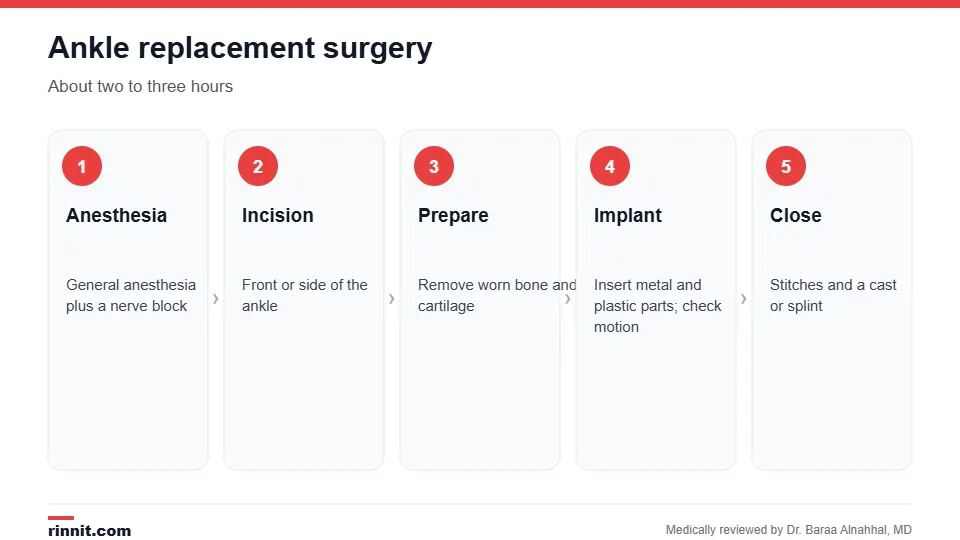
Surgery takes about two to three hours.
You get general anesthesia and a nerve block, and a tourniquet is placed on your leg.
The surgeon makes a cut at the front or side of your ankle.
Worn bone and cartilage are removed, and the joint surfaces are prepared.
The implant is inserted, and your range of motion is checked.
The cut is closed with stitches, and a cast or splint is applied. Sources: [1]
Risks
Risk | Notes |
Blood clots | Rare |
Infection | Rare |
Loosening of implant parts | May need repair surgery |
Nerve or blood vessel damage | Rare |
Incision healing problems | Rare |
Implant wear | Metal and plastic parts can wear over time |
Risks are higher if you smoke or have diabetes or an autoimmune disorder. Sources: [1]
Recovery
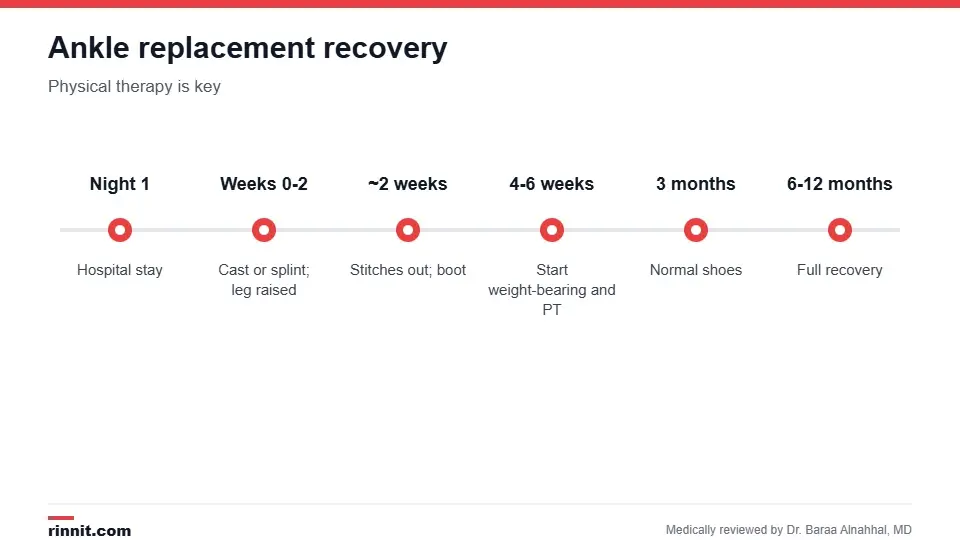
Physical therapy is a key part of recovery.
When | What to expect |
Hospital | Usually one night; some go home the same day |
Weeks 0 to 2 | Cast or splint, leg raised most of the time |
About 2 weeks | Stitches removed; removable boot |
4 to 6 weeks | Start some weight-bearing and physical therapy |
3 months | Normal shoes and light activity |
6 to 12 months | Full recovery |
Rehab may include walking practice, massage for swelling, strengthening, stretching and gradually adding weight. Sources: [1]
Results
Ankle replacement can help you regain strength and stability, keep your range of motion and walk more normally with less pain. Sources: [1, 2]
When to call your provider
Swelling of the ankle or foot.
A fever.
Pus or heavy bleeding from the incision.
Other signs of infection. Sources: [1]
Conclusion
Ankle replacement can ease arthritis pain while keeping your ankle moving. Preparing your home, following weight-bearing limits and sticking with physical therapy help you get the best result.
Keep learning: read about ankle arthritis and ankle fusion.
Frequently asked questions
What is ankle replacement surgery?
Surgery that replaces a damaged ankle joint with a metal and plastic implant.
Who needs an ankle replacement?
People with ankle arthritis when other treatments haven't helped.
How long does surgery take?
About two to three hours.
How long is the hospital stay?
Usually one night.
When can I walk after ankle replacement?
You'll start some weight-bearing after about four to six weeks.
How long is recovery?
Six to 12 months for full recovery.
Is ankle replacement better than fusion?
Replacement keeps more motion; long-term function is similar.
How long does an ankle replacement last?
In studies, most implants still worked at 10 years.
When can I wear normal shoes?
Around three months.
What are the risks?
Infection, blood clots, implant loosening and nerve damage, which are rare.
Related Reading
Foot and Ankle Arthritis: Symptoms, Types, and Management the condition ankle replacement treats.
Ankle Fusion (Ankle Arthrodesis): Procedure, Risks, and Recovery another surgery for ankle arthritis.
Ankle Surgery: Procedures, Recovery, and Treatment Options other types of ankle surgery.
Understanding the Ankle Joint: Anatomy, Function, and Common Conditions how the ankle joint works.
How to Use a Walker Safely getting around after surgery.
References
Cleveland Clinic. Ankle Replacement Surgery: What It Is & Recovery. Cleveland Clinic. Last updated September 22, 2025. https://my.clevelandclinic.org/health/treatments/14595-total-ankle-replacement
Zaidi R, Cro S, Gurusamy K, et al. The outcome of total ankle replacement: a systematic review and meta-analysis. Bone & Joint Journal. 2013;95-B(11):1500-1507. PMID 24151270. https://doi.org/10.1302/0301-620X.95B11.31633
Haddad SL, Coetzee JC, Estok R, et al. Intermediate and long-term outcomes of total ankle arthroplasty and ankle arthrodesis: a systematic review of the literature. Journal of Bone and Joint Surgery, American Volume. 2007;89(9):1899-1905. PMID 17768184. https://doi.org/10.2106/JBJS.F.01149
Medical disclaimer
This article is for general education only and does not replace advice from a qualified healthcare professional. Talk to your doctor about your own diagnosis and treatment, and seek emergency care right away for severe or sudden symptoms.



Comments