Foot and Ankle Arthritis: Symptoms, Types, and Management

Updated: 3 days ago
Medically reviewed by Dr. Baraa Alnahhal, MD · Last reviewed: October 2026
Source currency note: This guide reflects medical information reviewed in August 2024. Always confirm current guidance with your healthcare professional.
Quick Answer
Foot and ankle arthritis is any type of arthritis affecting the joints of the feet and ankles, including osteoarthritis, rheumatoid arthritis and gout. Symptoms include joint pain, stiffness, swelling and warmth, often worse in the morning. It is diagnosed with an exam and imaging. It cannot be cured, but pain relievers, orthotics and activity help; surgery is for severe cases. [4]
What the research says
Foot arthritis is common in older adults and most often affects the big toe joint. A 2018 review reports that symptomatic radiographic foot osteoarthritis affects 17% of adults aged 50 and over, with the first metatarsophalangeal joint (the base of the big toe) most commonly affected. Few randomized trials exist, but some evidence supports physical therapy, rocker-sole shoes, foot orthoses, and surgery for pain relief in big-toe joint osteoarthritis, and prefabricated orthoses in midfoot osteoarthritis (Roddy and Menz, Therapeutic Advances in Musculoskeletal Disease, 2018).
An ankle sprain raises the risk of later ankle arthritis. In a retrospective cohort of 195,393 Korean adults over middle age, 3.85% of those with a prior ankle sprain developed ankle osteoarthritis, versus 2.66% of those without a sprain, a 46% higher rate (hazard ratio 1.46; 95% CI 1.38 to 1.55). Women and people with overweight or obesity had a higher incidence after a sprain (Lee et al., Journal of Science and Medicine in Sport, 2022).
For end-stage ankle arthritis, ankle replacement and ankle fusion relieve pain similarly, but they trade off function and complications. A meta-analysis comparing total ankle arthroplasty with ankle arthrodesis (fusion) found no significant differences in pain relief, gait, or patient satisfaction. Replacement gave better function scores and range of motion, but it also had significantly higher complication and reoperation rates (Shih et al., Journal of Foot and Ankle Surgery, 2020).

What Is Foot and Ankle Arthritis?
Foot and ankle arthritis is any type of arthritis that affects the joints in the feet and ankles. Each foot has 26 bones and more than 30 joints, and your ankle joints are where your lower legs meet your feet. Arthritis can develop in any of these joints, which makes everyday activities such as walking and standing painful and difficult.
Many people link arthritis only with aging, but it can also come from health conditions or from injuries. Getting care early helps you keep moving and can prevent long-term joint damage.
Feature | Description |
Joints involved | 26 bones and more than 30 joints in each foot, plus the ankle joints |
Main causes | Natural wear and tear, injury, or autoimmune and metabolic conditions |
Common areas | Hindfoot (heel), midfoot (arch), and forefoot (ball of the foot and toes) |
Main impact | Pain, stiffness, and reduced mobility |
Common Types of Foot and Ankle Arthritis
There are more than 100 types of arthritis, and four of them most often involve the feet and ankles.
Osteoarthritis (OA)
The most common form, often called wear-and-tear arthritis. A lifetime of using your joints can eventually wear down the cartilage that cushions the ends of your bones. It is most common in people older than 50.
Rheumatoid arthritis (RA)
Unlike osteoarthritis, RA is an autoimmune disease. The immune system attacks the lining of the joints (the synovium), causing chronic inflammation and swelling, which can eventually lead to joint deformity.
Gout
Gout is a type of inflammatory arthritis caused by too much uric acid in the blood (hyperuricemia), which forms urate crystals in a joint. It often affects the joint at the base of the big toe first.
Post-traumatic arthritis
This type develops after an injury such as a fracture or severe sprain. Even if the injury heals, the joint may be more likely to develop arthritis years later, especially if you have injured the same joint more than once.
Symptoms and Warning Signs
Arthritis in the feet and ankles usually develops slowly, so you won't suddenly know you have it. Instead, you may notice the same kind of pain or other symptoms in the same spot again and again. Some types cause symptoms that come in waves, called flares, while others cause constant pain or stiffness.
Primary symptoms
Joint pain: aching or sharp pain during or after movement.
Stiffness: difficulty moving the foot, ankle, or toes, usually worse first thing in the morning or after sitting or lying down for a long time, and often easing once you start moving.
Swelling: visible inflammation around the affected joint.
Reduced range of motion: being unable to move your toes, foot, or ankle as far as usual.
Visual and physical signs
Skin discoloration: redness or a bruise-like look over the joint.
Tenderness: sensitivity to touch around a joint.
Warmth: the skin near the joint may feel warm.
Changes in how you walk: favoring one foot or altering your steps to avoid pain.
Causes and Risk Factors
What causes arthritis in your feet or ankles depends on the type. Osteoarthritis develops naturally as you age, rheumatoid arthritis comes from the immune system attacking the joints, and gout comes from too much uric acid. Understanding the cause helps with both prevention and choosing the right treatment.
Biological and lifestyle risk factors
Age and sex: risk is higher in people older than 50 and in men.
Family history: you may be more likely to develop arthritis if biological family members have it.
Tobacco use: smoking and other tobacco products increase your overall arthritis risk.
Other health conditions: autoimmune disease, obesity, or any condition that affects your joints raises the chance of developing arthritis. Excess weight also adds stress to the weight-bearing joints of the feet and ankles.
Injury, work, and activity risks
Previous injuries: fractures or sprains in the foot or ankle, especially repeated injuries to the same joint, are a major cause of post-traumatic arthritis.
High-impact sports: athletes who play sports that put a lot of stress on the feet and ankles, such as running or basketball, are at higher risk.
Demanding jobs: work that keeps you on your feet for long periods can speed up joint wear.

Diagnosis and Clinical Testing
A healthcare provider diagnoses arthritis in the feet and ankles with a physical exam, and you may be referred to a podiatrist. They will ask when your symptoms started, which activities or times of day make them worse, and which shoes you wear most often.
Clinical evaluation
Physical exam: checking your feet, ankles, and toes for swelling, tenderness, and range of motion, sometimes comparing with the unaffected foot.
Gait analysis: watching how you walk or move to spot changes in how you use your feet and ankles.
Medical history: reviewing past injuries, footwear, and family health patterns.
Imaging and lab work
X-rays: show joint changes in the bones, such as narrowing of the joint space.
MRI and CT scans: give detailed pictures of soft tissues and complex bone structures.
Blood tests: check uric acid levels if gout is suspected, and can show signs of infection or autoimmune disease.
Management and Treatment
Arthritis can't be cured, so the goals are to reduce pain, keep you moving, and protect your quality of life. Which treatments you need depends on the type of arthritis and the joints involved.
Non-surgical management
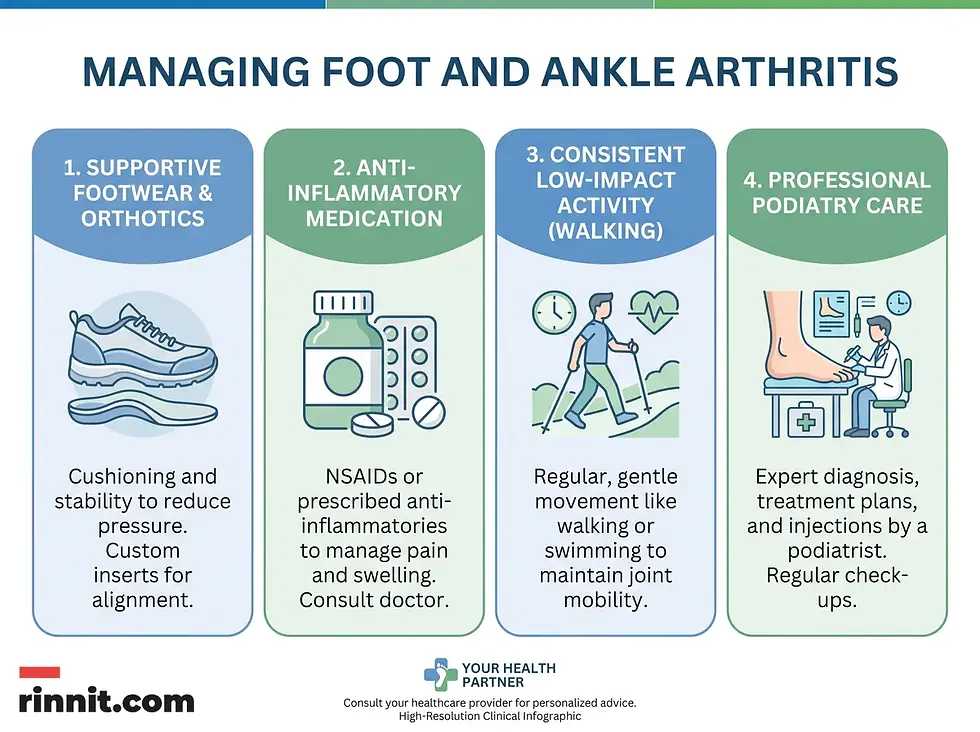
Over-the-counter pain relievers: NSAIDs such as ibuprofen, or acetaminophen, reduce inflammation and relieve pain. Don't take them for more than 10 days in a row without talking to your provider.
Corticosteroids: prescription anti-inflammatory medicines. Your provider may give cortisone shots directly into the affected joint.
Orthotics and supportive footwear: shoe inserts you can buy over the counter or have custom-made, plus shoes that support your feet and ankles.
Physical activity: walking, swimming, cycling, stretching, and yoga help keep joints flexible and can prevent symptoms from getting worse.
Surgical options
Surgery is usually suggested only when symptoms are severe and affect your quality of life, and nonsurgical treatments haven't worked.
Arthroscopy: a minimally invasive procedure used to manage early-stage arthritis before it severely damages the joint.
Joint fusion or replacement: used in advanced cases to relieve pain by joining the bones together or replacing the joint with an artificial one.
When to See a Healthcare Provider
Visit your healthcare provider if you have any of the following [4]:
Severe foot or ankle pain, especially if it lasts more than a week
Stiffness that is getting worse, especially if you suddenly can't move your feet or ankles as well as usual
Worsening or more frequent flare-ups of your usual symptoms
Prevention
Some types of arthritis happen naturally or because of conditions you can't control, so it can't always be prevented. You can lower your chances by:
Avoiding tobacco products
Following an eating and physical activity plan that is healthy for you
Doing low-impact exercise
Wearing proper protective equipment and footwear for any work, sport, or physical activity
Conclusion
Your feet and ankles carry you through your day, so pain, stiffness, and reduced mobility can affect how much you enjoy your favorite activities. Arthritis in these joints can't be cured, but most people can manage it well with supportive footwear, orthotics, medication, and regular low-impact movement. Don't ignore ongoing pain. See a provider as soon as you notice new or worsening symptoms.
Next step: Note when your symptoms are worst, which shoes you wear, and any past foot or ankle injuries, then bring that list to a healthcare provider or podiatrist for an assessment.
Frequently Asked Questions
Can foot arthritis be cured?
No. There is currently no cure for arthritis, but your healthcare provider can help you find treatments that reduce how much, and how often, it affects your daily routine.
Is walking good for arthritic feet?
Yes. Staying active is one of the best ways to relieve arthritis symptoms. Movement can reduce pain and stiffness and prevent symptoms from getting worse, but don't force yourself to do anything that causes severe pain. Swimming, cycling, stretching, and yoga are also good low-impact options.
How do I know if I have arthritis or just foot pain?
Arthritis symptoms tend to develop slowly and show up in the same spot, often with stiffness that is worse in the morning or after resting, plus swelling and tenderness. A healthcare provider or podiatrist can confirm the diagnosis.
What are the best shoes for foot arthritis?
Shoes that support and cushion your feet and ankles are generally best, and your provider may also suggest orthotic inserts. They may also advise you to wear or avoid certain types of shoes depending on which joints are affected.
Does smoking affect arthritis?
Yes. Smoking and using other tobacco products increases your overall arthritis risk, so avoiding tobacco is one way to lower your chances of developing it.
What is a gait analysis?
A gait analysis is an exam in which your provider watches how you walk or move to see how your feet and ankles work and how you distribute your weight.
Can gout affect joints other than the big toe?
Yes. Gout often starts in the big toe, but it can affect any joint in the foot or ankle, causing sudden and intense pain and swelling.
When should I consider surgery for foot arthritis?
Surgery is usually suggested only when symptoms are severe and affect your quality of life, and nonsurgical treatments such as medication, orthotics, and physical activity haven't worked.
Are custom orthotics better than over-the-counter ones?
Orthotics can be bought over the counter or custom-made. Custom inserts are tailored to your foot shape and gait, while over-the-counter options may be enough for mild symptoms. Your provider will tell you which kind you need and how often to wear them.
Can weight loss help with foot arthritis?
Weight loss can. Excess weight puts additional stress on the weight-bearing joints of the feet and ankles, so losing weight, with a plan that is healthy for you, can ease the load and may reduce pain.
Related Reading
Ankle Replacement Surgery: Procedure, Risks and Recovery explains ankle replacement surgery for arthritis.
Foot X-Ray: What It Shows, Why It's Done, What to Expect and Results explains the imaging test commonly used to diagnose this condition in the foot and ankle.
References
Roddy E, Menz HB. Foot osteoarthritis: latest evidence and developments. Therapeutic Advances in Musculoskeletal Disease. 2018;10(4):91-103. PMID 29619094. https://doi.org/10.1177/1759720X17753337
Lee S, Song K, Lee SY. Epidemiological study of post-traumatic ankle osteoarthritis after ankle sprain in 195,393 individuals over middle age using the National Health Insurance Database: a retrospective design. Journal of Science and Medicine in Sport. 2022;25(2):129-133. PMID 34565662. https://doi.org/10.1016/j.jsams.2021.08.018
Shih CL, Chen SJ, Huang PJ. Clinical outcomes of total ankle arthroplasty versus ankle arthrodesis for the treatment of end-stage ankle arthritis in the last decade: a systematic review and meta-analysis. Journal of Foot and Ankle Surgery. 2020;59(5):1032-1039. PMID 32709528. https://doi.org/10.1053/j.jfas.2019.10.008
Cleveland Clinic. Foot and ankle arthritis. Cleveland Clinic. August 27, 2024. https://my.clevelandclinic.org/health/diseases/13900-foot-and-ankle-arthritis
Medical disclaimer
This article was prepared for general information only and is not a substitute for professional medical advice.



Comments