Understanding Ankle Ligaments: Anatomy, Function, and Injury Prevention

Updated: 2 days ago
Medically reviewed by Dr. Baraa Alnahhal, MD · Last reviewed: October 2026
Quick Answer: What are ankle ligaments?
Ankle ligaments are strong, fibrous bands of connective tissue that connect the foot bones to the lower leg bones. [1] They stabilize the joint, prevent twisting or collapsing and absorb shock during walking and running. [1] They can overstretch or tear, causing a sprain. [1] Strengthening exercises, flexibility training and supportive footwear help keep them healthy. [1]
What the research says
Sprains most often involve the lateral (outer) ligaments, and some groups are at higher risk. A systematic review and meta-analysis of 181 prospective studies found that ankle sprains were more common in females than males (13.6 versus 6.94 per 1,000 exposures) and in adolescents than adults (1.94 versus 0.72 per 1,000 exposures), with indoor and court sports carrying the highest risk. Lateral ankle sprains were more common than syndesmotic or medial sprains (PubMed: Doherty et al., Sports Med, 2014 [2]).
Balance (proprioceptive) training lowers the risk of ankle sprains in athletes, especially those who have sprained before. A systematic review and meta-analysis of 7 randomized trials with 3,726 participants found that proprioceptive training reduced ankle sprain incidence (relative risk 0.65; 95% CI 0.55 to 0.77), including in participants with a previous sprain (relative risk 0.64; 95% CI 0.51 to 0.81). Evidence for preventing a first sprain remained inconclusive (PubMed: Schiftan et al., J Sci Med Sport, 2015 [3]).
What do ankle ligaments do, and how are they structured?
Ankle ligaments serve as the primary stabilizers of the ankle joint, connecting the talus and calcaneus (foot bones) to the tibia and fibula (lower leg bones). [1] These firm bands of fibrous tissue are composed of collagen proteins for strength and elastic fibers for flexibility. [1] Their placement on both sides of the ankle allows them to absorb shock and prevent the joint from moving in unsafe or unnatural directions. [1]
Primary Functions of Ankle Ligaments
The ligaments in the ankle are active during almost every weight-bearing movement. Their key responsibilities include:
Shock Absorption: Reducing the impact when the foot strikes a surface during walking or running. [1]
Bone Alignment: Keeping the bones of the foot and lower leg in their proper positions. [1]
Joint Stabilization: Preventing the ankle from twisting, folding, or collapsing under pressure. [1]
Safety Control: Stopping the ankle from extending beyond its safe range of motion.

How are ankle ligaments classified?
Ankle ligaments are classified into three main sets: the medial (deltoid) ligaments, the lateral ligaments and the syndesmotic ligaments. [1] Each set has a specific location and connects different bones to ensure proper movement.

Ligament Set | Location | Primary Bones Connected | Key Ligaments Included |
Medial (Deltoid) | Inner side of the ankle | Tibia to talus, calcaneus, and navicular [1] | ATTL, PTTL, TCL, TNL [1] |
Lateral | Outer side of the ankle | Fibula to talus and calcaneus [1] | ATFL, CFL, PTFL [1] |
Syndesmotic | Between lower leg bones | Tibia to fibula | AITFL, PITFL, ITL, TTFL, IOL [1] |
Medial Ligaments
Also known as deltoid ligaments, these are located on the inner side of the ankle. They originate at the medial malleolus, the bony bump on the inside of the ankle, and fan out to connect the tibia to several foot bones. [1]
Lateral Ligaments
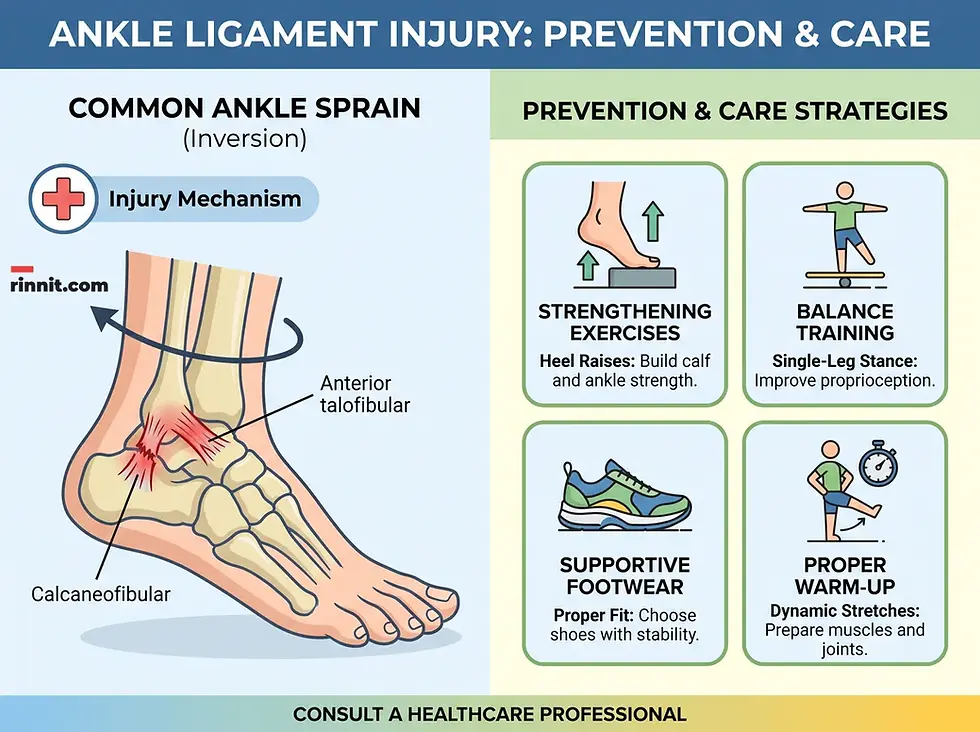
These ligaments are situated on the outer side of the ankle, starting at the lateral malleolus (the bump on the outside of the ankle). They connect the fibula to the talus and heel bone, providing lateral stability. [1]
Syndesmotic Ligaments
This group connects the two bones of the lower leg, the tibia and fibula, ensuring they remain properly aligned above the ankle joint.
What are common ankle ligament injuries, and how are they diagnosed?
A ligament injury occurs when the tissue is stretched too far or torn, a condition medically termed a sprain. [1] Ankle sprains are among the most common physical injuries and can happen during sports, falls, or even walking on uneven surfaces. [1] [2]
Common Causes of Sprains
Diagnostic Procedures
Healthcare providers use several methods to assess the severity of a ligament injury. The process typically begins with a physical exam to check for swelling and range of motion, often comparing the injured ankle to the healthy one. [1] Imaging tests such as X-rays are frequently used to rule out fractures, while an MRI may be ordered if the pain does not improve with initial treatment. [1]
How can you prevent ankle ligament injuries?
You can lower your risk of ankle ligament injuries with strengthening and balance exercises, supportive shoes, careful activity choices and a healthy weight. [1]
Strengthening: Exercises like heel raises, squats, and lunges build the muscles supporting the joint. [1]
Flexibility and Balance: Regular stretching and balance training, such as standing on one foot, help the body react safely to stumbles.
Proper Gear: Wearing well-fitting, supportive shoes provides external stability to the ankle.
Activity Management: Avoiding uneven surfaces and gradually increasing the intensity of new exercise routines can prevent sudden strain. [1]
Weight and Core Health: Maintaining a healthy weight reduces pressure on the joints, while a strong core improves overall body reaction time.
Conclusion
Ankle ligaments are vital components of the musculoskeletal system that enable stable movement and protect the joint from injury. By understanding their anatomy and function, individuals can take proactive steps to maintain their health through targeted exercises and proper care. If persistent pain or instability occurs, consulting a healthcare professional is essential for a proper diagnosis.
What are the next steps for ankle ligament health?
Protect your mobility by incorporating ankle-strengthening exercises into your daily routine. If you have recently experienced an ankle twist or persistent pain, schedule a consultation with a specialist to ensure your ligaments are properly supported and treated.
Frequently Asked Questions
1. What is the difference between a medial and lateral ankle ligament?
Medial ligaments, also called deltoid ligaments, are located on the inner side of the ankle and connect the tibia to the foot bones. Lateral ligaments are on the outer side, connecting the fibula to the talus and heel bone.
2. How do ankle ligaments provide stability?
Ankle ligaments stabilize the joint by connecting the foot bones to the lower leg bones, keeping them in the proper position and preventing the ankle from twisting or collapsing during movement.
3. What is a syndesmotic ligament?
Syndesmotic ligaments are a set of five ligaments that connect the tibia (shin bone) and fibula (calf bone) together, maintaining the alignment of the lower leg bones above the ankle.
4. What is the most common injury to an ankle ligament?
The most common injury is a sprain, which occurs when a ligament is overstretched or torn, usually due to a sudden twist or roll of the ankle.
5. Can you prevent all ankle ligament injuries?
While you cannot prevent every injury, you can lower the risk by improving flexibility, strengthening the ankle and core, and wearing supportive footwear.
6. What are ankle ligaments made of?
Ankle ligaments are composed of strong, cord-like connective tissue that contains collagen proteins for binding and elastic fibers for slight stretchability.
7. How does a doctor diagnose a ligament injury?
Diagnosis typically involves a physical exam to assess movement and swelling, X-rays to check for broken bones, and potentially an MRI if initial treatments are not effective.
8. What bones do the ankle ligaments connect?
The ankle ligaments connect the calcaneus (heel bone), fibula (calf bone), navicular, talus (ankle bone), and tibia (shin bone).
9. Why is shock absorption important for ankle ligaments?
Shock absorption helps protect the joint by reducing the impact force when the foot strikes a surface, preventing damage during activities like walking or running.
10. When should I see a doctor for ankle pain?
It is important to see a healthcare provider if you experience persistent pain, swelling, or instability in your ankle to receive a prompt diagnosis and treatment plan.
Related Reading
Sprained Ankle: Symptoms, Causes, Treatment & Complete Guide explains ankle sprain grades, home care and when to see a doctor.
High Ankle Sprain: Understanding Syndesmotic Injuries covers high ankle sprains and why they take longer to heal.
Understanding the Ankle Joint: Anatomy, Function, and Common Conditions describes the bones and joint surfaces that ankle ligaments hold together.
Deltoid Ligament: Anatomy, Function, and Injury Prevention looks closely at the strong ligament on the inner side of the ankle.
References
Cleveland Clinic. Ankle Ligaments: What They Are, Anatomy & Function. Cleveland Clinic. Dec. 2, 2024. https://my.clevelandclinic.org/health/body/21609-ankle-ligament
Doherty C, Delahunt E, Caulfield B, et al. The incidence and prevalence of ankle sprain injury: a systematic review and meta-analysis of prospective epidemiological studies. Sports Med. 2014;44(1):123-140. PMID 24105612. https://doi.org/10.1007/s40279-013-0102-5
Schiftan GS, Ross LA, Hahne AJ. The effectiveness of proprioceptive training in preventing ankle sprains in sporting populations: a systematic review and meta-analysis. J Sci Med Sport. 2015;18(3):238-244. PMID 24831756. https://doi.org/10.1016/j.jsams.2014.04.005
Medical Disclaimer
This article is for informational purposes only and does not constitute medical advice. Always seek the advice of your physician or other qualified health provider with any questions you may have regarding a medical condition. Never disregard professional medical advice or delay in seeking it because of something you have read here.



Comments