SLAP Tear Surgery: Procedure, Recovery and Success Rate

Updated: 2 days ago
Written and medically reviewed by Dr. Baraa Alnahhal, MD · Last reviewed: November 2026 · How we review
Quick Answer
SLAP tear surgery repairs a SLAP tear, an injury to the labrum, the ring of cartilage in the shoulder socket that anchors a biceps tendon. It's considered when symptoms continue despite rest, medicine and physical therapy. Surgery is usually arthroscopic. Full recovery takes a few months to more than a year, and about 70% of surgeries are successful.
What the research says
Most people returned to sports, but pitchers less often: across 22 studies of 944 patients, 69.6% returned to sport after arthroscopic SLAP repair at an average of 8.9 months, but only 57.5% of pitchers did, compared with 87.1% of non-pitchers returning to activity (Thayaparan A et al., Sports Health, 2019) [2]
Repair and tenodesis gave similar results in throwers: in 16 studies of 547 throwing athletes, return to play ranged from 37.5% to 94.7% after SLAP repair and 35.3% to 93.1% after biceps tenodesis, with SLAP repair failure or revision rates of 7.5% to 12.5% (Lack BT et al., Arthroscopy, 2025) [3]
Key takeaways
SLAP tear surgery repairs the labrum at the top of the shoulder socket.
It's considered when other treatments don't help.
Surgery is usually arthroscopic.
Expect a sling for a week to several weeks.
About 70% of surgeries are successful.
What is a SLAP tear?
A SLAP tear damages the top of the labrum in your shoulder joint. The labrum holds the upper arm bone in its socket and connects a biceps tendon to the shoulder blade. Untreated tears can cause chronic pain and limit how you use your arm. Sources: [1]
Why surgery is done
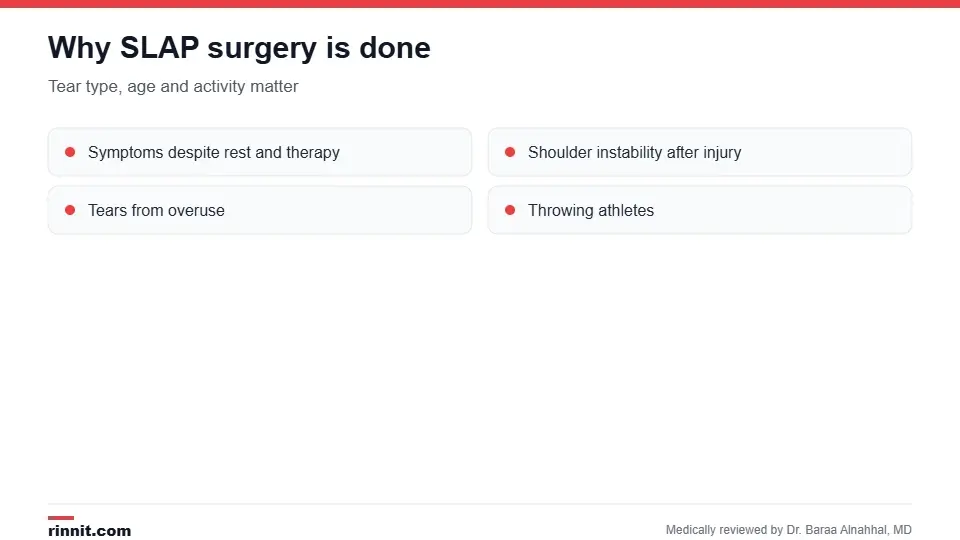
Your surgeon considers your tear type, age and activities.
Symptoms that don't improve with nonsurgical treatment.
An injury that caused the tear and made the shoulder unstable.
Tears from overuse.
Throwing athletes, such as baseball players. Sources: [1]
Your surgeon considers the type of tear, your age, your activities and past treatments. Sources: [1]
Types of SLAP surgery

Most surgeries are done arthroscopically.
Type | What it does |
SLAP repair | Reattaches the labrum to the socket with an anchor and stitches |
Cuts the biceps tendon and reattaches it to the upper arm bone | |
Debridement | Cleans up frayed tissue |
Sources: [1, 3]
What happens during surgery
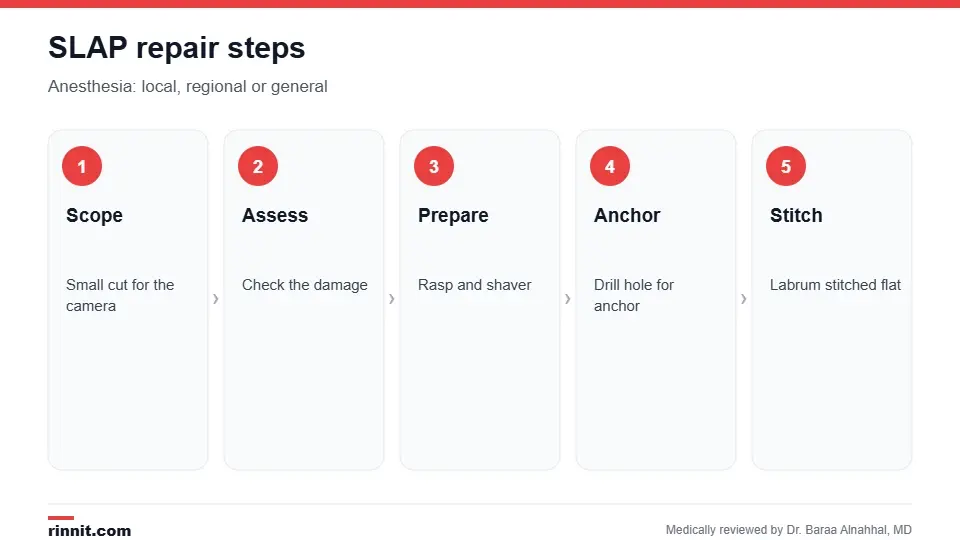
You may have local, regional or general anesthesia.
You get local, regional or general anesthesia.
The surgeon makes a small cut and inserts an arthroscope (camera).
The damage is assessed, and the area is prepared with a rasp and shaver.
A small hole is drilled in the socket for an anchor.
The labrum is stitched to the anchor so it lies flat. Sources: [1]
Learn more about shoulder arthroscopy. Sources: [1]
Risks
Risk | Notes |
Infection | Possible |
Heavy bleeding | Possible |
Nerve or blood vessel damage | Possible |
Stiffness | Physical therapy helps |
Ongoing instability | Possible |
New or repeat tears | Common, especially when returning to the same activity |
Sources: [1, 2]
Recovery
When | What to expect |
First week to several weeks | Sling or immobilizer; ice and pain medicine |
About 2 weeks | Stitches removed |
Every 4 to 6 weeks | Follow-up visits |
Weeks to months | Light exercises and physical therapy |
A few months to over a year | Full recovery |
You may need time off work and help with daily tasks, including driving. Sources: [1]
Results
About 70% of SLAP tear surgeries are successful. Surgery works best when the torn labrum is the only problem in the shoulder. Sources: [1, 2]
When to call your provider
Bleeding that soaks the bandage and doesn't stop with pressure.
Pain that medicine doesn't relieve.
Arm swelling.
Numbness or tingling in your fingers or hand.
Fingers or hand that look darker or feel cool.
Redness, swelling or yellow discharge from the wound.
A temperature above 101°F (38.3°C). Sources: [1]
Conclusion
SLAP tear surgery can relieve shoulder pain and restore stability when other treatments haven't worked. Following your sling and physical therapy plan gives your repair the best chance to heal.
Keep learning: read about SLAP tears and biceps tenodesis.
Frequently asked questions
What is SLAP tear surgery?
Surgery to repair a tear at the top of the shoulder labrum.
When is surgery needed for a SLAP tear?
When symptoms continue despite nonsurgical treatment.
Is SLAP surgery arthroscopic?
Usually, through small cuts with a camera.
What is biceps tenodesis?
Reattaching the biceps tendon to the upper arm bone instead of repairing the labrum.
How long will I wear a sling?
From a week to several weeks.
How long is recovery?
A few months to more than a year.
What is the success rate?
About 70%.
Can I return to sports?
Many people do, though pitchers return less often.
Can a SLAP tear happen again?
Yes, especially when returning to the same activity.
When are stitches removed?
About two weeks after surgery.
Related Reading
SLAP Tear: Understanding Shoulder Labrum Injuries the injury SLAP surgery repairs.
Biceps Tenodesis: Surgery, Recovery Timeline, Risks and Results an alternative to SLAP repair.
Understanding Shoulder Arthroscopy: A Minimally Invasive Approach to Joint Repair minimally invasive shoulder surgery.
Shoulder Joint: Anatomy, Function, and Common Conditions how the shoulder works.
Arthroscopy: Joint Surgery Procedure, Uses and Recovery an overview of arthroscopic surgery.
References
Cleveland Clinic. SLAP Tear Surgery: What Is It, Procedure, Benefits & Complications. Cleveland Clinic. Last updated September 20, 2021. https://my.clevelandclinic.org/health/treatments/21844-slap-tear-surgery
Thayaparan A, Yu J, Horner NS, et al. Return to sport after arthroscopic superior labral anterior-posterior repair: a systematic review. Sports Health. 2019;11(6):520-527. PMID 31584340. https://doi.org/10.1177/1941738119873892
Lack BT, Childers JT, Mowers CC, et al. Biceps tenodesis and SLAP repair show similar outcomes in overhead throwing athletes with baseball pitchers exhibiting worse rates of return to sport: a systematic review. Arthroscopy. 2025;41(9):3715-3729.e2. PMID 39938668. https://doi.org/10.1016/j.arthro.2025.01.061
Medical disclaimer
This article is for general education only and does not replace advice from a qualified healthcare professional. Talk to your doctor about your own diagnosis and treatment, and seek emergency care right away for severe or sudden symptoms.



Comments