Biceps Tenodesis: Surgery, Recovery Timeline, Risks and Results

Updated: 7 days ago
Written and medically reviewed by Dr. Baraa Alnahhal, MD · Last reviewed: October 2026 · How we review
Quick Answer: What is biceps tenodesis?
Biceps tenodesis is surgery that repairs a damaged or torn long head of the biceps tendon by detaching it from the labrum of the shoulder socket and anchoring it to the upper arm bone. It treats tendon tears, tendonitis and SLAP tears that don't improve with rest or therapy. Full recovery takes about 4 to 6 months. [1]
What the research says
Tenodesis prevents the "Popeye" bulge better than tenotomy. A pooled analysis of 11 randomized trials (860 patients) found pain and shoulder function were similar after tenodesis and tenotomy, but tenodesis cut the odds of a visible Popeye deformity by about 71% (odds ratio 0.29). Tenotomy was the quicker operation. (Hartland et al., BMJ Open, 2022)
For SLAP tears, more patients return to sport after tenodesis. A meta-analysis of 5 trials (204 patients) found significantly higher patient satisfaction and return to pre-injury sports after biceps tenodesis than after SLAP repair, with no difference in pain, stiffness or reoperation rates. (Li et al., J Orthop Translat, 2019)
About 1 in 8 patients have more shoulder surgery within 3 years. In a database study of over 25,000 people treated for SLAP tears, 13.0% of 840 tenodesis patients had another shoulder operation within 3 years, compared with 11.5% after SLAP repair, a difference that was not statistically significant. (Khazai et al., Arthrosc Sports Med Rehabil, 2020)
Key takeaways
Biceps tenodesis moves the top biceps tendon from the shoulder socket to the arm bone to relieve pain and weakness.
It treats biceps tendon tears, biceps tendonitis and SLAP (labrum) tears.
Expect a sling for 2–4 weeks (open) or 4–6 weeks (arthroscopic), then months of physical therapy.
Full recovery usually takes 4–6 months. Returning to sport too early can re-injure the tendon.
The main alternative, biceps tenotomy, gives similar pain relief but a higher chance of a Popeye bulge.
What is biceps tenodesis?
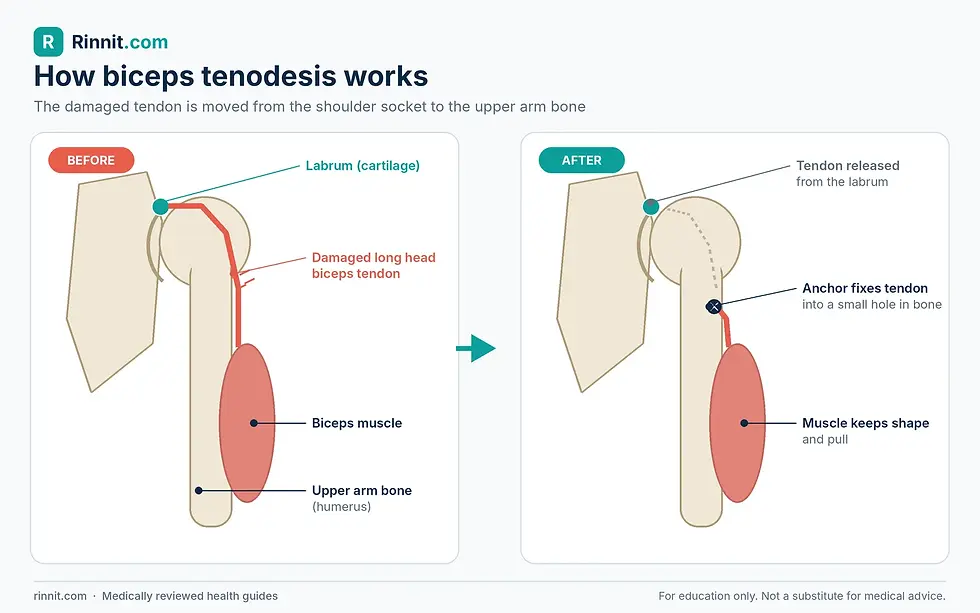
Biceps tenodesis is an operation that moves the long head of the biceps tendon from the shoulder socket to the upper arm bone. Your biceps muscle has two tendons at the shoulder. One of them, the long head of the biceps tendon, runs over the top of the arm bone and attaches to the labrum, the ring of cartilage that lines the shoulder socket. [1]
When that tendon frays, tears or becomes inflamed, it can cause deep shoulder pain and arm weakness.
In biceps tenodesis, the surgeon:
Releases the damaged tendon from the labrum.
Reattaches it lower down, onto the upper arm bone.
Moving the tendon takes the painful part out of the shoulder joint while keeping the biceps anchored, so the muscle keeps its normal shape and pull.
What are the signs you might need biceps tenodesis?
Biceps tenodesis may be suggested when shoulder pain won't settle with rest, physical therapy or pain medicine, or when you have signs of a damaged biceps tendon. [1] Your doctor may suggest this surgery if you have:
Shoulder pain that won't settle with rest, physical therapy or pain medicine.
A sudden, sharp pain in the upper arm, often with a snap or pop.
Upper arm cramps, especially after lifting or carrying heavy things.
An unusual bulge in the upper arm (a "Popeye" bulge).
Bruising or swelling running from the upper arm to the elbow.
Trouble turning your palm up.
What causes the biceps tendon to tear?
Cause | Why it matters |
Age | The tendon wears down over time and tears more easily. |
Overhead sports | Baseball, swimming and tennis repeatedly load the tendon as the arm reaches overhead. |
SLAP tear | When the labrum tears, the biceps tendon can tear with it or come loose from the shoulder. Read more in our guide to SLAP tears. |
Biceps problems often appear alongside other shoulder conditions, such as shoulder tendonitis and rotator cuff tears.
How is biceps tenodesis done?
Biceps tenodesis is done either as open surgery through one small cut or arthroscopically through several tiny cuts with a camera, and both approaches end with the tendon anchored to the arm bone. [1]
Before surgery
You'll get either general anesthesia (you're asleep) or regional anesthesia (you're awake, but your arm is numb and can't move). Arthroscopic surgery may also be done with local anesthesia.
Typical preparation steps:
Fast for 8 hours. No food or drink before you arrive. A sip of water is fine for regular medicines such as blood pressure pills.
Stop erectile dysfunction medicines (such as Viagra®) at least 24 hours before surgery.
Stop smoking for 2 weeks beforehand. This helps your heart and lungs work better during the operation.
Stop herbal supplements 1–2 weeks before surgery.
Always follow your own surgical team's instructions if they differ.
Open biceps tenodesis: step by step
The surgeon makes a cut where the top of the biceps tendon meets the labrum.
The tendon is pulled through the cut and released from the labrum.
A small hole is drilled in the upper arm bone.
A suture anchor presses the tendon into that hole (the screw fixation technique).
The cut is closed.
The scar is small, usually about 3–4 cm.
Arthroscopic biceps tenodesis: step by step
The surgeon makes several tiny cuts around the shoulder.
A thin camera (arthroscope) goes in to view the tendon and labrum.
Small tools cut the tendon free from the labrum.
A small hole is drilled in the upper arm bone and the tendon is fixed there.
The tiny cuts are closed.
You may get a nerve block that keeps the shoulder numb for several hours after the operation.
Open vs arthroscopic at a glance
Open | Arthroscopic | |
Incision | One small cut, ~3–4 cm | Several tiny cuts |
Sling time | 2–4 weeks | 4–6 weeks |
Main advantage | May allow a faster return to sports | May mean less pain and a shorter recovery |
Physical therapy | Yes, to rebuild motion and strength | Starts about 2 weeks after surgery, lasts several months |
Possible complications | Blood clots, pain, stiffness, infection, recurring instability, nerve injury | Blood clots, pain, stiffness, infection, recurring instability |

How long is the biceps tenodesis recovery timeline?
Full recovery from biceps tenodesis takes most people about 4 to 6 months, and healing takes patience. [1]
Phase | What to expect |
Day of surgery | Some pain and discomfort. Ice packs, pain medicine and a sling help. A nerve block may keep the shoulder numb for a few hours. |
Weeks 0–2 | Arm rests in a sling or immobilizer. You may need time off work and help with daily tasks. |
Around week 2 | Physical therapy usually begins after arthroscopic surgery. |
Weeks 2–6 | Sling comes off: around 2–4 weeks after open surgery, 4–6 weeks after arthroscopic surgery. |
Months 2–6 | Ongoing physical therapy to rebuild range of motion and strength. |
Months 4–6 | Full recovery for most people. |

Managing pain after surgery
Some pain is normal. Three things help most:
Ice packs on the shoulder.
Pain medicine as prescribed.
Wearing the sling to rest the repair.
When can I drive?
You can drive once both of these are true:
You're no longer taking medicine that affects your driving.
Your shoulder doesn't hurt when you control the steering wheel.
When can I exercise, lift weights or play sports?
There's no fixed date. Going back too soon can derail healing and re-injure the tendon, which may lead to another operation. Ask your surgeon or physical therapist when to add each activity to your program. Our guide to physical therapy explains what rehab sessions usually involve.
What are the risks and benefits of biceps tenodesis?
Biceps tenodesis can cause blood clots, pain, stiffness, infection, recurring instability and, with open surgery, nerve injury, but the procedure succeeds in more than 70% of cases. [1]
Possible complications
Complication | Open | Arthroscopic |
Blood clots | ✓ | ✓ |
Pain | ✓ | ✓ |
Stiffness | ✓ | ✓ |
Infection | ✓ | ✓ |
Recurring shoulder instability | ✓ | ✓ |
Nerve injury | ✓ | — |
Swelling, pain and warmth in an arm or leg after surgery can signal a clot. Learn the warning signs in our guide to deep vein thrombosis.
Benefits
Open surgery: people may return to sports sooner than after arthroscopic surgery.
Arthroscopic surgery: may mean less pain and a shorter recovery than open surgery.
Overall: the procedure succeeds in more than 70% of cases.
What is the difference between biceps tenodesis and biceps tenotomy?
Biceps tenotomy, the main alternative to biceps tenodesis, cuts the tendon away from the labrum but doesn't reattach it to the arm bone. [1]
Tenodesis | Tenotomy | |
What happens to the tendon | Released and reattached to the arm bone | Released and left to retract |
Pain relief and function | Similar | Similar |
Popeye bulge risk | Lower | Higher |
Operating time | Longer | Shorter |
Both procedures ease the symptoms of a damaged biceps tendon. The trade-off is mostly cosmetic: people who have tenotomy are more likely to develop a visible bulge in the upper arm. [2]
When should you call your doctor after biceps tenodesis?
Call your healthcare provider right away after biceps tenodesis if you have heavy bleeding, pain that medicine doesn't relieve, arm swelling, hand numbness or coldness, signs of infection or a fever above 101°F (38.3°C). [1] Watch for:
Bleeding that soaks through the dressing and doesn't stop with pressure.
Pain that pain medicine doesn't relieve.
Swelling in the arm.
Numbness or tingling in the fingers or hand.
Dark color or coldness in the hand or fingers.
Signs of infection: redness, pain, swelling or yellowish discharge at the wound.
Fever above 101°F (38.3°C).
Conclusion
Biceps tenodesis is often the first step toward a pain-free shoulder after a biceps tendon injury. The surgery itself is short. The real work comes after: weeks in a sling, months of physical therapy, and the discipline not to rush back to lifting or sport before the tendon has healed.
If frustration builds during recovery, tell your care team. They may suggest occupational or sports therapy to help you return to your normal routine safely.
Bring this guide to your next appointment. Use the recovery timeline and the "when to call" list to plan questions for your surgeon. For more on how the shoulder works, read our shoulder joint anatomy guide and our overview of the rotator cuff, and explore more trusted, plain-language health guides on Rinnit.com.
Frequently asked questions
What is biceps tenodesis in simple terms?
It's surgery that detaches the top biceps tendon from the shoulder socket and reattaches it to the upper arm bone, relieving pain caused by a damaged or torn tendon.
How long does it take to recover from biceps tenodesis?
Full recovery usually takes 4 to 6 months, including several weeks in a sling and months of physical therapy.
How long will I wear a sling after biceps tenodesis?
About 2–4 weeks after open surgery and 4–6 weeks after arthroscopic surgery.
Is biceps tenodesis painful?
You'll likely have some pain and discomfort afterward. Ice, prescribed pain medicine and the sling usually keep it manageable. A nerve block may numb the shoulder for several hours after surgery.
How successful is biceps tenodesis?
It's successful more than 70% of the time.
Will biceps tenodesis leave a scar?
Open surgery leaves a small scar of about 3–4 cm. Arthroscopic surgery leaves several tiny scars.
When does physical therapy start after biceps tenodesis?
After arthroscopic surgery, physical therapy usually begins about 2 weeks after the operation and continues for several months.
What is the difference between biceps tenodesis and tenotomy?
Tenodesis reattaches the tendon to the arm bone. Tenotomy cuts it free without reattaching it. Both relieve symptoms, but tenotomy carries a higher risk of a visible Popeye bulge.
Can I re-tear my biceps tendon after tenodesis?
Yes. Returning to sports and heavy activity before the tendon heals can re-injure it.
When can I drive after biceps tenodesis?
Once you're off medicines that affect driving and your shoulder doesn't hurt when you steer.
Related Reading
SLAP Tear Surgery: Procedure, Recovery and Success Rate explains SLAP tear surgery and recovery.
References
Cleveland Clinic. Biceps Tenodesis (Tendon Surgery): Procedure Details & Recovery. Cleveland Clinic. Last updated September 24, 2021. https://my.clevelandclinic.org/health/treatments/21926-biceps-tenodesis
Hartland AW, Islam R, Teoh KH, Rashid MS. Clinical effectiveness of tenotomy versus tenodesis for long head of biceps pathology: a systematic review and meta-analysis. BMJ Open. 2022;12(10):e061954. PMID: 36220319. https://doi.org/10.1136/bmjopen-2022-061954
Li M, Shaikh AB, Sun J, Shang P, Shang X. Effectiveness of biceps tenodesis versus SLAP repair for surgical treatment of isolated SLAP lesions: a systemic review and meta-analysis. J Orthop Translat. 2019;16:23-32. PMID: 30723678. https://doi.org/10.1016/j.jot.2018.09.002
Khazai RS, Lee CS, Boyajian HH, Shi LL, Athiviraham A. Rates of subsequent shoulder surgery within three years for patients undergoing SLAP repair versus biceps tenodesis. Arthrosc Sports Med Rehabil. 2020;2(2):e129-e135. PMID: 32368749. https://doi.org/10.1016/j.asmr.2020.01.003
AlQahtani SM, Bicknell RT. Outcomes following long head of biceps tendon tenodesis. Curr Rev Musculoskelet Med. 2016;9(4):378-387. PMID: 27599831. https://doi.org/10.1007/s12178-016-9362-7
Medical disclaimer
This article is for general education and does not replace advice from your own doctor.



Comments