Tendonitis: Symptoms, Causes, Treatment, and Recovery

Updated: 3 days ago
Medically reviewed by Dr. Baraa Alnahhal, MD · Last reviewed: October 2026
Quick Answer: What is tendonitis?
Tendonitis, also called tendinitis, is inflammation or irritation of a tendon, usually after overuse, repetitive movement, sudden strain, or injury. It causes pain and soreness around the affected tendon and joint, often near where the tendon attaches to bone. It can be acute (short-term) or chronic (long-term) and commonly affects the thumb base, elbow, shoulder, hip, knee, and Achilles tendon. [1]
Rest and avoiding activities that cause symptoms help the tendon heal. If symptoms do not improve, a healthcare provider may recommend physical therapy, splinting, corticosteroid injections, or—rarely—surgery for severe cases that do not respond to other treatment. [1]
What the research says
Loaded exercise is central to tendon care, and more demanding programs may work better. A meta-analysis of 110 studies (3,953 participants) of rotator cuff, Achilles, lateral elbow, patellar and gluteal tendinopathy found greater average benefit from resistance programs that added external load rather than body weight alone, and from lower-frequency (less than daily) programs. The authors note that exercise dose is poorly reported in this literature (Pavlova et al., Br J Sports Med, 2023). [2]
In tennis elbow, adding eccentric exercise improved pain and strength. A meta-analysis of six randomized trials (429 participants) found that adding eccentric exercise to adjuvant therapy lowered pain scores (standardized mean difference -0.63; 95% CI -0.90 to -0.36) and improved muscle strength (1.05; 95% CI 0.78-1.33) compared with adjuvant therapy alone. The authors caution that few studies were included and exercise parameters varied (Yoon et al., J Clin Med, 2021). [3]

What are tendons?
Tendons are connective-tissue bands between muscles and bones. When a muscle contracts, the tendon helps transfer that force to a bone so the body can move. [1]
Tendonitis causes the tendon to become irritated or inflamed. Pain is often felt around the affected joint and near the point where the tendon attaches to a bone. [1]
What types of tendonitis are common?
Some types of tendonitis are named after the sport or body area involved. [1]
Common name | Area or activity associated with it |
Tennis elbow | Tendons around the elbow and outer forearm. |
Golfer’s elbow | Tendons around the elbow and inner forearm. |
Pitcher’s shoulder | Shoulder tendons stressed by throwing. |
Swimmer’s shoulder | Shoulder tendons affected by repetitive swimming motion. |
Runner’s knee or jumper’s knee | Tendons around the knee affected by running or jumping. |
What are the symptoms of tendonitis?
The most common symptom is pain at the tendon and in the surrounding area. Movement may make the pain worse. [1]
Other symptoms may include stiff joints, trouble moving the area, a cracking or popping feeling when you move, and swelling. Swollen skin may look red, purple or darker than your natural skin tone. [1]
Pain may build gradually or become sudden and severe, especially when calcium deposits are present in the tissues. [1]
Symptom | What it may look or feel like |
Pain | Soreness at or around the tendon, often worse with movement. |
Stiffness | The joint or nearby body part feels less flexible. |
Limited movement | Moving the affected area is difficult or painful. |
Cracking or popping | A person hears or feels a sensation during movement. |
Swelling | The area becomes swollen and may change color. |
Where does tendonitis occur?
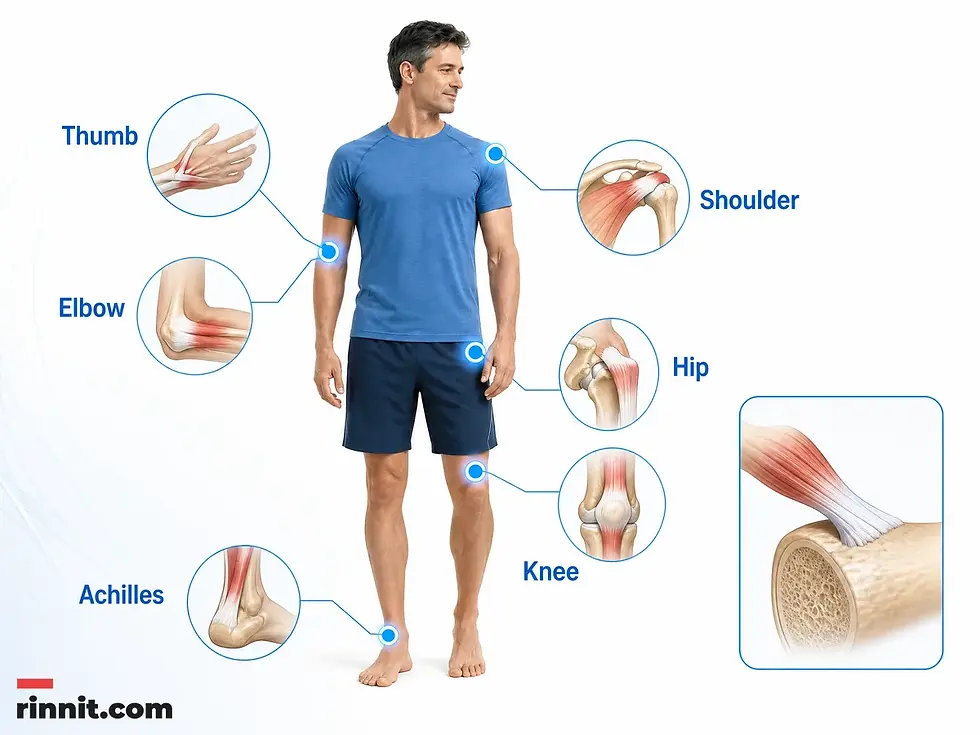
Tendonitis can occur almost anywhere a tendon connects a muscle to a bone. Common locations include the base of the thumb, elbow, shoulder, hip, knee, and Achilles tendon.
Knee symptoms are often below the kneecap, where a tendon attaches to the lower leg bone. The Achilles tendon connects the calf muscles to the heel bone.
Symptoms in one location may resemble other joint or muscle problems. A healthcare provider can evaluate the location, movement pattern, and medical history together.
What causes tendonitis?
Tendonitis commonly results from repetitive motions or overuse. Running, throwing or doing the same task again and again can strain a tendon. [1]
Other causes include a sudden strain, an injury, medication effects, and certain underlying health conditions. [1]
Possible cause | How it may contribute |
Overuse | Repeated movement places stress on a tendon over time. |
Sudden strain | A fast or forceful movement can overload the tendon. |
Injury | Trauma may irritate or damage tendon tissue. |
Medication effect | Statins, other cholesterol-lowering drugs, and fluoroquinolone antibiotics may be associated with tendonitis. |
Underlying condition | Diabetes, rheumatoid arthritis, gout or pseudogout, osteoarthritis, or infection may contribute. |
What are the risk factors?
Anyone can get tendonitis, but it is more common in people who do repetitive activities. Examples include gardening, landscaping, woodworking, shoveling, painting, scrubbing and sports such as tennis, golf or baseball. [1]
Poor posture and conditions that weaken muscles can also raise the risk. Age matters too. After age 40, tendons handle less stress, become less elastic and tear more easily. [1]
What complications can tendonitis cause?
Untreated tendonitis can become chronic and cause a constant dull pain when you move. It can also make it hard or impossible to move the affected area, cause muscle weakness or lead to a torn tendon. [1]
Persistent or worsening symptoms are a reason to seek medical evaluation rather than continuing to stress the tendon.
How is tendonitis diagnosed?
A healthcare provider diagnoses tendonitis by asking about your history and symptoms, examining you and ordering tests if needed. [1]
Imaging can help the provider see the tendons. Possible tests include an X-ray or MRI. [1]
Evaluation step | What it helps clarify |
Medical history | Whether symptoms followed overuse, sudden strain, injury, medication use, or another health condition. |
Symptom review | Pain location, timing, movement triggers, swelling, and other changes. |
Physical examination | How the tendon and joint respond to movement and touch. |
X-ray | A form of imaging that may help evaluate the area. |
MRI | Detailed imaging that can help the provider see tendons and nearby structures. |
How is tendonitis treated?
Tendonitis treatment often starts with reducing stress on the tendon. On the day of an injury, you can ice the area, rest it, avoid activities that trigger symptoms and take over-the-counter nonsteroidal anti-inflammatory drugs (NSAIDs) if they are safe for you. [1]
If symptoms do not improve in about three weeks, a healthcare provider may recommend additional treatment. [1]
Physical therapy and splinting
Physical therapy may include range-of-motion exercises, a splint for the thumb, forearm or hand, and work to loosen soft tissue. Over time, therapy can help restore movement, function and strength. [1]
A gradual loading program can help the tendon work better. A physical therapist may also check how other joints move, in case stiffness there added to the problem.
Corticosteroid injections
Corticosteroid injections can work quickly to reduce inflammation and tendon pain. Injection-site pain is a possible side effect. [1]
A person should discuss potential benefits and risks with a healthcare provider before treatment.
Surgery
Surgery is rarely needed. It may be considered for severe symptoms that do not respond to other treatments. [1]
Possible surgical complications include bleeding and infection. A healthcare provider can explain whether surgery is appropriate for a particular tendon problem. [1]

How long does tendonitis take to heal?
A tendon may heal in about two to three weeks after treatment and rest. Severe tendonitis may take a few months to heal. [1]
Rest is an important part of recovery. Avoid strenuous exercise and activities that stress the healing tendon until a healthcare provider says it is safe to return.
Recovery depends on how severe the problem is and how well you can avoid the stress that worsens it. Going back too soon raises the chance of another injury.
What is the outlook for tendonitis?
Most people with tendonitis do very well after treatment and rest. Recovery may take a few weeks to a couple of months, depending on severity. [1]
Tendonitis can come back if the tendon is put under too much stress. A healthcare provider, sports medicine clinician or physical therapist can help you lower the risk of it happening again.
Can tendonitis be prevented?
To prevent tendonitis, reduce repeated strain and use good body position during daily tasks, work and exercise. [1]
Prevention step | How to apply it |
Take regular breaks | Avoid staying in the same position; take a break about every 30 minutes. |
Use good posture | Learn proper posture and body positions for each activity. |
Reach directly | Face an object directly and reach forward instead of reaching sideways. For overhead objects, center the body and use both hands. |
Use a moderate grip | Hold objects firmly without squeezing too tightly. |
Share heavy loads | Carry heavy objects with both hands rather than one hand at the side. |
Avoid awkward leg positions | Do not sit with a leg folded under the body. |
Stop when pain starts | Pain during an activity is a signal to stop and reassess. |
Before exercise or sports, stretch and warm up. Wear well-fitting clothes, shoes and gear. Start slowly and build up gradually. Stop if you feel pain. [1]
When should I see a healthcare provider?
See a healthcare provider if tendonitis symptoms come with a fever over 100°F (38°C), swelling with redness and warmth, feeling generally ill, pain in several places or being unable to move the area. [1]
These signs may point to another condition that needs faster care. Also get checked if symptoms last, get in the way of normal activity or come back after treatment.
What questions should you ask a healthcare provider about tendonitis?
Useful questions about tendonitis include whether it is another condition, when you can return to sports, whether you need physical therapy and how to prevent repeat injury.
Do I have tendonitis or another condition? Pain may overlap with arthritis or other problems.
When can I return to sports or exercise? A clinician can help set a safer timeline.
What treatment side effects should I watch for? This supports informed monitoring.
Do I need physical therapy or a splint? These options may support movement and tendon recovery.
Do I need surgery? Surgery is rarely needed, but a provider can explain when it is considered.
How can I reduce repeat injury risk? Activity and movement guidance may help prevent recurrence.
Conclusion: Understanding tendonitis
Tendonitis is inflammation or irritation of a tendon, usually from overuse, repetitive movement, sudden strain or injury. It can cause pain and swelling, stiffness, trouble moving, and cracking or popping near the tendon and joint. [1]
First care often includes rest, avoiding activities that cause symptoms, icing the area on the day of injury and suitable over-the-counter anti-inflammatory medicines. If symptoms do not improve, physical therapy, splinting, corticosteroid injections and, rarely, surgery may be considered. [1]
Many people recover in a few weeks, though severe cases may take a few months. Taking breaks, using good posture and equipment, building activity slowly and stopping when pain starts can help prevent repeat strain. [1]
Frequently Asked Questions
What is tendonitis?
Tendonitis is inflammation or irritation of a tendon, the connective tissue that connects muscle to bone. It often follows overuse, repetitive strain, sudden movement, or injury.
What are the main symptoms of tendonitis?
Common symptoms include pain around the tendon, pain that worsens with movement, stiffness, difficulty moving, cracking or popping, and swelling with possible skin discoloration.
Where is tendonitis most common?
Tendonitis commonly affects the base of the thumb, elbow, shoulder, hip, knee, and Achilles tendon.
What causes tendonitis?
Possible causes include repetitive movement, overuse, sudden strain, injury, medication effects, diabetes, rheumatoid arthritis, gout or pseudogout, osteoarthritis, and infection.
How is tendonitis diagnosed?
Diagnosis may include a medical history, symptom review, physical examination, and imaging such as an X-ray or MRI.
What is the first treatment for tendonitis?
Initial care may include icing the area on the day of injury, avoiding activities that trigger symptoms, resting the injured area, and taking over-the-counter anti-inflammatory medicines when appropriate.
Is physical therapy used for tendonitis?
Yes. Physical therapy may include range-of-motion exercises, splinting, soft-tissue mobility work, gradual tendon loading, and exercises that restore movement, function, and strength.
Is surgery needed for tendonitis?
Surgery is rarely needed. It may be considered when symptoms are severe and do not respond to other treatments.
How long does tendonitis take to heal?
Recovery may take two to three weeks after treatment and rest. Severe cases may take a few months.
Can tendonitis come back?
Yes. Tendonitis can recur if a healing tendon is exposed to too much stress. Gradual return to activity and guidance from a healthcare provider or physical therapist may help reduce the risk.
When should I seek medical care for tendonitis?
Seek medical evaluation for fever, swelling with redness and warmth, general illness, pain at multiple sites, or inability to move the affected area. These signs may point to another condition needing more immediate attention.
Related Reading
Tendinopathy: Symptoms, Causes, Diagnosis and Treatment — What You Need to Know explains long-lasting tendon pain and damage and how it heals.
Rotator Cuff Tear: Symptoms, Causes, and Recovery Guide covers shoulder tendon tears and recovery options.
Achilles Tendinitis: Complete Guide to Symptoms, Causes, Self-Care, and Treatment Options explains heel cord pain, self-care steps and treatment.
De Quervain Tenosynovitis: Thumb Pain, Causes & Treatment — Complete Guide explains tendon pain on the thumb side of the wrist.
References
Cleveland Clinic. Tendonitis. Cleveland Clinic. Last updated July 18, 2023. https://my.clevelandclinic.org/health/diseases/10919-tendonitis
Pavlova AV, Shim JSC, Moss R, et al. Effect of resistance exercise dose components for tendinopathy management: a systematic review with meta-analysis. Br J Sports Med. 2023;57(20):1327-1334. PMID 37169370. https://doi.org/10.1136/bjsports-2022-105754
Yoon SY, Kim YW, Shin IS, et al. The beneficial effects of eccentric exercise in the management of lateral elbow tendinopathy: a systematic review and meta-analysis. J Clin Med. 2021;10(17):3968. PMID 34501416. https://doi.org/10.3390/jcm10173968
Disclaimer
This article is for general educational purposes and is not a substitute for professional medical advice, diagnosis or treatment. Always seek the advice of a qualified health provider with any questions you may have regarding a medical condition.
It explains tendonitis symptoms, common locations, causes, diagnosis, treatment options, recovery time and prevention in general terms. It is not a diagnosis, emergency protocol, prescription or personal treatment plan. Seek timely medical care for fever, swelling with redness and warmth, general illness, pain at multiple sites or inability to move the affected area.



Comments