Tendinopathy: Symptoms, Causes, Diagnosis and Treatment — What You Need to Know

Updated: 2 days ago
Medically reviewed by Dr. Baraa Alnahhal, MD · Last reviewed: October 2026
TL;DR: Tendinopathy is an umbrella term for any condition affecting a tendon, the cord that attaches muscle to bone, and includes tendinitis, tendinosis, and tenosynovitis. [1] It usually results from overuse or repeated movement and causes pain, tenderness, stiffness, and mild swelling where the tendon attaches to bone. Most cases improve with rest, ice, pain relievers, and physical therapy [2], so avoid working or playing through the pain.
When to see a doctor: You can treat many cases of tendinopathy with self-care, such as rest, ice, and pain relievers. See your healthcare professional if your symptoms don't lessen after a few days and get in the way of daily activities. Tendinopathy is not a medical emergency, but persistent tendon pain deserves a proper diagnosis rather than months of self-treatment.
Quick Answer: What is tendinopathy?
Tendinopathy is an umbrella term for any condition affecting a tendon, the cord-like tissue connecting muscle to bone. [1] It causes pain, tenderness, stiffness and sometimes mild swelling, most often from overuse or repeated movement, in areas such as the shoulders, elbows, knees and heels. Most cases improve with rest, ice, pain relievers and physical therapy.

What the research says
Steroid injections relieve pain briefly, but the benefit can reverse. A systematic review of 41 randomized trials (2,672 participants) found that corticosteroid injections reduced pain in the short term, but this effect was reversed at intermediate and long-term follow-up. In lateral epicondylalgia (tennis elbow), the short-term effect was large (SMD 1.44; 95% CI 1.17 to 1.71) while no intervention was favored at the long term (SMD -0.31; 95% CI -0.61 to -0.01). Among 991 people who received corticosteroid injections, one (0.1%) had a serious adverse event (tendon rupture) (Coombes et al., Lancet, 2010) [3].
Some medicines raise tendon risk. In a meta-analysis of 15 observational studies, fluoroquinolone antibiotics were associated with higher odds of Achilles tendon rupture (OR 2.52; 95% CI 1.81 to 3.52), Achilles tendinitis (OR 3.95; 95% CI 3.11 to 5.01), and any tendon disorder (OR 1.98; 95% CI 1.62 to 2.43). Older age and concomitant corticosteroid use appeared to be additional risk factors (Alves et al., Eur J Clin Pharmacol, 2019) [4].
Evidence for shockwave therapy depends on the tendon. A systematic review and meta-analysis found low-to-moderate evidence that shockwave therapy has a negligible effect on pain and function for patellar and Achilles tendinopathy, while high-quality evidence showed a large effect for plantar fasciitis (Charles et al., Front Immunol, 2023) [5].
What Is Tendinopathy?
Tendinopathy is an umbrella term for any condition that affects a tendon. Tendons are cords that attach muscle to bone. Tendinopathy, which can cause pain and tenderness, is common. It is often caused by overuse or repeated movement and tends to affect certain tendons in the arm or leg. [1]
The umbrella covers three related conditions. Tendinitis is new or sudden swelling and irritation (inflammation) of a tendon, and people often mistakenly call all tendon conditions by this term. Tendinosis is a breakdown change in the tendon that occurs gradually over time. Tenosynovitis is inflammation of the thin layer of tissue that surrounds a tendon, called the sheath. [1]
Take tennis elbow as an example of the mechanism. Its pain occurs mainly where the tough, cord-like forearm tendons attach to a bony bump on the outside of the elbow. Tiny tears and longtime swelling can cause the tendon to break down, and that breakdown is what causes the pain. [1]
Question | Answer |
|---|---|
What is tendinopathy? | An umbrella term for any condition affecting a tendon (a muscle-to-bone cord) |
What conditions does it include? | Tendinitis, tendinosis, tenosynovitis |
Is it common? | Yes, tendinopathy is described as common |
What causes it? | Usually overuse or repeated movement; also age-related tendon changes and sudden injury |
Where does it occur? | Shoulders, elbows, wrists, hips, knees, heels |
Can it be treated? | Most cases respond to rest, physical therapy, and pain medicine |
What Are the Types of Tendinopathy?
Tendinopathy comes in many types, and the common ones all follow the same overuse pattern while affecting different tendons. The common ones below all follow the same overuse pattern but affect different tendons.

Type | Location and Hallmark Detail |
|---|---|
Tennis elbow (lateral epicondylitis) | Pain where forearm tendons attach to the bony bump on the outside of the elbow; linked to repeated wrist and arm motions [1] |
Golfer's elbow (medial epicondylitis) | Pain where forearm tendons attach to the bony bump on the inside of the elbow; pain may spread into the forearm and wrist; caused by repeated rotation of the forearm and wrist |
Achilles tendinitis | The tendon connecting calf muscles to the heel bone; caused by overuse or strain, such as a runner increasing training intensity |
Biceps tendinopathy (bicipital tendinitis) | Tendon connecting the biceps to the shoulder joint (or at the elbow); often from repeated overhead arm movement or lifting heavy weights |
Calcific tendinopathy | Calcium deposits in a tendon; cause unclear, possibly genetic; pain when moving the joint; most common in the shoulder [1] |
De Quervain tenosynovitis (Gamer's thumb) | Thumb-side wrist tendons; pain when turning the wrist, grasping, or making a fist; caused by long-term repeated hand or wrist motions |
Gluteal tendinopathy | Tendon on the side of the hip; much more common in women [1]; also called greater trochanteric pain syndrome; causes include overuse, injury, being overweight, and hormone changes |
Hamstring tendinopathy | Hamstring tendon connecting to the "sit-bone" in the hip; pain with sitting and climbing stairs; common in runners |
Patellar tendinitis (jumper's knee) | Tendon connecting kneecap to shinbone; common in jumping sports like basketball and volleyball, but non-jumpers can get it too |
Rotator cuff injury | Group of muscles and tendons surrounding the shoulder joint; wear and tear over time from repeated overhead motions or heavy lifting; dull ache that worsens at night or with reaching |
For a closer look at one of these shoulder conditions, see our guide to rotator cuff tears.
What Are the Symptoms of Tendinopathy?
Tendinopathy symptoms can vary based on the type, but they tend to occur where the tendon attaches to the bone. [1] The common pattern is movement-related pain at a specific attachment point.
Symptom | Notes |
|---|---|
Pain, often a dull ache | Especially when moving the hurt limb or joint |
Stiffness or weakness | In the affected area |
Tenderness | In the affected area |
Mild swelling | Around the tendon |
What Causes Tendinopathy?
Tendinopathy can be caused by wear and tear on a tendon. This can happen due to overuse or naturally over time as people age and their tendons become less flexible. Most people develop tendinopathy because their jobs or hobbies involve motions they repeat over and over. Jobs such as carpentry or house painting, or sports such as baseball, tennis, and golf, require the same motions to be repeated, and over time this puts stress on the tendons. Some tendinopathies also can be caused by sudden injury, such as a fall or accident. [1]
How you move matters too. Moving incorrectly can overload the tendon [1], so proper form and technique are especially important when movements must be repeated for a sport or a job.
What increases the risk?
Risk factors include older age and having jobs or hobbies that involve doing the same motion over and over. Some medical conditions and certain medicines also may increase the risk. [1]
Risk Factor | Detail |
|---|---|
Older age | Tendons become less flexible, easier to injure |
Repetitive work | Gardeners, carpenters, painters: raking, hammering, overhead reaching |
Repetitive sport | Baseball, tennis, golf: same motions over and over |
Training errors | Sudden increase in amount or difficulty; too little recovery time |
Environment | Hard surfaces such as concrete or gym floors |
Equipment | Old shoes or ones without good support |
Form and technique | Poor posture or incorrect form overloads the tendon |
Medical conditions | Diabetes |
Medicines | Fluoroquinolone antibiotics; corticosteroids (cortisone); statins; aromatase inhibitors [1] |
Can Tendinopathy Be Prevented?
Yes, tendinopathy can often be prevented by easing up on stressful activities, cross-training, learning proper technique and strengthening the muscles you use. Four concrete habits can lower your chance of developing tendinopathy:
Ease up: Avoid activities that place too much stress on the tendons, especially for long periods. If you have pain during an exercise, stop and rest.
Mix it up: If one exercise causes pain, take a break and try something else. Cross-training can combine high-impact exercise like running with low-impact exercise like biking or swimming.
Improve the way you move: Take lessons or get professional instruction when starting a new sport or using new exercise equipment.
Prepare your muscles: Strengthen the muscles used in your activity. Stronger muscles bear the load better and lower the risk of injury. [1]
How Is Tendinopathy Diagnosed?
Often a medical history and a physical exam are enough to diagnose many types of tendinopathy. Your healthcare professional may press on the affected joint and move the joint into different positions. Sometimes imaging tests help with diagnosis. [2]
Diagnostic Step | Purpose and Key Details |
|---|---|
Medical history and physical exam | Often enough on its own; pressing on the joint and moving it through positions |
X-rays | Show bone spurs or other causes like arthritis; rule out other conditions |
Ultrasound | Sound waves create images of structures such as muscles and tendons |
MRI | Radio waves and a magnetic field create detailed images of the affected area |
How Is Tendinopathy Treated?
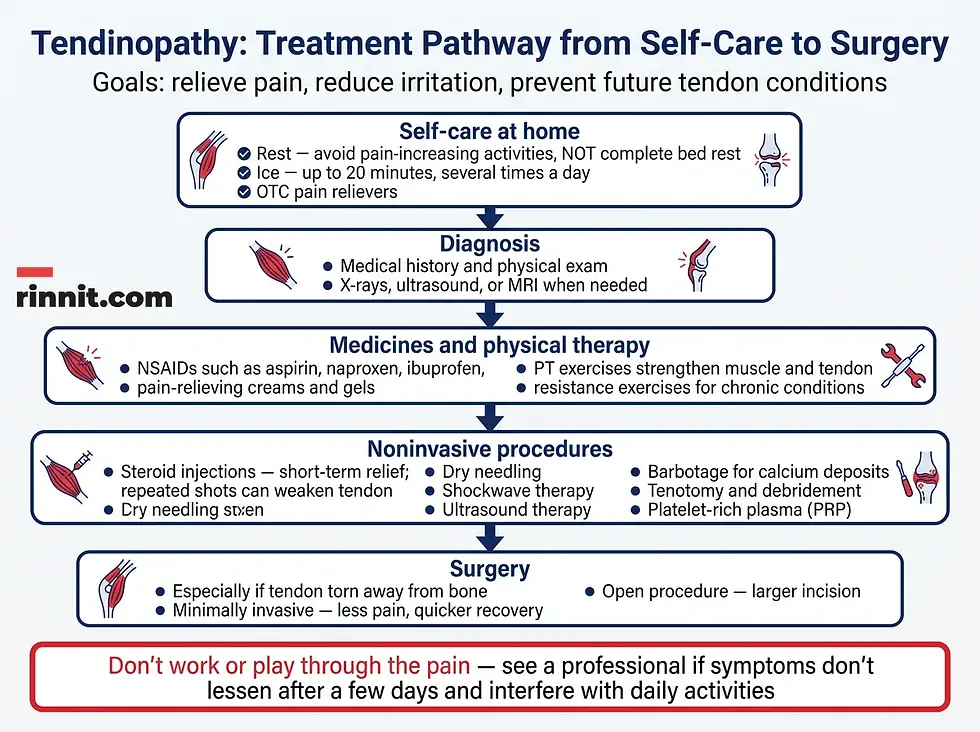
The goals of tendinopathy treatment are to relieve pain, reduce irritation, and prevent future tendon conditions. [2] Self-care (rest, ice, and pain relievers) might be all that's needed. Changing how you do certain activities and doing physical therapy exercises can help improve pain and prevent future injuries. Other options include noninvasive and surgical procedures.
What can I do at home?
Rest: Avoid doing things that increase the pain or swelling, and don't try to work or play through the pain. Healing requires rest, but not complete bed rest. You can do activities and exercises that don't stress the injured tendon; swimming and water exercise may be good options.
Ice: To decrease pain, muscle spasm, and swelling, apply ice to the injured area for up to 20 minutes several times a day. [2] Ice packs, ice massage, or slush baths with ice and water all can help.
Pain relievers: Over-the-counter pain relievers such as ibuprofen or acetaminophen may help reduce the pain caused by swelling in the tendon.
What treatments does a professional offer?
Nonsteroidal anti-inflammatory medicines, such as aspirin, naproxen sodium, ibuprofen, or acetaminophen, may relieve pain, and you also can apply pain-relieving creams or gels to the skin. Physical therapy exercises can help strengthen the muscle and tendon in the affected area, and resistance exercises can effectively treat many chronic tendon conditions. [2]
When more is needed, procedural options include:
Steroid injections: A shot around a tendon might ease pain for a short time, but repeated steroid shots can weaken a tendon and increase tear risk over time. [2]
Dry needling: A fine needle makes small holes in the tendon, which can reduce pain.
Shockwave therapy: Shockwaves delivered through a tool placed on the skin are used to relieve pain and help tissue heal.
Ultrasound therapy: Promotes healing by increasing blood flow. [2]
Barbotage: A needle and saline break up and remove calcium deposits under ultrasound guidance. [2]
Tenotomy: An ultrasound-guided needle or device makes holes in the tendon to trigger healing factors, and specialized devices can remove unhealthy tissue in a step called debridement.
Platelet-rich plasma therapy: Your own blood is spun to separate platelets and healing factors, then injected into the area. Research is still exploring the best way to use it, but it has shown promise in many chronic tendon conditions. [2]
Surgery: To repair the tendon, especially if it has torn away from the bone. Minimally invasive techniques usually have less pain and quicker recovery than an open procedure, and the best option depends on the type and location of the injury. [2]
Treatment Category | Options |
|---|---|
Self-care | Rest (not complete bed rest); ice up to 20 minutes several times a day; over-the-counter pain relievers |
Medicines | Aspirin, naproxen, ibuprofen, acetaminophen; pain-relieving creams and gels |
Physical therapy | Exercises to strengthen muscle and tendon; resistance exercises for chronic conditions |
Injections and needling | Steroid injections (short-term relief; repeated shots can weaken tendon); dry needling; platelet-rich plasma therapy |
Device-based therapies | Shockwave therapy; ultrasound therapy |
Needle procedures | Barbotage for calcium deposits; tenotomy and debridement |
Surgery | Repair the tendon, especially if torn away from the bone; minimally invasive or open |
How Should You Prepare for an Appointment?
You might start by talking to your family healthcare professional, who may refer you to a specialist in physical medicine and rehabilitation, sports medicine, or orthopedic surgery for more-specialized care. Bring a written list with details about your symptoms, other medical conditions you've had, all the medicines, vitamins, and supplements you take (including doses), and questions for the care team.
Useful questions to ask include the most likely cause of your symptoms, other possible causes, tests you need, recommended treatment, whether you'll need to stop any medicines, how to manage other conditions alongside treatment, activity limits, and self-care you can do at home.
Expect your doctor to ask where the pain is felt, when it began and whether it came on all at once or bit by bit, what kind of work you do, your hobbies, whether you've been instructed in proper technique, whether the pain occurs or worsens during certain activities, any recent fall or injury, what home treatments you've tried and what they did, and what makes your symptoms better or worse.
Conclusion and When to Seek Help
Tendinopathy is a common condition, and one that is often misnamed, because many people call everything "tendinitis." In reality, it is an umbrella covering tendinitis, tendinosis, and tenosynovitis, and the treatment path depends on which tendon is affected and how far the condition has progressed. Most cases respond to disciplined self-care: rest without complete bed rest, ice, pain relievers, and physical therapy that rebuilds the muscle and tendon. The costly mistake is working or playing through the pain, because healing requires rest.
When to seek help: Give the affected tendon a few days of genuine rest, ice, and an over-the-counter pain reliever. If the pain doesn't lessen and it's getting in the way of daily activities, see a healthcare professional for a proper diagnosis, which may only take a physical exam. Before you return to the activity that caused it, check your form, your equipment, and your training load. The four prevention habits (ease up, mix it up, move better, strengthen up) are your best insurance against a repeat.
Frequently Asked Questions
What is tendinopathy?
It is an umbrella term for any condition that affects a tendon, the tough cords that attach muscle to bone. It is common, often caused by overuse, and most often affects tendons in the shoulders, elbows, wrists, hips, knees, and heels.
Is tendinopathy the same as tendinitis?
No. Tendinopathy is the umbrella term. Tendinitis is new or sudden inflammation of a tendon. Tendinosis is a gradual breakdown change over time. Tenosynovitis is inflammation of the sheath surrounding the tendon.
What causes tendinopathy?
Wear and tear from overuse or repeated movement, natural aging (tendons become less flexible), and sometimes sudden injury such as a fall or accident.
Where does tendinopathy occur most often?
In the shoulders, elbows, wrists, hips, knees, and heels.
What is tennis elbow?
Also called lateral epicondylitis, it is pain where the forearm tendons attach to the bony bump on the outside of the elbow, often caused by repeated motions of the wrist and arm.
What is golfer's elbow?
Also called medial epicondylitis, it is pain where the forearm tendons attach to the bony bump on the inside of the elbow, often caused by repeated rotation of the forearm and wrist.
What is jumper's knee?
Patellar tendinitis, an injury to the tendon connecting the kneecap to the shinbone. It is most common in sports involving frequent jumping, like basketball and volleyball, but people who don't play jumping sports can get it too.
What is Gamer's thumb?
De Quervain tenosynovitis, a painful condition of the thumb-side wrist tendons caused by long-term repeated hand or wrist motions, causing pain when turning the wrist, grasping, or making a fist.
Is gluteal tendinopathy more common in women?
Yes, it is much more common in women. It affects a tendon on the side of the hip and may also be called greater trochanteric pain syndrome or trochanteric bursitis.
Can medicine increase the risk of tendinopathy?
Yes. Fluoroquinolone antibiotics, corticosteroids such as cortisone, statins, and aromatase inhibitors may increase risk, and conditions like diabetes raise it as well.
What are the symptoms?
Pain (often a dull ache, especially when moving the limb or joint), stiffness or weakness, tenderness, and mild swelling, usually where the tendon attaches to the bone.
When should I see a doctor?
If symptoms don't lessen after a few days and they get in the way of daily activities.
Can I treat tendinopathy at home?
Many cases respond to self-care: rest (avoid activities that increase pain, but not complete bed rest), ice up to 20 minutes several times a day, and over-the-counter pain relievers.
Does tendinopathy require complete bed rest?
No. Healing requires rest, but not complete bed rest. You can do activities and exercises that don't stress the injured tendon; swimming and water exercise may be good options.
How is it diagnosed?
Often a medical history and physical exam are enough. Imaging, such as X-rays, ultrasound, or MRI, may be used to help or to rule out other causes like bone spurs or arthritis.
What is physical therapy's role?
Physical therapy exercises strengthen the muscle and tendon in the affected area, and resistance exercises can effectively treat many chronic tendon conditions.
Are steroid injections a good idea?
They vary by condition. A shot around a tendon might ease pain for a short time, but repeated steroid shots can weaken the tendon and increase the risk of tearing over time.
What is platelet-rich plasma (PRP) therapy?
A sample of your own blood is spun to separate platelets and healing factors, then injected into the irritated area. Research is still exploring the best way to use it, but it has shown promise in many chronic tendon conditions.
When is surgery needed?
Depending on the seriousness, especially if the tendon has torn away from the bone. Minimally invasive techniques usually have less pain and quicker recovery than an open procedure.
How can I prevent tendinopathy?
Ease up (stop and rest if you have pain during exercise), mix it up (cross-train high- and low-impact activities), improve the way you move (get lessons or professional instruction), and prepare your muscles (strengthen the muscles your sport or job demands).
Related Reading
Yergason's Test: How It's Done, What Results Mean and Accuracy explains the quick biceps tendon exam, what a click or pain means and how accurate it is.
References
Mayo Clinic Staff. Tendinopathy: symptoms and causes. Mayo Clinic. March 22, 2025. https://www.mayoclinic.org/diseases-conditions/tendinopathy/symptoms-causes/syc-20580660
Mayo Clinic Staff. Tendinopathy: diagnosis and treatment. Mayo Clinic. March 22, 2025. https://www.mayoclinic.org/diseases-conditions/tendinopathy/diagnosis-treatment/drc-20580691
Coombes BK, Bisset L, Vicenzino B. Efficacy and safety of corticosteroid injections and other injections for management of tendinopathy: a systematic review of randomised controlled trials. Lancet. 2010;376(9754):1751–1767. PMID 20970844. https://doi.org/10.1016/S0140-6736(10)61160-9
Alves C, Mendes D, Marques FB. Fluoroquinolones and the risk of tendon injury: a systematic review and meta-analysis. Eur J Clin Pharmacol. 2019;75(10):1431–1443. PMID 31270563. https://doi.org/10.1007/s00228-019-02713-1
Charles R, Fang L, Zhu R, et al. The effectiveness of shockwave therapy on patellar tendinopathy, Achilles tendinopathy, and plantar fasciitis: a systematic review and meta-analysis. Front Immunol. 2023;14:1193835. PMID 37662911. https://doi.org/10.3389/fimmu.2023.1193835
Medical Disclaimer
This article is for education only and is not a substitute for professional medical advice, diagnosis, or treatment. Always consult a qualified healthcare professional about your individual health situation.



Comments