Yergason's Test: How It's Done, What Results Mean and Accuracy

Updated: 2 days ago
Written and medically reviewed by Dr. Baraa Alnahhal, MD · Last reviewed: November 2026 · How we review
Quick Answer: What is Yergason's test?
Yergason's test is a physical exam for problems with the long head of the biceps tendon. With your elbow bent at your side, you turn your palm upward against the provider's resistance. A click, snap or pain is a positive sign. It has a sensitivity of 43% and a specificity of 79%, so it's combined with other tests.
What the research says
Single shoulder tests shift the diagnosis only a little. In a meta-analysis of 11 studies, all physical tests for SLAP lesions pooled together gave a diagnostic odds ratio of 1.38, and no single test showed clearly superior performance, so the authors advise choosing among the tests with the highest pooled accuracy. (Gismervik et al., BMC Musculoskeletal Disorders, 2017) [2]
Evidence on biceps and labrum tests is inconsistent. A Cochrane review of 33 studies covering 170 test and condition combinations, including tests for long head of biceps tendon problems, found insufficient evidence to recommend specific physical tests because of wide variation in how they were performed and interpreted. (Hanchard et al., Cochrane Database of Systematic Reviews, 2013) [3]
Key takeaways
Yergason's test checks the long head of the biceps tendon and the ligament that holds it in its groove. [1]
You bend your elbow to 90 degrees and turn your palm up against resistance while your provider feels the front of your shoulder. [1]
A click or snap points to a torn transverse humeral ligament; pain points to tendinopathy, tendinosis or a SLAP tear. [1]
The test has a sensitivity of 43% and a specificity of 79%, so it is one piece of the puzzle. [1]
Next steps may include Speed's test, O'Brien's test, an MRI and treatments from rest to surgery. [1]
What is Yergason's test?
Yergason's test is a simple exam used to detect problems with the long head of the biceps tendon, which connects the biceps muscle to the top of the shoulder socket (glenoid). The transverse humeral ligament holds that tendon in the bicipital groove at the front of the upper arm bone. The test can also help identify biceps tendonitis and a SLAP tear, a tear of the cartilage ring (labrum) around the socket. [1]
How is Yergason's test performed?

How Yergason's test is done.
You stand or sit with your arm at your side and your elbow bent to 90 degrees, keeping the elbow and upper arm against your body with the palm facing the floor. [1]
Your provider places their fingertips on the front of your shoulder to feel the bicipital groove. [1]
With their other hand, they grip your forearm to provide resistance. [1]
Keeping the elbow tight to your side, you rotate your forearm so the palm faces up while moving the forearm outward. [1]
The provider repeats the test on your other arm for comparison. [1]
No preparation is needed, and results are known right away. [1]
What do Yergason's test results mean?
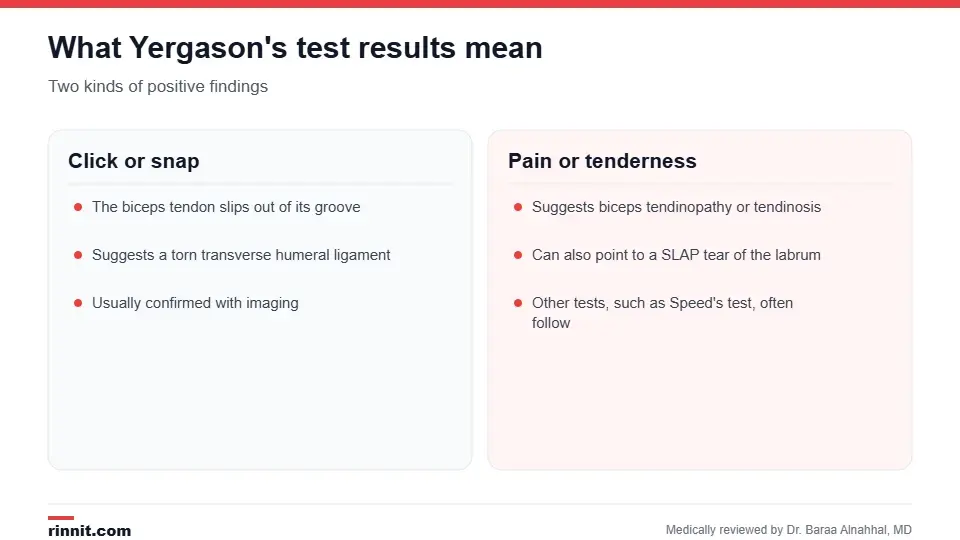
Two kinds of positive findings.
Finding | What it suggests |
A snap or click under the provider's fingers | The transverse humeral ligament is torn and the biceps tendon has slipped out of its groove |
Pain or tenderness in the groove | Tendinopathy (long-term tendon injury), tendinosis (breakdown of tendon collagen) or a SLAP tear |
No click and no pain | A negative test; other causes of shoulder pain are considered |
Sources: [1]
How accurate is Yergason's test?
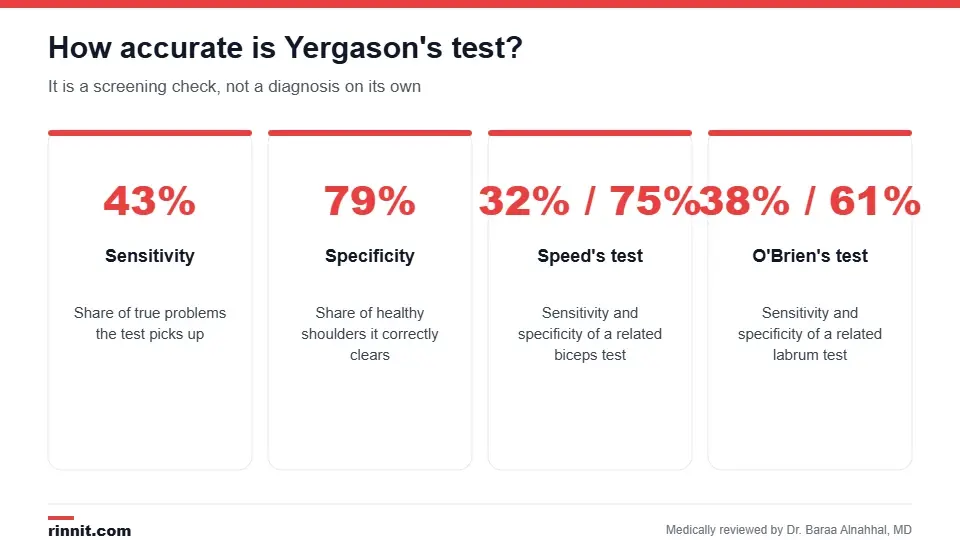
How Yergason's test compares with related shoulder tests.
Yergason's test has a sensitivity of 43%, meaning it picks up fewer than half of true problems, and a specificity of 79%, meaning it correctly clears about 4 in 5 healthy shoulders. That is why providers pair it with other exams. [1] Pooled research on shoulder tests confirms that no single maneuver is accurate enough on its own. [2] [3]
Related shoulder tests
Test | What it checks | Sensitivity / specificity |
Yergason's test | Long head of the biceps tendon, transverse humeral ligament, SLAP tear | 43% / 79% |
Speed's test | Biceps tendon injuries, SLAP tears, shoulder tendinopathy | 32% / 75% |
O'Brien's test | SLAP lesions and long head of biceps injuries | 38% / 61% |
Sources: [1]
What happens after Yergason's test?
Depending on the findings, your provider may do other quick physical tests, such as Speed's test or the O'Brien test, and order imaging such as an MRI. Treatment depends on the cause and can include rest, ice, anti-inflammatory medicine, cortisone shots, physical therapy, debridement of frayed tissue, or surgery such as biceps tenotomy or tenodesis. [1]
When should you call a doctor?
See a provider for shoulder pain at the front of the joint that lasts more than a few weeks, a snapping sensation when you rotate your arm, or weakness when bending the elbow or lifting. Seek urgent care for sudden severe pain with a visible bulge in the upper arm, which can signal a ruptured biceps tendon.
Conclusion
Yergason's test is a fast, no-cost way to check the long head of the biceps tendon. A click suggests the tendon has slipped out of its groove, and pain suggests tendinopathy or a labral tear. [1]
With a sensitivity of 43%, a negative test does not rule out a problem, so expect your provider to add other exams and possibly an MRI before recommending treatment. [1]
Keep learning: Read our guide to the O'Brien test, another quick exam used to find SLAP tears.
Frequently asked questions
What is Yergason's test?
A quick physical exam that checks the long head of the biceps tendon and the ligament that holds it in its groove.
How is Yergason's test done?
With your elbow bent to 90 degrees at your side, you turn your palm up against resistance while your provider feels the front of your shoulder.
What is a positive Yergason's test?
A click or snap, which suggests a torn transverse humeral ligament, or pain, which suggests tendinopathy or a SLAP tear.
How accurate is Yergason's test?
Its sensitivity is 43% and its specificity is 79%, so it is combined with other tests.
Does Yergason's test hurt?
It may reproduce your shoulder pain for a moment, but it is brief and needs no preparation.
What is the difference between Yergason's test and Speed's test?
Both check the biceps tendon. Speed's test resists forward raising of a straight arm; Yergason's resists turning the palm up with a bent elbow.
What does a click during Yergason's test mean?
The biceps tendon may be slipping out of its groove because the transverse humeral ligament is torn.
What tests follow a positive Yergason's test?
Other physical tests and often an MRI.
How is a biceps tendon problem treated?
Rest, ice, anti-inflammatory medicine, cortisone shots, physical therapy or, in some cases, surgery.
Can Yergason's test detect a SLAP tear?
Pain during the test can suggest a SLAP tear, but imaging is needed to confirm it.
Related Reading
O'Brien Test: How It's Done, Positive vs Negative Results and Next Steps explains a related shoulder exam used to find SLAP tears and AC joint problems.
SLAP Tear: Understanding Shoulder Labrum Injuries covers the labrum tear that can cause pain on Yergason's test.
Tendinopathy: Symptoms, Causes, Diagnosis and Treatment — What You Need to Know explains long-term tendon injury, one cause of a positive test.
Rotator Cuff Tear: Symptoms, Causes, and Recovery Guide describes another common cause of shoulder pain.
References
Cleveland Clinic. Yergason's Test: What It Is & How it's Performed. Cleveland Clinic. Last updated April 10, 2022. https://my.clevelandclinic.org/health/diagnostics/22705-yergasons-test
Gismervik SØ, Drogset JO, Granviken F, et al. Physical examination tests of the shoulder: a systematic review and meta-analysis of diagnostic test performance. BMC Musculoskelet Disord. 2017;18(1):41. PMID 28122541. https://doi.org/10.1186/s12891-017-1400-0
Hanchard NC, Lenza M, Handoll HH, et al. Physical tests for shoulder impingements and local lesions of bursa, tendon or labrum that may accompany impingement. Cochrane Database Syst Rev. 2013;(4):CD007427. PMID 23633343. https://doi.org/10.1002/14651858.CD007427.pub2
Medical disclaimer
This article is for general education only and does not replace advice from a qualified healthcare professional. Talk to your doctor about your own diagnosis and treatment, and seek emergency care right away for severe or sudden symptoms.



Comments