O'Brien Test: How It's Done, Positive vs Negative Results and Next Steps

Updated: 2 days ago
Written and medically reviewed by Dr. Baraa Alnahhal, MD · Last reviewed: November 2026 · How we review
Quick Answer: What is the O'Brien test?
The O'Brien test, also called the active compression test, is a physical exam for shoulder pain. You hold your arm out and push up against the provider's hand, first with the thumb down and then palm up. Pain with the thumb down that eases with the palm up points to a SLAP tear or an AC joint problem.
What the research says
No single shoulder test can confirm a SLAP tear on its own. In a meta-analysis of 11 studies, all physical tests for SLAP lesions pooled together gave a diagnostic odds ratio of only 1.38. The best single test, compression-rotation, had a sensitivity of 43% and a specificity of 89%, and no test was clearly superior. (Gismervik et al., BMC Musculoskeletal Disorders, 2017) [2]
Evidence is too varied to rank shoulder tests. A Cochrane review of 33 studies covering 170 test and condition combinations found insufficient evidence to choose physical tests for labral, tendon or bursa problems, with wide differences in how tests were performed and interpreted. (Hanchard et al., Cochrane Database of Systematic Reviews, 2013) [3]
Key takeaways
The O'Brien test checks for a SLAP tear of the shoulder labrum and for AC joint problems. [1]
It is done in the office in under a minute with no preparation. [1]
A positive test means pain with the thumb pointing down that lessens when the palm faces up. [1]
Deep pain suggests the labrum; pain near the top of the shoulder suggests the AC joint. [1]
The test can be positive in healthy shoulders, so it is combined with other exams and often an MRI. [1]
What is the O'Brien test?
The O'Brien test is a simple clinical exam that helps providers sort out the cause of shoulder pain. It checks two structures: the acromioclavicular joint, where the top of the shoulder blade meets the collarbone, and the superior labrum, the cartilage rim around the shoulder socket. A tear in the upper part of the labrum is called a SLAP tear (superior labrum, anterior to posterior). [1]
How is the O'Brien test performed?
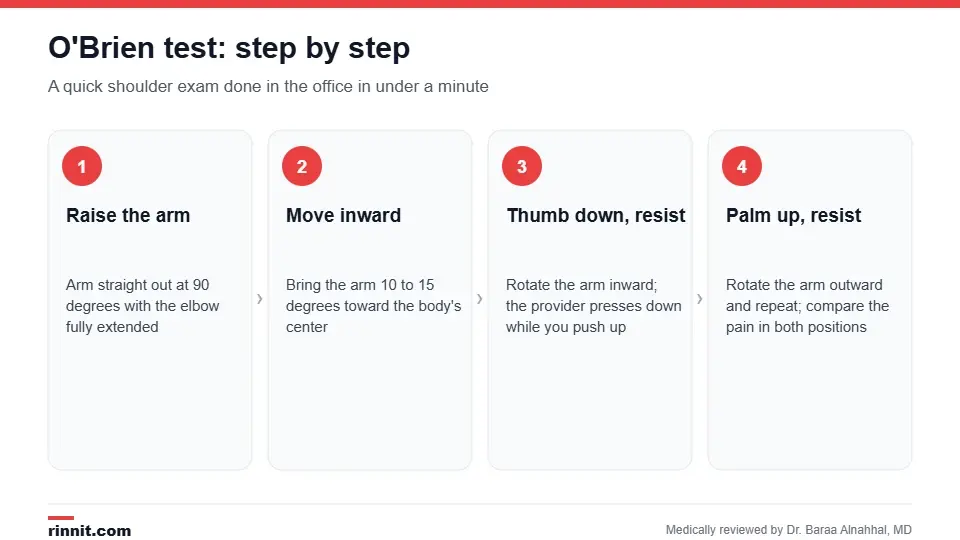
How the O'Brien test is done.
You sit or stand and raise your arm straight out in front of you to 90 degrees, parallel to the floor, with the elbow fully extended. [1]
You move the arm 10 to 15 degrees toward the center of your body. [1]
You rotate the arm inward so your thumb points down. Your provider presses down on the arm while you resist by pushing up. [1]
You rotate the arm the other way so the palm faces up. Your provider presses down again while you resist. [1]
No preparation is needed, and the test is usually done in a doctor's office. [1]
O'Brien test at a glance
Item | Typical detail |
Time | Less than a minute |
Preparation | None |
Setting | Doctor's office |
Results | Immediate |
Commonly paired with | Other shoulder exams and MRI |
Sources: [1]
What do O'Brien test results mean?
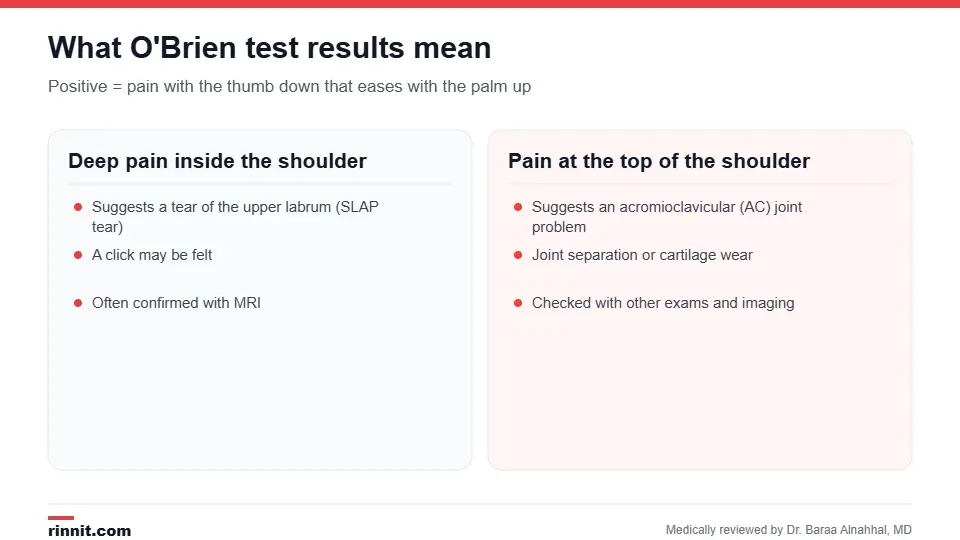
How providers interpret a positive O'Brien test.
The test is positive when you feel pain in the first, thumb-down position and less pain in the second, palm-up position. Reduced pain in the second position is required for a positive result. [1]
Where you feel the pain | What it suggests |
Deep inside the shoulder, sometimes with a click | A tear of the upper labrum (SLAP tear) |
Closer to the surface at the top of the shoulder | An AC joint problem such as separation or cartilage wear |
Sources: [1]
How accurate is the O'Brien test?
The test can be positive in people with healthy shoulders, so it is one tool among many and is usually combined with other tests for an accurate diagnosis. [1] Research backs this up: pooled studies of SLAP tests show only a small shift in the likelihood of a tear, and no single exam performs clearly better than the others. [2] A Cochrane review likewise found the evidence too inconsistent to rank shoulder tests. [3]
What happens next?

What to expect after the test.
Results are known immediately. Your provider reviews them with you, explains what they may mean and decides whether you need other tests, such as more physical exams or an MRI. [1] Treatment depends on the cause and may include rest, physical therapy, injections or surgery for a confirmed tear.
When should you call a doctor?
See a provider for shoulder pain that lasts more than a few weeks, follows an injury, comes with a deep click or catching, or makes it hard to lift or rotate your arm. Seek urgent care for a shoulder that looks deformed or cannot move after an injury.
Conclusion
The O'Brien test is a fast, free screening exam that helps point shoulder pain toward the labrum or the AC joint. A positive result means pain with the thumb down that eases with the palm up. [1]
Because healthy shoulders can also test positive, the result is a clue rather than a diagnosis. Expect your provider to combine it with other exams and, often, imaging before settling on a treatment plan. [1]
Keep learning: Read our guide to SLAP tears to understand the injury this test looks for.
Frequently asked questions
What is the O'Brien test?
A quick shoulder exam, also called the active compression test, that checks for a labral (SLAP) tear or an AC joint problem.
How is the O'Brien test done?
You hold your arm out at 90 degrees, slightly across your body, and resist downward pressure first with the thumb down and then with the palm up.
What is a positive O'Brien test?
Pain in the thumb-down position that is less in the palm-up position.
What does deep shoulder pain on the O'Brien test mean?
It suggests a tear of the upper labrum, sometimes with a click.
What does pain at the top of the shoulder mean?
It suggests a problem in the acromioclavicular (AC) joint.
How accurate is the O'Brien test?
It can be positive in healthy shoulders, so it is combined with other tests for an accurate diagnosis.
Do I need to prepare for the O'Brien test?
No preparation is needed.
How long does the O'Brien test take?
Less than a minute, with results known immediately.
What tests come after a positive O'Brien test?
Other physical exams and often an MRI to confirm a labral or AC joint problem.
Who performs the O'Brien test?
Primary care providers, sports medicine doctors, orthopedic surgeons and physical therapists.
Related Reading
SLAP Tear: Understanding Shoulder Labrum Injuries explains the labrum tear the O'Brien test screens for.
Understanding the AC Joint: Anatomy, Function, and Common Injuries covers the acromioclavicular joint and its common injuries.
Rotator Cuff Tear: Symptoms, Causes, and Recovery Guide describes another frequent cause of shoulder pain.
MRI (Magnetic Resonance Imaging): Uses, What to Expect, Safety and Results explains the imaging test often used to confirm a SLAP tear.
Yergason's Test: How It's Done, What Results Mean and Accuracy explains the quick biceps tendon exam, what a click or pain means and how accurate it is.
References
Cleveland Clinic. O'Brien Test: Procedure, Positive vs Negative Results. Cleveland Clinic. Last updated March 21, 2022. https://my.clevelandclinic.org/health/diagnostics/22609-o-brien-test
Gismervik SØ, Drogset JO, Granviken F, et al. Physical examination tests of the shoulder: a systematic review and meta-analysis of diagnostic test performance. BMC Musculoskelet Disord. 2017;18(1):41. PMID 28122541. https://doi.org/10.1186/s12891-017-1400-0
Hanchard NC, Lenza M, Handoll HH, et al. Physical tests for shoulder impingements and local lesions of bursa, tendon or labrum that may accompany impingement. Cochrane Database Syst Rev. 2013;(4):CD007427. PMID 23633343. https://doi.org/10.1002/14651858.CD007427.pub2
Medical disclaimer
This article is for general education only and does not replace advice from a qualified healthcare professional. Talk to your doctor about your own diagnosis and treatment, and seek emergency care right away for severe or sudden symptoms.



Comments