Understanding the AC Joint: Anatomy, Function, and Common Injuries

Updated: 3 days ago
Medically reviewed by Dr. Baraa Alnahhal, MD · Last reviewed: October 2026
Quick Answer
The AC (acromioclavicular) joint is where the collarbone connects to the top of the shoulder blade, [1] acting as a bridge that supports shoulder stability and arm movement. Common problems include sprains, separations and arthritis, often from falls, sports collisions or car accidents. [1] After an injury, keep the shoulder still and never try to force it back into place. [1]
What the research says
Even for severe separations, surgery is not clearly better. A meta-analysis of 19 studies (954 patients) of acute high-grade AC dislocations found no clinical difference in functional outcome scores between surgery and no surgery. Surgery gave better cosmetic results and X-ray alignment, while non-surgical care meant faster return to work and fewer implant and infection problems (Chang et al., J Orthop Trauma, 2018) [2].
Surgery may give a small edge in function and alignment, with trade-offs. A 2024 meta-analysis of 13 studies (729 patients with Rockwood III–V injuries) found slightly better Constant scores (mean difference 2.38) and better joint alignment after surgery at 24–48 months, but more non-surgical patients rated their results as good; complications occurred in 18.3% of the surgical group and 15.9% of the non-surgical group (Adra et al., Cureus, 2024) [3].
The evidence for type III injuries is still unsettled. A systematic review of 14 studies (646 shoulders) found a 14% recurrence rate in the surgical group and no significant differences in later osteoarthritis or persistent pain; the authors concluded there was insufficient evidence on functional outcome and called for high-quality randomized trials (Longo et al., Br Med Bull, 2017) [4].
What is the anatomy and structure of the AC joint?
The shoulder is one of the most mobile and complex structures in the body, and the AC joint is one of the two joints that make it up. [1] Located at the very top of the shoulder, it is the point where the outermost edge of the clavicle (collarbone) meets the acromion, the top part of the scapula (shoulder blade). [1] Its name reflects those two landmarks. As a planar joint, it lets the two bones glide smoothly past each other. [1]

Several components keep the joint working:
Bones: The clavicle and scapula form the rigid framework.
Cartilage: Tough, thick cartilage cushions the joint and helps the bones move smoothly past each other. [1]
Ligaments: Three ligaments connect the bones and help the joint hold its shape. [1]
Nerves: The joint gets its sensation from nerves in your neck that branch out into the shoulder. [1]
Blood vessels: The suprascapular and thoracoacromial arteries supply the joint with blood. [1]
What are the main functions and movements of the AC joint?
The AC joint's main job is to support the shoulder and act as a connection point for ligaments around it. [1] Unlike many joints that are moved directly by attached muscles, it is a passive joint: your shoulder muscles move the rest of the shoulder, which in turn moves the AC joint. [1] It helps the shoulder move from back to front (anteroposterior), such as in a rowing motion or when pushing and pulling objects away from the body. [1]
Component | Role in the AC Joint |
|---|---|
Clavicle | The horizontal strut that connects the arm to the trunk. |
Acromion | The top part of the shoulder blade that forms the roof of the shoulder and meets the collarbone. |
Ligaments | Strong bands that hold the joint's bones in place. |
Cartilage | A shock absorber that reduces wear during movement. |
What are common AC joint conditions and disorders?
The AC joint is very prone to injury because of its prominent location and the stress placed on it during physical activity. Experts estimate that around 40% of shoulder injuries affect the AC joint, and AC joint injuries are the most common shoulder injuries. [1] Anything that puts a lot of sudden force on the shoulder can damage the joint, and sports injuries and trauma such as car accidents and falls are the most common causes. [1]
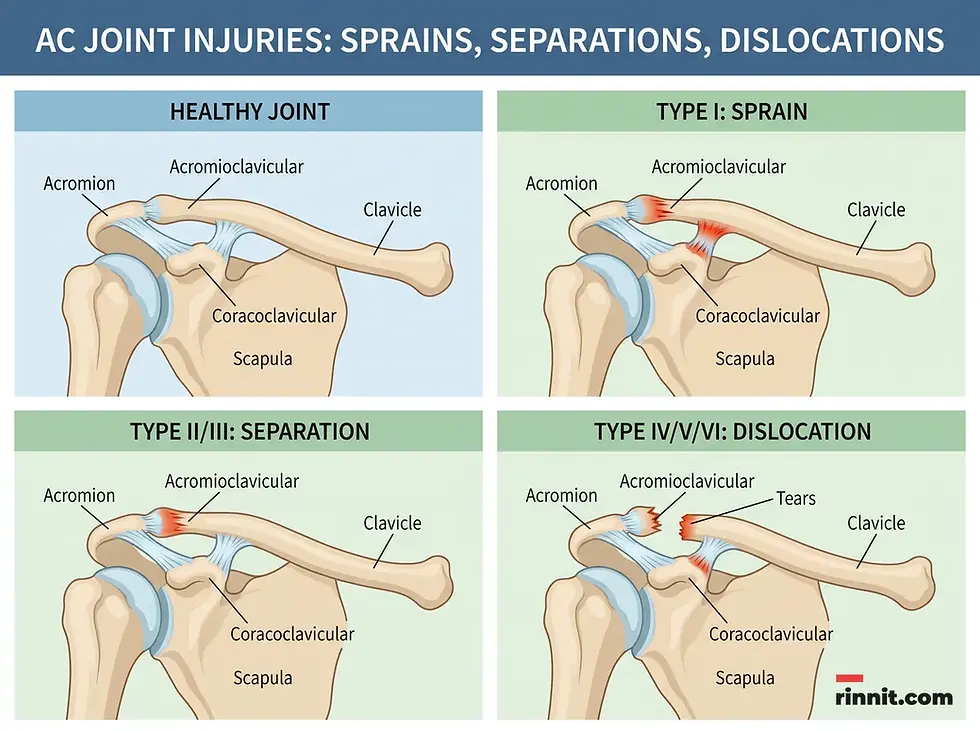
Shoulder sprains: Stretching or tearing of the stabilizing ligaments.
Separated shoulder: A more severe injury in which the ligaments are torn, so the bones can move out of alignment.
Dislocation: A complete displacement of the collarbone from the acromion.
Fractures: Breaks of the bones around the joint, which may need surgery.
Arthritis: Wear and tear of the joint cartilage, which can develop over time. Many people never feel pain or other symptoms and may never need treatment. [1]
Recognizing Symptoms
When your shoulder hurts, it can be hard to say for sure that the pain is coming from the AC joint. You may feel it right at the joint, or it may spread (radiate) to the neck, lower in the shoulder, or to muscles in the chest or back. [1] It can feel sharp and stabbing, especially when you move or use the shoulder; dull and achy, like a constant hum in the background; or sore, the way you feel after a big workout. [1]
It is normal for joints to pop sometimes. This is usually just gas trapped in the joint lining being squeezed out. [1] But see a healthcare provider if you hear or feel a pop during a fall or hard hit, especially if your shoulder hurts or you cannot move it afterward, if the shoulder pops in exactly the same way every time, or if you feel grinding when you move. [1]
How are AC joint problems diagnosed and treated?
Diagnosis usually starts with a review of your symptoms and a physical examination. Because the AC joint sits close to the surface, a provider can often spot swelling or a deformity by looking at and feeling the shoulder, and imaging such as X-rays may be used to check bone alignment and look for fractures or joint wear.
Treatment depends on the injury or problem. Your provider will suggest treatments to manage symptoms and help the joint heal.

Treatment Type | Common Interventions |
|---|---|
Behavioral | Rest and avoiding intense physical activity. [1] |
Medication | Over-the-counter NSAIDs (such as ibuprofen) or acetaminophen to relieve pain and reduce inflammation. [1] |
Clinical | Prescription corticosteroids, including cortisone shots, for more severe inflammation. [1] |
Rehabilitative | Physical therapy to restore strength and range of motion. |
Supportive | A sling or brace to immobilize the joint while it heals. [1] |
Surgical | Surgery to repair bone fractures or other serious injuries. [1] |
How can you take care of your AC joint?
The best way to look after your AC joint is to maintain good overall health, warm up and stretch around activity, wear protective gear and never play through shoulder pain.
Follow an eating and physical activity plan that is healthy for you
Stretch, warm up, and cool down before and after physical activity
Never play through the pain if your shoulder hurts during or after activity
Wear proper protective equipment for any sport, activity, or work you do
See a healthcare provider for regular checkups and as soon as you notice changes or symptoms in your shoulders [1]
What are the next steps for AC joint health?
If you have persistent shoulder pain, stiffness, or a visible deformity at the top of your shoulder after a fall, see a healthcare provider for a formal evaluation. Early care, including rest and physical therapy when appropriate, can help the joint heal and restore function.
Frequently Asked Questions
1. What exactly is the AC joint?
It is the joint where your collarbone (clavicle) connects to the top of your shoulder blade (the acromion).
2. Where is the AC joint located?
It sits at the very top of your shoulder, where the outermost point of the collarbone meets the front of the shoulder blade.
3. What does "AC" stand for?
It stands for acromioclavicular, a name that combines the two bones that meet there.
4. Is the AC joint a ball-and-socket joint?
No. It is a planar joint, in which two bones glide smoothly past each other.
5. Why are AC joint injuries so common?
Its position at the top of the shoulder makes it a frequent point of impact in falls, sports collisions, and car accidents. Experts estimate that around 40% of shoulder injuries affect the AC joint.
6. What is a separated shoulder?
It is an injury in which the ligaments of the AC joint are torn, which can let the bones move out of alignment.
7. Can I have arthritis in my AC joint without knowing it?
Yes. Many people have AC joint arthritis but never feel pain or other symptoms and may never need treatment.
8. Does a popping sound in my shoulder mean I'm injured?
Not necessarily. Joint popping is usually harmless gas being squeezed out of the joint lining. See a provider if you hear or feel a pop during a fall or hard hit, if the pop happens the same way every time, or if you feel grinding.
9. How long does an AC joint sprain take to heal?
It depends on how severe the injury is. Mild injuries often improve with rest, activity changes, and physical therapy, but your provider should guide you on timing and when to return to sport or heavy lifting.
10. Do all AC joint injuries require surgery?
No. Many are treated without surgery using rest, medicine, a sling or brace, and physical therapy. Surgery is used for fractures and other serious injuries.
11. Can AC joint pain spread to my neck?
Yes. The pain may start at the joint and spread (radiate) to the neck, lower in the shoulder, or to muscles in the chest or back.
12. What medications help with AC joint pain?
Over-the-counter NSAIDs or acetaminophen are common first choices, and a provider may prescribe corticosteroids, including cortisone shots, for more severe inflammation.
13. When should I see a doctor for shoulder pain?
See a provider if the pain is severe or lasting, if you notice stiffness or a visible bump, or after a fall or hit. Go to the emergency room if you think your shoulder is dislocated or separated.
14. How can I protect my AC joint during sports?
Wear proper protective equipment, warm up and stretch before activity, cool down afterward, and never play through shoulder pain.
15. What is the best way to care for my AC joint?
Stay healthy overall with regular activity and good nutrition, stretch and warm up, wear protective gear, avoid playing through pain, and see a provider for regular checkups and any new shoulder symptoms.
Trusted External Resources
Related Reading
O'Brien Test: How It's Done, Positive vs Negative Results and Next Steps explains the quick shoulder exam used to screen for a SLAP tear or an AC joint problem.
References
Cleveland Clinic. AC Joint (Acromioclavicular Joint). Cleveland Clinic. Last updated November 6, 2024. https://my.clevelandclinic.org/health/body/ac-joint-acromioclavicular-joint
Chang N, Furey A, Kurdin A. Operative versus nonoperative management of acute high-grade acromioclavicular dislocations: a systematic review and meta-analysis. J Orthop Trauma. 2018;32(1):1-9. PMID 29257778. https://doi.org/10.1097/BOT.0000000000001004
Adra M, Mohamed Haroon A, Milchem H, et al. Operative versus nonoperative management of high-grade acromioclavicular injuries: a systematic review and meta-analysis. Cureus. 2024;16(12):e76682. PMID 39898132. https://doi.org/10.7759/cureus.76682
Longo UG, Ciuffreda M, Rizzello G, et al. Surgical versus conservative management of type III acromioclavicular dislocation: a systematic review. Br Med Bull. 2017;122(1):31-49. PMID 28334148. https://doi.org/10.1093/bmb/ldx003
Medical Disclaimer
This article is for informational purposes only and does not constitute medical advice. Always seek the advice of your physician or other qualified health provider with any questions you may have regarding a medical condition. Never disregard professional medical advice or delay in seeking it because of something you have read in this article. If you think you may have a medical emergency, call your doctor or emergency services immediately.



Comments