SLAP Tear: Understanding Shoulder Labrum Injuries

Updated: 3 days ago
Medically reviewed by Dr. Baraa Alnahhal, MD · Last reviewed: October 2026
Quick Answer: What is a SLAP tear?
A SLAP tear is an injury to the top part of the shoulder's labrum, the cartilage ring that keeps the upper arm bone in its socket. [1] It results from repetitive overhead motion, falls or age-related wear, causing pain and instability. [1] Diagnosis uses an exam and MRI. [1] Treatment ranges from medication and physical therapy to arthroscopic surgery. [1]

What the research says
For type II SLAP lesions, surgery did not beat sham surgery in a double-blind trial. In 118 surgical candidates (mean age 40) with an isolated type II SLAP lesion, patients were randomly assigned to labral repair (40), biceps tenodesis (39), or sham surgery (39). There were no significant between-group differences at any follow-up, including Rowe scores at 2 years, and the authors concluded neither operation had a significant clinical benefit over sham surgery in the population studied (Schrøder et al., Br J Sports Med, 2017) [2].
When surgery is done, repair and biceps tenodesis or tenotomy perform similarly on most measures. A meta-analysis of 8 studies (2 randomized trials and 6 observational studies) found no significant difference in UCLA scores, SST scores, or complications between arthroscopic repair and biceps tenotomy or tenodesis. Two measures (ASES score and satisfaction rate) favored tenotomy or tenodesis, but study quality was low to moderate (Ren et al., J Orthop Surg Res, 2019) [3].
Surgery can mean a long time away from work. In a secondary analysis of the same randomized trial (114 patients), the mean total sick leave in the 2 years after surgery was 148 days, and days on sick leave doubled in the year after surgery in all three groups. Sick leave before surgery and symptoms of anxiety or depression predicted return to work at 2 years (Brox et al., BMJ Open, 2020) [4].
What Is a SLAP Tear?
The shoulder is a complex joint that relies on a ring of cartilage called the glenoid labrum for stability and smooth movement. SLAP stands for Superior Labrum, Anterior to Posterior, and a SLAP tear occurs when the top portion of this cartilage is damaged. [1] The labrum has two critical functions: it cushions the head of the upper arm bone (humerus) and it provides a connection point for the biceps tendon. [1] When this tissue is torn, the shoulder often loses stability and becomes a source of significant pain. [1]
Shoulder pain is widespread, affecting approximately 25% of adults at any given time. [1] Within the spectrum of shoulder injuries, SLAP tears represent 4% to 8% of all cases. [1] They are particularly common among athletes and people whose daily activities involve repetitive overhead motions. [1] Left untreated, the condition can lead to chronic pain, limited mobility, and a higher risk of more serious shoulder problems over time. [1]
What causes a SLAP tear, and what are its symptoms?
SLAP tears generally arise from one of three causes. Chronic injury, or overuse, is the most frequent culprit, often seen in people who play sports like swimming or baseball, or who lift weights. [1] Acute injuries, such as falling onto an outstretched arm or using a sudden jerking motion to lift a heavy object, can also cause immediate tearing. [1] Finally, the natural aging process can wear out the labrum over time, most commonly in people over the age of 40. [1]
Symptoms typically include a deep, persistent ache within the shoulder joint. [1] Many people feel sharp pain with specific movements, such as reaching behind the head or throwing a ball. [1] Other common signs include a grinding or popping sensation during arm movement and a feeling that the shoulder might "pop out" of its socket. [1] Because these symptoms can mimic other shoulder problems, a professional evaluation is necessary for an accurate diagnosis.
Symptom Type | Common Experiences |
|---|---|
Pain characteristics | Deep dull ache or sharp pain during specific movements |
Mechanical signs | Popping noises, grinding feelings, or clicking in the joint |
Functional limits | Difficulty throwing, reaching overhead, or lifting |
Instability | A sensation that the shoulder is loose or about to dislocate |
How are SLAP tears classified?
Healthcare providers classify SLAP tears into four main types based on the location and severity of the damage. [1] This classification helps determine the most appropriate treatment plan. [1]
Type 1: The labrum shows fraying or shredding but still functions. This type is frequently seen in middle-aged and older adults as a result of normal wear and tear. [1]
Type 2: The most common form of SLAP tear. Both the labrum and the attached biceps tendon are torn away from the shoulder socket. [1]
Type 3: A portion of the torn labrum becomes displaced and caught within the shoulder joint [1], often causing mechanical symptoms like locking or catching.
Type 4: The tear starts in the labrum and extends into the biceps tendon [1], causing significant structural damage to both.
How is a SLAP tear diagnosed and treated?
To diagnose a SLAP tear, providers typically begin with a physical examination to assess the shoulder's strength and range of motion. [1] Advanced imaging, such as magnetic resonance imaging (MRI) or an MRI arthrogram (which involves injecting a contrast dye into the joint), is often needed to see the soft-tissue damage clearly. [1] The choice of treatment depends on the tear's classification, the patient's age, and their activity level. [1]
Non-surgical treatment is often the first line of defense, especially for less severe tears. [1] It may include rest, anti-inflammatory medications, and targeted physical therapy to strengthen the surrounding shoulder muscles. [1] In some cases, cortisone injections may be used to manage pain and inflammation. [1] If non-surgical methods do not provide relief after several months, or if the tear is severe, surgical options such as arthroscopic labral repair or biceps tenodesis may be considered.

What are recovery and the long-term outlook after a SLAP tear?
Recovering from a SLAP tear is a long-term commitment. With non-surgical treatment, it can take three to four months to see significant improvement in pain and function. [1] Surgical recovery is more extensive, often requiring a sling for several weeks and a total rehabilitation period of up to one year. [1] Patience and adherence to the prescribed physical therapy program are essential for regaining full strength and mobility.
Many people return to their previous activity levels, but there is a risk of re-injury, particularly for those who resume high-demand overhead sports. [1] Long-term management involves protecting the shoulder by warming up thoroughly before activity, avoiding repetitive overhead lifting when possible, and watching for any new pain or stiffness. [1]
Recovery Phase | Typical Timeline | Key Focus Areas |
|---|---|---|
Initial phase | 0–6 weeks | Protection, rest, and wearing a sling |
Intermediate phase | 6–12 weeks | Gradual restoration of range of motion |
Advanced phase | 3–6 months | Strengthening and functional exercises |
Full return | 6–12 months | Return to sports and heavy lifting |
How can you prevent a SLAP tear and care for your shoulder?
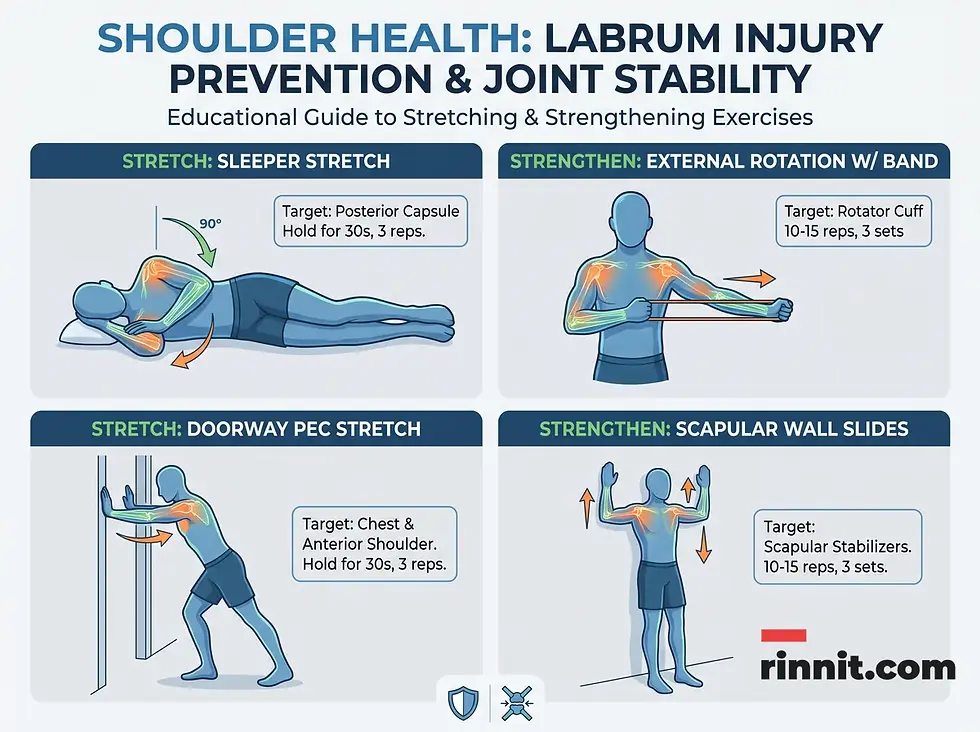
Some injuries, such as those caused by a sudden fall, are unavoidable, but many SLAP tears can be prevented with proper shoulder care. [1] Maintaining flexibility and strength in the rotator cuff and surrounding muscles gives the labrum better support. Athletes should stretch before and after activity and should never ignore persistent shoulder pain [1], as early attention can often keep minor fraying from becoming a major tear.
Related reading on Rinnit: Rotator Cuff Tear: Symptoms, Causes, and Recovery Guide
Frequently Asked Questions
Can a SLAP tear heal on its own?
The labrum has a limited blood supply and may not "heal" in the traditional sense, but many SLAP tears become symptom-free with proper rest and physical therapy.
Is surgery always necessary for a SLAP tear?
No. Many people manage their symptoms with non-surgical treatment. Surgery is typically reserved for severe tears or cases that do not improve with conservative care.
How do I know if I have a SLAP tear or just a strained muscle?
SLAP tears often cause deep joint pain and mechanical symptoms like popping or grinding, whereas a strain is usually more superficial. A professional diagnosis is needed to tell the two apart.
Can I still play sports with a SLAP tear?
It depends on the severity of the tear and the sport. Many athletes need treatment and rehabilitation before returning to high-demand overhead activities.
What happens if I leave a SLAP tear untreated?
Untreated tears can lead to chronic pain, reduced use of the arm and shoulder, and a higher risk of more serious shoulder problems.
Does an MRI always show a SLAP tear?
Standard MRIs can sometimes miss small tears. An MRI arthrogram, which uses contrast dye injected into the joint, is often more accurate for labrum injuries.
Are SLAP tears common in older adults?
Yes. Age-related wear often leads to Type 1 SLAP lesions in people over 40, and these are often painless.
How long do I have to wear a sling after surgery?
The time in a sling after surgery varies with the procedure and your surgeon's protocol, from several weeks to several months. Follow your surgeon's instructions.
What is the difference between a SLAP tear and a Bankart lesion?
A SLAP tear occurs at the top (superior) part of the labrum, while a Bankart lesion typically occurs at the front-bottom (anteroinferior) part, usually after a shoulder dislocation.
Can lifting weights cause a SLAP tear?
Yes. Heavy lifting with jerking movements or repetitive overhead pressing can put significant stress on the labrum.
Is physical therapy painful for a SLAP tear?
Therapy should focus on strengthening without causing sharp pain. Some discomfort is normal as you regain mobility, and your therapist should help you manage it.
Can a SLAP tear cause biceps pain?
Yes. The biceps tendon attaches to the superior labrum, so a tear in that area can cause pain that radiates down the front of the arm.
Are there different sub-types of Type 2 tears?
Yes. Type 2 tears are further categorized by whether the damage is mainly in the anterior (front), posterior (back), or both sections of the superior labrum.
What is debridement?
Debridement is a surgical procedure in which the surgeon trims away frayed or torn edges of the labrum so they do not catch in the joint.
Can I drive after SLAP tear surgery?
Generally not while you are required to wear a sling or are taking prescription pain medication. Ask your surgeon when it is safe.
Related Reading
SLAP Tear Surgery: Procedure, Recovery and Success Rate explains SLAP tear surgery and recovery.
Neer's Test: How It Checks for Shoulder Impingement, Steps and What Results Mean explains the quick in-office shoulder exam providers use to check for shoulder impingement.
Arthrogram (Arthrography): What It Is, Why It's Done, What to Expect and Results explains how contrast dye and imaging show the ligaments, tendons and cartilage inside a joint, and what to expect.
O'Brien Test: How It's Done, Positive vs Negative Results and Next Steps explains the quick shoulder exam used to screen for a SLAP tear or an AC joint problem.
Yergason's Test: How It's Done, What Results Mean and Accuracy explains the quick biceps tendon exam, what a click or pain means and how accurate it is.
References
Cleveland Clinic. SLAP tear. Cleveland Clinic. January 12, 2022. https://my.clevelandclinic.org/health/diseases/21717-slap-tear
Schrøder CP, Skare Ø, Reikerås O, et al. Sham surgery versus labral repair or biceps tenodesis for type II SLAP lesions of the shoulder: a three-armed randomised clinical trial. Br J Sports Med. 2017;51(24):1759-1766. PMID 28495804. https://doi.org/10.1136/bjsports-2016-097098
Ren YM, Duan YH, Sun YB, et al. Is arthroscopic repair superior to biceps tenotomy and tenodesis for type II SLAP lesions? A meta-analysis of RCTs and observational studies. J Orthop Surg Res. 2019;14(1):48. PMID 30760293. https://doi.org/10.1186/s13018-019-1096-y
Brox JI, Skare Ø, Mowinckel P, et al. Sick leave and return to work after surgery for type II SLAP lesions of the shoulder: a secondary analysis of a randomised sham-controlled study. BMJ Open. 2020;10(4):e035259. PMID 32241790. https://doi.org/10.1136/bmjopen-2019-035259
Medical Disclaimer
This article is for informational purposes only and does not constitute medical advice. Always seek the advice of your physician or other qualified health provider with any questions you may have regarding a shoulder injury or treatment plan.



Comments