Neer's Test: How It Checks for Shoulder Impingement, Steps and What Results Mean

Updated: 2 days ago
Written and medically reviewed by Dr. Baraa Alnahhal, MD · Last reviewed: November 2026 · How we review
Quick Answer: What is Neer's test?
Neer's test is a quick physical exam to check for shoulder impingement, a painful pinching around the shoulder when you move it. Your provider steadies your shoulder blade, turns your arm so your thumb points down and slowly lifts it. Pain at the top of that movement suggests impingement. The test takes seconds and has no risks. [1]
What the research says
Neer's test is a useful first check, not a final answer. A meta-analysis of shoulder exam studies found that Neer's test picked up about 72% of people with subacromial impingement, with a specificity of 60%. The authors concluded that no single shoulder test should be used on its own to make a diagnosis. (Hegedus et al., British Journal of Sports Medicine, 2012) [2]
A modified version may be more accurate. In a study of 85 shoulders checked against arthroscopy and MRI, a modified Neer test identified subacromial impingement with 90.6% accuracy and 95.6% specificity, and helped tell it apart from frozen shoulder. (Guosheng et al., European Journal of Orthopaedic Surgery & Traumatology, 2017) [3]
Key takeaways
Neer's test is an in-office physical exam used to help diagnose shoulder impingement. [1]
Your provider lifts your arm with your thumb pointing down while holding your shoulder blade still. [1]
Pain with your arm raised at the top of the motion is a positive result and suggests impingement. [1]
A negative result doesn't always rule out impingement or other shoulder problems. [1]
Imaging tests like X-rays, MRI or ultrasound often confirm the diagnosis. [1]
What is Neer's test?
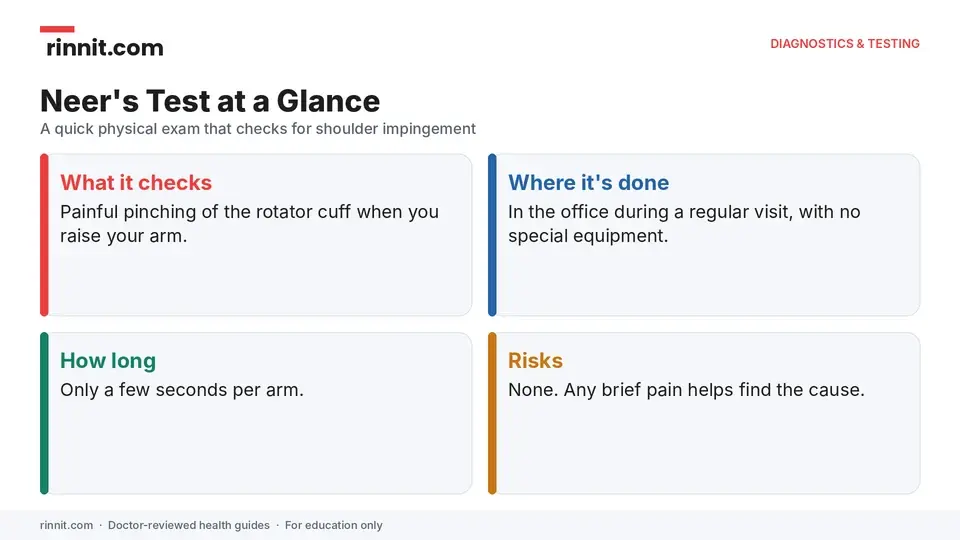
Neer's test is a physical movement exam that healthcare providers use to diagnose shoulder impingement. Your provider can do it during a regular visit, without special equipment or a separate appointment. [1]
Shoulder impingement is painful pinching around your shoulder when you move it. It happens when parts of your shoulder joint pinch or squeeze your rotator cuff, the group of muscles and tendons that holds your upper arm bone in its socket. [1]
How does Neer's test work?

Neer's test helps your provider check your shoulder's range of motion, meaning how far you can move it without pain. There's a good chance you have shoulder impingement if you feel pain when your arm is lifted up close to your ear. The test follows these steps: [1]
You stand with your arms at your sides.
Your provider stands next to you and gently presses on the top of your shoulder. This light pressure holds your shoulder blade in place.
They rotate your arm so your thumb points down and your palm faces out, away from your body.
Holding your palm in that position, they slowly lift your arm up. This checks your passive range of motion, because your provider does the moving.
Lifting your arm in this position gently pinches your rotator cuff if you have impingement. That's why some providers call the result Neer's sign. Pain with your arm raised at the top of the motion is a sign of impingement. [1]
Your provider may test both arms. Comparing sides helps them understand your normal range of motion when you're not in pain. [1]
Is Neer's test painful or risky?
Neer's test has no risks or side effects. You may feel some pain if you have impingement, but the test only takes seconds. Your provider won't force your arm into any position that could damage your shoulder, and any discomfort you feel helps them find the cause of your pain. [1]
What do Neer's test results mean?
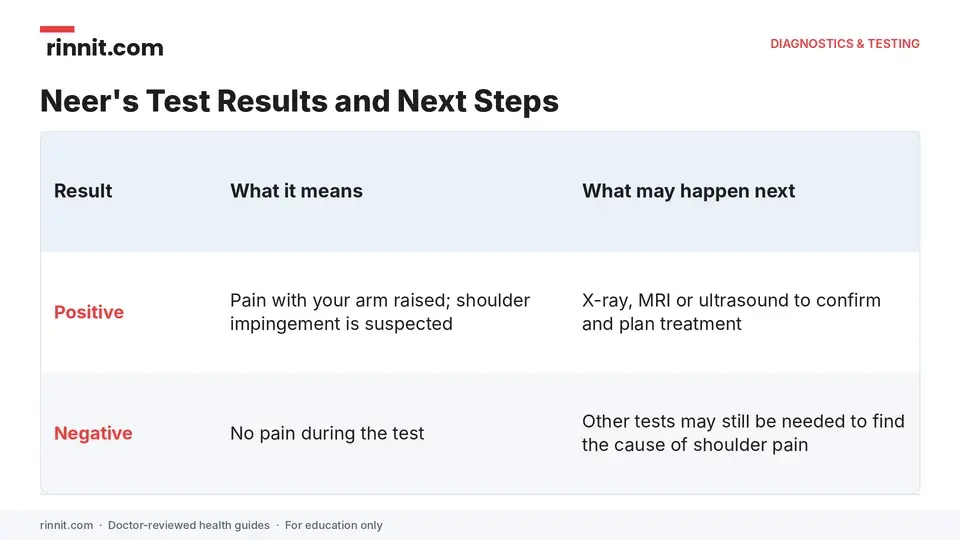
Your provider records the test as positive or negative: [1]
Result | What it means | What may happen next |
Positive | You felt pain with your arm raised, and your provider suspects shoulder impingement | Imaging tests to confirm impingement and plan treatment |
Negative | You didn't feel pain during the test | You may still need other tests, because impingement or another shoulder problem is still possible |
Sources: [1]
A Neer's test may be all your provider needs to diagnose shoulder impingement. Still, they'll probably suggest imaging tests to confirm it and take pictures of your shoulder. These may include: [1]
Your provider will tell you which treatments you need. The best option depends on the type of impingement you have and what's causing it. [1]
When should you see a doctor for shoulder pain?
See a healthcare provider if you have shoulder pain, stiffness or other symptoms that last more than a few days. Shoulder pain is very common and many problems can cause it, so don't ignore it, especially if you use your shoulders a lot for sports or work. [1]
Conclusion
Neer's test is a simple, fast exam that takes only a few seconds. If you feel pain or pinching as your provider lifts your arm, you might have shoulder impingement, which could explain the pinching you feel when you move your arm.
A positive test is often the first step. Imaging tests then show what's happening inside your shoulder so you can get the right treatment and start feeling better.
Keep learning: Read our guide to rotator cuff injuries or our explainer on the McMurray test for knee injuries. For more trusted, doctor-reviewed health guides, visit Rinnit.com.
FAQ
What is Neer's test?
It is a quick in-office shoulder exam that helps diagnose shoulder impingement.
What is shoulder impingement?
Painful pinching around the shoulder when parts of the joint squeeze the rotator cuff.
How is Neer's test done?
Your provider steadies your shoulder blade, turns your thumb down and slowly lifts your arm.
What does a positive Neer's test mean?
You felt pain with your arm raised, which suggests shoulder impingement.
What does a negative Neer's test mean?
You felt no pain, but you may still need other tests to find the cause of your symptoms.
What is Neer's sign?
Pain at the top of the arm-raising motion, caused by pinching of the rotator cuff.
Does Neer's test hurt?
It may briefly hurt if you have impingement, but it only takes seconds.
Is Neer's test risky?
No. It has no risks or side effects and won't damage your shoulder.
Will I need imaging after Neer's test?
Often yes. X-rays, MRI or ultrasound can confirm impingement.
When should I see a doctor for shoulder pain?
If pain, stiffness or other shoulder symptoms last more than a few days.
Related Reading
What Is a Rotator Cuff Injury? A Plain-Language Guide to the Shoulder Problem That Aches Deep and Keeps You Up at Night explains the rotator cuff problems that impingement can lead to and how they're treated.
Rotator Cuff Tear: Symptoms, Causes, and Recovery Guide covers torn rotator cuff tendons, a possible cause of shoulder pain when you lift your arm.
Frozen Shoulder (Adhesive Capsulitis): Symptoms, Causes & Treatment — Complete Guide describes a stiff, painful shoulder condition that can look like impingement.
SLAP Tear: Understanding Shoulder Labrum Injuries explains labrum injuries, another cause of shoulder pain your provider may check for.
Rotator Cuff: Four Muscles, Function, Injuries and Care describes the four muscles and tendons that get pinched in shoulder impingement.
Shoulder Joint: Anatomy, Function, and Common Conditions explains how your shoulder joint is built and the common problems that affect it.
References
Cleveland Clinic. Neer's Test: What It Is, How It's Done & Results. Cleveland Clinic. Last updated December 16, 2025. https://my.clevelandclinic.org/health/diagnostics/neers-test
Hegedus EJ, Goode AP, Cook CE, et al. Which physical examination tests provide clinicians with the most value when examining the shoulder? Update of a systematic review with meta-analysis of individual tests. Br J Sports Med. 2012;46(14):964-978. PMID 22773322. https://doi.org/10.1136/bjsports-2012-091066
Guosheng Y, Chongxi R, Guoqing C, et al. The diagnostic value of a modified Neer test in identifying subacromial impingement syndrome. Eur J Orthop Surg Traumatol. 2017;27(8):1063-1067. PMID 28534226. https://doi.org/10.1007/s00590-017-1979-8
Medical disclaimer
This article is for general education only and does not replace advice from a qualified healthcare professional. Talk to your doctor about your own diagnosis and treatment, and seek emergency care right away for severe or sudden symptoms.



Comments