Rotator Cuff Tear: Symptoms, Causes, and Recovery Guide

Updated: 3 days ago
Medically reviewed by Dr. Baraa Alnahhal, MD · Last reviewed: October 2026
Quick Answer: What is a rotator cuff tear?
A rotator cuff tear is damage to or detachment of the tendons that connect the shoulder muscles to the upper arm bone. Symptoms include deep shoulder pain, arm weakness and difficulty lifting objects. Tears can be partial or complete. Surgery is sometimes needed for full-thickness tears, but approximately 80% of partial tears improve with nonsurgical treatment. [1]

What the research says
Physical therapy works for most people with atraumatic full-thickness tears. In a multicenter cohort of 452 patients, a structured physical therapy program was effective in approximately 75% of patients followed for 2 years, and patients chose surgery less than 25% of the time (Kuhn et al., J Shoulder Elbow Surg, 2013). [2]
The benefit lasts. At 10 years of follow-up in the same cohort, physical therapy was effective for more than 70% of patients, patient-reported outcomes did not decline over time, and only 1 patient (0.2%) went on to have a reverse shoulder replacement (Kuhn et al., J Am Acad Orthop Surg, 2024). [3]
Expectations matter more than tear size. Among 433 patients with full-thickness tears, 87 had surgery during follow-up. Low expectations about physical therapy were the strongest predictor of surgery, more than symptoms or features of the tear (Dunn et al., J Shoulder Elbow Surg, 2016). [4]
What is a rotator cuff tear?
The rotator cuff is a critical group of four muscles and tendons that stabilize the shoulder joint. It acts like a sleeve, keeping the ball of the upper arm bone (humerus) firmly within the shoulder blade socket. A tear occurs when these tendons are damaged, making it difficult to lift or rotate the arm. [1]
Rotator cuff problems are exceptionally common, affecting more than 2 million Americans every year. While they can occur at any age, the risk increases significantly after age 40 as tendons naturally wear down. Some people even have a tear without any noticeable symptoms. [1]
Types of Rotator Cuff Tears
Medical professionals classify tears based on the severity of the tendon damage. Understanding the specific type of tear is essential for determining the most effective treatment plan.
Tear Type | Description | Bone Attachment |
|---|---|---|
Partial Tear | Also called an incomplete tear; the tendon is damaged but still partially attached. | Somewhat attached |
Complete Tear | Also called a full-thickness tear; the tendon separates entirely from the bone. | Fully detached |
What are the symptoms and warning signs of a rotator cuff tear?
The most prominent symptom of a rotator cuff tear is pain, which often feels like a dull ache deep in the shoulder. This pain typically worsens when you try to sleep on the affected side or when you lift your arm away from your body. [1]
Common indicators include:
When to Seek Medical Attention
While mild shoulder discomfort may resolve with rest, certain signs indicate a need for professional evaluation. You should contact a healthcare provider if you experience chronic pain, nighttime discomfort that prevents sleep, or visible redness and swelling around the shoulder joint. [1]

What causes a rotator cuff tear, and who is at risk?
Rotator cuff tears generally fall into two categories: acute and degenerative. Acute tears are caused by sudden trauma, such as falling on an outstretched arm or lifting a heavy object with a jerking motion. These injuries often occur alongside other issues like a dislocated shoulder or broken collarbone. [1]
Degenerative tears are much more common and result from the gradual wearing down of the tendon over time. Several factors contribute to this process: [1]
Bone spurs: Over time, bony growths can develop on the shoulder bone, rubbing against the tendon and causing friction (shoulder impingement). [1]
Reduced blood flow: As we age, blood supply to the rotator cuff tendons naturally decreases, hindering the body’s ability to repair minor damage. [1]
Overuse: Repetitive overhead movements, common in sports like tennis or professions like painting and carpentry, stress the tendons. [1]
How is a rotator cuff tear diagnosed and treated?
To diagnose a tear, a healthcare provider will assess your shoulder’s range of motion, tenderness, and strength. Imaging tests are usually required to confirm the diagnosis and determine the tear’s size. X-rays are used to identify bone spurs or arthritis, while MRIs and ultrasounds provide detailed views of the soft tissues and tendons. [1]
Management Options
Treatment aims to reduce pain and restore function. The choice between surgical and nonsurgical care depends on the tear’s severity, the patient’s activity level, and how long the symptoms have persisted.
Treatment Method | Description | Goal |
|---|---|---|
Physical Therapy | Specific exercises to strengthen surrounding shoulder muscles. | Restore strength and mobility |
Medications | Use of NSAIDs (pain relievers) or steroid injections. | Reduce inflammation and pain |
Rest and Slings | Limiting activity and immobilizing the arm temporarily. | Allow the tendon time to rest |
Surgical Repair | Reattaching the tendon to the bone, often arthroscopically. | Restore anatomical connection |
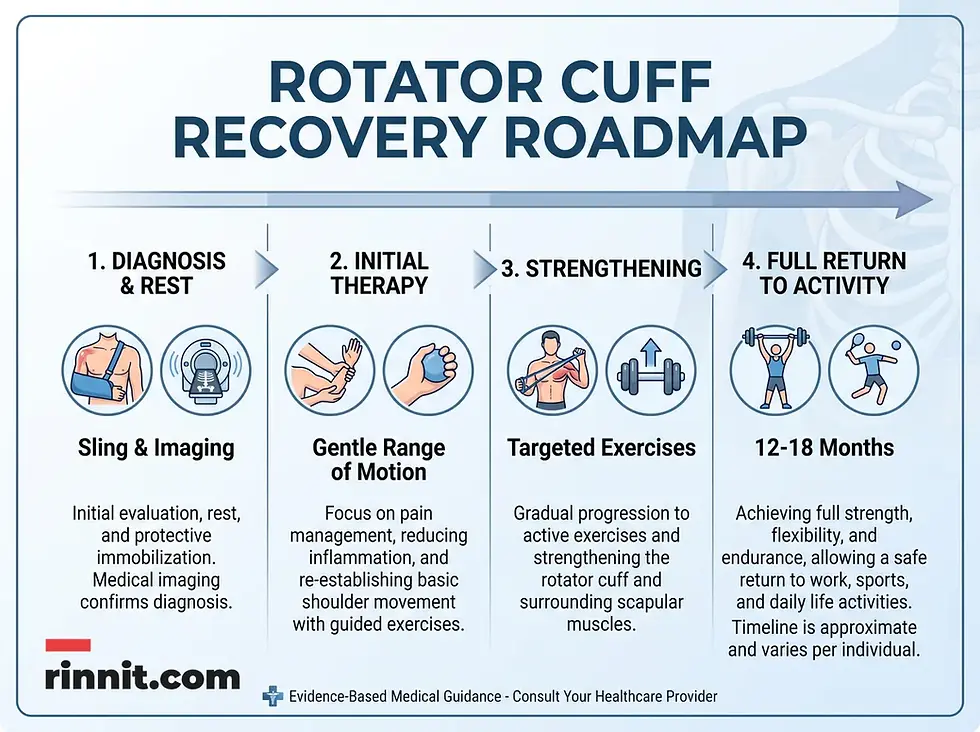
Recovery and Outlook
For those undergoing surgery, recovery is a long-term commitment. Patients typically wear a sling for four to six weeks, followed by several months of physical therapy. While basic function often returns within six months, full recovery and strength restoration can take 12 to 18 months. [1]
Nonsurgical treatment is successful for many, especially those with partial tears. About 80% of patients with partial tears see improvement without surgery, though it may take up to a year of consistent therapy to achieve optimal results. [1]
Conclusion
A rotator cuff tear can be a significant setback, but it is a highly treatable condition. Whether through dedicated physical therapy or surgical repair, the majority of patients are able to return to their favorite activities and live without chronic shoulder pain. Early diagnosis and a committed recovery plan are the most important steps toward regaining your strength.
What are the next steps if you have a rotator cuff tear?
If you are experiencing persistent shoulder pain or weakness that interferes with your sleep or daily routine, consult an orthopedic specialist to discuss a personalized recovery plan.
Trusted resources: American Academy of Orthopaedic Surgeons (AAOS), Arthritis Foundation, National Institute of Arthritis and Musculoskeletal and Skin Diseases (NIAMS).
Related reading on Rinnit: Physical Therapy: Enhancing Mobility, Strength, and Recovery
Frequently Asked Questions
Can a rotator cuff tear heal on its own?
Small partial tears may improve with rest and therapy, but a complete tear will not reattach to the bone without surgical intervention. However, many people can regain function by strengthening the surrounding muscles. [1]
What happens if I leave a rotator cuff tear untreated?
Untreated tears can enlarge over time, leading to chronic pain, permanent weakness, and a significant loss of shoulder mobility. [1]
Can I still exercise with a rotator cuff tear?
Yes, but you must follow a specific program designed by a physical therapist to avoid further injury. Avoid heavy lifting or overhead movements until cleared by a professional.
How long does the pain last?
With nonsurgical treatment, pain often improves within a few weeks to months. Post-surgical pain decreases significantly after the first few weeks, but full recovery takes much longer.
Are bone spurs the same as a rotator cuff tear?
No, but bone spurs can cause a tear by rubbing against the tendon every time you move your shoulder. [1]
Does smoking affect rotator cuff healing?
Yes. Smoking reduces blood flow and oxygen levels in the body, which significantly slows down the healing process for tendons and muscles.
Can I drive after rotator cuff surgery?
Usually not for the first six weeks while you are required to wear a sling, as you cannot safely operate a vehicle with one arm.
What is the difference between a strain and a tear?
A strain is an overstretching of the tendon, while a tear involves an actual rip or detachment of the fibers.
Is a rotator cuff tear common in young people?
A rotator cuff tear is less common but can occur due to high-impact sports or sudden traumatic injuries.
Can physical therapy fix a complete tear?
Physical therapy cannot physically reattach the tendon, but it can strengthen other muscles to compensate for the lost function. [1]
What is an arthroscopic repair?
An arthroscopic repair is a minimally invasive surgery performed through small incisions using a tiny camera and specialized tools. [1]
Why does the pain get worse at night?
Lying down can increase pressure on the shoulder joint, and the lack of daily distractions often makes the brain more aware of the dull, aching pain.
Can I re-tear the rotator cuff after surgery?
Yes, re-tears are possible, especially if the original tear was large or if the patient returns to heavy activity too quickly. [1]
What is a “reverse” shoulder replacement?
A “reverse” shoulder replacement is a procedure for complex or unrepairable tears where the ball and socket parts of the shoulder joint are switched to allow different muscles to move the arm.
Related Reading
Shoulder Replacement Surgery: Types, Recovery and Restrictions explains shoulder replacement surgery and recovery.
Arthroscopy: Joint Surgery Procedure, Uses and Recovery explains how arthroscopy repairs joints through small incisions.
Neer's Test: How It Checks for Shoulder Impingement, Steps and What Results Mean explains the quick in-office shoulder exam providers use to check for shoulder impingement.
Arthrogram (Arthrography): What It Is, Why It's Done, What to Expect and Results explains how contrast dye and imaging show the ligaments, tendons and cartilage inside a joint, and what to expect.
O'Brien Test: How It's Done, Positive vs Negative Results and Next Steps explains the quick shoulder exam used to screen for a SLAP tear or an AC joint problem.
Yergason's Test: How It's Done, What Results Mean and Accuracy explains the quick biceps tendon exam, what a click or pain means and how accurate it is.
Shoulder X-Ray: Why It's Done, What It Shows and What to Expect explains the X-ray used first for shoulder pain and injuries.
References
Cleveland Clinic. Rotator cuff tear. Cleveland Clinic. August 21, 2023. https://my.clevelandclinic.org/health/diseases/8291-rotator-cuff-tear
Kuhn JE, Dunn WR, Sanders R, et al. Effectiveness of physical therapy in treating atraumatic full-thickness rotator cuff tears: a multicenter prospective cohort study. J Shoulder Elbow Surg. 2013;22(10):1371-1379. PMID 23540577. https://doi.org/10.1016/j.jse.2013.01.026
Kuhn JE, Dunn WR, Sanders R, et al. 2024 Kappa Delta Ann Doner Vaughan Award: nonsurgical treatment of symptomatic, atraumatic full-thickness rotator cuff tears: a prospective multicenter cohort study with 10-year follow-up. J Am Acad Orthop Surg. 2024;32(23):1061-1073. PMID 39325825. https://doi.org/10.5435/JAAOS-D-24-00841
Dunn WR, Kuhn JE, Sanders R, et al. 2013 Neer Award: predictors of failure of nonoperative treatment of chronic, symptomatic, full-thickness rotator cuff tears. J Shoulder Elbow Surg. 2016;25(8):1303-1311. PMID 27422460. https://doi.org/10.1016/j.jse.2016.04.030
Medical Disclaimer
This article is for informational purposes only and does not constitute medical advice. Always seek the advice of your physician or other qualified health provider with any questions you may have regarding a medical condition.



Comments