Shoulder Replacement Surgery: Types, Recovery and Restrictions

Updated: 2 days ago
Written and medically reviewed by Dr. Baraa Alnahhal, MD · Last reviewed: November 2026 · How we review
Quick Answer
Shoulder replacement surgery (shoulder arthroplasty) is an operation that replaces the damaged ball and socket of the shoulder joint with a metal and plastic prosthesis. It's suggested when severe pain, stiffness and limited movement don't improve with nonsurgical treatment, most often from arthritis. Full recovery takes a few months, and most replacements last at least 15 years.
What the research says
Most anatomic shoulder replacements lasted 10 to 20 years: a meta-analysis of 15 studies with 1,163 anatomic shoulder replacements found implant survival of 93.0% at 10 years, 85.1% at 15 years and 82.5% at 20 years, with 17.0% revised overall (Ranieri R et al., International Orthopaedics, 2026) [2]
Reverse replacement needed fewer revisions in some cases: in 14 studies of 4,819 cases of osteoarthritis with an intact rotator cuff, reverse shoulder replacement had lower odds of revision than anatomic replacement, with similar function scores, though anatomic replacement gave better outward rotation (Thamrongskulsiri N et al., Clinics in Orthopedic Surgery, 2025) [3]
Key takeaways
Shoulder replacement swaps a damaged joint for a metal and plastic prosthesis.
It's mostly used for severe shoulder arthritis.
Surgery takes about two hours.
You'll wear a sling for a few weeks and start physical therapy.
Most replacements last at least 15 years.
What is shoulder replacement surgery?
Your shoulder is a ball-and-socket joint: the head of the upper arm bone (humerus) sits in a socket on the shoulder blade (glenoid). During a joint replacement, the surgeon removes damaged bone and cartilage and installs a prosthesis. Learn more about shoulder anatomy. Sources: [1]
Why it's done
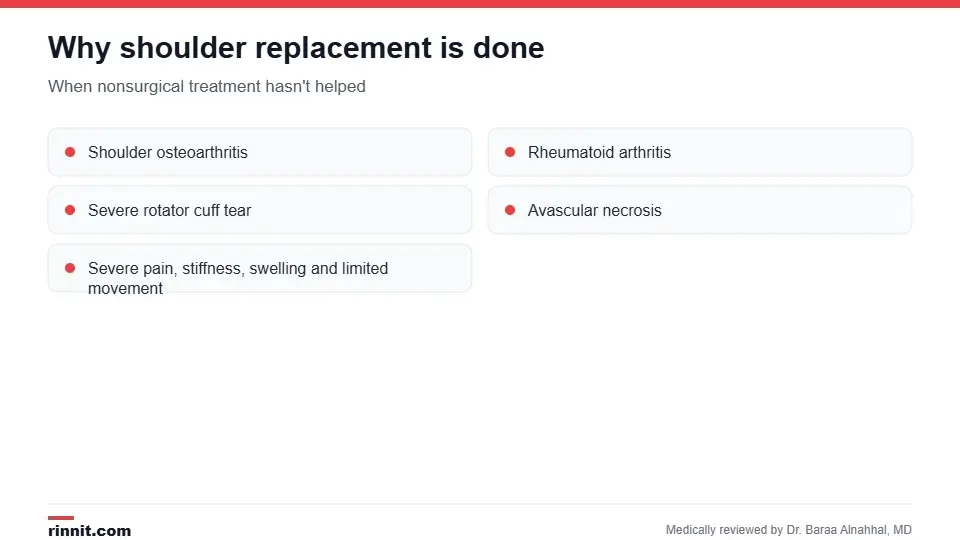
Most people who need it have shoulder arthritis.
Shoulder osteoarthritis or rheumatoid arthritis.
A severe rotator cuff tear.
Avascular necrosis.
Pain, stiffness, swelling and limited mobility that nonsurgical treatment hasn't helped. Sources: [1]
Types of shoulder replacement

Partial replacements are less common.
Type | What's replaced |
Total replacement | Both the ball and socket |
Partial replacement (hemiarthroplasty) | Usually only the ball, when the socket is undamaged |
A reverse shoulder replacement is another option your surgeon may discuss. Sources: [1, 3]
How to prepare
You may have a dental exam and cleaning to lower infection risk.
Tests may include a physical exam, shoulder X-ray, CT or MRI, an EKG and blood tests.
Tell your surgeon about all medicines and supplements; some may need to stop.
Most people fast for eight hours before surgery. Sources: [1]
What happens during surgery

You may go home the same day or stay overnight.
You get general anesthesia, regional anesthesia or both.
The surgeon makes an incision and removes damaged bone and cartilage.
The prosthetic shoulder is installed.
Your arm and shoulder are realigned, and the incision is closed. Sources: [1]
Surgery usually takes around two hours. Sources: [1]
Risks
Blood clots.
Infection.
Nerve or blood vessel damage.
Fractures around the implant.
Loosening, early wear or dislocation of the prosthesis. Sources: [1]
These complications are rare. Sources: [1]
Recovery
You may go home the same day or stay at least overnight.
Wear a sling for at least a few weeks.
Start your surgeon's exercises right away and physical therapy a few weeks later.
Expect pain in the first few weeks; take pain medicine as directed.
Do light daily tasks after two or three weeks.
Avoid heavy lifting and sports for a few months; some lifting limits may be permanent. Sources: [1]
Full recovery takes a few months. Sources: [1]
Outlook
Shoulder replacement can greatly reduce pain and stiffness and improve how you use your shoulder. Most people keep their replacement for at least 15 years, and many for life. Sources: [1, 2]
When to call your provider
Bleeding.
Chest pain or shortness of breath.
A fever over 101 degrees Fahrenheit.
New or worsening pain in your arm, hand or wrist.
Severe pain that medicine doesn't relieve.
Signs of infection: leaking, swelling, discoloration, odor or warmth. Sources: [1]
Conclusion
Shoulder replacement can relieve severe arthritis pain and help you move your shoulder again. Following your sling, exercise and therapy plan helps you get the best long-term result.
Keep learning: read about reverse shoulder replacement and joint replacement.
Frequently asked questions
What is shoulder replacement surgery?
Surgery that replaces a damaged shoulder joint with a metal and plastic prosthesis.
Who needs a shoulder replacement?
Mostly people with severe shoulder arthritis that other treatments haven't helped.
What is a partial shoulder replacement?
A hemiarthroplasty, which usually replaces only the ball.
How long does surgery take?
Around two hours.
Will I stay in the hospital?
You may go home the same day or stay at least overnight.
How long will I wear a sling?
At least a few weeks.
When does physical therapy start?
A few weeks after surgery.
How long is recovery?
Full recovery takes a few months.
How long does a shoulder replacement last?
Most last at least 15 years, and many last a lifetime.
What are the risks?
Rarely, blood clots, infection, nerve damage or implant loosening.
Related Reading
Arthroplasty (Joint Replacement): Procedure, Types, and Recovery an overview of joint replacement.
Reverse Shoulder Replacement: Benefits and Recovery another type of shoulder replacement.
Shoulder Joint: Anatomy, Function, and Common Conditions how the shoulder works.
Rotator Cuff Tear: Symptoms, Causes, and Recovery Guide a reason for shoulder surgery.
Understanding Shoulder Arthroscopy: A Minimally Invasive Approach to Joint Repair a less invasive shoulder surgery.
References
Cleveland Clinic. Shoulder Replacement Surgery: Recovery & Restrictions. Cleveland Clinic. Last updated January 27, 2025. https://my.clevelandclinic.org/health/treatments/8290-shoulder-replacement
Ranieri R, Illuminati M, Delle Rose G, et al. Long-term glenoid loosening, radiological and clinical outcomes in cemented all-polyethylene anatomic total shoulder arthroplasty: a systematic review and meta-analysis. Int Orthop. 2026;50(7):1683-1696. PMID 42243505. https://doi.org/10.1007/s00264-026-06853-9
Thamrongskulsiri N, Limskul D, Tanpowpong T, et al. Comparison of revision rates and clinical outcomes between anatomic and reverse total shoulder arthroplasty for rotator cuff-intact osteoarthritis: a systematic review and meta-analysis. Clin Orthop Surg. 2025;17(6):907-921. PMID 41356545. https://doi.org/10.4055/cios25012
Medical disclaimer
This article is for general education only and does not replace advice from a qualified healthcare professional. Talk to your doctor about your own diagnosis and treatment, and seek emergency care right away for severe or sudden symptoms.



Comments