Reverse Shoulder Replacement: Benefits and Recovery

Updated: 2 days ago
Medically reviewed by Dr. Baraa Alnahhal, MD · Last reviewed: October 2026
Reverse shoulder replacement is a surgical procedure that swaps the positions of the shoulder's ball and socket to improve stability and function. [1] It is primarily used for patients with severe arthritis and significant rotator cuff damage who are not candidates for traditional replacement. The procedure takes one to two hours, and while full recovery takes about six months, most implants last over 15 years, providing long-term relief from chronic pain and limited mobility. [1]
Quick Answer
Reverse shoulder replacement is a surgery that reverses the shoulder's ball and socket, attaching a metal ball to the shoulder blade and a socket to the upper arm bone. [1] This lets the deltoid muscle power the arm, bypassing damaged rotator cuff tendons. It treats severe pain and mobility loss and typically lasts 15 years or longer. [1]
What the research says
Reverse replacement can relieve pain and restore function when a massive rotator cuff tear cannot be repaired. A systematic review and meta-analysis of 6 studies (266 shoulders, follow-up of 24 to 61.4 months) in patients with irreparable massive rotator cuff tears without osteoarthritis found improvement from before to after surgery in clinical score (Cohen d = 1.35), function (d = 1.04) and pain (d = -0.89, meaning less pain), and concluded these patients have a high likelihood of a painless shoulder with functional improvement (Sevivas et al., Journal of Shoulder and Elbow Surgery, 2017 [2]).
About 1 in 8 reverse replacements had a complication in one large review, and dislocation was the most common. In a systematic review covering 13,513 reverse shoulder arthroplasty procedures, the overall complication rate was 12.1%, dislocation was the most common complication (2.5%), and intraoperative fractures occurred in 1.4% of procedures (2.9% in first-time surgeries and 13.6% in revision surgeries) (Dolci et al., Geriatric Orthopaedic Surgery & Rehabilitation, 2021 [3]).
Results after reverse replacement for a fracture are slightly lower than for rotator cuff arthropathy. A meta-analysis of 11 observational studies (6,698 patients: 1,832 with proximal humerus fractures and 4,866 with rotator cuff arthropathy) found that fracture patients had lower ASES scores (mean difference of -5 points), less forward flexion (-14°) and less abduction (-17°), with similar pain scores and a higher risk of revision for dislocation (risk ratio 1.59), although the absolute differences were modest (Yazdanpanah et al., JSES Reviews, Reports, and Techniques, 2026 [4]).
Why is a reverse shoulder replacement sometimes necessary?
The primary reason for choosing a reverse replacement over a traditional one is the presence of significant rotator cuff damage. In a healthy shoulder, the rotator cuff muscles hold the ball of the humerus in the socket. When these muscles are severely torn or weakened, a traditional replacement often fails because the joint lacks the necessary stability to function. The reverse design creates a more stable pivot point, allowing the larger deltoid muscle to take over the work of the damaged rotator cuff.

Condition | Traditional Replacement | Reverse Replacement |
|---|---|---|
Simple Osteoarthritis | Primary Choice | Rarely Used |
Severe Rotator Cuff Tear | High Failure Risk | Primary Choice |
Complex Fractures | Limited Success | Recommended |
Chronic Dislocations | Difficult to Stabilize | Effective Solution |
Tumors/Bone Damage | Often Impossible | Viable Option |
How do you prepare for a reverse shoulder replacement?
Preparation for a reverse shoulder replacement involves a comprehensive health assessment to minimize surgical risks. Patients typically undergo a physical exam, blood tests, and an electrocardiogram (EKG) to ensure they are healthy enough for anesthesia. [1] Imaging tests, such as X-rays, MRIs, or CT scans, are essential for the surgeon to plan the exact placement of the implants. Additionally, a dental exam is often required to rule out hidden infections that could potentially spread to the new joint after surgery.

What happens during reverse shoulder replacement surgery and right after?
The surgery itself generally lasts between one and two hours. [1] Under general or regional anesthesia, the surgeon removes damaged cartilage and bone before securing the new metal and plastic components. [1] The metal ball is screwed into the scapula, while the socket is fitted into the top of the humerus. [1] Once the joint is realigned and the incision is closed, patients are moved to a recovery area for monitoring. [1] Depending on the complexity, the procedure may be performed on an outpatient basis or require an overnight hospital stay. [1]
What is long-term recovery like after a reverse shoulder replacement?
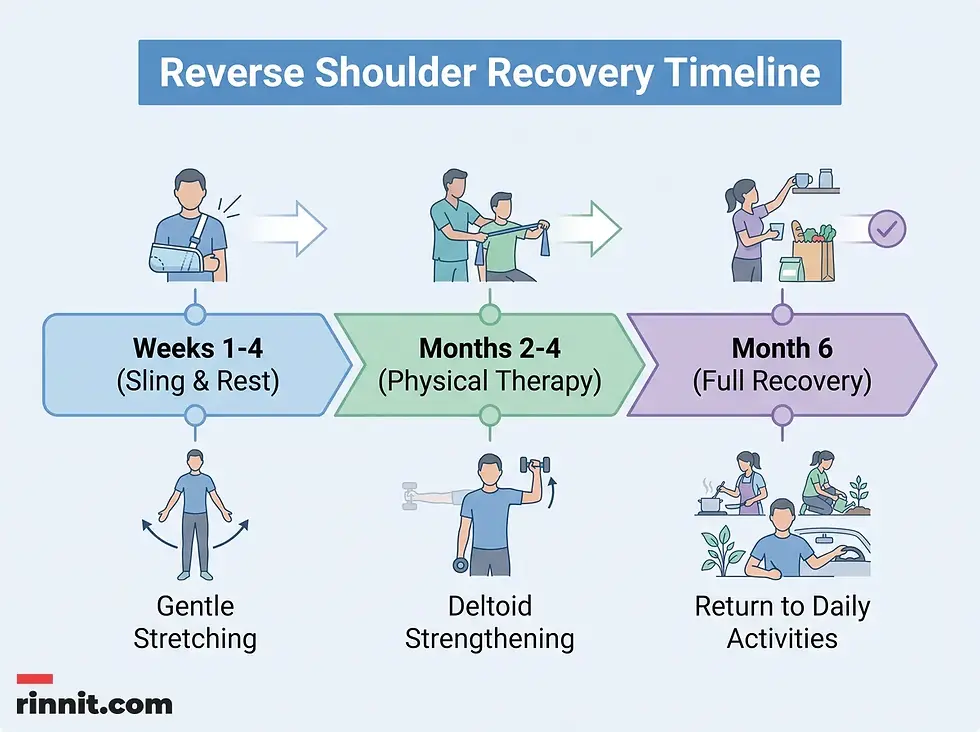
Full recovery from a reverse shoulder replacement is a gradual process that typically spans six months. [1] For the first few weeks, the arm must remain in a sling to protect the new joint as it heals. [1] Physical therapy is a critical component of the recovery phase, focusing on strengthening the deltoid muscle and gradually restoring the shoulder's range of motion. While patients must avoid heavy lifting and intense sports for several months, the long-term outlook is highly positive, with most implants remaining functional for at least 15 years. [1]
Conclusion
Reverse shoulder replacement offers a life-changing option for individuals suffering from severe shoulder dysfunction that cannot be addressed by traditional methods. By re-engineering the joint's mechanics, this procedure provides a stable, pain-free shoulder for those with complex injuries. If you are experiencing chronic shoulder pain that limits your daily activities, consult with an orthopedic specialist to determine if this advanced surgical solution is appropriate for your needs.
Frequently Asked Questions
How is a reverse shoulder replacement different from a traditional one?
In a traditional replacement, the ball is placed on the humerus and the socket on the scapula, mimicking natural anatomy. In a reverse replacement, these positions are swapped, allowing the deltoid muscle to power the shoulder when the rotator cuff is damaged.
Who is the ideal candidate for this surgery?
Ideal candidates are those with severe shoulder pain and limited mobility who also have a massive rotator cuff tear, a complex fracture, or have had a previous shoulder replacement that failed.
How long does the surgery take?
The surgical procedure typically takes between one and two hours, though this can vary depending on the extent of the damage to the joint and surrounding tissues.
What is the expected recovery time?
While immediate healing takes a few weeks, full recovery and the return to most normal activities generally take about six months of consistent rehabilitation and physical therapy. [1]
Will I need to stay in the hospital?
Many procedures are now performed as outpatient surgeries, allowing patients to go home the same day. However, some patients may require an overnight stay for monitoring. [1]
What are the main benefits of the procedure?
The primary benefits include a significant reduction in chronic pain, improved shoulder stability, and a restored ability to perform daily tasks that were previously impossible. [1]
What are the risks associated with this surgery?
As with any major surgery, risks include infection, blood clots, nerve or blood vessel damage, and the possibility of the implant loosening or wearing out over time. [1]
How long will the new joint last?
Modern reverse shoulder implants are very durable, with clinical data showing that the vast majority last for 15 years or longer. [1]
When can I start physical therapy?
Physical therapy usually begins a few weeks after surgery, once the initial healing phase has progressed enough for the surgeon to clear you for gentle movement.
What activities should I avoid after surgery?
Patients should avoid heavy lifting, pushing, pulling, or participating in high-impact sports for several months following the procedure to ensure the joint heals correctly.
How do I prepare for a reverse shoulder replacement?
Expect a physical exam, blood tests, an EKG, imaging and a dental exam to rule out hidden infection. Tell your provider and surgeon about all medications and supplements you take, as you may need to stop some, and follow your surgeon's fasting instructions [1].
Does reverse shoulder replacement hurt, and what anesthesia is used?
You receive general anesthesia, regional anesthesia that numbs the shoulder, or both, so you do not feel the surgery. Afterward your surgeon suggests a combination of prescription pain medication, over-the-counter NSAIDs if safe for you, and acetaminophen [1].
When should I call my doctor after a reverse shoulder replacement?
Call 911 for chest pain or sudden shortness of breath, which can mean a blood clot in the lungs. Call your surgeon right away for bleeding, a fever above 101°F, new or worsening pain in your arm, hand or wrist, pain that medication does not relieve, or signs of infection at the surgical site [1].
Related Reading
Shoulder Replacement Surgery: Types, Recovery and Restrictions explains shoulder replacement surgery and recovery.
References
Cleveland Clinic. Reverse Shoulder Replacement. Cleveland Clinic. January 29, 2025. https://my.clevelandclinic.org/health/procedures/reverse-shoulder-replacement
Sevivas N, Ferreira N, Andrade R, et al. Reverse shoulder arthroplasty for irreparable massive rotator cuff tears: a systematic review with meta-analysis and meta-regression. Journal of Shoulder and Elbow Surgery. 2017;26(9):e265-e277. PMID 28684233. https://doi.org/10.1016/j.jse.2017.03.039
Dolci A, Melis B, Verona M, et al. Complications and intraoperative fractures in reverse shoulder arthroplasty: a systematic review. Geriatric Orthopaedic Surgery & Rehabilitation. 2021;12:21514593211059865. PMID 34900387. https://doi.org/10.1177/21514593211059865
Yazdanpanah S, Soth BT, Eskew JR, et al. Decreased clinical and functional outcomes following reverse total shoulder arthroplasty for proximal humerus fractures compared to rotator cuff arthropathy: a systematic review and meta-analysis. JSES Reviews, Reports, and Techniques. 2026;6(2):100691. PMID 41853732. https://doi.org/10.1016/j.xrrt.2026.100691
Medical disclaimer
The information provided in this article is for educational purposes only and should not be used as a substitute for professional medical advice, diagnosis, or treatment. Always seek the advice of your physician or other qualified health provider with any questions you may have regarding a medical condition.



Comments