Shoulder X-Ray: Why It's Done, What It Shows and What to Expect

Updated: 2 days ago
Written and medically reviewed by Dr. Baraa Alnahhal, MD · Last reviewed: November 2026 · How we review
Quick Answer
A shoulder X-ray is a painless imaging test that shows the bones of the shoulder. It's the first test for shoulder pain, an injury or trouble moving the arm, and it can show fractures, dislocations and arthritis. It takes a few minutes and uses a low radiation dose. Tendons and cartilage don't show, so ultrasound or MRI may follow.
What the research says
Different imaging answers different shoulder questions: a systematic review of 40 studies and 2,560 shoulders found CT arthrography had the highest accuracy for detecting Hill-Sachs lesions (bone dents from dislocation), with a median accuracy of 91% and sensitivity of 94%, and 3D CT was the most reliable for measuring bone loss (Vopat ML et al., Arthroscopy, 2021) [2]
AI can read rotator cuff tears from images, including X-rays: a systematic review of 37 studies and 46,593 patients found AI models diagnosed rotator cuff tears with average accuracy of 84% (AUC 0.86) on radiographs, 89.5% (AUC 0.93) on MRI and 91% (AUC 0.97) on ultrasound, outperforming junior clinicians on radiographs and MRI (Zhan H et al., Arthroscopy, 2026) [3]
Key takeaways
Shows the five bones of the shoulder; bone appears white, soft tissue gray or black.
Finds fractures, dislocations, arthritis, rotator cuff calcium deposits, alignment problems and bone tumors.
Remove jewelry, piercings, glasses and other metal; wear a gown from the waist up.
Several views from different angles; takes only a few minutes.
Tendons, cartilage and nerves aren't seen directly; ultrasound, MRI or CT may be next.
What is a shoulder X-ray?
The shoulder is the body's most mobile joint. An X-ray sends a small amount of radiation through it; bone blocks more radiation and appears white, while muscles and tendons appear gray or black. Soft tissues such as cartilage, tendons and nerves aren't visible directly, but their health can be inferred from the position and shape of the bones. Sources: [1]
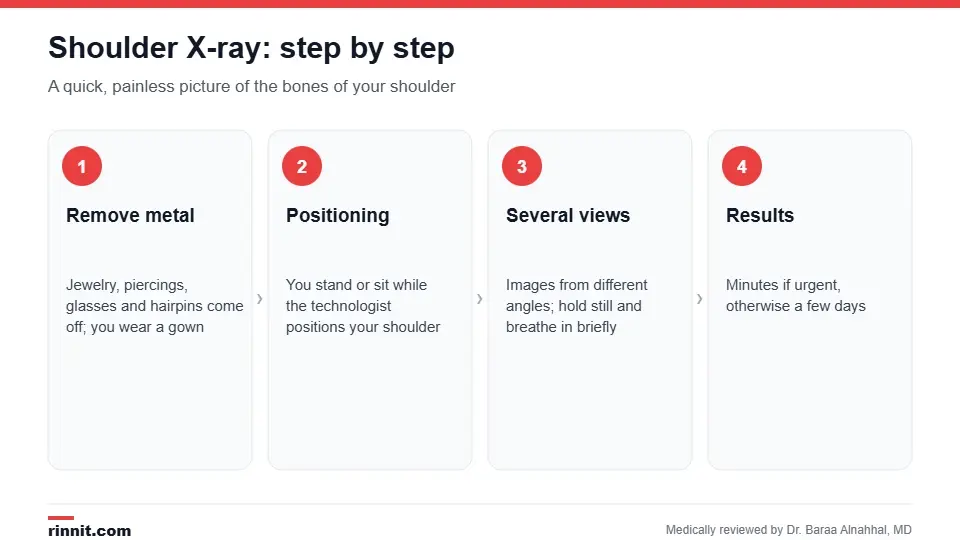
A shoulder X-ray takes only a few minutes.
Why is it done?
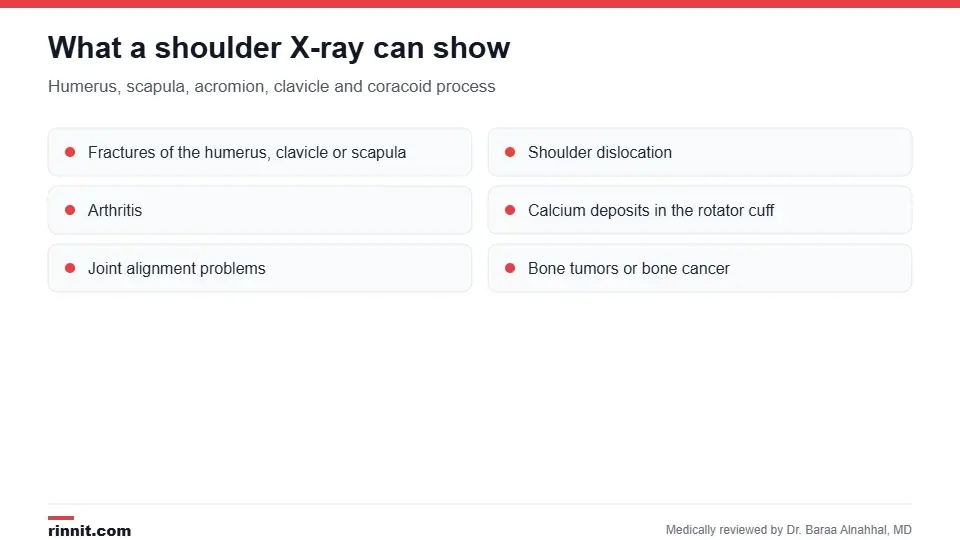
A shoulder X-ray shows the humerus, scapula, acromion, clavicle and coracoid process.
Providers order shoulder X-rays for shoulder pain or difficulty moving the arm. It is the most commonly ordered shoulder imaging test because it is quick, painless and widely available. It can detect: Sources: [1]
Fractures, including a broken collarbone.
Shoulder dislocation and joint alignment problems.
Arthritis.
Bursitis-related changes and calcium deposits in the rotator cuff.
Signs that suggest a rotator cuff tear, such as a high-riding humeral head.
Benign bone tumors or bone cancer.
How do I prepare?
No fasting or food and drink restrictions.
Remove jewelry, body piercings, glasses, hairpins and other metal objects.
Tell your provider if you are or might be pregnant. Sources: [1]
What happens during the X-ray?
You change into a hospital gown from the waist up.
You stand or sit while the technologist positions your shoulder against the imaging plate.
Several images are taken from different angles; you hold still and may briefly hold your breath.
You may be asked to rotate your arm between images.
The images are checked for clarity, and blurry ones are retaken. Sources: [1]
The test takes only a few minutes, and you can usually return to normal activities right away. A radiologic technologist or radiologist assistant takes the images, and a radiologist interprets them. Sources: [1]
X-ray vs other shoulder imaging

X-rays show bone; soft tissue problems need other imaging.
Test | Best for | Limits |
X-ray | Fractures, dislocation, arthritis, calcium deposits | Doesn't show tendons, labrum or cartilage |
Ultrasound | Rotator cuff tears, bursitis, tendon problems | Operator-dependent; limited view of bone and deep joint |
MRI | Rotator cuff, labrum, cartilage, bone bruising | Takes longer; costs more |
CT or CT arthrography | Complex fractures, bone loss after dislocation (Hill-Sachs lesions) | Higher radiation dose |
For detecting a Hill-Sachs lesion (bone dent) after a dislocation, CT arthrography is the most accurate (median accuracy 91%). Research also shows AI tools can flag rotator cuff tears from X-rays with about 84% accuracy, though ultrasound and MRI remain the standard tests for tendon tears. Sources: [2, 3]
Understanding your results
Urgent results may be ready within minutes; non-urgent results usually take a few days. The radiologist's report describes bone alignment, any fracture or dislocation, joint spaces, calcium deposits and bone lesions, and your provider discusses what it means and whether more imaging is needed. Call your provider if you haven't heard after a week, or if pain gets worse. Sources: [1]
Radiation and safety
Exposure is small, and modern doses are very low; benefits usually outweigh the risks.
Children and developing babies are more sensitive, so pregnant people should discuss the test first, and lower-dose options may be used for children. Sources: [1]
Conclusion
A shoulder X-ray is the quick first look at the bones of a painful or injured shoulder. It answers questions about fractures, dislocation and arthritis in minutes; if your symptoms point to a tendon or cartilage problem, expect ultrasound or MRI as the next step.
Keep learning: read about frozen shoulder and Neer's test for shoulder impingement.
Frequently asked questions
How long does a shoulder X-ray take?
Only a few minutes.
Does a shoulder X-ray hurt?
No. Moving an injured shoulder into position may be uncomfortable, but the X-ray itself is painless.
Can a shoulder X-ray show a rotator cuff tear?
Not directly. It can show signs such as a high-riding humeral head or calcium deposits; ultrasound or MRI confirms the tear.
Can it show a dislocation?
Yes. Shoulder dislocations and the bone damage they leave are commonly seen on X-rays.
How many views are taken?
Usually several images from different angles and arm positions.
Is the radiation safe?
Yes. The dose is very low, though pregnant people should discuss the test with their provider first.
Do I need to fast?
No. There are no food or drink restrictions.
When will I get my results?
Within minutes if urgent; otherwise usually in a few days.
What if my X-ray is normal but my shoulder still hurts?
Soft tissue problems such as tendon tears, bursitis or frozen shoulder don't show on X-rays. Ultrasound or MRI may be next.
Who reads the X-ray?
A radiologist, a doctor trained in imaging, interprets it and sends a report to your provider.
Related Reading
Dislocated Shoulder: Symptoms, First Aid, Treatment & Recovery — Complete Guide an injury shoulder X-rays confirm.
Rotator Cuff Tear: Symptoms, Causes, and Recovery Guide why imaging often goes beyond X-ray for shoulder pain.
What Is a Broken Collarbone (Clavicle Fracture)? Symptoms, Causes, Treatment & Recovery a fracture commonly seen on shoulder X-rays.
Frozen Shoulder (Adhesive Capsulitis): Symptoms, Causes & Treatment — Complete Guide a cause of stiffness with a normal X-ray.
Shoulder Joint: Anatomy, Function, and Common Conditions the bones and joints the X-ray shows.
References
Cleveland Clinic. Shoulder X Ray: Anatomy, Procedure & What to Expect. Cleveland Clinic. Last updated March 11, 2022. https://my.clevelandclinic.org/health/diagnostics/22531-shoulder-x-ray
Vopat ML, Peebles LA, McBride T, et al. Accuracy and reliability of imaging modalities for the diagnosis and quantification of Hill-Sachs lesions: a systematic review. Arthroscopy. 2021;37(1):391-401. PMID 32798670. https://doi.org/10.1016/j.arthro.2020.08.005
Zhan H, Liang Q, Zhao Z, et al. Artificial intelligence models based on medical imaging achieve accurate detection of rotator cuff tear and initial predictive capability for postoperative outcomes: a systematic review. Arthroscopy. 2026. PMID 42852970. https://doi.org/10.1002/arj.70584
Medical disclaimer
This article is for general education only and does not replace advice from a qualified healthcare professional. Talk to your doctor about your own diagnosis and treatment, and seek emergency care right away for severe or sudden symptoms.



Comments