Dislocated Shoulder: Symptoms, First Aid, Treatment & Recovery — Complete Guide

Updated: 2 days ago
Medically reviewed by Dr. Baraa Alnahhal, MD · Last reviewed: October 2026
Quick Answer
A dislocated shoulder is an injury in which the upper arm bone pops out of the socket of the shoulder blade; it is the most frequently dislocated joint. Signs include visible deformity, swelling, intense pain and trouble moving the arm. Seek care right away and never pop it back yourself. With treatment, most people regain full use within weeks.
What the research says
Surgery after a first dislocation sharply cuts repeat dislocations in young, active people. A systematic review and meta-analysis of five randomized trials (126 patients treated with surgical stabilization and 133 treated with a sling alone, average age about 23) found that 6.3% of surgically treated patients had recurrent instability at the latest follow-up (average 59.7 months) compared with 46.6% of those treated with a sling only, and 4.0% versus 30.8% needed a later instability surgery. (Belk et al., Am J Sports Med, 2023) [3]
Where the sling holds the arm may matter. A meta-analysis of randomized trials in people with a first shoulder dislocation (13 trials, 1,042 participants reviewed; 11 trials pooled for recurrence) found that immobilizing the arm in external rotation was linked to fewer recurrences than internal rotation (relative risk 0.55, 95% CI 0.36–0.82) and fewer complications (relative risk 0.6, 95% CI 0.39–0.92); the authors rated the evidence for recurrence as moderate and described the review as low-powered. (Zhang et al., Orthop Traumatol Surg Res, 2020) [4]
At a Glance
Topic | Key Facts |
What it is | Upper arm bone pops out of the cup-shaped socket of the shoulder blade |
Most common type | Forward (anterior) dislocation; can also go backward or downward; complete or partial |
Main signs | Shoulder looks out of place, swelling or bruising, intense pain, limited movement, numbness or tingling |
Who is most at risk | People in their teens and 20s, especially contact-sport athletes; anyone with a past dislocation |
Common causes | Contact sports, accidents, awkward falls, a sudden blow, or extreme twisting of the joint |
How it's confirmed | Physical exam and X-ray; CT or MRI for broken bones or other damage |
Main treatments | Closed reduction, immobilization (sling or splint), medication, rehabilitation; surgery for repeat dislocations |
Recovery timeline | Most people regain full use within a few weeks |
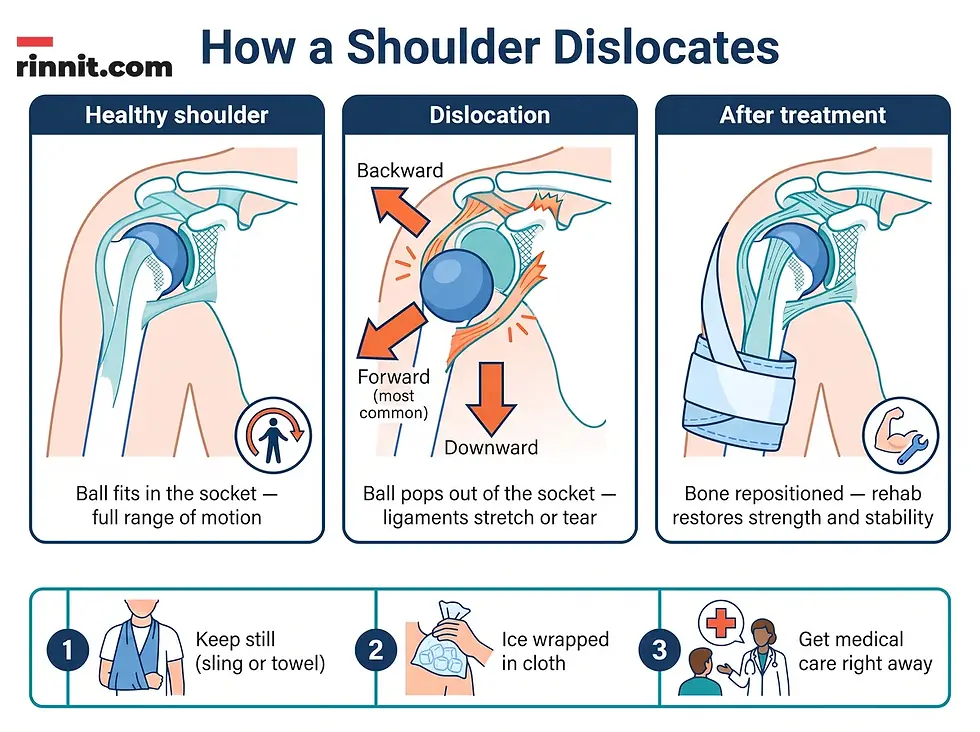
What Is a Dislocated Shoulder?
A dislocated shoulder is an injury in which the upper arm bone pops out of the cup-shaped socket that is part of the shoulder blade.
The shoulder is the most flexible joint in the body, and that flexibility is exactly what makes it the most frequently dislocated joint. Because the joint moves in several directions, the shoulder can dislocate forward, backward, or downward — with a forward dislocation, also called an anterior dislocation, being the most common.
A dislocation can be complete (the bone fully out of the socket) or partial (the bone is partially in and partially out of the socket).
When the joint moves out of place toward the front, the ligaments that connect the bones may stretch or tear — which can make the injury more serious. A dislocation takes a strong force, such as a sudden blow, to pull the bones out of place, and extreme twisting of the joint can pop the ball out of the socket.
The good news: most people regain full use of their shoulder within a few weeks.
Signs and Symptoms
Symptoms of a dislocated shoulder may include:
A shoulder that looks out of place or has a strange shape
Swelling or bruising in the shoulder area
Intense pain
Trouble moving the shoulder
A shoulder dislocation may also cause numbness, weakness, or tingling in the neck, shoulder, or arm. The muscles in the shoulder may spasm, which can make the pain worse.
Symptom | What you may notice |
Deformed shape | Shoulder looks out of place or oddly shaped |
Swelling or bruising | Visible swelling or discoloration around the joint |
Intense pain | Severe, immediate pain at the joint |
Limited movement | Trouble moving the shoulder or arm |
Nerve warning signs | Numbness, weakness, or tingling in the neck, shoulder, or arm |
Muscle spasm | Muscles tighten, worsening the pain |
What to Do Right Away
If you think your shoulder is dislocated, get medical help right away — go to the emergency room or urgent care. While you wait for care, follow three rules:
Don't try to move your shoulder or pop it back in place. Trying to fix it yourself can damage nerves, blood vessels, or soft tissue around the joint.
Keep your shoulder still. Use a sling, towel, or even your other arm to gently support your shoulder in the position it is in, and try not to move it.
Apply ice. If you can, place a cold pack or a bag of ice wrapped in a cloth on your shoulder to help with swelling and pain.
What Causes a Dislocated Shoulder?
A dislocation takes a strong force. The three most common situations are:
Cause | Details |
Sports injuries | Common in contact sports such as football and hockey, and in sports that involve falls, such as downhill skiing, gymnastics, and volleyball |
Trauma not related to sports | A hard blow to the shoulder, such as during a motor vehicle accident |
Falls | Landing awkwardly after a fall, such as from a ladder or after tripping on a loose rug |
Risk Factors
Anyone can dislocate a shoulder. However, dislocated shoulders occur most often in people in their teens and 20s, particularly athletes involved in contact sports.
The single most important risk factor for the future: dislocating your shoulder makes it more likely to dislocate again.
Complications
A dislocated shoulder can involve more than the joint itself. Possible complications include:
Tearing of the muscles, ligaments, and tendons that support the shoulder joint
Damage to nearby nerves or blood vessels
A higher risk of the shoulder dislocating again, especially if the injury was severe
Stretched or torn ligaments may require surgery to repair them. Damaged tendons in the shoulder, or damaged nerves or blood vessels around the shoulder, may also require surgery.
Prevention
To help prevent a dislocated shoulder:
Take care to avoid falls and shoulder injuries
Wear protective gear when playing contact sports
Exercise regularly to maintain strength and flexibility in joints and muscles
If you have already dislocated your shoulder, keep doing the strength and stability exercises prescribed for the injury to help avoid a recurrence.
How a Dislocated Shoulder Is Diagnosed
Diagnosis starts with a physical exam. A healthcare professional examines the injured area for tenderness, swelling, and changes in shape, and also checks for signs of nerve or blood vessel injury.
Test | Purpose |
Physical exam | Checks tenderness, swelling, shape changes, and nerve or blood vessel injury |
X-ray | The best way to confirm the shoulder is dislocated |
CT scan or MRI | Identifies broken bones or other damage to the joint |
Depending on the severity of the injury, the first healthcare professional you see may recommend that an orthopedic surgeon (a joint and bone surgery specialist) examine the injury.
Treatment Options
Treatment for a dislocated shoulder typically moves through several steps:
Closed reduction. Gentle movements help move the upper arm bones back into position. Depending on the amount of pain and swelling, a muscle relaxant or sedative is given before moving the bones; rarely, general anesthesia is used so you are asleep during the procedure. When the bones are back in place, severe pain typically improves almost immediately.
Immobilization. After closed reduction, a special splint or sling worn for a few weeks keeps the shoulder from moving while it heals.
Medication. A pain reliever or muscle relaxant provides comfort while the shoulder heals.
Rehabilitation. Once the splint or sling is no longer needed, a rehabilitation program restores range of motion, strength, and stability to the shoulder joint.
Treatment | What it is | When it is used |
Closed reduction | Gentle movements reposition the bones, with sedation or anesthesia | First step for most dislocations |
Immobilization | Splint or sling worn for a few weeks | Immediately after reduction, while the joint heals |
Medication | Pain relievers or muscle relaxants | During healing for comfort |
Rehabilitation | Program restoring motion, strength, and stability | After the splint or sling is removed |
Surgery | Repairs weak joints, ligaments, tendons, nerves, or blood vessels | Repeated dislocations after rehab; rare nerve or vessel damage; to reduce reinjury risk in young athletes |
Surgery may help those with weak shoulder joints or ligaments who have repeated dislocations even after strengthening and rehabilitation. In rare cases, damaged nerves or blood vessels require surgery. Surgical treatment may reduce the risk of reinjury in young athletes.
Recovery and Self-Care
A simple shoulder dislocation that doesn't involve major nerve or tissue damage typically gets better in a few weeks. Before returning to regular activities, make sure you have full movement in your shoulder with no pain and your strength back — going back to activity too soon can lead to another shoulder injury.
Once treated, these self-care steps help ease discomfort and encourage healing:
Self-care step | How to do it |
Rest the shoulder | Avoid the action that caused the dislocation and painful movements; limit heavy lifting and overhead reaching until the shoulder feels better |
Ice, then heat | Ice for 15 to 20 minutes at a time, every couple of hours for the first day or two, always with a thin cloth between skin and ice |
Pain relievers | Aspirin, ibuprofen (Advil, Motrin IB), naproxen sodium (Aleve), or acetaminophen (Tylenol) — follow label directions and stop when pain improves |
Maintain motion | After one or two days, do gentle exercises to maintain range of motion; inactivity can cause joints to stiffen |
Once the injury heals and the shoulder has good range of motion, keep exercising. Daily shoulder stretches and a shoulder-strengthening and stability program may help prevent another dislocation — ask your healthcare professional to help you plan an appropriate routine.

Preparing for Your Appointment
Depending on the severity of the injury, the healthcare professional you see first may recommend that an orthopedic surgeon examine the injury.
What You Can Do
Write detailed descriptions of the symptoms and the cause of the injury
Note information about past medical issues
List the names and doses of all medicines and dietary supplements you take
Prepare your questions — some basic ones to consider: Is my shoulder dislocated? What tests do I need? What treatment approach do you recommend, and are there alternatives? How long will healing take? Will I have to stop playing sports, and for how long? How can I protect my shoulder from injury again?
What Your Doctor May Ask
How severe is your pain?
What other symptoms do you have?
Can you move your arm?
Is your arm numb or tingling?
Have you dislocated your shoulder before?
What improves or worsens your symptoms?
Frequently Asked Questions
What does a dislocated shoulder look like?
A dislocated shoulder often looks out of place or has a strange shape, and it is usually accompanied by swelling or bruising around the joint. The arm may be hard or painful to move.
How do I know if my shoulder is dislocated?
The main signs are intense pain, a shoulder that looks out of place, swelling or bruising, and trouble moving the shoulder. Numbness, weakness, or tingling in the neck, shoulder, or arm can also occur. If you suspect a dislocation, seek emergency or urgent care right away.
Can you pop a dislocated shoulder back yourself?
No — never try to move the shoulder or pop it back in yourself. Doing so can damage the nerves, blood vessels, or soft tissue around the joint. Keep the shoulder still, apply ice, and get professional care immediately.
How long does it take to recover from a dislocated shoulder?
Most people regain full use of their shoulder within a few weeks. A simple dislocation without major nerve or tissue damage typically gets better in a few weeks with closed reduction, immobilization, and rehabilitation.
How is a dislocated shoulder treated?
Treatment usually starts with closed reduction — gentle movements that reposition the bones back into the socket, often with a sedative or muscle relaxant. It is followed by wearing a splint or sling for a few weeks, pain medication, and rehabilitation to restore motion, strength, and stability.
Can a shoulder dislocate more than once?
Yes. Once a shoulder dislocates, it becomes more likely to dislocate again — especially after a severe injury that stretched or tore the ligaments. People with repeated dislocations may need surgery, and daily strengthening and stability exercises help prevent recurrence.
Can a shoulder partially dislocate?
Yes. A partial dislocation happens when the upper arm bone is partially in and partially out of the shoulder socket. An X-ray is the best way to confirm whether a shoulder is dislocated and how far out of place it is.
Conclusion
The shoulder is the body's most flexible — and most dislocated — joint, and a dislocation happens when the upper arm bone pops out of its cup-shaped socket, usually forward.
Act fast and never self-treat — seek emergency care right away, keep the shoulder still, and ice it, but never try to pop it back in yourself.
Most people make a full recovery in a few weeks through closed reduction, a sling or splint, and rehabilitation — but a past dislocation raises the risk of another one, so keep up the strengthening exercises.
This guide covered what a dislocated shoulder is, the warning signs, what to do first, how it is diagnosed, and every step of treatment and recovery. For more joint and injury guides, explore our frozen shoulder complete guide and other resources at rinnit.com.
Your Next Steps
Share your thoughts — comment below with your questions or experience.
Stay updated — sign up on rinnit.com for new complete guides and health updates.
This content is provided for general educational purposes only and is not a substitute for professional medical advice. Always consult a qualified healthcare professional for diagnosis and treatment.
Related Reading
Shoulder X-Ray: Why It's Done, What It Shows and What to Expect explains the X-ray used first for shoulder pain and injuries.
References
Mayo Clinic Staff. Dislocated shoulder - Symptoms and causes. Mayo Clinic. May 7, 2026. https://www.mayoclinic.org/diseases-conditions/dislocated-shoulder/symptoms-causes/syc-20371715
Mayo Clinic Staff. Dislocated shoulder - Diagnosis and treatment. Mayo Clinic. May 7, 2026. https://www.mayoclinic.org/diseases-conditions/dislocated-shoulder/diagnosis-treatment/drc-20371720
Belk JW, et al. Shoulder Stabilization Versus Immobilization for First-Time Anterior Shoulder Dislocation: A Systematic Review and Meta-analysis of Level 1 Randomized Controlled Trials. Am J Sports Med. 2023;51(6):1634-1643. PMID 35148222. https://doi.org/10.1177/03635465211065403
Zhang B, et al. Immobilization in external rotation versus internal rotation after shoulder dislocation: A meta-analysis of randomized controlled trials. Orthop Traumatol Surg Res. 2020;106(4):671-680. PMID 32446811. https://doi.org/10.1016/j.otsr.2020.03.011



Comments