De Quervain Tenosynovitis: Thumb Pain, Causes & Treatment — Complete Guide

Updated: 3 days ago
Medically reviewed by Dr. Baraa Alnahhal, MD · Last reviewed: October 2026
Quick Answer: What Is De Quervain Tenosynovitis?
De Quervain tenosynovitis is a painful condition of the two tendons on the thumb side of the wrist, where repetitive gripping or thumb motions irritate and swell the tendon sheath. Classic signs are pain and swelling near the base of the thumb with a catching feeling. Rest, splinting and often an injection typically resolve symptoms within four to six weeks.
What the research says
Corticosteroid injection with brief immobilization remains the main effective treatment. In a network meta-analysis of 14 randomized controlled trials, corticosteroid injection combined with casting, and laser therapy with an orthosis, showed favorable short-term outcomes; at one year, corticosteroid injection alone and platelet-rich plasma injections showed sustained pain relief, and extracorporeal shockwave therapy ranked as a secondary option. (Chong et al., J Hand Surg Am, 2024) [3]
Pregnancy-related de Quervain affects about 2 in 100 pregnant women. In a South Korean national database study, 34,342 women among 1,601,501 pregnant women (a cumulative incidence of about 2.1%) were diagnosed during pregnancy or the postpartum period; age ≥ 30 years, multiple gestation, cesarean delivery, hypertensive disorders in pregnancy and underlying rheumatoid arthritis were significant risk factors. (Bae et al., Clin Orthop Surg, 2023) [4]
First pregnancies and long pregnancies carry more risk. The condition affects women about 6 times more than men; among 63 postpartum women with de Quervain compared with 630 controls, pregnancy longer than 40 weeks (OR 5.81, 95% CI 3.29–10.28), first childbirth (OR 2.23, 95% CI 1.32–3.77) and BMI above 25 (OR 2.08, 95% CI 1.14–3.81) were significant risk factors. (Daglan et al., Hand (N Y), 2024) [5]
At a Glance
Question | Answer |
What is de Quervain tenosynovitis? | A painful swelling of the tendon sheath on the thumb side of the wrist |
Where does it hurt? | Near the base of the thumb; may spread to the thumb and forearm |
Who is most at risk? | Women, ages 30 to 50, especially during pregnancy or while caring for a baby |
What triggers it? | Repetitive gripping, lifting, twisting, and thumb motions |
How is it diagnosed? | Physical exam and the Finkelstein test; X-rays usually not needed |
First-line treatment | Rest, ice, splint, and OTC NSAIDs such as ibuprofen or naproxen |
Recovery time | Symptoms typically improve within 4 to 6 weeks with early treatment |
What Is De Quervain Tenosynovitis?
De Quervain tenosynovitis (dih-kwer-VAIN ten-oh-sine-oh-VIE-tis) is a painful condition that affects the tendons on the thumb side of the wrist. Tendons are rope-like tissues that connect muscles to bones, and the tendons on the thumb side help your thumb and wrist work together when you move.
If you have this condition, you typically feel pain when you turn your wrist, grip something, or make a fist. Everyday actions that once felt effortless — turning a doorknob, wringing out a cloth, picking up a child — can suddenly become the most painful moments of your day.
The exact cause isn't known. But activities that involve repeating the same hand or wrist movements can make the condition worse. Gardening, playing golf or racket sports, and lifting a baby are classic aggravators.

What are the four warning signs of de Quervain tenosynovitis at the thumb base?
The symptoms of de Quervain tenosynovitis cluster in one unmistakable spot. If several of these apply to you, the condition deserves a proper look.
Sign | What you experience |
Pain near the base of the thumb | Aching or sharp pain on the thumb side of the wrist |
Swelling near the base of the thumb | Visible or palpable puffiness over the tendon tunnel |
Trouble moving the thumb and wrist | Difficulty gripping or pinching objects |
Sticking or catching | A snagging feeling when you move your thumb |
When symptoms spread
If the condition is not treated, the pain may spread into the thumb, forearm, or both. Moving the thumb or wrist makes the pain worse, which is how the problem tends to announce itself: the harder you work your thumb, the more it protests.
When to see a doctor
Try self-care first, then get checked. Talk to a healthcare professional if you still have pain or trouble using your thumb after trying the following:
Resting your thumb and avoiding activities that cause pain.
Applying ice or a cold pack to the area — always put a thin cloth between your skin and the ice.
Taking over-the-counter pain medicine such as ibuprofen (Advil, Motrin IB) or naproxen sodium (Aleve). These are nonsteroidal anti-inflammatory medicines, called NSAIDs.
If rest, ice, and NSAIDs don't quiet the thumb within a few weeks, it is time for a professional evaluation.
What Causes De Quervain Tenosynovitis?
The mechanics behind this condition are surprisingly simple — which is exactly why repetitive motion causes it.
When you grip, grasp, clench, pinch, or wring anything, two tendons in your wrist and lower thumb glide smoothly through the small tunnel that connects them to the base of the thumb. Doing the same hand movements over and over — lifting, gripping, twisting — can irritate the protective covering (sheath) around these tendons. When that covering is irritated, the tendons swell and thicken, making it harder for them to slide smoothly through the narrow tunnel.
Think of it as a rope being pulled through a pipe that has started to narrow. Every tug scrapes a little more, and the rope moves less freely each time.
Other contributing causes
Cause | How it contributes |
Inflammatory arthritis | Conditions such as rheumatoid arthritis can inflame the tendon sheath |
Wrist or tendon injury | Injury may lead to scar tissue that limits tendon movement |
Fluid buildup | Often caused by hormone changes during pregnancy |
Who is most at risk of de Quervain tenosynovitis?
De Quervain tenosynovitis has a clear demographic fingerprint. It strikes women far more often than men, and it concentrates in the 30-to-50 age range.
Risk factor | Why it matters |
Age 30 to 50 | People in this range are at higher risk |
Female sex | Women are more likely to develop the condition than men |
Pregnancy and breastfeeding | Hormonal fluid buildup and repeated baby care strain the tendons |
Caring for a baby | Repeatedly lifting a child, especially using your thumbs for support |
Repetitive hand or wrist movements | Jobs or hobbies like typing, gardening, or playing certain sports |
The pattern explains the condition's nickname in new-parent circles — "new mom's thumb." Months of lifting, feeding, and rocking a baby with strained thumbs makes this one of the most common postpartum hand problems.
What complications can untreated de Quervain tenosynovitis cause?
Untreated de Quervain tenosynovitis can make it hard to use your hand and wrist the way you want. You may lose some range of motion in your wrist over time. The good news: this complication is entirely preventable, because the condition responds so well to early, simple treatment.
How does the Finkelstein test diagnose de Quervain tenosynovitis?
Diagnosing de Quervain tenosynovitis is refreshingly low-tech. Your healthcare professional checks your hand and presses on the thumb side of your wrist to see whether it causes pain.
The signature diagnostic move is the Finkelstein test:
Bend your thumb across your palm.
Fold your fingers over your thumb, closing your fist around it.
Bend your wrist toward your little finger.
If this movement causes pain on the thumb side of your wrist, you likely have de Quervain tenosynovitis. That's the whole test — and it works. Imaging tests, such as X-rays, generally aren't needed to diagnose this condition.
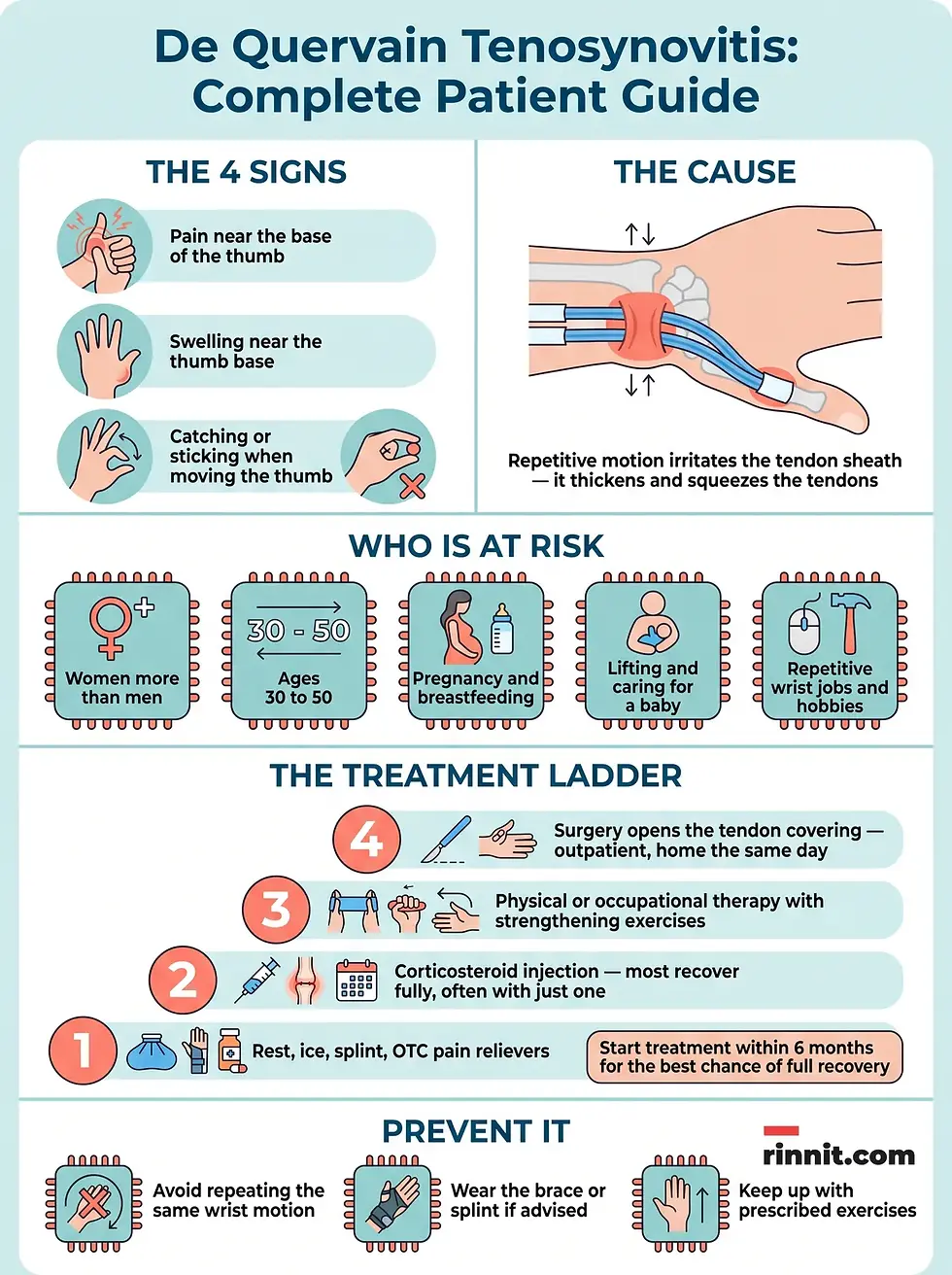
What are the four steps of de Quervain tenosynovitis treatment?
Treatment focuses on three goals: reducing inflammation, keeping the thumb still in a comfortable position, and preventing the condition from coming back. The prognosis is genuinely encouraging — if treatment begins early, symptoms typically improve within 4 to 6 weeks. And if the condition starts during pregnancy, symptoms typically go away by the end of pregnancy or after breastfeeding ends.
Step | Treatment | What it does |
1 | Rest, ice, splint, OTC NSAIDs | Reduces inflammation while the tendon sheath calms down |
2 | Corticosteroid injection | Lessens inflammation directly at the tendon covering; most people recover fully, often after just one injection |
3 | Physical or occupational therapy | Teaches strain-reduction techniques and strengthening exercises |
4 | Surgery (outpatient) | Opens the tendon covering to relieve pressure and restore free movement |
Step 1: Medications
To reduce pain and swelling, your healthcare professional may recommend pain relievers you can buy without a prescription, including ibuprofen (Advil, Motrin IB) and naproxen sodium (Aleve).
A corticosteroid injection into the tissue covering the tendon can lessen inflammation directly. Here is the most encouraging stat in this whole guide: if treatment starts within the first six months of symptoms, most people recover fully — often after just one injection.
Step 2: Therapies
Therapy for de Quervain tenosynovitis typically includes a combination of protective habits:
Wearing a splint or brace to keep your thumb and wrist straight, allowing the tendons to rest.
Avoiding repetitive thumb movements as much as possible.
Not pinching or gripping with your thumb while moving your wrist side to side.
Applying ice to the painful area to lessen swelling and pain.
You may also work with a physical therapist or occupational therapist. The therapist examines how you use your wrist, suggests ways to reduce strain, and teaches exercises to strengthen your wrist, hand, and arm muscles. This combination may relieve pain and prevent further irritation of the tendons.
Step 3: Surgery, if needed
Surgery may be recommended if the condition is more serious or doesn't improve with other treatments. It is typically done as an outpatient procedure — you go home the same day.
During surgery, the doctor looks at the protective covering around the affected tendon or tendons and carefully opens the covering. This relieves pressure and allows the tendons to move more freely.
After surgery, ask your healthcare team how long you need to rest and how you can strengthen and care for your wrist. A physical or occupational therapist may meet with you afterward, teaching exercises and showing you how to adjust back to daily activities so the condition does not return.
What lifestyle changes and home remedies help de Quervain tenosynovitis?
Managing de Quervain tenosynovitis without surgery is much the same as preventing it, relying on simple daily habits that protect the thumb side of the wrist. The daily habits that protect your thumb side of the wrist are simple to remember:
Avoid repeating the same wrist movements over and over.
Wear a brace or splint if your healthcare professional tells you to.
Keep up with any exercises you are told to do.
Pay attention to activities that cause pain, swelling, or numbness in your thumb or wrist. Avoid these activities, and tell your healthcare professional what triggers your symptoms.
How should you prepare for a de Quervain tenosynovitis appointment?
Make an appointment with your healthcare professional if you have hand or wrist pain that doesn't improve after avoiding activities that make it worse. After the first exam, you may be referred to a specialist such as an orthopedist, rheumatologist, hand therapist, or occupational therapist.
What you can do
Write down important medical information, including other health conditions and all medicines and supplements you take.
List hobbies or activities that stress your hand or wrist — knitting, gardening, playing an instrument, racket sports, repetitive work tasks.
Note any recent injuries to your hand or wrist.
Write down a list of questions to ask.
Helpful questions to ask your healthcare professional
What is the most likely cause of my symptoms?
Are there any other possible causes?
Do I need tests to confirm the diagnosis?
What treatment do you recommend?
I have other health conditions — how can I best manage them together?
Will I need surgery?
How long will I need to avoid the activities that may have caused this?
What can I do on my own to improve my condition?
What to expect from your doctor
Your healthcare professional may ask questions such as:
What are your symptoms and when did they start?
Are your symptoms getting worse or staying the same?
Are there specific activities that seem to trigger your symptoms?
Do you take part in hobbies or sports involving repeated hand or wrist movements?
What tasks do you do at work?
Have you had any recent injuries to your hand or wrist?
Does avoiding certain activities relieve your symptoms?
Have you tried home treatments, such as over-the-counter pain relievers? What has and hasn't worked?
Frequently Asked Questions
What is de Quervain tenosynovitis?
De Quervain tenosynovitis is a painful condition affecting the two tendons on the thumb side of the wrist. The protective sheath around these tendons becomes irritated, thickened, and swollen, making it harder for the tendons to glide through their tunnel. It causes pain when you turn your wrist, grip something, or make a fist.
What does de Quervain tenosynovitis feel like?
The hallmark feeling is pain and swelling near the base of the thumb, along with trouble moving the thumb and wrist when gripping or pinching. Many people also notice a sticking or catching sensation when they move the thumb. Untreated, the pain can spread into the thumb and forearm.
What causes de Quervain tenosynovitis?
The exact cause is unknown, but repeating the same hand or wrist motions day after day irritates the tendon sheath, causing thickening and swelling that restricts tendon movement. Lifting a baby, gardening, typing, and racket sports are classic triggers, and pregnancy hormone changes or a prior wrist injury can also contribute.
Who is most at risk of getting de Quervain tenosynovitis?
Women are more likely to develop it than men, with the highest risk between ages 30 and 50. Pregnancy, breastfeeding, and caring for a baby — especially repeatedly lifting a child using your thumbs for support — all raise the risk, as do jobs and hobbies involving repetitive hand and wrist movements.
How is de Quervain tenosynovitis diagnosed?
A healthcare professional presses on the thumb side of the wrist to check for pain and may perform the Finkelstein test: you bend your thumb across your palm, wrap your fingers over it, and bend your wrist toward your little finger. Pain with that movement points strongly to de Quervain tenosynovitis, and imaging such as X-rays generally isn't needed.
Will de Quervain tenosynovitis go away on its own?
Often, yes — especially if it starts during pregnancy, since symptoms typically resolve by the end of pregnancy or after breastfeeding ends. With early treatment, symptoms usually improve within four to six weeks, and most people recover fully with conservative care such as a splint and, when needed, a corticosteroid injection.
Does de Quervain tenosynovitis require surgery?
Most cases do not. Surgery is reserved for cases that are more serious or fail to improve with other treatments, and even then it is an outpatient procedure you go home from the same day. The operation opens the tight tendon covering to relieve pressure and restore smooth tendon movement.
What home remedies help de Quervain tenosynovitis?
Rest the thumb, avoid motions that cause pain, and apply ice wrapped in a thin cloth. Over-the-counter pain relievers such as ibuprofen or naproxen and a thumb splint can also help.
Do steroid injections help de Quervain tenosynovitis?
Yes. A corticosteroid injection into the tendon covering can reduce inflammation directly. When treatment starts within the first six months, most people recover fully, often after one injection.
When should you see a doctor for thumb and wrist pain?
See a healthcare professional if pain or trouble using your thumb continues after a few weeks of rest, ice, and over-the-counter pain medicine. Get prompt care for numbness, a hand that looks deformed after an injury, or signs of infection such as fever or spreading redness.
Conclusion
If you take away only three lessons from this guide, make them these:
The thumb-side pain pattern is the clue. Pain and swelling at the base of the thumb that worsens with gripping, lifting, and twisting — plus that catching sensation — is the classic signature of de Quervain tenosynovitis.
Timing matters more than drama. Start treatment within the first six months and most people recover fully, often after a single corticosteroid injection. Symptoms typically improve within four to six weeks of early, consistent care.
Repetition is both the cause and the cure. The same wrist habits that inflamed the tendon sheath must be retrained — with splinting, rest, and guided exercises — to keep the tendons gliding freely for good.
This guide has walked you through every stage of the condition, from the swollen wrist tunnel to the four-step treatment ladder. If your thumb pain is already part of your story, don't wait months to act — the earlier you treat it, the easier the recovery.
For more complete health guides on tendon, joint, and pain conditions, browse the full rinnit.com library. Share your thoughts: leave a comment below — your experience can help another parent or desk worker figure out their thumb pain.
This article is for general information only and is not a substitute for professional medical advice, diagnosis, or treatment. Always consult a qualified healthcare professional about your specific medical condition.
Related Reading
Thumb Arthritis: Symptoms, Causes, Tests and Treatment compares another common cause of pain at the base of the thumb.
Carpal Tunnel Syndrome: Symptoms, Causes, Diagnosis and Treatment explains a wrist nerve condition that causes numbness and tingling.
Wrist Pain: Symptoms, Causes, and Proven Relief Strategies covers common wrist pain causes and ways to find relief.
Cortisone Shots (Steroid Injections): How They Work, Side Effects, and What to Expect explains steroid injections, their uses, and possible side effects.
References
Mayo Clinic Staff. De Quervain tenosynovitis — Symptoms and causes. Mayo Clinic. April 15, 2026. https://www.mayoclinic.org/diseases-conditions/de-quervain-tenosynovitis/symptoms-causes/syc-20371332
Mayo Clinic Staff. De Quervain tenosynovitis — Diagnosis and treatment. Mayo Clinic. April 15, 2026. https://www.mayoclinic.org/diseases-conditions/de-quervain-tenosynovitis/diagnosis-treatment/drc-20371337
Chong HH, Pradhan A, Dhingra M, et al. Advancements in de Quervain tenosynovitis management: a comprehensive network meta-analysis. J Hand Surg Am. 2024;49(6):557-569. PMID 38613563. https://doi.org/10.1016/j.jhsa.2024.03.003
Bae KJ, Baek GH, Lee Y, et al. Incidence and risk factors for pregnancy-related de Quervain's tenosynovitis in South Korea: a population-based epidemiologic study. Clin Orthop Surg. 2023;15(1):145-152. PMID 36778998. https://doi.org/10.4055/cios22099
Daglan E, Morgan S, Yechezkel M, et al. Risk factors associated with de Quervain tenosynovitis in postpartum women. Hand (N Y). 2024;19(4):643-647. PMID 36692105. https://doi.org/10.1177/15589447221150524
Medical disclaimer
The information provided in this article is for educational purposes only and should not be used as a substitute for professional medical advice, diagnosis, or treatment. Always seek the advice of your physician or other qualified health provider with any questions you may have regarding a medical condition.



Comments