Thumb Arthritis: Symptoms, Causes, Tests and Treatment

Updated: 2 days ago
Medically reviewed by Dr. Baraa Alnahhal, MD · Last reviewed: October 2026
Quick Answer: What is thumb arthritis?
Thumb arthritis is arthritis affecting the basal joint at the base of the thumb. This joint helps the thumb move in different directions so you can grip objects. When its protective cartilage breaks down, the joint can become painful, stiff, swollen or weak.
Question | Short answer |
Which joint is affected? | The basal, or carpometacarpal (CMC), joint where the thumb meets the wrist. |
What is the usual type? | Osteoarthritis, caused by cartilage breakdown over time. |
What does it feel like? | Pain, swelling, stiffness, less strength and less motion, especially when gripping or pinching. |
How is it diagnosed? | Symptom history and hand examination; X-rays may confirm it. |
How is it treated? | Ice or heat, pain medicine, a splint, occupational therapy, steroid injections or surgery depending on severity. |

What the research says
Surgical options for thumb arthritis show similar results on average. A systematic review of 177 articles covering 13,332 thumbs (average age 61, 81% female) found that grip strength, DASH and pain scores were similar across the main techniques. Revision rates were about 6% after CMC arthroplasty, 4% after arthrodesis and 1% for trapeziectomy, suspensionplasty and ligament reconstruction with tendon interposition. The evidence was mostly observational (Hones et al., J Hand Microsurg, 2026). [2]
High-quality trials comparing surgery with non-surgical care are lacking. The Cochrane review of 25 trials (1,591 participants) found no placebo-controlled trials and no trials comparing surgery with non-operative treatment. Trapeziectomy with ligament reconstruction and tendon interposition made little to no difference to pain or function compared with trapeziectomy alone (low-certainty evidence) (Baljer et al., Cochrane Database Syst Rev, 2026). [3]
Hyaluronic acid injections are another non-surgical option under study. A meta-analysis of 14 studies found pain scores fell by about 2.3 points at 3 months (95% CI −2.65 to −1.90) and about 2.4 points at 6 months (95% CI −2.84 to −1.93) after injection, although results varied widely between studies (Ong et al., Hand Surg Rehabil, 2026). [4]
Where is the basal or CMC joint?
The basal joint is near the wrist, at the fleshy part of the thumb. Its formal name is the carpometacarpal joint, often shortened to CMC. The joint allows the thumb to move around in different directions, which supports gripping, pinching and other hand movements.

What causes thumb arthritis?
The most common type is osteoarthritis. It happens when the protective cartilage that cushions the joint wears out and deteriorates. Cartilage helps the bones glide smoothly. As cartilage breaks down, the bones can rub against each other, causing friction and damage. Age and use can contribute. Read more about arthroplasty and joint fusion later in this guide. [1]
Arthritis in the hands is extremely common, and it often develops in the thumbs because they are used for so many movements. Some health conditions cause other types of arthritis; for example, rheumatoid arthritis happens when the immune system damages cartilage by mistake. [1]
What are the symptoms of thumb arthritis?
Symptoms can affect how the thumb feels and how well the hand works.
Symptom | How it may appear |
Pain with gripping | Pain when grasping, gripping or pinching objects, such as opening a jar or turning a key |
Aching after use | Discomfort after using the hand for a long time; it can feel like a constant dull ache or be sharp, pinching or stabbing |
Swelling or tenderness | Swelling, stiffness or tenderness at the thumb base |
Reduced strength | Less force when gripping or pinching |
Reduced motion | Difficulty moving the thumb normally |
Grinding | A feeling or sound of grinding in the CMC joint |
Enlarged joint or bone spur | The joint may look larger than usual, and a bony growth may appear at the base of the thumb |
Persistent symptoms deserve a clinical assessment because several conditions can cause thumb or hand pain, including De Quervain tenosynovitis.
Who is more likely to develop thumb arthritis?
Risk factor | What it means |
Age over 40 | Risk increases with age |
Female sex | Being female is a listed risk factor |
Previous thumb injury | A prior injury or fracture may increase risk |
Inflammatory health conditions | Conditions that cause inflammation in the body, such as lupus or psoriasis |
Having a risk factor does not establish a diagnosis. A healthcare provider considers symptoms, examination findings and any relevant history. See our guide to lupus for one associated condition.
How is thumb arthritis diagnosed?
A healthcare provider can usually diagnose thumb arthritis with a physical exam. They may ask whether the thumb hurts all the time, which activities cause pain, when symptoms started and whether the thumb has been injured before. [1]
During the examination, the provider may feel the CMC joint and have you move it. Findings that may suggest thumb arthritis include pain with movement, a gritty feeling or a grinding sound called crepitus. You may not need any tests, but an X-ray may be requested to show arthritis and joint damage.
Evaluation step | What it may assess |
Symptom history | Pain pattern, triggering activities and prior injury |
Hand and thumb examination | Pain, movement, strength and joint response |
Movement while the joint is held | Pain or a gritty sensation during motion |
Listening for crepitus | Grinding or crackling noise during movement |
X-ray | Imaging that shows arthritis and joint damage |
How is thumb arthritis treated?
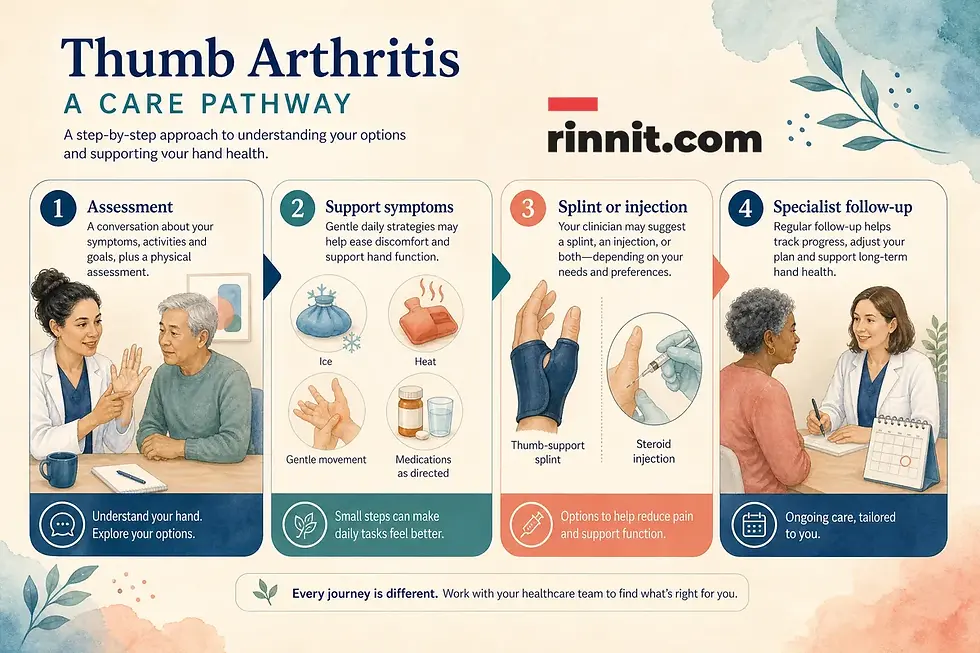
Thumb arthritis has no cure, but treatments such as ice or heat, pain medicine and a splint or brace can help, depending on symptom severity. Treatment varies with the severity of symptoms, and a healthcare provider can help match it to pain, function and examination findings. [1]
At-home measures for mild symptoms
Icing can relieve pain and swelling, and heat can help reduce stiffness. A provider may suggest an ice pack, cold compress or heating pad on the thumb for up to 15 minutes at a time, a few times a day, and trying both to see which works best. [1]
A provider may also recommend pain medicine, such as NSAIDs like ibuprofen or aspirin, or acetaminophen. Medication choices and safe use depend on your health history and other medicines, so follow a healthcare provider’s guidance. [1]
A splint or brace may protect the thumb joint, take pressure off it and allow it to rest. It may be worn during certain activities, from time to time during the day or overnight, depending on the provider’s recommendation. Occupational therapy can help strengthen the muscles in and around the hand, manage pain and stiffness and find safe ways to do daily tasks. [1]
Steroid injections
If symptoms are severe or worsen, a provider may recommend injecting a corticosteroid into the thumb joint. This typically provides pain relief for several months, but injections may become less effective over time.
Surgery
Surgery is usually suggested only when symptoms are severe and other treatments have not helped. Options include:
Procedure | Description |
Arthroplasty | Removes all or part of the joint and replaces it with an artificial implant |
Denervation | Removes pain signals coming from nerve endings that relay signals to the brain |
Fusion (arthrodesis) | Fuses the bones of the joint; may reduce pain and increase strength but can limit movement |
Ligament reconstruction and tendon interposition (LRTI) | Removes all or part of the joint and suspends the remaining thumb using a wrist tendon; may reduce pain while allowing movement |
Trapeziectomy with suspensionplasty | Removes part of the joint and suspends the thumb using nearby tendons or sutures; may reduce pain while allowing motion |
The appropriate procedure depends on the joint, symptoms, examination and treatment goals. A hand specialist can explain likely benefits, limitations and alternatives.
What can help protect daily hand function?
Thumb arthritis can make gripping, pinching and prolonged hand use uncomfortable. If symptoms interfere with daily activities, discuss options with a healthcare provider. A splint may protect the joint and provide rest, while a clinician can help determine whether medication, injection or surgery is appropriate.
Do not use an article to choose a medicine, injection or procedure for yourself. Treatment should reflect the severity of symptoms, examination findings, health history and personal goals.
When should you see a healthcare provider?
Arrange an assessment for persistent or worsening thumb pain, swelling, stiffness, tenderness, weakness or reduced motion. Also seek care if symptoms make it difficult to grip, pinch or complete routine hand activities.
A previous thumb injury or fracture, lupus, psoriasis or rheumatoid arthritis may be relevant to the evaluation. Bring a list of symptoms, activities that trigger pain and any medicines you take.
What is the outlook for thumb arthritis?
Thumb arthritis is very treatable. It may take some time to find the right combination of treatments, and a healthcare provider can discuss what to expect after conservative care, injection or surgery. There is no universal timeline or outcome that applies to every person. [1]
Conclusion: thumb arthritis can affect everyday movement
Thumb arthritis is most often osteoarthritis in the basal, or CMC, joint at the base of the thumb. Cartilage breakdown can lead to pain, swelling, stiffness, reduced strength and less motion, especially during gripping or pinching. [1]
Diagnosis usually involves a symptom history and hand examination, sometimes with an X-ray. Treatment may include ice or heat, pain medicine, splinting, occupational therapy, steroid injection or surgery, depending on symptom severity. [1]
If thumb pain or weakness is affecting daily activities, schedule an evaluation with a qualified healthcare provider. [1]
Frequently Asked Questions
Is thumb arthritis the same as basal joint arthritis?
Yes. Thumb arthritis usually affects the basal joint at the base of the thumb, also called the carpometacarpal or CMC joint. Healthcare providers may use “CMC arthritis” or “basal joint arthritis” to describe it.
What does thumb arthritis feel like?
Thumb arthritis may cause pain when grasping, gripping or pinching, aching after prolonged hand use, swelling, stiffness or tenderness at the base of the thumb. It may also reduce thumb strength and motion.
Why does my thumb hurt when I grip or pinch?
Pain with gripping or pinching can occur when osteoarthritis affects the thumb’s CMC joint. Other conditions can also cause thumb pain, so persistent symptoms should be assessed by a healthcare provider.
Can thumb arthritis cause swelling?
Yes. Swelling, stiffness and tenderness at the base of the thumb are common symptoms. The joint may also look enlarged.
How is thumb arthritis diagnosed?
A provider asks about symptoms and prior injury, examines the hand and thumb, checks movement and may feel or listen for gritty movement or crepitus. An X-ray may be used to show arthritis and joint damage.
What is the first treatment for mild thumb arthritis?
For mild symptoms, a provider may recommend ice or heat, pain medicine, a splint and occupational therapy. Icing or heating is usually done for up to 15 minutes at a time, a few times a day.
Do thumb splints help arthritis?
A provider may recommend a splint to protect the thumb joint and let it rest. It may be worn during certain activities, at times during the day or overnight, depending on clinical guidance.
How long does a steroid injection last?
A steroid injection typically provides pain relief for several months, but injections may become less effective over time.
What surgeries are used for thumb arthritis?
Options include arthroplasty, denervation, fusion, ligament reconstruction with tendon interposition (LRTI) and trapeziectomy with suspensionplasty. Each procedure has different effects on pain, strength and movement.
Who is at risk for thumb arthritis?
Risk factors include being over 40, being female, a previous thumb injury or fracture, and health conditions that cause inflammation such as lupus or psoriasis.
Can a thumb injury lead to arthritis?
A previous thumb injury or fracture is a risk factor. A healthcare provider can evaluate whether symptoms are related to arthritis or another condition.
Is thumb arthritis curable?
There is no cure for arthritis, but treatments can help reduce symptoms and improve function. Treatment depends on symptom severity and may include conservative care, injection or surgery.
Related reading
De Quervain Tenosynovitis: Thumb Pain, Causes & Treatment — Complete Guide
Rheumatoid Arthritis — Symptoms, Causes, Diagnosis, Treatment & Complete Guide
Understanding NSAIDs: A Comprehensive Guide to Nonsteroidal Anti-Inflammatory Drugs
Arthroplasty (Joint Replacement): Procedure, Types, and Recovery
Arthrodesis (Joint Fusion): Procedure, Recovery, and Long-Term Benefits
References
Cleveland Clinic. Thumb (Basal Joint) Arthritis: Tests & Treatment Options. Cleveland Clinic. Last updated August 2, 2026. https://my.clevelandclinic.org/health/diseases/thumb-arthritis
Hones KM, Rakauskas TR, Childers J, et al. Surgical management of thumb carpometacarpal arthritis: a systematic review of trapeziectomy, suspension, and arthroplasty procedures over the last 20 years. J Hand Microsurg. 2026;18(6):100509. PMID 42733760. https://doi.org/10.1016/j.jham.2026.100509
Baljer B, Vinycomb T, Low N. Surgery for thumb (trapeziometacarpal joint) osteoarthritis. Cochrane Database Syst Rev. 2026;5(5):CD004631. PMID 42206643. https://doi.org/10.1002/14651858.CD004631.pub6
Ong DS, Ng ZY, Lai SHS, et al. Viscosupplementation for the trapeziometacarpal joint: a meta-analysis of current evidence. Hand Surg Rehabil. 2026;45(4):102693. PMID 42214487. https://doi.org/10.1016/j.hansur.2026.102693
Disclaimer
This article is for general educational purposes and is not a substitute for professional medical advice, diagnosis or treatment. Always seek the advice of a qualified healthcare professional with any questions about a medical condition or treatment.



Comments