Anterior Drawer Test: How It's Done, Positive vs Negative Results and Accuracy

Updated: 2 days ago
Written and medically reviewed by Dr. Baraa Alnahhal, MD · Last reviewed: November 2026 · How we review
Quick Answer
The anterior drawer test is a hands-on exam for a torn anterior cruciate ligament (ACL). You lie on your back with the knee bent to 90 degrees while the provider pulls the shin bone forward; too much forward movement is a positive result. A positive result is usually followed by MRI to confirm the tear.
What the research says
Pooled accuracy for ACL tears: a meta-analysis of 18 articles and 2,031 patients found the anterior drawer test had 64% sensitivity and 87% specificity, compared with 76% and 89% for the Lachman test, which is why Lachman is often preferred as the first check (Huang Z et al., Medicine, 2022) [2]
Muscle guarding lowers sensitivity: a review of 20 studies found the anterior drawer test detected only 38% of tears in awake patients (specificity 81%) but 63% under anesthesia (specificity 91%), showing how pain and hamstring tension can hide a positive result (van Eck CF et al., Knee Surgery, Sports Traumatology, Arthroscopy, 2013) [3]
Key takeaways
Checks the ACL by pulling the tibia forward with the knee bent at 90 degrees.
A positive test suggests an ACL tear; a negative test does not rule one out.
The Lachman test (knee at 20–30 degrees) is more sensitive and is often done first.
Variants exist for the ankle (anterior talofibular ligament) and shoulder (instability).
No preparation or risks; MRI or arthroscopy confirms the diagnosis.
What is the anterior drawer test?
The ACL runs through the center of the knee and stops the shin bone (tibia) from sliding forward on the thigh bone (femur). The anterior drawer test applies exactly that forward force. If the ligament is intact, the tibia stops firmly; if it is torn, the tibia slides forward like a drawer being pulled open, often with a mushy end feel. Sources: [1]
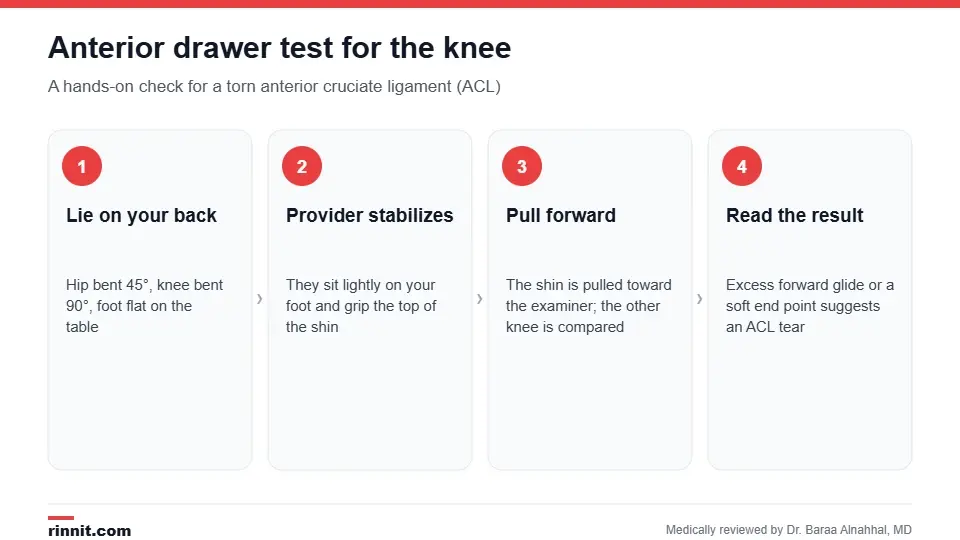
The anterior drawer test takes about a minute and needs no equipment.
Why is it done?
Providers use it after a knee injury with a "pop," rapid swelling, instability or giving way, typically from pivoting sports, sudden stops or landing awkwardly. It is part of the standard knee exam alongside: Sources: [1]
Lachman test: same forward pull with the knee bent 20–30 degrees.
Pivot-shift test: checks rotational instability.
Tests for the other ligaments (PCL, MCL, LCL) and the menisci, such as the McMurray test.
How is the test performed?
You lie on your back with the hip bent about 45 degrees and the knee bent 90 degrees, foot flat.
The provider sits lightly on your foot to hold it still and wraps both hands around the top of the shin.
They pull the tibia forward and feel how far it moves and how it stops.
The uninjured knee is tested the same way for comparison. Sources: [1]
Ankle variant: the provider holds the heel and pulls the foot forward while stabilizing the shin to test the anterior talofibular ligament after an ankle sprain. Shoulder variant: the arm is held in slight abduction while the humeral head is pulled forward to assess instability. Sources: [1]
Anterior drawer vs Lachman test
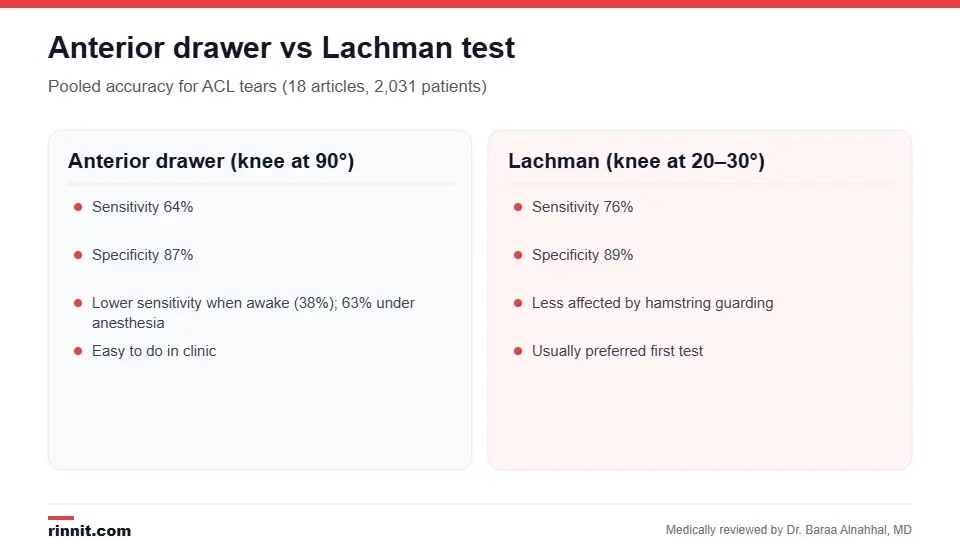
Pooled accuracy from 18 studies: Lachman is more sensitive, both are fairly specific.
Feature | Anterior drawer | Lachman |
Knee angle | 90 degrees | 20–30 degrees |
Sensitivity (pooled) | 64% | 76% |
Specificity (pooled) | 87% | 89% |
Effect of hamstring guarding | Large; sensitivity 38% awake vs 63% under anesthesia | Smaller |
Typical use | Confirms findings, easy to do | Usually the first test |
Sources: [2, 3]
Understanding your results
Positive: the tibia moves forward more than on the other side (often more than 6 mm) or has a soft end point. This suggests a complete or partial ACL tear.
Negative: firm stop with symmetric movement. Because sensitivity is modest, a negative test does not exclude a tear, especially in the first days when pain and muscle spasm limit the exam.
Grading: some providers grade translation as 1+ (up to 5 mm), 2+ (6–10 mm) or 3+ (more than 10 mm). Sources: [1, 2]
Risks
There are no risks. You may feel discomfort if the knee is very swollen, and the provider will stop if the test is too painful. Sources: [1]
What happens next?

A physical test is the start of the work-up, not the end.
After a positive or uncertain test, your provider may order an X-ray to rule out fracture and an MRI to confirm the ACL tear and look for meniscus or cartilage damage. Ultrasound is sometimes used for the ankle. Arthroscopy is the definitive way to look inside the joint. Treatment ranges from rehabilitation and bracing to ACL reconstruction, depending on your activity level and how unstable the knee is. Sources: [1]
Seek urgent care for extreme pain, a knee that is locked or visibly deformed, or an inability to bear weight. Sources: [1]
Conclusion
The anterior drawer test is a quick, no-cost way for a clinician to feel whether your ACL is doing its job. It is most useful when combined with the Lachman and pivot-shift tests and confirmed by MRI. If your knee gave way or swelled quickly after a twist, ask to be examined even if you can still walk on it.
Keep learning: read our complete guide to ACL injury and how a torn meniscus is diagnosed.
Frequently asked questions
What does a positive anterior drawer test mean?
The shin bone slides forward more than normal or stops softly, which suggests the ACL is torn. MRI is usually ordered to confirm.
Can the test miss an ACL tear?
Yes. Pooled sensitivity is about 64%, and only 38% in awake patients in some studies, because pain and tight hamstrings can mask the movement.
Which is better, anterior drawer or Lachman?
The Lachman test is more sensitive (about 76% vs 64%) and less affected by muscle guarding, so it is usually done first; the two are often combined.
Does the anterior drawer test hurt?
It is usually only mildly uncomfortable. If the knee is very swollen it may be painful, and the provider will stop if needed.
Is there an anterior drawer test for the ankle?
Yes. It checks the anterior talofibular ligament after an ankle sprain by pulling the heel forward while the shin is held still.
How soon after injury can it be done?
It can be done right away, but swelling and spasm in the first few days lower its accuracy; a repeat exam after a week is often more reliable.
Do I need an MRI if the test is positive?
Usually yes, to confirm the tear and check the menisci and cartilage before deciding on treatment.
What is the pivot-shift test?
A test for rotational instability that complements the anterior drawer and Lachman tests; it is very specific for ACL tears.
Can I do the anterior drawer test on myself?
It is not reliable to self-test. A trained clinician compares both knees and feels the end point, and imaging confirms the result.
What treatments follow an ACL tear?
Options range from physical therapy and bracing to surgical reconstruction, depending on your age, activity level and knee stability.
Related Reading
ACL Injury: Complete Guide to Symptoms, Causes, Diagnosis, and Treatment the injury this test is designed to detect.
ACL Tear: What It Is, How It Happens, and How It Is Treated how ACL tears happen and are treated.
McMurray Test: How Doctors Check for a Torn Meniscus and What Results Mean the companion exam for a torn meniscus.
Torn Meniscus: Symptoms, Causes, Treatment, and Recovery — Complete Guide an injury often found alongside ACL tears.
Knee Pain: Symptoms, Causes, Diagnosis, and Treatment Guide the broader work-up of a painful knee.
References
Cleveland Clinic. Anterior Drawer Test: What It Is & Test Details. Cleveland Clinic. Last updated November 28, 2023. https://my.clevelandclinic.org/health/diagnostics/anterior-drawer-test
Huang Z, Liu Z, Fan C, et al. Value of clinical tests in diagnosing anterior cruciate ligament injuries: a systematic review and meta-analysis. Medicine (Baltimore). 2022;101(31):e29263. PMID 35945782. https://doi.org/10.1097/MD.0000000000029263
van Eck CF, van den Bekerom MP, Fu FH, et al. Methods to diagnose acute anterior cruciate ligament rupture: a meta-analysis of physical examinations with and without anaesthesia. Knee Surgery, Sports Traumatology, Arthroscopy. 2013;21(8):1895-1903. PMID 23085822. https://doi.org/10.1007/s00167-012-2250-9
Medical disclaimer
This article is for general education only and does not replace advice from a qualified healthcare professional. Talk to your doctor about your own diagnosis and treatment, and seek emergency care right away for severe or sudden symptoms.

Comments