Osteogenesis Imperfecta (Brittle Bone Disease): Symptoms, Causes, Types, and Management — What You Need to Know

Updated: 2 days ago
Medically reviewed by Dr. Baraa Alnahhal, MD · Last reviewed: September 2026
TL;DR
Osteogenesis imperfecta (OI), widely known as brittle bone disease, is a lifelong genetic condition that causes bones to be fragile and easily broken. It results from defects in collagen production, the protein responsible for bone strength. While symptoms range from mild to life-threatening across 19 identified types, common signs include frequent fractures, blue-tinted eye whites, and hearing loss. There is currently no cure, but management through physical therapy, specialized surgery, and medications can significantly improve quality of life and bone density.
Quick Answer: What is Osteogenesis Imperfecta?
Osteogenesis imperfecta (OI) is a congenital genetic disorder that severely weakens the skeletal system, leading to bones that thin and break with little or no external force. The term literally translates to "imperfectly formed bone." The condition primarily stems from mutations in the COL1A1 or COL1A2 genes, which are responsible for producing Type I collagen. Collagen acts as the structural "scaffold" for bones; when it is insufficient or malformed, the bones become brittle. Beyond the skeleton, OI can impact the teeth, skin, spine, lungs, and internal organs. While Type I is the most common and mildest form, other types can cause severe physical disabilities or be fatal shortly after birth. Diagnosis typically involves a combination of genetic testing, X-rays, and family history, with management focused on fracture prevention and strengthening bone structures through multidisciplinary care.
Understanding the Mechanics of Brittle Bone Disease
Osteogenesis imperfecta functions by disrupting the body's ability to create strong, mineralized bone tissue. The primary culprit is a deficiency or structural flaw in collagen, which normally provides the flexibility and strength required for bones to withstand impact.
"Osteogenesis imperfecta means 'imperfectly formed bone.' If you have OI, your body makes much less collagen than it should. Or the collagen you have doesn't form correctly. This weakens your bones and makes them more brittle than usual." (Cleveland Clinic)
Feature | Impact of Osteogenesis Imperfecta |
Bone Density | Significantly reduced; bones appear thin on X-rays. |
Fracture Risk | Extremely high; breaks can occur during normal daily activities. |
Collagen Quality | Either insufficient quantity (Type I) or structural malformation (Types II-IV). |
Growth | Often leads to small stature or skeletal deformities. |

Classification: The Four Primary Types of OI
While researchers have identified 19 distinct types of the disorder, the majority of cases fall into one of the first four categories.
Type | Severity | Key Characteristics |
Type I | Mild | Most common; mild symptoms; few bone deformities; fractures mostly before puberty. |
Type II | Extremely Severe | Fatal at or shortly after birth; multiple fractures occur in utero; underdeveloped lungs. |
Type III | Severe | Significant bone deformities; very fragile bones; results in physical disabilities. |
Type IV | Moderate | More severe than Type I but less than Type III; moderate bone fragility. |

Symptoms Beyond Bone Fractures
While easy fracturing is the hallmark of the condition, OI is a systemic disorder that affects multiple body parts due to the widespread presence of collagen in human tissue.
Skeletal Symptoms
Thin, fragile bones that break with minimal force.
Bone deformities, such as bowed legs or a curved spine (scoliosis).
Barrel-shaped ribcage and small physical stature.
Loose joints and chronic bone pain.
Non-Skeletal Symptoms
Blue Sclera: The whites of the eyes appear blue or gray.
Dentinogenesis Imperfecta: Weak, brittle, or discolored teeth that may not align properly.
Hearing Loss: Often developing in early adulthood.
Respiratory Issues: Including trouble breathing or frequent pneumonia.
Skin & Muscles: Easy bruising and general muscle weakness.
Genetic Causes and Inheritance
A specific genetic mutation is responsible for the development of brittle bone disease. In the vast majority of cases, these changes occur in the genes that regulate bone strength.
Genetic Factor | Description |
Primary Genes | COL1A1 and COL1A2. |
Biological Role | These genes produce Type I collagen for bone strength. |
Inheritance | Can be passed through families; some individuals are asymptomatic carriers. |
Mutation Effect | Causes the body to make too little collagen or malformed collagen. |
Diagnostic Procedures
Healthcare providers use a multi-faceted approach to diagnose OI, often beginning in early childhood or even before birth.
Physical Examination: Reviewing family history and identifying clinical signs like blue sclera.
Imaging: Using X-rays to detect current or healing fractures and bone thinning.
Genetic Testing: Confirming mutations in collagen-related genes.
Prenatal Screening: Ultrasounds can detect unusual bone development in a fetus; amniocentesis provides genetic confirmation.
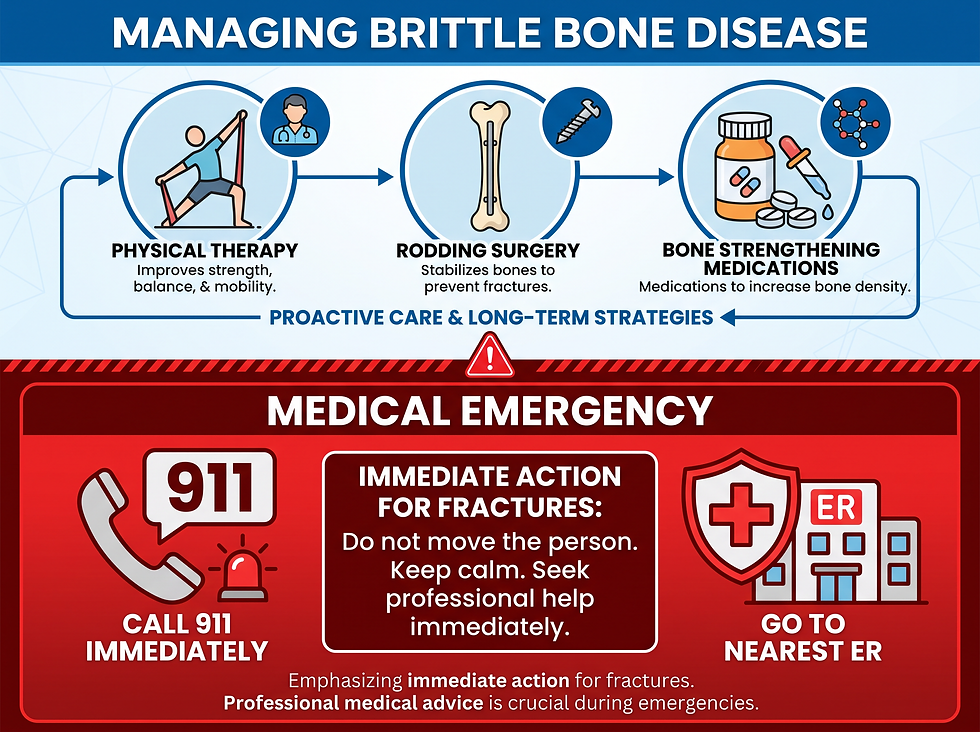
Management and Treatment Strategies
There is currently no cure for osteogenesis imperfecta. Treatment focuses on managing symptoms, increasing bone density, and maintaining mobility.
Therapeutic Interventions
Physical & Occupational Therapy: Focuses on maintaining muscle strength and improving joint range of motion safely.
Assistive Devices: Walkers, canes, and crutches help reduce the risk of falls.
Medications: Supplements and specific drugs are prescribed to increase bone density over time.
Surgical and Dental Care
Rodding Surgery: Inserting metal rods into long bones to provide internal support and prevent bowing.
Dental Treatments: Specialized care for brittle or misaligned teeth.
Specialized Care: Monitoring for lung, spine, and heart complications.
Life-Threatening Medical Emergency
IMMEDIATE ACTION REQUIRED: If you suspect a broken bone, seek emergency medical care immediately. Do not attempt to move the affected limb. Notify emergency responders and hospital staff that you or the patient has a diagnosis of osteogenesis imperfecta, as this significantly changes the handling and stabilization requirements.
Outlook and Long-Term Care
Living with brittle bone disease requires lifelong management and lifestyle adjustments. While the condition is permanent, many individuals lead active lives by following their care team's guidance.
Aspect of Life | Management Strategy |
Physical Activity | Avoid contact sports; focus on low-impact exercise. |
Monitoring | Regular bone density tests and screenings for heart/lung issues. |
Bone Density | May improve with age and consistent treatment. |
Independence | Many achieve realistic goals with the help of OTs and PTs. |
Conclusion and Next Steps
Osteogenesis imperfecta is a challenging condition, but proactive management can reduce the frequency of fractures and protect vital organ function. If you have a family history of OI or notice unusual bruising and fractures in a child, consult a pediatric rheumatologist or geneticist for evaluation. Early intervention is critical for maximizing bone health and preventing long-term disability.
Frequently Asked Questions (FAQ)
Is brittle bone disease always fatal?
No. While Type II is fatal at birth, the most common form (Type I) is mild and does not typically shorten life expectancy.
Can you develop osteogenesis imperfecta later in life?
No. It is a genetic condition you are born with, though mild cases may not be diagnosed until later in childhood.
Why do the eyes turn blue in OI?
The blue tint (blue sclera) occurs because the thinness of the collagen in the eye allows the underlying veins to show through.
Can people with OI have children?
Yes, but there is a risk of passing the genetic mutation to their children. Genetic counseling is recommended.
Does milk help prevent fractures in OI?
While calcium is important, diet alone cannot overcome the genetic collagen defect that causes OI.
Is surgery always required?
Not always. Surgery is typically reserved for severe bowing of the bones or frequent fractures in the same location.
Can exercise make OI worse?
Only if it is high-impact. Controlled physical therapy is actually essential for maintaining the muscle strength that supports the bones.
What is the most common cause of death in severe OI?
Respiratory failure, often due to a combination of ribcage deformities and frequent pneumonia.
Are there 19 types of OI?
Yes, researchers have identified 19 types, though the first four types remain the most frequently diagnosed.
Is hearing loss guaranteed?
No, but it is common, often starting in the 20s or 30s due to changes in the small bones of the ear.
Can OI be detected during pregnancy?
Yes, through high-resolution ultrasound and genetic testing like amniocentesis.
What is "rodding"?
It is a surgical procedure where a metal rod is placed inside a long bone (like the femur) to act as an internal splint.
Does OI affect intelligence?
No. Osteogenesis imperfecta does not impact cognitive development or intelligence.
Is there a cure on the horizon?
While there is no cure today, research into gene therapy and new bone-strengthening medications is ongoing.
External Resources
Medical Disclaimer
The information provided in this article is for educational purposes only and should not be used as a substitute for professional medical advice, diagnosis, or treatment. Always seek the advice of your physician or other qualified health provider with any questions you may have regarding a medical condition.
Comments