Connective Tissue Diseases: Types, Symptoms, and Treatment Options

Updated: 3 days ago
Medically reviewed by Dr. Baraa Alnahhal, MD · Last reviewed: October 2026
Quick Answer
Connective tissue disease is a group of more than 200 conditions that harm the tissues holding your body together, caused by autoimmune attack, inherited gene mutations or cancer (sarcoma) [1]. Symptoms include pain, weakness and fatigue [1]. Most are lifelong [1]. Treatment depends on the cause, including immunosuppressants for autoimmune types and surgery or chemotherapy for sarcomas [1].
What the research says
Lung scarring (interstitial lung disease) varies widely between connective tissue diseases. A meta-analysis of 237 articles found the pooled prevalence of interstitial lung disease was 11% in rheumatoid arthritis, 47% in systemic sclerosis (scleroderma), 41% in idiopathic inflammatory myositis, 17% in primary Sjögren's syndrome, 56% in mixed connective tissue disease, and 6% in systemic lupus erythematosus. Positive antibody tests and higher inflammatory markers were risk factors across the conditions (PubMed: Joy et al., Eur Respir Rev, 2023) [2].
Some "undifferentiated" cases go on to become a defined disease, and certain signs predict which ones. A systematic review of 59 studies found that, for progression to lupus, serositis (relative risk 2.69; 95% CI 1.61 to 4.51) and anti-dsDNA antibodies (RR 4.27; 95% CI 1.92 to 9.51) were among the strongest predictors. For progression to systemic sclerosis, puffy fingers (RR 3.09; 95% CI 1.48 to 6.43) and anti-topoisomerase-I antibodies (RR 1.83; 95% CI 1.45 to 2.30) stood out. The authors noted that study variability and risk of bias limit use in routine practice (PubMed: Dyball et al., Autoimmun Rev, 2022) [3].
Newer drugs are being tested for lung disease in scleroderma, but the evidence is still weak. A meta-analysis of 5 studies of tocilizumab in systemic sclerosis-associated interstitial lung disease found that lung capacity (forced vital capacity) fell by 241 mL less than with placebo at 48 weeks, with fewer serious adverse events. The authors rated the quality of evidence as very low and called for larger trials (PubMed: Ghazipura et al., Ann Am Thorac Soc, 2024) [4].
What Is a Connective Tissue Disease?
A connective tissue disease is an umbrella term for a wide range of diseases that affect your connective tissues, the tissues that connect and support your organs and body structure [1]. These tissues hold your muscle fibers together and cover and protect your nerves. Your connective tissues also include your body fat, bones, cartilage, fascia, ligaments, skin, and tendons [1].
Because these tissues are in almost every part of your body, connective tissue diseases can affect you all over. They might affect one or two types of tissues throughout your body or many. They can also affect many organs. Different types of connective tissue disease have different symptoms. Common symptoms include musculoskeletal pain and fatigue [1].
Key fact | Detail |
Definition | Umbrella term for diseases that damage the tissues connecting and supporting the body |
Scope | Over 200 known connective tissue disorders |
Tissues involved | Body fat, bones, cartilage, fascia, ligaments, skin, tendons |
Main categories | Autoimmune diseases, genetic disorders, cancers (sarcomas) |
Common symptoms | Musculoskeletal pain, fatigue, weakness, stiffness |
Course | Most are lifelong conditions requiring ongoing management |
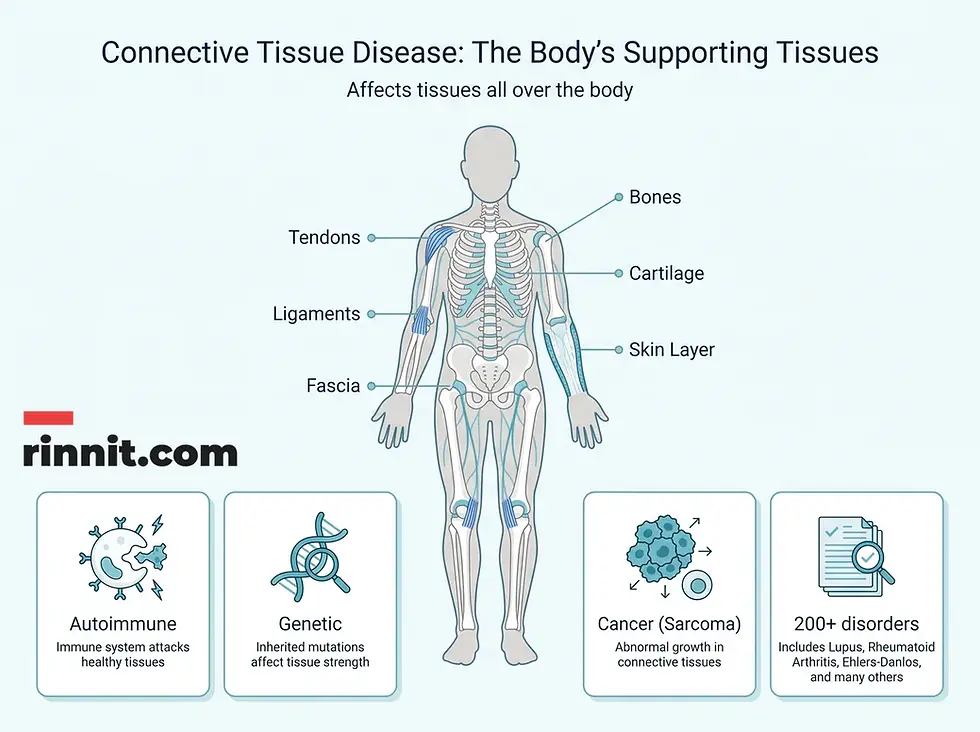
Some people have overlapping features of several autoimmune connective tissue disorders. That is called mixed connective tissue disease [1]. If you have some symptoms of autoimmune diseases but they don't meet the criteria for any specific disorder, it is called undifferentiated connective tissue disease [1].
What are the types of connective tissue disease?
Over 200 known connective tissue diseases fall into three main categories: autoimmune diseases, genetic disorders and cancers (sarcomas) [1]. They fall into three main categories: autoimmune diseases, genetic disorders, and cancers (sarcomas).
Category | Underlying mechanism | Examples | Can it go into remission? |
Autoimmune | Immune system generates chronic inflammation | Lupus, rheumatoid arthritis, scleroderma, Sjögren's syndrome, myositis, relapsing polychondritis | Yes, but it can recur |
Genetic | Inherited gene mutation affecting collagen or elastin | Marfan syndrome, Ehlers-Danlos syndrome, osteogenesis imperfecta, Stickler syndrome, epidermolysis bullosa, Loeys-Dietz syndrome | The genetic defect can't be treated yet |
Cancer (sarcoma) | Cells divide uncontrollably | Osteosarcoma, chondrosarcoma, Ewing sarcoma, fibrosarcoma, liposarcoma | Yes, but it can recur |

Autoimmune Connective Tissue Diseases
Autoimmune diseases are what many people think of when they think of connective tissue disease. In these conditions, your immune system generates chronic inflammation in some parts of your body. Chronic inflammation causes pain, swelling and, eventually, permanent damage to your tissues [1]. Six common autoimmune connective tissue disorders include the following [1].
Autoimmune condition | What it does |
Rheumatoid arthritis | Causes joint inflammation, sometimes leading to joint destruction and deformity; inflammation may spread to blood vessels or other organs |
Relapsing polychondritis | Inflammation and degeneration of cartilage in the ears, nose and throat; can affect hearing and breathing, sometimes the eyes |
Myositis | Inflammation and degeneration of muscles, causing weakness; some types affect muscles and/or skin, causing rashes |
Sjögren's syndrome | Inflames and damages moisture-producing glands, causing dryness in the eyes, mouth, digestive system and respiratory system |
Lupus | Inflammation in any connective tissues, sometimes all; systemic lupus may affect skin, joints, heart, lungs and kidneys |
Scleroderma | Overproduction of collagen causes thickening and hardening of skin and organs, including the digestive system, kidneys, heart and lungs |
Genetic Connective Tissue Disorders
Genetic disorders of the connective tissue result from a gene mutation that you inherit at birth. The mutation affects how your connective tissues develop. It usually affects one of the two primary building blocks in all connective tissues: collagen or elastin [1]. This causes various defects in your tissues.
Genetic condition | What it affects | Typical effects |
Marfan syndrome | Fibrillin, a protein that helps build the elastic fibers in tissues | Tissues too loose; elongated limbs; cardiovascular issues |
Ehlers-Danlos syndrome | Collagen throughout the body | Skin and joints hyperextendable, fragile and unstable; possible cardiovascular effects |
Osteogenesis imperfecta | Type 1 collagen (ligaments, bones, teeth) | Loose joints; brittle, weak bones and teeth |
Stickler syndrome | Collagen in cartilage and the eye's gel-like vitreous humor | Hearing and vision issues; arthritis |
Epidermolysis bullosa | Collagen in skin | Fragile skin; chronic blistering; possible mucous membrane involvement |
Loeys-Dietz syndrome | Signals that guide connective tissue development | Musculoskeletal abnormalities; enlarged aorta |
People born with these conditions can have a wide variety of symptoms and complications, ranging from mild to severe. Because healthcare providers can't treat the genetic defect, they treat the symptoms and complications individually as much as they can. They'll monitor your condition throughout your life [1].
Cancers of the Connective Tissues
The type of cancer that can start in your connective tissues is called sarcoma. Sarcomas can start in your bones, cartilage, fat, muscles, ligaments, tendons or the deep layers of your skin [1]. They can also start in the lining of blood vessels (endothelium), as in angiosarcoma. For more detail, see our sarcoma guide.
Sarcoma type | Where it starts |
Osteosarcoma | Bone; the most common type of primary bone cancer |
Chondrosarcoma | Bone, starting from cartilage |
Ewing sarcoma | Cartilage or bone |
Fibrosarcoma | Fibrous tissues, like ligaments and tendons |
Clear cell sarcoma | Muscles, tendons or fascia of the legs |
Liposarcoma | Body fat |
Dermatofibrosarcoma | Middle layer (dermis) of the skin |
Myxofibrosarcoma | A lump under the skin, usually in an arm or leg |
What are the symptoms of connective tissue disease?
Different connective tissue diseases can cause a wide variety of different symptoms, but there are some common themes. Most can cause symptoms all over your body. Musculoskeletal pain, weakness and/or stiffness are common, as are systemic symptoms like fatigue [1].
Many connective tissue disorders can affect your lungs and cardiovascular system. Your lungs have a lot of connective tissue and rely heavily on it. Blood vessels run through most of your connective tissues, and because they're made of similar material, inflammation spreads easily between them [1]. As a result, many connective tissue diseases can cause musculoskeletal symptoms together with cardiopulmonary symptoms. If your blood vessels become inflamed, they can swell and break, causing unexplained bleeding [1].
Symptom area | What it can feel like |
Muscles and joints | Pain, weakness and/or stiffness |
Whole body | Systemic symptoms like fatigue |
Lungs | Shortness of breath |
Cardiovascular system | Changes to blood pressure or heartbeat |
Blood vessels | Swelling and breakage causing unexplained bleeding |
Sarcoma symptoms look different. Sarcomas often won't cause symptoms until they grow large enough to compress an organ or vessel [1]. Some cause bone pain or joint pain where they start. Others may appear as a lump under the skin that may or may not be tender. Most sarcomas can spread, causing more widespread symptoms [1].
What Causes Connective Tissue Disease?
Connective tissue disease happens when something in your body malfunctions. In autoimmune disease, your immune system launches an attack against your own body. In genetic diseases, a mutated gene causes your tissues to develop wrong. Cancer happens when cells continue to divide uncontrollably [1].
For the most part, scientists don't know the underlying reasons why these malfunctions occur. But certain risk factors might play a part in making you more vulnerable to these diseases. Severe infections that overstress your immune system and exposure to certain toxic chemicals are possible risk factors [1].
How Are Connective Tissue Diseases Diagnosed?
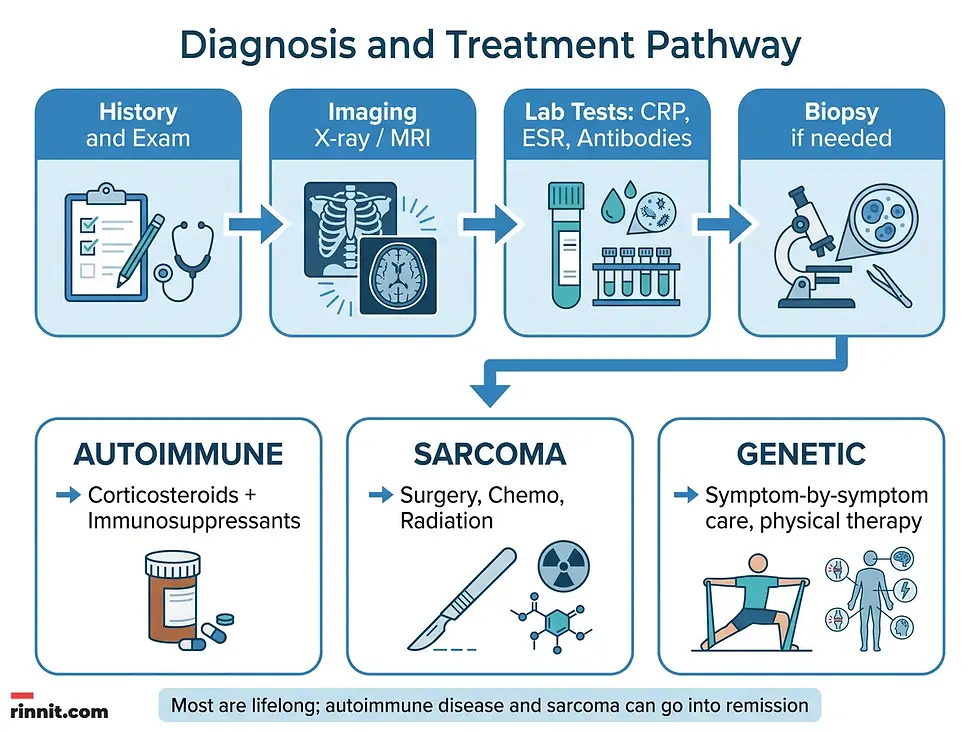
Your doctor may order various tests depending on what type of connective tissue disorder is suspected. They'll first ask for your medical history and a family history, and will do a physical examination [1].
Diagnostic step | What it looks for |
Medical and family history | Patterns that point to a specific category |
Physical examination | Signs of joint, skin, and tissue involvement |
Imaging tests (X-rays, MRI) | Structural damage or tumors |
Inflammation markers (C-reactive protein, ESR) | Active inflammation levels |
Antibody tests | Autoimmune conditions |
Dry eye and dry mouth tests | Sjögren's-type gland damage |
Blood and urine tests | Organ function and systemic involvement |
Tissue biopsy | Direct examination of affected tissue |
How is connective tissue disease treated?
Most connective tissue disorders are lifelong conditions [1]. Healthcare providers do what they can to reduce their severity and treat the symptoms and complications individually. Autoimmune diseases and sarcomas can go into remission, which means periods without any signs or symptoms, but they can also recur [1].
Disease category | Treatment approach |
Autoimmune | Anti-inflammatory drugs (corticosteroids) plus immune system-repressing drugs (immunosuppressants) to stop the automatic inflammation |
Sarcoma | Surgery, chemotherapy and radiation therapy |
Genetic | Symptoms and complications treated individually; medications plus regular low-stress exercise or physical therapy |
Scientists are researching genetic therapies that may one day be able to reduce the effects of genetic connective tissue disorders. For now, providers can only treat the symptoms [1]. In addition to medications, providers recommend regular low-stress exercise or physical therapy to help manage musculoskeletal pain [1].
How can people live well with a connective tissue disease?
The wide range of connective tissue disorders have very different outlooks and possible complications. Your healthcare provider is the best person to tell you what signs and symptoms to look out for and when to seek treatment. They may also recommend lifestyle changes to help optimize your overall health.
Monitoring. Attend regular follow-ups so symptom changes are caught early.
Pain management. Use low-stress exercise or physical therapy for musculoskeletal pain.
Lifestyle changes. Follow the adjustments your provider recommends to optimize your overall health.
Self-advocacy. Don't ignore symptoms, even if they seem unrelated. They could be different effects of the same disease.
It can be hard to recognize the signs and symptoms of a connective tissue disease. But getting a diagnosis and beginning treatment sooner puts you in a better position to manage your condition [1].
Conclusion: A Body-Wide Group of Conditions That Needs Early Attention
Connective tissue disease is an umbrella term for more than 200 conditions that damage the tissues holding your body together: your bones, cartilage, tendons, ligaments, fascia, skin and fat. Because these tissues are everywhere, symptoms can appear all over your body, most often as musculoskeletal pain, weakness, and fatigue.
The three main categories (autoimmune, genetic, and cancerous) behave very differently. Autoimmune diseases like lupus and scleroderma are treated with corticosteroids and immunosuppressants and can go into remission. Sarcomas need surgery, chemotherapy, and radiation. Genetic conditions like Marfan and Ehlers-Danlos syndromes are managed symptom by symptom for life.
If you have unexplained body-wide pain, fatigue, or organ symptoms, see a healthcare provider. The earlier a connective tissue disease is identified, the better your position for managing it, so don't dismiss symptoms that seem unrelated, because they may be different effects of the same disease.
Related reading: our sarcoma guide.
Frequently Asked Questions
1. What is a connective tissue disease?
A connective tissue disease is an umbrella term for more than 200 conditions that affect the tissues connecting and supporting your organs and body structure, including bones, cartilage, tendons, ligaments, skin, fascia, and body fat.
2. How many connective tissue disorders are there?
There are over 200 known connective tissue disorders, falling into three main categories: autoimmune diseases, genetic disorders, and cancers called sarcomas.
3. What are the most common symptoms?
Most connective tissue diseases cause body-wide symptoms, most commonly musculoskeletal pain, weakness or stiffness, and fatigue. Many also affect the lungs and cardiovascular system, causing shortness of breath or blood pressure changes.
4. Is a connective tissue disease the same as an autoimmune disease?
Not exactly. Autoimmune diseases like lupus, rheumatoid arthritis, and scleroderma are one category of connective tissue disease. Genetic disorders and sarcomas are the other two categories, and they have different causes and treatments.
5. What causes connective tissue disease?
Autoimmune diseases happen when the immune system attacks the body, genetic diseases result from inherited gene mutations affecting collagen or elastin, and sarcomas happen when cells divide uncontrollably. Scientists don't fully know why these malfunctions occur, though severe infections and toxic chemical exposure are possible risk factors.
6. Can connective tissue disease be cured?
Most connective tissue disorders are lifelong. Autoimmune diseases and sarcomas can go into remission but may return. The genetic defect in genetic connective tissue disorders can't be treated yet, so providers manage symptoms individually.
7. How is connective tissue disease diagnosed?
Diagnosis starts with medical history, family history, and a physical exam, followed by imaging tests (X-rays, MRI), inflammation markers (C-reactive protein, ESR), antibody tests, dry eye and dry mouth tests, blood and urine tests, and sometimes a tissue biopsy.
8. What is the treatment for autoimmune connective tissue disease?
Providers treat autoimmune connective tissue diseases with a combination of anti-inflammatory drugs (corticosteroids) and immune system-repressing drugs (immunosuppressants) to stop the automatic inflammation.
9. Is connective tissue disease genetic?
Some types are. Genetic connective tissue disorders like Marfan syndrome, Ehlers-Danlos syndrome, and osteogenesis imperfecta come from gene mutations inherited at birth that affect how collagen or elastin develop.
10. What are sarcomas?
Sarcomas are cancers that can start in connective tissues, such as bones, cartilage, fat, muscles, ligaments, tendons, or the deep layers of skin, and are treated with surgery, chemotherapy, and radiation therapy.
11. What should I do if I think I have a connective tissue disease?
See a healthcare provider about any unexplained, widespread, or recurring symptoms. Getting a diagnosis and starting treatment sooner puts you in a better position to manage the condition, so don't ignore symptoms even if they seem unrelated.
Related Reading
Learn more in our guide to Beighton Score: How Joint Hypermobility Is Measured and What Your Score Means.
References
Cleveland Clinic. Connective Tissue Diseases. Cleveland Clinic. November 15, 2024. https://my.clevelandclinic.org/health/diseases/14803-connective-tissue-diseases
Joy GM, Arbiv OA, Wong CK, Lok SD, Adderley NA, Dobosz KM, Johannson KA, Ryerson CJ. Prevalence, imaging patterns and risk factors of interstitial lung disease in connective tissue disease: a systematic review and meta-analysis. Eur Respir Rev. 2023;32(167):220210. doi:10.1183/16000617.0210-2022. PMID: 36889782.
Dyball S, Rodziewicz M, Mendoza-Pinto C, Bruce IN, Parker B. Predicting progression from undifferentiated connective tissue disease to definite connective tissue disease: a systematic review and meta-analysis. Autoimmun Rev. 2022;21(11):103184. doi:10.1016/j.autrev.2022.103184. PMID: 36031048.
Ghazipura M, Macrea M, Herman D, Barnes H, Knight SL, Silver RM, Montesi SB, Raghu G, Hossain T. Tocilizumab in patients with systemic sclerosis-associated interstitial lung disease: a systematic review and meta-analysis. Ann Am Thorac Soc. 2024;21(2):328-337. doi:10.1513/AnnalsATS.202301-056OC. PMID: 37773003.
Medical Disclaimer
This article is for informational purposes only and does not constitute medical advice. Always seek the advice of your physician or other qualified health provider with any questions you may have regarding a medical condition. Never disregard professional medical advice or delay in seeking it because of something you have read here.



Comments