Heart Disease in Women: Symptoms, Causes, Risk Factors, and Prevention

Updated: 2 days ago
Medically reviewed by Dr. Baraa Alnahhal, MD · Last reviewed: October 2026
Quick Answer
Heart disease in women is coronary artery disease or other heart conditions affecting females, and it is the No. 1 cause of death for women in the U.S. and worldwide. [1] Women more often have fatigue, nausea or back, jaw or neck pain with chest discomfort, and more silent heart attacks. [1] Get yearly exams and call 911 for unexplained symptoms. [1]
What the research says
Women's heart attack symptoms differ from men's, but chest pain is still the most common. A systematic review and meta-analysis of 27 studies found that, compared with men, women with acute coronary syndromes (heart attacks and closely related emergencies) had higher odds of pain between the shoulder blades (odds ratio 2.15), nausea or vomiting (1.64), and shortness of breath (1.34), and lower odds of chest pain (0.70). Even so, chest pain was the most common symptom in both sexes (74% of women and 79% of men), and symptom patterns overlapped considerably. (van Oosterhout et al., J Am Heart Assoc, 2020) [7]
Preeclampsia is linked to a much higher heart risk later in life. A meta-analysis of 22 studies covering more than 6.4 million women, including more than 258,000 who had preeclampsia, found that preeclampsia was independently linked to about a 4-fold higher risk of future heart failure (risk ratio 4.19), and to higher risks of coronary heart disease (2.50), death from cardiovascular disease (2.21), and stroke (1.81). The authors highlight lifelong monitoring of heart risk factors for women with a history of preeclampsia. (Wu et al., Circ Cardiovasc Qual Outcomes, 2017) [8]
Early menopause is linked to a higher risk of coronary heart disease. A meta-analysis of 32 studies including 310,329 women found that women who went through menopause before age 45 had a higher risk of coronary heart disease than women who reached menopause at 45 or older (relative risk 1.50), along with higher risks of death from cardiovascular disease (1.19) and from any cause (1.12). (Muka et al., JAMA Cardiol, 2016) [9]
What Is Heart Disease in Women?
Heart disease in women refers to coronary artery disease (blockages in the heart's arteries) or other heart conditions that affect females. [1] Heart disease is the No. 1 cause of death for both women and men in the U.S. and around the world. [1]
For a long time, the common belief was that women were less likely to get heart disease or have a heart attack. [1] Today, we know that is simply not true. [1] In fact, more women in the U.S. die of heart disease than from all forms of cancer combined. [1]
Why Is a Woman's Cardiovascular System Different?
Women and men share a lot in common when it comes to heart disease, but there are key sex-specific differences in the cardiovascular system: [1]
Difference | What it means in plain language |
Anatomy | Females have smaller blood vessels and heart chambers, and the walls of their ventricles (pumping chambers) are thinner. [1] |
Blood count | Females have fewer red blood cells, so they can't take in or carry as much oxygen at any given time. [1] |
Cardiovascular adaptations | Changes in altitude or body position (like standing up quickly) are more likely to affect females, sometimes causing sudden drops in blood pressure. [1] |
Hormones |
What Does a Heart Attack Feel Like in Women?
A heart attack is a medical emergency in which blood flow to your heart suddenly drops. [1] Chest pain or discomfort is the most common symptom of a heart attack for everyone. [1] [7] But women are more likely to have some other type of symptom in addition to chest pain — or instead of it. [1] Women are also more likely to have a silent heart attack, a heart attack that happens without obvious symptoms. [1]
Where can the pain show up?
A heart attack in women may feel like pain or discomfort in the: [1]
Body area | Notes |
Chest | The most common location [1] |
Left breast | Less recognized, but a warning sign |
Back or between the shoulder blades | Often mistaken for muscle pain |
Neck or throat | Can feel like tightness |
Jaw or teeth | Easy to blame on dental issues |
Arms (one or both) | Classic warning sign |
Shoulders | Also commonly overlooked |
In addition to pain or discomfort, women experiencing a heart attack may also have: [1]
Symptom | Notes |
Unusual fatigue | The most common extra symptom [1] |
Shortness of breath | With or without chest pain |
Feeling dizzy or faint | A drop in blood pressure can cause this |
Feeling hot or flushed | Often dismissed as “just hot” |
Indigestion | Frequently mistaken for heartburn |
Fast heart rate | Heart beating faster than normal [1] |
Numbness in the hands or fingers | Sometimes mistaken for nerve problems |
Nausea or vomiting | Often attributed to the stomach |
Choking sensation | A feeling of something in the throat |
Call 911 or your local emergency number right away if you have any of these symptoms without another known cause — and especially if you have more than one symptom at once. [1]
It is also important to stay alert to early warning signs of a heart attack, which can affect both women and men. [1] Some warning signs include unusual fatigue and fleeting episodes of chest pain. [1]

What Causes Heart Disease in Women?
Women and men share many of the same cardiovascular disease causes. [1] A common cause of heart attacks for everyone is plaque buildup in the heart's blood vessels. [1] This plaque can rupture, leading to a blood clot that blocks blood flow to the heart muscle. [1]
But women often have heart attacks even without severe coronary blockages. [1] In those cases, common causes include:
Cause | What it means in plain language |
Coronary artery spasm | A severe, reversible tightening of the heart's arteries [1] |
Coronary microvascular disease | Problems with the small vessels that branch off from the coronary arteries [1] |
Spontaneous coronary artery dissection | A separation or tear in a coronary artery wall that happens without warning [1] |
Broken heart syndrome | Rapid weakening of the heart muscle after sudden physical or emotional stress [1] |
There are also sex-specific differences in the causes of heart failure. [2] Some research shows that the risk of developing heart failure due to high blood pressure (hypertension) is greater for women than for men. [1] That is why diagnosing and treating high blood pressure in women is especially important [1] for preventing long-term heart damage.
What Risk Factors Are Unique to Women?
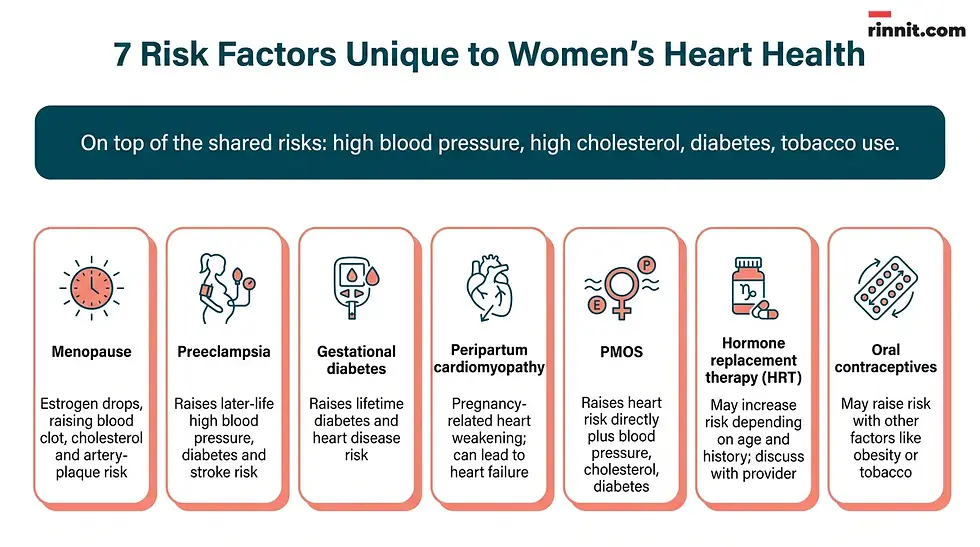
Women and men share many risk factors in common, like high blood pressure, high cholesterol, diabetes, and tobacco use. [1] The risk factors unique to females are tied to pregnancy, hormones, and life stages: [1]
Unique risk factor | How it raises heart risk |
Menopause | |
Preeclampsia | Preeclampsia during pregnancy greatly raises the risk of high blood pressure and/or diabetes later in life, and raises the risk of stroke or dying from heart and blood vessel disease. [1] |
Gestational diabetes | This common pregnancy condition raises the lifetime risk of developing diabetes or cardiovascular disease. [1] |
Peripartum cardiomyopathy | A weakening of the heart associated with pregnancy that can lead to serious complications, including heart failure or death. [1] |
Polyendocrine metabolic ovarian syndrome (PMOS) | Raises heart disease risk directly; women with this common condition often develop individual risk factors like diabetes, high blood pressure, high cholesterol, and sleep apnea. [1] |
Hormone replacement therapy (HRT) | |
Oral contraceptive therapy | “The pill” may raise heart disease risk if you have other risk factors, such as obesity or tobacco use. [1] |
How Is Heart Disease Tested and Treated Differently in Women?
Some aspects of testing and treatment for cardiovascular disease are different for women. [1]
Sometimes, rather than having a large chunk of plaque, a woman's artery contains a smooth layer of plaque. [1] This happens more often in females. [1] A coronary angiogram (the dye-and-X-ray test that looks inside arteries) can't always catch this type of plaque. [1] So if you have symptoms and your test results come back fine, you may need more tests to identify the cause of your symptoms. [1]
Females are also more likely to have ACE inhibitor intolerance — trouble tolerating a common family of blood pressure medicines. [1] And while statins reduce cholesterol for everyone, females may be more likely to develop side effects. [1] That said, true statin side effects remain very rare, including in females. [1]
The takeaway: it is important to talk with your provider about your risks, symptoms, test results, and responses to medication. Sex-based differences are sometimes less important than individual differences from your unique medical history and social environment. [1]
How Can Women Prevent Cardiovascular Disease?
Many heart disease prevention tips apply to both women and men — but some are unique to women:
Prevention step | Why it matters |
Yearly physical exams [1] | Catches risk factors early, before symptoms appear |
Ask for a preventive cardiologist referral | Even if you're young and feel healthy — it's never too early [1] |
Learn your risk factors | Then talk to your provider about how to manage them [1] |
Ask about sex-specific risk factors | Preeclampsia or menopause can affect your heart years later [1] |
Talk about your contraception | Including any risks tied to “the pill” [1] |
Make an exercise plan | After checking with your provider first |
Avoid tobacco; limit alcohol [1] | Two of the biggest heart risk factors you can control |
Follow a heart-healthy eating plan | The Mediterranean diet is one example [1] |
Take prescribed medications | For high blood pressure, high cholesterol, and other risk factors [1] |

The Bottom Line
Heart disease used to have a reputation as a “man's disease.” [1] We have come a long way in awareness and understanding, but there is still room for progress. The practical message is clear: know your numbers, know your unique risk factors, and never dismiss unusual fatigue, indigestion-like discomfort, or pain in your jaw, back, or left breast — especially if more than one symptom shows up at once. When in doubt, call 911. And talk with your healthcare provider about the steps and resources available to keep your heart healthy for as long as possible.
When Should I Get Emergency Help?
Call 911 or your local emergency number right away if you experience symptoms that could signal a heart attack, including chest pain or discomfort, pain in the chest, back, neck, jaw, or arms, unusual fatigue, shortness of breath, dizziness, nausea, or a choking sensation — particularly if you have more than one symptom without another known cause. [1]
Frequently Asked Questions
Is heart disease really the biggest killer of women?
Yes. Heart disease is the No. 1 cause of death for women in the U.S. and worldwide, and more women in the U.S. die of heart disease than from all forms of cancer combined. [1]
Do women have heart attacks differently than men?
Chest pain is still the most common symptom for everyone, but women are more likely to have additional symptoms like unusual fatigue, nausea, and shortness of breath, and women are more likely to have a silent heart attack. [1]
Can women have heart attacks without clogged arteries?
Yes. Women often have heart attacks without severe coronary blockages. [1] In those cases, causes include coronary artery spasm, coronary microvascular disease, spontaneous coronary artery dissection, and broken heart syndrome. [1]
Why can my heart test results look normal when something is wrong?
Women more often have a smooth layer of plaque instead of a large chunk of plaque, and a coronary angiogram can't always catch this type. [1] If you still have symptoms after a “normal” result, ask about more testing. [1]
Does menopause raise my heart disease risk?
Yes. Estrogen helps protect the heart. [1] When natural menopause or surgical ovary removal drops estrogen levels, the risk of blood clots, high cholesterol, and atherosclerosis goes up. [1]
How does preeclampsia affect my future heart health?
Preeclampsia during pregnancy greatly raises your risk of developing high blood pressure and/or diabetes later in life, and also raises your risk of stroke or dying from heart and blood vessel disease. [1]
What is peripartum cardiomyopathy?
Peripartum cardiomyopathy is a weakening of the heart that is associated with pregnancy. [1] It can lead to serious complications, such as heart failure or death [1], which is why follow-up care matters.
Does “the pill” raise heart disease risk?
Taking oral contraceptives may raise your risk for heart disease if you have other risk factors, such as obesity or tobacco use. [1] Talk with your provider about the right form of contraception for you. [1]
Does hormone replacement therapy hurt the heart?
HRT for menopause may increase cardiovascular risk depending on your age and personal medical history. [1] It is best to discuss this risk with your physician. [1]
What is PMOS and how does it affect my heart?
Polyendocrine metabolic ovarian syndrome (PMOS) raises heart disease risk. [1] Women with this common condition often develop individual risk factors such as diabetes, high blood pressure, high cholesterol, and sleep apnea. [1]
Is unusual fatigue really a heart attack sign?
Unusual fatigue can be. Unusual fatigue is the most common extra symptom women report during a heart attack, and it can also be an early warning sign for both women and men. [1]
Should I call 911 or drive myself to the hospital?
Call 911 or your local emergency number right away. [1] Do not wait to see if symptoms pass, especially if you have more than one symptom without another known cause. [1]
Am I too young to worry about heart disease?
It is never too early to start the conversation. [1] Ask your healthcare provider for a referral to a preventive cardiologist, even if you are young and feel healthy. [1]
Can high blood pressure damage my heart more than it would a man's?
Some research shows the risk of developing heart failure due to high blood pressure is greater for women than for men, making diagnosis and treatment of high blood pressure especially important for women. [1]
What everyday steps protect a woman's heart?
Yearly physical exams, learning and managing your risk factors, discussing sex-specific risks like preeclampsia and menopause with your provider, exercising, avoiding tobacco, limiting alcohol, eating heart-healthy foods like the Mediterranean diet, and taking prescribed medications. [1]
References
Cleveland Clinic. Heart Disease in Women. Cleveland Clinic Health Library. Last updated August 3, 2026. Accessed October 15, 2026. https://my.clevelandclinic.org/health/diseases/17645-women--cardiovascular-disease
Ballard-Hernandez J, Itchhaporia D. Heart failure in women due to hypertensive heart disease. Heart Fail Clin. 2019;15(4):497-507. PMID: 31472885. https://doi.org/10.1016/j.hfc.2019.06.002
Blakeman JR, Stapleton SJ. An integrative review of fatigue experienced by women before and during myocardial infarction. J Clin Nurs. 2018;27(5-6):906-916. PMID: 29076243. https://doi.org/10.1111/jocn.14122
de Marvao A, Alexander D, Bucciarelli-Ducci C, et al. Heart disease in women: a narrative review. Anaesthesia. 2021;76(Suppl 4):118-130. PMID: 33682102. https://doi.org/10.1111/anae.15376
McSweeney JC, Rosenfeld AG, Abel WM, et al. Preventing and experiencing ischemic heart disease as a woman: state of the science: a scientific statement from the American Heart Association. Circulation. 2016;133(13):1302-1331. PMID: 26927362. https://doi.org/10.1161/CIR.0000000000000381
Norris CM, Yip CYY, Nerenberg KA, et al. State of the science in women's cardiovascular disease: a Canadian perspective on the influence of sex and gender. J Am Heart Assoc. 2020;9(4):e015634. PMID: 32063119. https://doi.org/10.1161/JAHA.119.015634
van Oosterhout REM, de Boer AR, Maas AHEM, et al. Sex differences in symptom presentation in acute coronary syndromes: a systematic review and meta-analysis. J Am Heart Assoc. 2020;9(9):e014733. PMID: 32363989. https://doi.org/10.1161/JAHA.119.014733
Wu P, Haththotuwa R, Kwok CS, et al. Preeclampsia and future cardiovascular health: a systematic review and meta-analysis. Circ Cardiovasc Qual Outcomes. 2017;10(2):e003497. PMID: 28228456. https://doi.org/10.1161/CIRCOUTCOMES.116.003497
Muka T, Oliver-Williams C, Kunutsor S, et al. Association of age at onset of menopause and time since onset of menopause with cardiovascular outcomes, intermediate vascular traits, and all-cause mortality: a systematic review and meta-analysis. JAMA Cardiol. 2016;1(7):767-776. PMID: 27627190. https://doi.org/10.1001/jamacardio.2016.2415
Medical disclaimer
This article is for general educational purposes only and is not a substitute for professional medical advice, diagnosis, or treatment. Always seek the advice of your physician or other qualified healthcare provider with any questions you may have regarding a medical condition. Never disregard professional medical advice or delay seeking it because of something you have read here. If you are experiencing a medical emergency, call 911 or go to your nearest emergency center immediately.



Comments