Apolipoprotein B (Apo B) Test: Normal Levels and What High Results Mean

Updated: 2 days ago
Written and medically reviewed by Dr. Baraa Alnahhal, MD · Last reviewed: November 2026 · How we review
Quick Answer: What is an Apo B test?
An Apo B (apolipoprotein B-100) test is a blood test that helps estimate the risk of heart and blood vessel disease by counting "bad" cholesterol particles such as LDL and VLDL. A normal level is 66 to 133 mg/dL for males and 60 to 117 mg/dL for females. A level above 130 mg/dL means higher risk. [1]
What the research says
Apo B was the strongest of three common cholesterol markers. A meta-analysis of 12 studies with 233,455 people and 22,950 heart and blood vessel events found Apo B was the most potent marker of risk (relative risk ratio 1.43), ahead of non-HDL cholesterol (1.34) and LDL cholesterol (1.25). (Sniderman et al., Circulation: Cardiovascular Quality and Outcomes, 2011) [2]
Lowering Apo B tracks closely with the benefit of statins. In a meta-analysis of 7 placebo-controlled statin trials, each standard-deviation drop in Apo B was linked with a 24.4% lower risk of coronary heart disease, compared with about 20% for LDL or non-HDL cholesterol. (Thanassoulis et al., Journal of the American Heart Association, 2014) [3]
Key takeaways
Apo B is a protein carried only by "bad" cholesterol particles like LDL and VLDL.
The test helps estimate your risk of heart and blood vessel disease.
Normal levels are 66 to 133 mg/dL for males and 60 to 117 mg/dL for females.
Above 130 mg/dL means higher risk.
High Apo B is treated the same way as high LDL cholesterol.
What is apolipoprotein B?
Apolipoprotein B carries lipids (fats) where they need to go. But it only carries the kind with a bad reputation: low-density lipoprotein (LDL), very low-density lipoprotein (VLDL) and others. It doesn't travel with high-density lipoprotein (HDL), the "good" cholesterol. Where you find Apo B, you find LDL. [1]
These particles help build plaque, a waxy fat that can block your arteries. Measuring Apo B tells your provider how many of these plaque-building particles are in your blood. [1]

Why is an Apo B test done?
Your provider may order it when they want another way to measure your heart disease risk, such as when your usual risk factors don't clearly put you at high or low risk. They may also order it after you start a statin to lower your bad cholesterol. [1]
Apo B vs a lipid panel
Some providers believe Apo B is more accurate than a standard lipid panel for estimating risk. Because each Apo B molecule carries one bad lipoprotein, the test gives an accurate particle count. [1]
Providers can also subtract HDL from total cholesterol to estimate risk, but this isn't accurate for everyone. Apo B can be a better predictor for people with metabolic syndrome or diabetes, whose LDL particles may be smaller or denser. [1]
Feature | Apo B test | Lipid panel |
What it measures | Number of particles carrying bad cholesterol | Amounts of total, LDL and HDL cholesterol and triglycerides |
Fasting needed? | No | Often, for 12 hours |
Better risk predictor for metabolic syndrome or diabetes? | Can be | Less accurate for some people |
Sources: [1]
How do you prepare for an Apo B test?
You don't need to fast for an Apo B test. If you're having a lipid panel at the same time, avoid eating or drinking for 12 hours beforehand. Water is fine, and staying hydrated makes it easier to find your vein. A short-sleeved shirt also helps. [1]
What happens during the test?
You sit in a chair with your arm resting in front of you.
A provider ties a stretchy band around your upper arm to make your vein easier to find.
They clean the area with an alcohol pad.
They insert a small needle into your vein.
Blood flows into a collection tube.
They remove the band and needle, press on the spot with gauze and put on a bandage.
Sources: [1]

Are there risks?
Most people feel fine afterward. Some feel dizzy or lightheaded. If that happens, sit for a few minutes, put your head between your knees or drink some water or juice. You may have a bruise for a couple of days. If you often feel lightheaded after blood tests, ask someone to drive you. [1]
What do Apo B results mean?
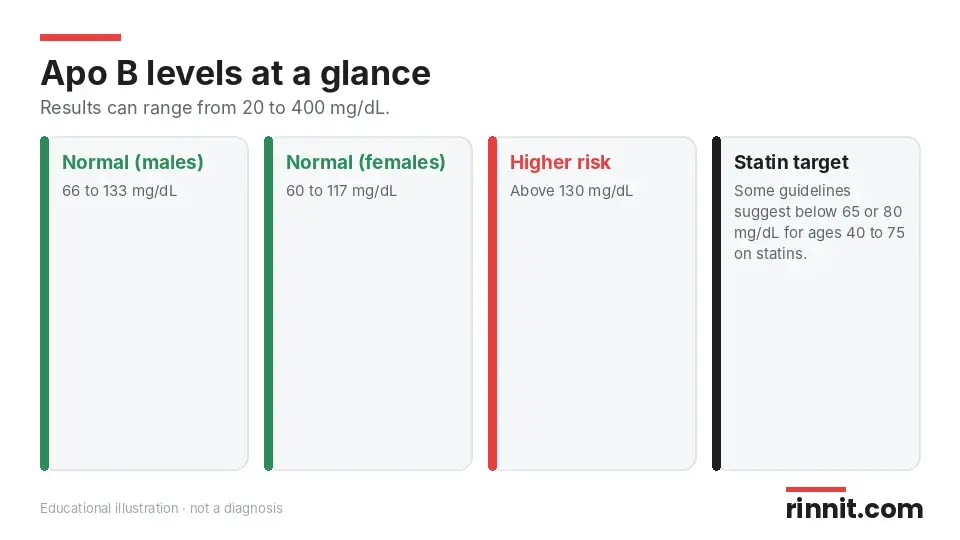
Apo B results can range from 20 to 400 mg/dL. [1]
Result | What it means |
66 to 133 mg/dL (males) | Normal |
60 to 117 mg/dL (females) | Normal |
Above 130 mg/dL | Higher risk of heart and blood vessel disease |
Below 65 or 80 mg/dL | Target some cardiology guidelines suggest for people aged 40 to 75 who take statins |
Sources: [1]
What can raise Apo B?
Pregnancy
High cholesterol
Nephrotic syndrome, a kidney condition
Sources: [1]
What can lower Apo B?
Sepsis
Liver disease
Taking estrogen
Sources: [1]
What happens if your Apo B is high?
Your provider will recommend the same treatments used for high LDL cholesterol: [1]
Exercise for 30 minutes or more each day.
Eat plenty of fruits and vegetables.
Limit saturated fats.
Stay at a weight that's right for you.
Avoid tobacco products.
Take a cholesterol-lowering medicine if prescribed.
When will you get your results?
It usually takes several days. Every lab is different, so ask your provider when to expect results. Contact your provider if you have questions about your results or treatment. [1]
Is Apo B the same as LDL?
No. But knowing how much Apo B you have tells you how much LDL (bad cholesterol) you have. [1]
How much does an Apo B test cost?
Independent labs in the United States offer this test for less than $100. Check with your provider or insurer for the cost in your area. [1]
Questions to ask your provider
Should I have an Apo B test in addition to a lipid panel?
What is my Apo B level, and what is my target?
Do I need a cholesterol-lowering medicine?
How often should I recheck my Apo B?
Conclusion
An Apo B test counts the particles that carry bad cholesterol and build plaque in your arteries. It can give a sharper picture of heart and blood vessel risk than a standard lipid panel, especially if you have diabetes or metabolic syndrome.
If your level is high, the same steps that lower LDL cholesterol, from daily exercise to medicine, can bring your risk down.
Keep learning: Read our guides to the lipid panel, the calcium score test, the comprehensive metabolic panel (CMP) and statins. For more on this test, see StatPearls: Biochemistry, Apolipoprotein B.
FAQ
What is an Apo B test?
It is a blood test that counts the particles carrying bad cholesterol to estimate your risk of heart and blood vessel disease. [1]
What is a normal Apo B level?
A normal level is 66 to 133 mg/dL for males and 60 to 117 mg/dL for females. [1]
What Apo B level is high?
A level above 130 mg/dL means a higher risk of heart and blood vessel disease. [1]
Do I need to fast for an Apo B test?
No, unless you're having a lipid panel at the same time, which needs a 12-hour fast. [1]
Is Apo B better than LDL cholesterol?
Some providers find it more accurate, especially for people with metabolic syndrome or diabetes. [1]
Is Apo B the same as LDL?
No, but your Apo B level tells you how much LDL you have. [1]
What raises Apo B?
Pregnancy, high cholesterol and nephrotic syndrome can raise it. [1]
How do you lower Apo B?
The same way you lower LDL: daily exercise, more fruits and vegetables, less saturated fat, a healthy weight, no tobacco and medicine if needed. [1]
How long do Apo B results take?
Usually several days, depending on the lab. [1]
How much does an Apo B test cost?
Independent US labs offer it for less than $100. [1]
Related Reading
Learn more in our guide to Understanding Hyperlipidemia: Managing High Cholesterol for Heart Health.
Learn more in our guide to High Blood Cholesterol: What Your Numbers Mean, Why It Matters, and How to Lower It.
Learn more in our guide to What Is Cardiovascular Disease? Symptoms, Causes, and Prevention.
Learn more in our guide to What Is Metabolic Syndrome? Five Warning Signs and How to Reverse Your Risk.
Learn more in our guide to Nephrotic Syndrome: Symptoms, Causes, and Treatment Guide.
Learn more in our guide to Diabetes: Symptoms, Types, Causes, Diagnosis & Treatment — Complete Guide.
Blood Tests for Heart Disease Risk: Lipids, Lp(a), apoB and hs-CRP explains the blood tests used to estimate coronary artery disease risk.
References
Cleveland Clinic. Apolipoprotein B (APOB) Test. Cleveland Clinic. Last updated May 16, 2023. https://my.clevelandclinic.org/health/diagnostics/24992-apolipoprotein-b-test
Sniderman AD, Williams K, Contois JH, et al. A meta-analysis of low-density lipoprotein cholesterol, non-high-density lipoprotein cholesterol, and apolipoprotein B as markers of cardiovascular risk. Circ Cardiovasc Qual Outcomes. 2011;4(3):337-345. PMID 21487090. https://doi.org/10.1161/CIRCOUTCOMES.110.959247
Thanassoulis G, Williams K, Ye K, et al. Relations of change in plasma levels of LDL-C, non-HDL-C and apoB with risk reduction from statin therapy: a meta-analysis of randomized trials. J Am Heart Assoc. 2014;3(2):e000759. PMID 24732920. https://doi.org/10.1161/JAHA.113.000759
Medical disclaimer
This article is for general education only and does not replace advice from a qualified healthcare professional. Talk to your doctor about your own diagnosis and treatment, and seek emergency care right away for severe or sudden symptoms.



Comments