Methylmalonic Acid (MMA) Test: Normal Range, High MMA and Vitamin B12

Updated: 2 days ago
Written and medically reviewed by Dr. Baraa Alnahhal, MD · Last reviewed: November 2026 · How we review
Quick Answer
A methylmalonic acid (MMA) test is a blood or urine test that measures a substance that builds up when the body doesn't have enough vitamin B12 or can't use it properly. Because MMA rises early, it can reveal a B12 deficiency even when the B12 level looks normal. A typical normal blood level is below 0.40 µmol/L.
What the research says
MMA helps avoid over- and under-diagnosis: an analysis of US national survey data from 1999–2004 found that the share of adults labeled B12-deficient varied widely depending on the marker used; about 6% had an MMA above age-specific cutoffs, and combining B12 with MMA gave results close to the best three-marker approach (Mineva EM et al., American Journal of Clinical Nutrition, 2021) [2]
MMA starts rising before B12 looks very low: in a study of older Dutch adults, MMA began to rise once blood B12 fell below about 330 pmol/L and rose sharply below 220 pmol/L, levels that many labs still report as normal or borderline (van Wijngaarden JP et al., Journal of Nutrition, Health & Aging, 2017) [3]
Key takeaways
MMA rises when your body can't use vitamin B12 properly.
It can detect early B12 deficiency when B12 levels look normal.
Typical normal: below 0.40 µmol/L in blood; up to 4.0 mmol/mol creatinine in urine.
Done with a blood draw or urine sample; newborns get a heel stick.
Usually interpreted with B12 and homocysteine.
What is methylmalonic acid?
Your body uses vitamin B12 to convert methylmalonic acid into another compound during the breakdown of certain fats and proteins. When B12 is low, or your body can't absorb or use it, this step slows and MMA builds up in your blood and urine. That makes MMA a sensitive "functional" marker: it shows whether B12 is actually working in your cells, not just how much is in your blood. Sources: [1]
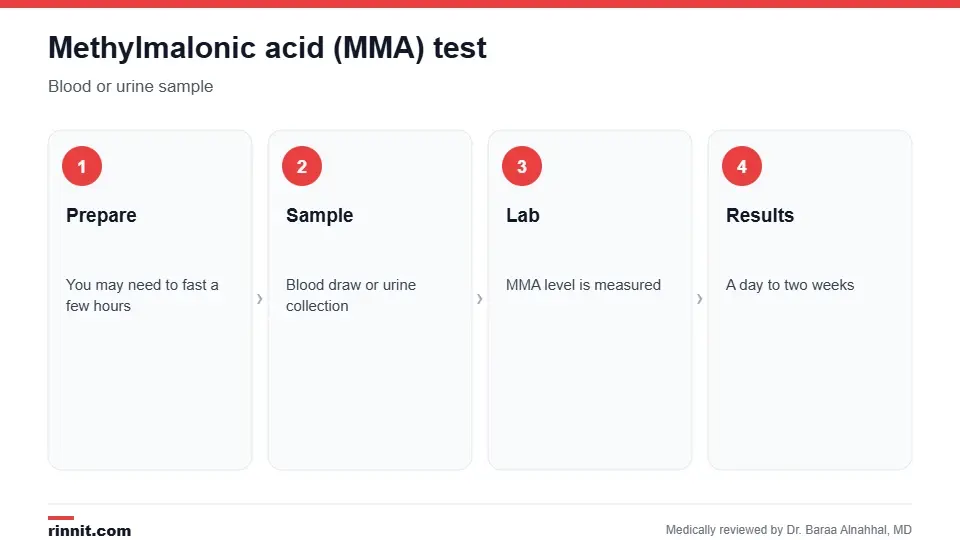
MMA is measured in blood or urine.
Why is it done?
To confirm vitamin B12 deficiency when the B12 level is borderline or symptoms suggest it.
For symptoms such as fatigue, weakness, digestive problems, low appetite, numbness or tingling in the hands or feet, or memory changes.
To investigate megaloblastic anemia found on a complete blood count, often with a high MCV.
To evaluate peripheral neuropathy.
As part of newborn screening for methylmalonic acidemia, and to monitor it with urine tests. Sources: [1]
How do I prepare?
You may need to fast for several hours before a blood test. For a 24-hour urine test, you may be asked to avoid certain foods or medicines. Follow your provider's instructions. Sources: [1]
How is the test done?
Blood test: a phlebotomist draws blood from a vein near your elbow; it takes a few minutes.
24-hour urine test: you collect all your urine for 24 hours in a container and return it to the lab.
Single urine sample: you collect a sample in a sterile cup.
Newborns: a few drops of blood from a heel prick. Sources: [1]
What do the results mean?
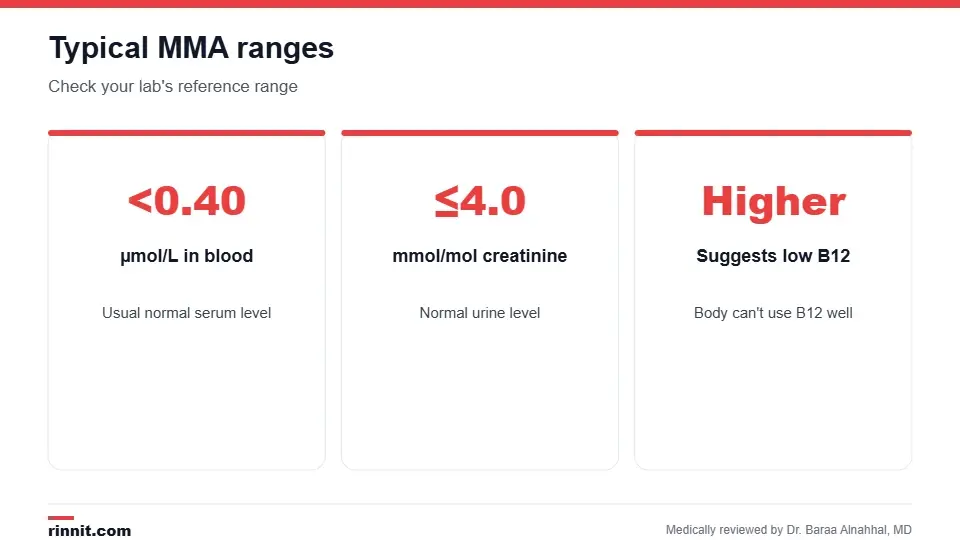
Ranges vary by lab, so check your report.
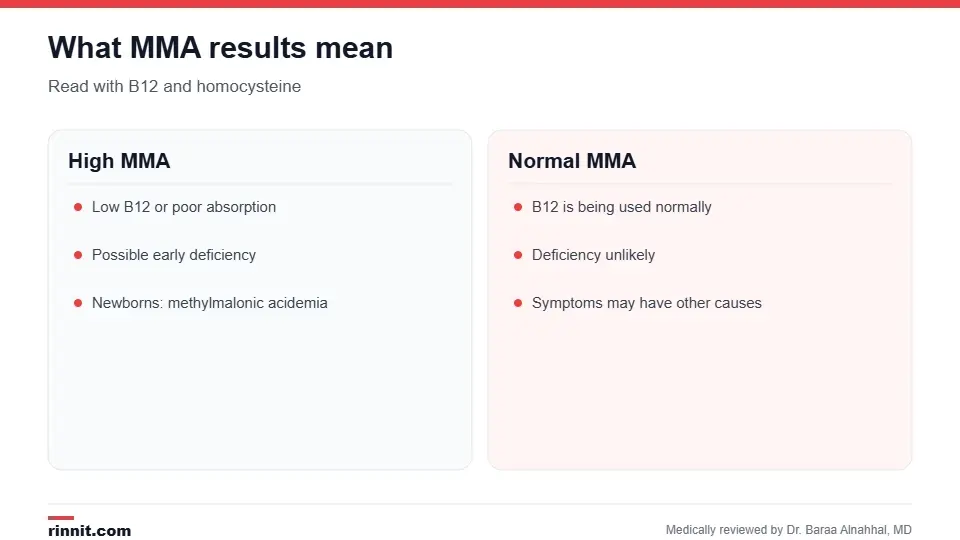
MMA is read together with B12 and homocysteine.
Result | What it may mean |
Normal MMA | Your body is using B12 normally; symptoms likely have another cause |
High MMA with low B12 | Vitamin B12 deficiency |
High MMA with normal B12 | Possible early or mild B12 deficiency, especially with symptoms |
High MMA in a newborn | Possible methylmalonic acidemia, confirmed with more tests |
Sources: [1, 2, 3]
Kidney disease can also raise MMA, so your provider considers kidney function. Providers often review MMA alongside B12 and the homocysteine test; homocysteine rises with both B12 and folate deficiency, while MMA rises mainly with B12 deficiency. Results usually take a day to two weeks. Sources: [1]
Risks
A blood draw carries a small risk of bruising or infection. Urine results can be inaccurate if the sample isn't collected correctly or becomes contaminated. Sources: [1]
What happens next?
If MMA is high, your provider looks for the cause of B12 deficiency, such as diet, pernicious anemia, stomach or intestinal surgery, or medicines like metformin and acid reducers, and usually starts B12 supplements or injections. Newborns with methylmalonic acidemia are treated with supplements and a special low-protein diet. Sources: [1]
Conclusion
The MMA test is one of the best ways to tell whether your body is truly short of vitamin B12. It can catch deficiency early, before nerve damage or anemia becomes severe, so talk with your provider if you have symptoms even when your B12 level looks normal.
Keep learning: read about vitamin B12 deficiency and vitamin deficiency anemia.
Frequently asked questions
What does an MMA test show?
Whether your body has enough working vitamin B12.
What is a normal MMA level?
Usually below 0.40 µmol/L in blood, though labs vary.
What does high MMA mean?
Most often vitamin B12 deficiency.
Can MMA be high with normal B12?
Yes. It can signal an early or mild deficiency.
Do I need to fast?
You may need to fast for several hours; ask your provider.
Is the test done on blood or urine?
Either; blood is most common for adults.
Why is MMA checked in newborns?
To screen for methylmalonic acidemia, a rare inherited disorder.
Can kidney disease affect MMA?
Yes. It can raise MMA levels.
How long do results take?
Usually a day to two weeks.
What's the difference between MMA and homocysteine?
Both rise with B12 deficiency, but homocysteine also rises with folate deficiency.
Related Reading
Understanding Vitamin B12 Deficiency: Causes, Symptoms, and Recovery the deficiency an MMA test detects.
Megaloblastic Anemia: Understanding Vitamin-Deficiency Blood Disorders anemia caused by low B12 or folate.
Vitamin Deficiency Anemia: Symptoms, Causes, Treatment & Complete Guide anemia from low vitamin levels.
Peripheral Neuropathy: Symptoms, Causes, and Treatment Options Explained nerve damage that B12 deficiency can cause.
Homocysteine Test: Normal Levels, Causes of High Homocysteine and What It Means for Your Heart the companion test for B12 and folate status.
References
Cleveland Clinic. Methylmalonic Acid Test: What It Is, Procedure, Results & Types. Cleveland Clinic. Last updated August 6, 2024. https://my.clevelandclinic.org/health/diagnostics/methylmalonic-acid-test
Mineva EM, Sternberg MR, Bailey RL, et al. Fewer US adults had low or transitional vitamin B12 status based on the novel combined indicator of vitamin B12 status compared with individual, conventional markers, NHANES 1999-2004. Am J Clin Nutr. 2021;114(3):1070-1079. PMID 33963731. https://doi.org/10.1093/ajcn/nqab122
van Wijngaarden JP, Dhonukshe-Rutten RAM, Brouwer-Brolsma EM, et al. Vitamin B12 intake and related biomarkers: associations in a Dutch elderly population. J Nutr Health Aging. 2017;21(10):1268-1276. PMID 29188889. https://doi.org/10.1007/s12603-017-0911-6
Medical disclaimer
This article is for general education only and does not replace advice from a qualified healthcare professional. Talk to your doctor about your own diagnosis and treatment, and seek emergency care right away for severe or sudden symptoms.



Comments