Hydrogen Breath Test: How to Prepare, What Happens and What Results Mean

Updated: 6 days ago
Written and medically reviewed by Dr. Baraa Alnahhal, MD · Last reviewed: November 2026 · How we review
Quick Answer: What is a hydrogen breath test?
A hydrogen breath test is a simple, noninvasive test that measures hydrogen in your breath after you drink a test sugar. It helps diagnose digestive problems such as lactose and other sugar intolerances and small intestinal bacterial overgrowth (SIBO), and it can help when providers are evaluating irritable bowel syndrome (IBS). [1]
You breathe into a bag before and every 15 to 30 minutes after the drink for a few hours. A rise of more than 20 parts per million (ppm) above your starting level points to poor sugar digestion. [1]
What the research says
Experts agree on how to read the test. A North American consensus reached agreement on 26 of 28 statements: a hydrogen rise of 20 ppm or more by 90 minutes on a glucose or lactulose test is positive for SIBO, and methane of 10 ppm or more counts as methane-positive. (Rezaie et al., The American Journal of Gastroenterology, 2017) [2]
The glucose test is more specific than lactulose for SIBO. Pooling 14 studies against jejunal culture, the glucose breath test had 54.5% sensitivity and 83.2% specificity, versus 42.0% and 70.6% for the lactulose test. (Losurdo et al., Journal of Neurogastroenterology and Motility, 2020) [3]
Key takeaways
The test measures hydrogen (and often methane) in your breath after a test sugar. [1]
It helps diagnose lactose, fructose, sucrose or sorbitol intolerance and SIBO. [1]
Preparation starts a month before, with antibiotics and probiotics stopped. [1]
You fast for 12 hours before the test and give breath samples every 15 to 30 minutes. [1]
A rise of more than 20 ppm above baseline suggests poor digestion of the test sugar. [1]
What is a hydrogen breath test?
A hydrogen breath test measures how much hydrogen is in the air you breathe out. It is simple and noninvasive, and it helps diagnose digestive problems. [1]
Providers usually order it to confirm or rule out: [1]
Carbohydrate malabsorption: trouble digesting lactose, fructose, sucrose or sorbitol. Lactose intolerance is the most common.
Small intestinal bacterial overgrowth (SIBO): when bacteria from the colon have moved into the small intestine.
When providers are diagnosing irritable bowel syndrome (IBS), they need to consider both SIBO and carbohydrate malabsorption as possible contributors. [1]
How does a hydrogen breath test work?
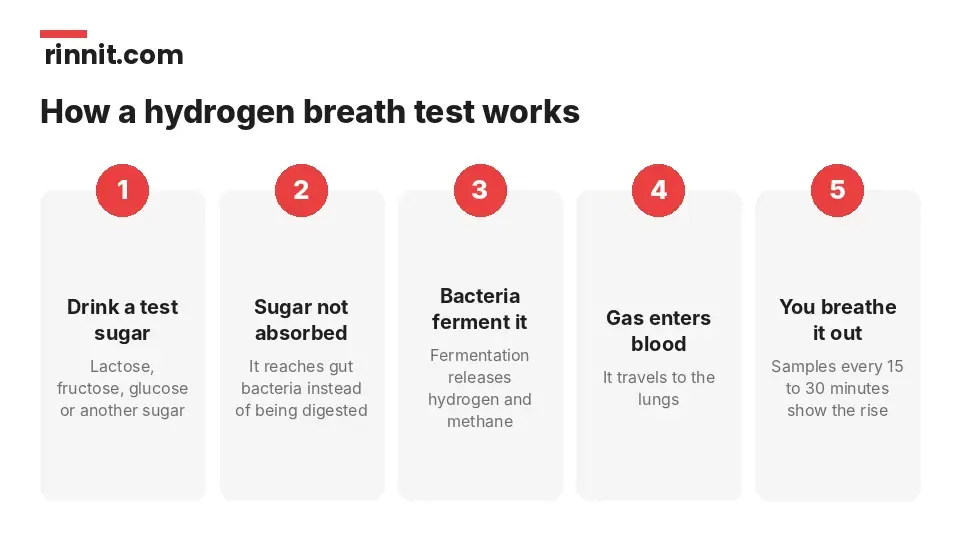
From sugar drink to measurable breath gas.
The gas that causes bloating, pain and flatulence is at least partly hydrogen. It is made when bacteria in your gut ferment sugars that were not fully digested before reaching the colon. That gas is absorbed into your blood and breathed out, so your breath reflects what is happening in your gut. How much hydrogen appears, and how quickly, shows how well you digest the test sugar. [1]
Which sugar is used?
The test uses one sugar at a time, chosen for the suspected problem: lactose, fructose, sucrose, sorbitol, glucose or lactulose. Lactose, fructose, sucrose and sorbitol test for intolerance. Glucose is the preferred sugar for SIBO, because it is normally absorbed quickly in the small intestine; if bacteria there ferment it into hydrogen, that suggests overgrowth. [1]
What about methane?
Some people make more methane than hydrogen, so most clinics now measure both. The methane test is newer and may be less accurate than the hydrogen test. The H. pylori breath test is different: it measures carbon dioxide after a carbon-labeled drink. [1]
How do you prepare for a hydrogen breath test?

Preparation starts a month ahead.
When | What to do |
One month before | Stop antibiotics and probiotics |
One week before | Stop smoking, laxatives, fiber supplements, antacids and prokinetics (medicines that affect gut movement) |
One day before | Eat only low-fiber, easy-to-digest foods; plain baked or boiled fish or poultry with salt and pepper is a common choice |
Day of the test | Fast for 12 hours (no food or water) and avoid exercise and sleep within a few hours of the test |
Sources: [1]
The day-before diet often leaves out oils and fats, sweeteners and seasonings, dairy and grains other than white bread and white rice. Recommendations vary, so follow your provider's instructions and check before stopping any prescribed medicine. [1]
What happens during the test?
You breathe into a breathalyzer, often a bag with a tube, to give a baseline sample.
You drink the test sugar solution.
You give more breath samples about every 15 to 30 minutes for the next few hours.
You note any symptoms, such as belly pain, bloating or gas.
Keep physical activity low during the test. Reading or watching TV while you wait is fine. [1]
Are there side effects?
The test is generally harmless. The sugar may cause belly discomfort similar to the symptoms that led to testing. [1]
What do the results mean?
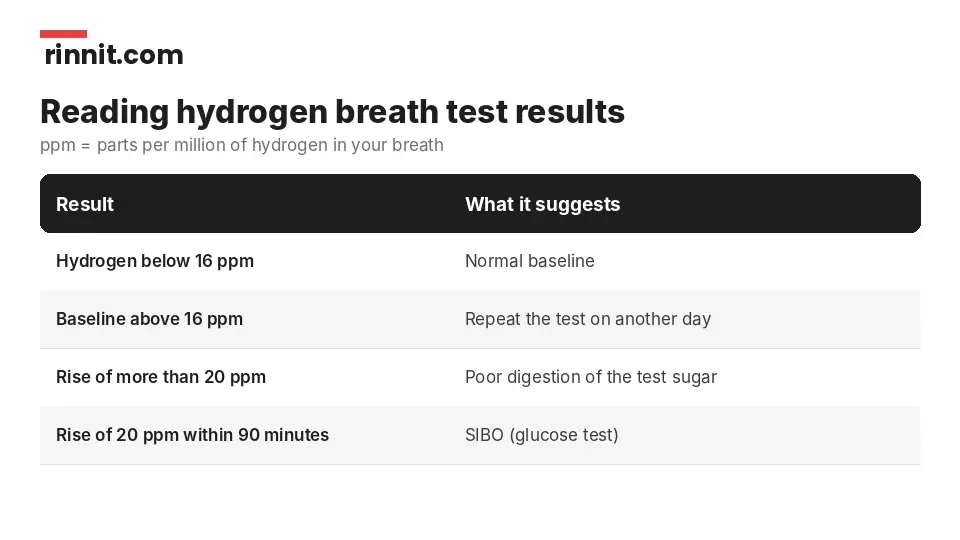
How hydrogen levels are read.
Result | What it suggests |
Hydrogen below 16 ppm | Normal |
Baseline above 16 ppm | Repeat the test another day after returning to your usual pre-test diet |
Rise of more than 20 ppm above baseline | Poor digestion of the test sugar (carbohydrate malabsorption) |
Rise of 20 ppm above baseline within 90 minutes | SIBO |
Sources: [1]
How reliable is it?
A positive result usually shows you do not digest the test sugar well. Breath tests for SIBO are less reliable: they can miss many cases and sometimes give false positives. Results can be wrong if you did not follow the preparation, such as taking antibiotics or laxatives or not fasting. About 15% to 30% of people make more methane than hydrogen, which may affect results. A positive result may not explain all your symptoms, so you may need more tests or diet changes. [1]
Conclusion
A hydrogen breath test turns your breath into a window on your gut. With careful preparation, it can show whether a sugar such as lactose is behind your bloating or whether bacteria have overgrown in your small intestine. [1]
Follow the month-long preparation closely, because antibiotics, laxatives or a missed fast can skew the results. [1]
Keep learning: Read our guides to SIBO and lactose intolerance, or see how endoscopy looks inside the gut. For more background, see MedlinePlus on lactose intolerance.
FAQ
What is a hydrogen breath test?
A noninvasive test that measures hydrogen in your breath after a test sugar to check how well you digest it. [1]
What does a hydrogen breath test diagnose?
Lactose, fructose, sucrose or sorbitol intolerance and SIBO. [1]
How do I prepare for a hydrogen breath test?
Stop antibiotics and probiotics a month before, certain medicines and smoking a week before, eat a low-fiber diet the day before and fast 12 hours. [1]
Can I drink water before a hydrogen breath test?
No. You fast from food and water for 12 hours. [1]
How long does a hydrogen breath test take?
A few hours, with samples every 15 to 30 minutes. [1]
What is a normal hydrogen breath test result?
Hydrogen below 16 ppm. [1]
What result means lactose intolerance?
A rise of more than 20 ppm above baseline after lactose suggests poor lactose digestion. [1]
What breath test result suggests SIBO?
A rise of 20 ppm above baseline within 90 minutes, usually on a glucose test. [1]
Why is methane measured too?
About 15% to 30% of people make more methane than hydrogen, which can affect results. [1]
Does a hydrogen breath test have side effects?
It is generally harmless, but the sugar may cause temporary belly discomfort. [1]
Related Reading
Gastric Emptying Study in Children (Solid-Meal GES): What to Expect explains the stomach emptying test for children.
Small Intestinal Bacterial Overgrowth (SIBO) Guide: Symptoms, Causes, Diagnosis, and Treatment explains the bacterial overgrowth the glucose breath test looks for.
Lactose Intolerance: Symptoms, Causes, Diagnosis, and Treatment Guide covers the most common sugar intolerance this test finds.
Irritable Bowel Syndrome: Symptoms, Causes, and Treatment explains a condition where breath testing helps rule out other causes.
Gastric Emptying Study: How to Prepare, What Happens and Normal Results explains the scan that measures how fast food leaves the stomach.
References
Cleveland Clinic. Hydrogen Breath Test: What Is It, How To Prep & Results. Cleveland Clinic. Last updated May 3, 2022. https://my.clevelandclinic.org/health/diagnostics/12360-hydrogen-breath-test
Rezaie A, Buresi M, Lembo A, et al. Hydrogen and Methane-Based Breath Testing in Gastrointestinal Disorders: The North American Consensus. Am J Gastroenterol. 2017;112(5):775-784. PMID 28323273. https://doi.org/10.1038/ajg.2017.46
Losurdo G, Leandro G, Ierardi E, et al. Breath Tests for the Non-invasive Diagnosis of Small Intestinal Bacterial Overgrowth: A Systematic Review With Meta-analysis. J Neurogastroenterol Motil. 2020;26(1):16-28. PMID 31743632. https://doi.org/10.5056/jnm19113
Medical disclaimer
This article is for general education only and does not replace advice from a qualified healthcare professional. Talk to your doctor about your own diagnosis and treatment, and seek emergency care right away for severe or sudden symptoms.



Comments