Overbite: Symptoms, Causes, and Management Strategies

Updated: 2 days ago
Medically reviewed by Dr. Baraa Alnahhal, MD · Last reviewed: October 2026
Quick Answer
An overbite is a form of malocclusion in which the upper teeth overlap the lower teeth vertically [1]. A small overlap is normal, but an excessive deep bite can cause jaw stiffness, breathing issues and premature tooth wear [1]. Diagnosis usually starts with a dental exam, often with dental X-rays, and may involve referral to an orthodontist [1].
What the research says
Deep bite is hard to hold in place, and timing matters. A systematic review of six studies noted that deep bite has a high relapse tendency and is more common in mixed dentition (21.3%) than in temporary dentition (14.1%); patients treated in late mixed to early permanent dentition had better efficacy and more stable results than those treated in the early mixed phase (PubMed: El Guennouni et al., Int Orthod, 2025) [2].
Several orthodontic methods reduce overbite in teens and adults. In a systematic review of eight randomized trials, miniscrew-supported intrusion reduced overbite more than a Connecticut intrusion arch (mean difference −0.36 mm; low- to moderate-quality evidence), and anterior bite turbos and a lower reverse curve of Spee both effectively reduced overbite (−4.07 mm and −3.27 mm; moderate-quality evidence) (PubMed: Rasol et al., Prog Orthod, 2025) [3].
Clear aligners work for mild to moderate deep bites, with limits. A systematic review of 18 studies found aligners opened the bite by 0.4 to 3.8 mm, with accuracy of 33% to 48.88% in correcting deep bite, so refinements are often needed; they appear less effective than fixed braces for skeletal cases, and the evidence was low quality (PubMed: Husain et al., Clin Oral Investig, 2025) [4].
What is an overbite, and how does dental alignment work?
An overbite occurs when the upper teeth overlap the lower teeth more than the typical functional range [1]. While a small degree of overlap is necessary for proper dental health and chewing function, an excessive overlap — often referred to as a "deep bite" — is a type of malocclusion (a "bad bite") [1] that requires professional attention.
Feature | Overbite (deep bite) | Overjet (buck teeth) |
Misalignment type | Vertical | Horizontal |
Appearance | Upper teeth cover too much of the lower teeth | Upper teeth protrude diagonally outward |
Common impact | Jaw pain and tooth erosion | Increased risk of front tooth injury |

What are the common symptoms and signs of an overbite?
The primary indicator of an overbite is that the upper front teeth overlap the lower front teeth more than they should [1]. In severe cases, the lower teeth may be largely hidden when the jaw is closed. Beyond appearance, this misalignment often shows up as functional challenges and physical discomfort [1].
Symptom category | Specific signs |
Functional | Pain while chewing, speech challenges, breathing issues |
Physical | Jaw pain, temporomandibular disorders (TMD), headaches, earaches, neck pain |
Dental | Excessive tooth erosion, frequent cavities, gum disease |
What causes an overbite, and who is at risk?
Overbites can develop due to a combination of genetic predispositions and behavioral habits during early childhood [1]. The shape of the jaw and the way teeth erupt are often inherited traits that set the baseline alignment of the mouth [1].
Cause type | Examples and behaviors |
Genetic | Inherited jaw shape and bone structure |
Behavioral | Excessive nail biting, teeth grinding (bruxism) |
Developmental | Tongue-thrusting, thumb-sucking or pacifier use past age 3 |

How is an overbite diagnosed?
Dentists typically notice an overbite during a routine physical exam [1]. If a vertical misalignment is suspected, the patient may be referred to an orthodontist, a dentist who specializes in tooth and jaw alignment [1]. The process involves measuring the degree of overlap to judge how severe the malocclusion is.
How is an overbite managed and treated?
Treatment for an overbite depends on the patient's age and the severity of the misalignment [1]. Because children are still growing, their bones are softer and their teeth move more easily, so dentists can often fix an overbite in kids with orthodontics alone [1].
Pediatric treatment options
Palate expanders: used during growth spurts to widen the roof of the mouth [1].
Headgear: an orthodontic appliance that corrects the position of the jaw [1].
Braces: move all teeth into proper alignment [1].
Primary tooth removal: removing baby teeth to make room for adult teeth [1].
Retainers: keep teeth in alignment after braces [1].
Adult treatment options
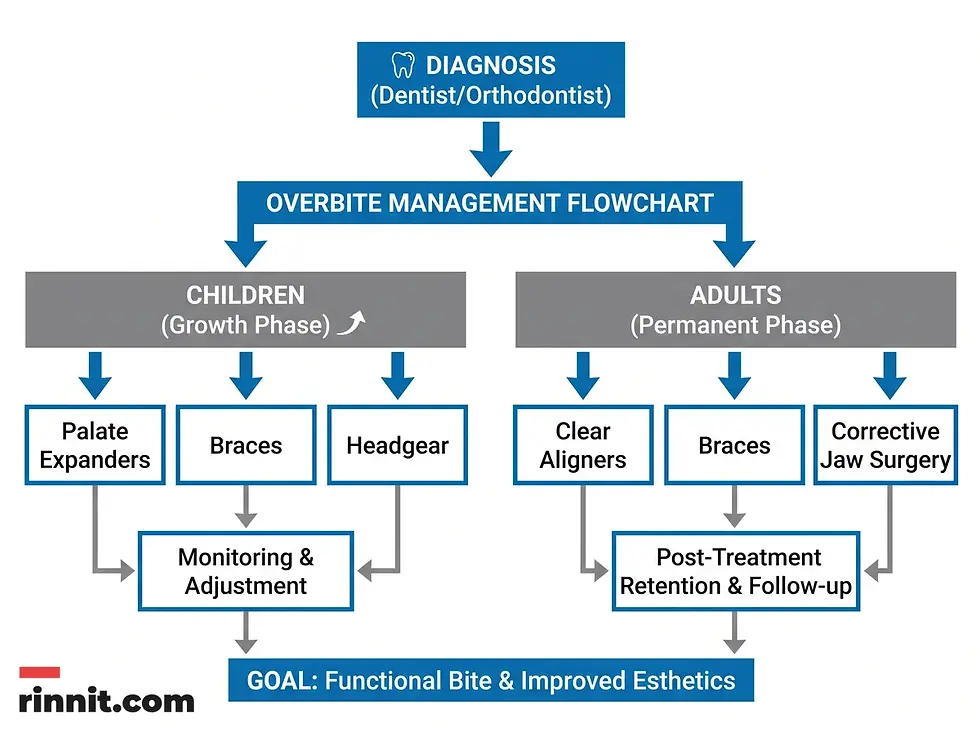
Can an overbite be prevented, and what is the long-term outlook?
Some people are born with an overbite, and that cannot be prevented [1]. But certain developmental factors can be managed to lower the chance that a child develops one [1]. If you have an overbite but are not ready for treatment, good oral hygiene and regular dental visits can help reduce the risk of complications [1].
Sippy cup alternatives: traditional spill-proof valves require sucking, and some children suck on the spout for long periods; a 360-degree cup that lets a child sip from the side is a better choice [1].
Habit cessation: discourage pacifier use and thumb-sucking by age 3 [1].
Early dental visits: a child's first dental visit should happen by age 1 or when the first tooth comes in [1].
Protective gear: wear a mouth guard during contact sports and a night guard if you grind your teeth or thrust your tongue while you sleep [1].
Key Takeaways
An overbite is a vertical dental misalignment where the upper teeth overlap the lower teeth more than they should. While a minor overlap is normal and necessary for function, an overlap beyond 2 to 4 millimeters can lead to jaw pain, tooth erosion, and speech challenges [1]. Treatment ranges from childhood palate expanders and braces to adult orthodontics and corrective jaw surgery [1].
Take the Next Step
Not everyone with an overbite needs treatment, but if your dentist uses this term, ask how it affects your oral health. Treating it sooner rather than later can reduce your risk of further issues [1]. See your dentist about every six months [1], and tell them about any new pain, infection, or tooth mobility between visits.
Further reading: Cleveland Clinic — Overbite
Frequently Asked Questions
1. What is the difference between an overbite and an overjet?
An overbite is a vertical misalignment where upper teeth overlap lower teeth downward. An overjet is a horizontal misalignment where upper teeth protrude forward.
2. Can an overbite cause headaches?
Yes. An untreated overbite can lead to jaw strain and temporomandibular disorders (TMD), which frequently cause headaches and earaches.
3. Is a small overbite normal?
Yes. A small vertical overlap is necessary for the teeth to function correctly during chewing and speaking. It becomes an overbite when the upper teeth overlap the lower teeth by more than 2 to 4 millimeters.
4. At what age should a child see a dentist for bite issues?
A child should have their first dental visit by age 1 or when their first tooth appears, so the dentist can spot potential oral health issues early.
5. Can clear aligners fix a deep bite?
Adults can be treated with traditional or clear braces, and clear aligners can correct some mild to moderate deep bites, though they often need refinements. Severe cases may also need corrective jaw surgery. Your orthodontist can tell you which option fits.
6. Does overbite get worse with age?
Left untreated, an overbite can lead to complications such as jaw pain and stiffness, headaches, tooth decay, and gum disease. Regular dental visits let your dentist monitor it.
7. What is a deep bite?
A deep bite is another name for an overbite, where the upper teeth overlap the lower teeth more than they should.
8. Is surgery always necessary for adults?
No. In some cases orthodontic treatment alone is enough. Corrective jaw surgery is reserved for some severe cases.
9. How long does overbite treatment take?
The length of treatment depends on the severity of the overbite and your age. Ask your dentist or orthodontist how long treatment is likely to take for you.
Related Reading
Making space for orthodontic treatment: Interproximal Reduction (IPR): Purpose, Procedure, Benefits and Risks
References
Cleveland Clinic. Overbite. Cleveland Clinic Health Library. Medically reviewed; last updated February 9, 2024. https://my.clevelandclinic.org/health/diseases/21473-overbite
El Guennouni B, Houb-Dine A, Ben Mohimd H, et al. Orthodontic treatment of deep bite in mixed dentition and/or early permanent dentition: what about stability? A systematic review. Int Orthod. 2025;23(2):100956. doi:10.1016/j.ortho.2024.100956. PMID: 39742828.
Rasol OA, Hajeer MY, Alam MK, et al. Evaluation of different methods of correcting deep bite in adult and adolescent patients: a systematic review and meta-analysis. Prog Orthod. 2025;26(1):37. doi:10.1186/s40510-025-00586-y. PMID: 41091306.
Husain F, Riccardi J, Alletto L, et al. Effectiveness and accuracy of clear aligners in treatment of deep bite: a systematic review. Clin Oral Investig. 2025;29(6):306. doi:10.1007/s00784-025-06381-7. PMID: 40394411.
Medical Disclaimer
This article is for informational purposes only and does not constitute medical advice. Always seek the advice of your physician or other qualified health provider with any questions you may have regarding a medical condition. Never disregard professional medical advice or delay in seeking it because of something you have read here.



Comments