Maxillofacial Surgery: Advanced Care for Face, Jaw, and Neck Conditions

Updated: 2 days ago
Medically reviewed by Dr. Baraa Alnahhal, MD · Last reviewed: October 2026
Maxillofacial surgery is a special type of dentistry in which a highly trained dental surgeon operates to treat diseases or fix injuries of the face, jaw, neck, or mouth. Common examples include jaw surgery, cleft palate repair, and reconstructive facial surgery [1].
Quick Answer: What is maxillofacial surgery?
Maxillofacial surgery is surgery that treats conditions of the mouth, jaw, face and neck, including jaw fractures, cleft lip and palate, TMJ disorders and head and neck cancers. Most operations use general anesthesia. Recovery ranges from a week or two for extractions or implants to several months for jaw surgery. Call your provider for fever, pus or uncontrolled pain. [1]
What the research says
Jaw (orthognathic) surgery corrects deformities with high satisfaction, but complications are common and mostly minor. A systematic review of 65 studies with 6,482 patients found that 87.3% kept skeletal stability at one year or longer, the overall complication rate was 32.4% (mostly minor and self-limiting), neurosensory disturbances occurred in 52.8% of patients with 92.6% recovering by 12 months and 3.4% having permanent changes, relapse of more than 2 mm occurred in 18.7%, and patient satisfaction was 87.6% (Ebenezer et al., Front Oral Health, 2026 [2]).
Chewing, speech, and taste may dip briefly and then improve. A systematic review of 17 studies of oral function-related quality of life found that mild deterioration in oral function can occur in the short term after jaw surgery, while long-term follow-up showed significant improvements, particularly in chewing, speech, and taste (Zheng et al., Oral Maxillofac Surg, 2025 [3]).
Digital planning can improve precision without changing complication rates. A meta-analysis of 30 studies (12 randomized trials and 18 cohort studies, 1,317 patients) found that patient-specific implants gave smaller translational deviations than CAD/CAM splints in jaw surgery, with no significant difference in complications (relative risk 1.01, 95% CI 0.64 to 1.60) (Guo et al., BMC Oral Health, 2026 [4]).
What Is Maxillofacial Surgery?
Maxillofacial surgery is a special type of dentistry. It is similar to oral surgery, but in addition to treating conditions that affect your mouth, it also treats conditions that affect your jaw, face, and neck. If your dentist thinks you need maxillofacial surgery, they will refer you to a specialist for an evaluation [1].
Feature | Oral surgeons and maxillofacial surgeons |
Education and credentials | The same. |
Shared procedures | Both extract teeth, do bone grafts, and place dental implants. |
More complex procedures | Maxillofacial surgeons also do procedures such as reconstructive facial surgery. |
Where they work | Oral surgeons usually have private practices and work from outpatient surgery centers, while maxillofacial surgeons typically work in hospitals. |
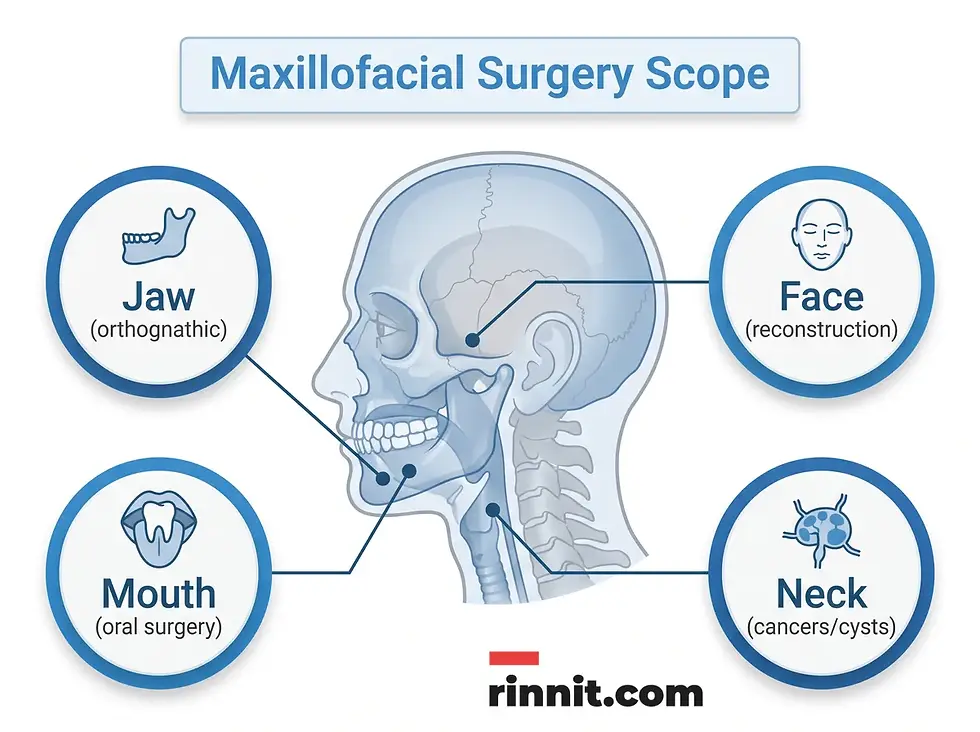
Maxillofacial surgery covers the jaw, face, mouth, and neck.
Which conditions does maxillofacial surgery treat, and with which procedures?
Maxillofacial surgeons can treat broken jaws, chronic facial pain, congenital (present at birth) facial abnormalities, facial fractures (including the cheekbones, eye sockets, and jaws), head and neck cancers, jaw cysts and tumors, prognathism (a protrusion of one or both jaws), and TMJ disorders [1]. The table groups these conditions with the procedures most often used for them [1]:
Category | Conditions | Common procedures |
Trauma and injury | Broken jaws and facial fractures (cheekbones, eye sockets, and jaws). | Reconstructive facial surgery. |
Congenital differences | Cleft lip, cleft palate, and other facial abnormalities present at birth. | Cleft lip and cleft palate repair. |
Jaw alignment and chronic conditions | Prognathism, TMJ disorders, and chronic facial pain. | Jaw (orthognathic) surgery and jaw implants. |
Pathology | Jaw cysts and tumors, and head and neck cancers. | Maxillectomy and reconstructive facial surgery. |
Oral reconstruction | Bone loss and missing teeth. | Dental bone grafting and dental implants. |
Breathing during sleep | Obstructive sleep apnea. | Sleep apnea surgery. |
What is the maxillofacial surgery experience like?
What happens depends on your situation. Some procedures take a single visit, while others need a staged approach and multiple appointments, and your provider will tell you what to expect [1].
Day of Surgery
In general [1]:
A trusted friend or family member drives you to the hospital.
A healthcare provider gives you general anesthesia so you sleep through the procedure.
Once you are asleep, your surgeon makes one or more incisions, and where they go depends on the type of surgery.
Your surgeon does the surgery with small, specialized instruments and may take dental X-rays during the procedure.
When the procedure is over, your surgeon closes the incisions with stitches and covers the surgical site.
After Surgery
Your team moves you to a recovery room. As the anesthesia wears off you may have some discomfort, and your provider will prescribe medication to help. Normal side effects include bleeding, bruising, and swelling. Your surgeon will tell you how the procedure went and what to expect during recovery, and when you are cleared to go home, you will need someone you trust to drive you. Your stitches will dissolve in about a week, or your surgeon will remove them at your follow-up visit [1].
What are the benefits of maxillofacial surgery?
Maxillofacial surgery can relieve pain, improve biting, chewing and speaking, protect oral and overall health, and address cosmetic concerns such as crowded teeth.
Pain relief: misaligned jaws or teeth can cause facial pain, headaches, and toothaches, and maxillofacial surgery can correct these issues [1].
Better function: jaw and facial conditions can interfere with biting, chewing, and speaking, and surgery helps all the structures work together [1].
Improved health: conditions and injuries of the mouth or face can affect your oral and overall health, and sometimes surgery is the only way to get rid of an infection and reduce the risk of further damage [1].
Enhanced aesthetics: surgery can address cosmetic concerns such as crowded teeth or facial abnormalities [1].
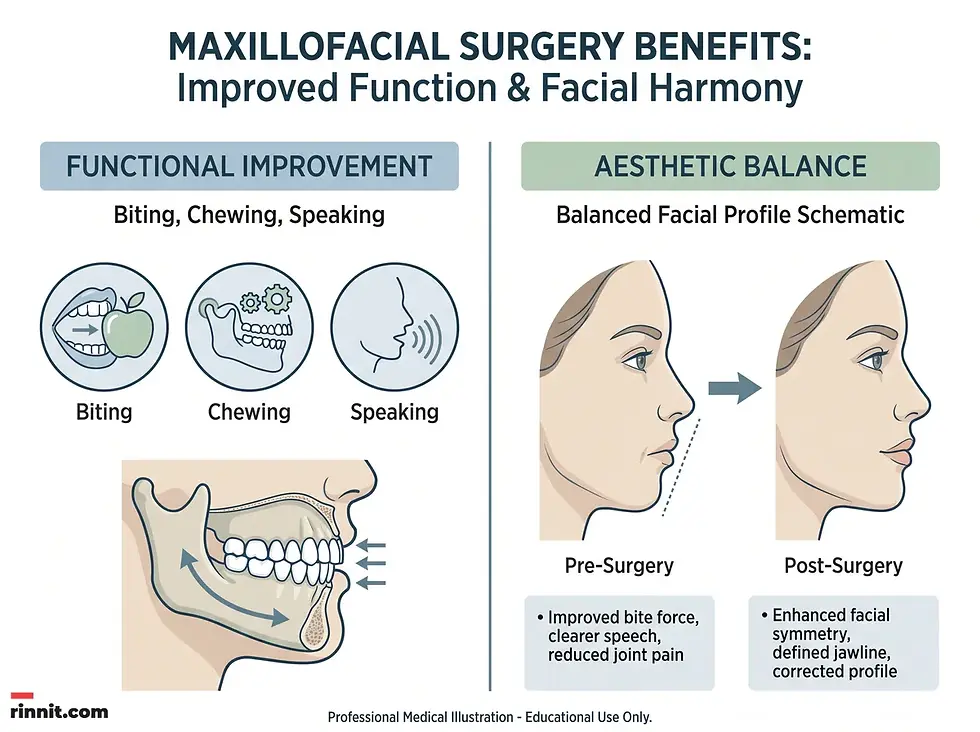
Jaw surgery can improve biting, chewing, and speaking, as well as facial balance.
What is recovery and the long-term outlook after maxillofacial surgery?
Recovery depends on the type of procedure. You will likely have some discomfort, sensitivity, swelling, and bleeding. Your provider will tell you what to expect in your situation [1].
Procedure | Typical healing time | What to expect |
Extractions or dental implants | About a week or two. | Discomfort, sensitivity, swelling, and bleeding. |
Complex procedures such as jaw surgery | Several months. | You can resume most normal activities, but you may have dietary restrictions. |
Making Recovery Easier
Your provider will give you specific instructions. In the meantime, general guidelines are to [1]:
Apply ice packs to reduce inflammation.
Elevate your head.
Get lots of rest.
Take all medications as prescribed.
Until your provider says it is okay, avoid [1]:
Foods that are crunchy, chewy, or hard.
Tobacco products and alcohol.
Strenuous activity.
Vigorous swishing or spitting.

A general recovery timeline. Your own timeline depends on your procedure, so follow your surgeon’s instructions.
What are the potential risks and complications of maxillofacial surgery?
Possible complications of maxillofacial surgery include [1]:
Excessive bleeding.
Damage to your nerves.
Dry socket.
Infection.
Injury to your bones or tissues.
Numbness or changes in sensation in your mouth or face.
Root fragment, a rare complication in which a piece of tooth root breaks off and stays in its socket.
Your provider will check for these complications at your follow-up visits [1].
When should you call your provider after maxillofacial surgery?
After maxillofacial surgery, seek medical attention if you develop [1]:
Fever or chills.
Pus coming from your incisions.
A salty, metallic, or bad taste in your mouth.
Severe pain that does not go away with medication.
Swelling that interferes with your breathing.
What is the bottom line on maxillofacial surgery?
Surgery on your face or mouth can feel intrusive, and dental anxiety may tempt you to skip treatment, but without surgery your condition may worsen. Maxillofacial surgeons today use advanced techniques that help you heal faster, and your provider can help you weigh your options [1].
Your next step: if you or your dentist suspect you have a jaw, face, or mouth condition that needs surgery, ask for a referral to a maxillofacial surgeon for an evaluation, and bring your questions about the procedure and recovery [1].
Frequently Asked Questions
What is the main difference between an oral surgeon and a maxillofacial surgeon?
Oral surgeons and maxillofacial surgeons have the same education and credentials and do some of the same procedures, such as tooth extractions, bone grafts, and dental implants. Maxillofacial surgeons also do more complex procedures such as reconstructive facial surgery and typically work in hospitals, while oral surgeons usually work from private practices and outpatient surgery centers.
What conditions can maxillofacial surgery treat?
Maxillofacial surgery can treat broken jaws, facial fractures, chronic facial pain, congenital facial abnormalities, head and neck cancers, jaw cysts and tumors, prognathism, and TMJ disorders.
How long will it take to recover?
It depends on the procedure. Extractions or dental implants may take about a week or two, while more complex procedures such as jaw surgery may need several months of healing.
Will I need anesthesia and a ride home?
Most operations use general anesthesia so you sleep through the procedure, and when you are cleared to go home you will need someone you trust to drive you.
When do the stitches come out?
Your stitches will dissolve in about a week, or your surgeon will remove them at your follow-up visit.
What is orthognathic surgery?
Orthognathic surgery is jaw surgery. Providers use it to correct jaw problems such as prognathism, a protrusion of one or both jaws.
How can I make recovery easier?
Apply ice packs, keep your head elevated, rest, and take all medications as prescribed. Avoid crunchy, chewy, or hard foods, tobacco, alcohol, strenuous activity, and vigorous swishing or spitting until your provider says it is okay.
Can maxillofacial surgery help with sleep apnea?
Sleep apnea surgery is one of the procedures maxillofacial surgeons perform. Ask your provider whether surgery could be an option for you.
What are the possible complications?
The possible complications include excessive bleeding, nerve damage, dry socket, infection, injury to bones or tissues, numbness or changes in sensation in the mouth or face, and, rarely, a root fragment left in its socket.
When should I call my healthcare provider after surgery?
Call if you develop fever or chills, pus from your incisions, a salty, metallic, or bad taste in your mouth, severe pain that medication does not relieve, or swelling that interferes with your breathing.
How do I prepare for maxillofacial surgery?
If your dentist thinks you need maxillofacial surgery, they refer you to a specialist for an evaluation, and your provider tells you what to expect. [1] Some procedures take a single visit, while others need several appointments. [1] Arrange for a trusted friend or family member to drive you to the hospital and home again. [1]
Related Reading
Maxillectomy: Types, Reconstruction and Recovery explains maxillectomy surgery.
Double Jaw Surgery (Bimaxillary Osteotomy): Procedure and Recovery explains surgery that repositions both the upper and lower jaws.
References
Cleveland Clinic. Maxillofacial Surgery. Cleveland Clinic. October 1, 2024. https://my.clevelandclinic.org/health/procedures/maxillofacial-surgery
Ebenezer V, Ganesh P, Vinayagar M. Clinical outcomes, complications and impact on quality of life following orthognathic surgery: a systematic review. Front Oral Health. 2026;7:1790589. PMID 42273603. https://doi.org/10.3389/froh.2026.1790589
Zheng L, Saddki N, Su L, et al. The impact of orthognathic surgery on oral function-related quality of life: a systematic review. Oral Maxillofac Surg. 2025;29(1):181. PMID 41116030. https://doi.org/10.1007/s10006-025-01475-8
Guo X, Gong H, Zhao F, et al. Patient-specific guides and osteosynthesis versus CAD/CAM occlusal splints in orthognathic surgery: a systematic review and meta-analysis of accuracy, operative time, and complications. BMC Oral Health. 2026;26(1). PMID 42420964. https://doi.org/10.1186/s12903-026-09056-1
Medical disclaimer
This article is for informational purposes only and is not a substitute for professional medical advice, diagnosis, or treatment. The clinical information in this guide reflects source material last reviewed in October 2024. The research findings in the “What the research says” section concern jaw (orthognathic) surgery, one type of maxillofacial surgery.



Comments