Maxillectomy: Types, Reconstruction and Recovery

Updated: 2 days ago
Written and medically reviewed by Dr. Baraa Alnahhal, MD · Last reviewed: November 2026 · How we review
Quick Answer
A maxillectomy is surgery to remove part or all of the upper jaw (maxilla), mainly to treat cancer in the upper jaw, sinuses, nose or roof of the mouth. The opening is often rebuilt with a tissue flap or a prosthetic. The hospital stay can be up to two weeks, and speech and swallowing may take months to recover.
What the research says
Flaps and prosthetics gave similar quality of life: a review comparing 206 people rebuilt with flaps or grafts and 260 with prosthetic obturators after maxillectomy found no significant differences in quality of life, speech or chewing (König J et al., Journal of Prosthetic Dentistry, 2025) [2]
Both reconstruction methods restored function: a review of 16 studies with 528 people after upper jaw cancer surgery found obturators and flaps both restored function, with weak evidence favoring flaps for word clarity and chewing (Cao Y et al., Oral Oncology, 2018) [3]
Key takeaways
A maxillectomy removes part or all of the upper jaw.
It mainly treats cancers of the jaw, sinuses, nose and palate.
There are five types, based on how much is removed.
The opening is rebuilt with a flap or prosthetic.
Speech and swallowing may take months to recover.
What is a maxillectomy?
The maxilla forms your upper jaw, the roof of your mouth and part of your eye sockets and nose. It's a type of maxillofacial surgery. Removing cancer gives a better chance of survival. Sources: [1]
Why it's done

Removing the cancer improves the chance of survival.
Cancer of the upper jaw.
Sinonasal tumors.
Cancer of the roof of the mouth, such as hard palate cancer.
Invasive fungal sinusitis, such as mucormycosis. Sources: [1]
Types of maxillectomy
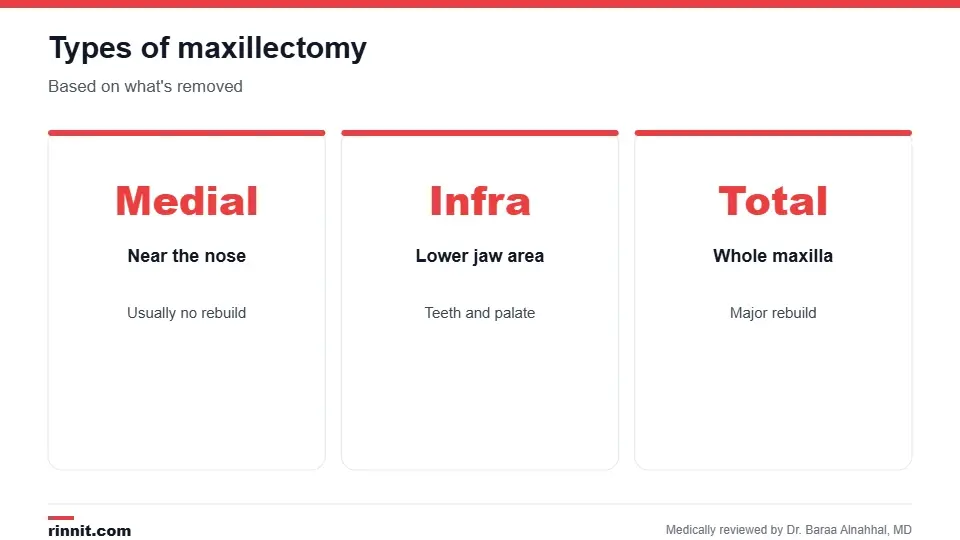
More extensive types need more reconstruction.
Type | What's removed | Reconstruction |
Medial | Part near the nose and nearby teeth | Usually none |
Infrastructure | Lower maxilla, teeth and hard palate | Flap or prosthetic |
Suprastructure | Upper maxilla; may include eye socket, eye or tear duct | Needed |
Subtotal (partial) | Part of the maxilla | Depends on approach |
Total | Whole maxilla on one side, hard palate and eye socket floor | Major reconstruction and prosthetics |
Sources: [1, 2]
Other procedures that may be needed
A feeding tube.
Tear duct surgery (dacryocystorhinostomy).
Neck dissection if cancer may have spread.
A tracheostomy if airway swelling is a concern.
Reconstructive surgery. Sources: [1]
How it's done
The approach depends on the type. A medial maxillectomy may use an incision on the side of the nose or an endoscope through the nostril. Larger surgeries need more extensive incisions and reconstruction. Sources: [1]
Reconstruction options

Studies show similar quality of life with both.
Option | What it is |
Tissue flap or graft | Your own tissue closes the opening |
Obturator | A removable prosthetic plate that closes the opening |
Both can restore eating and speech. Sources: [1, 2, 3]
Risks
Bleeding and bruising (hematoma).
Blood clots.
Infection.
A droopy lower eyelid.
Eustachian tube problems.
Cheek numbness from nerve damage.
Watery eyes. Sources: [1]
Recovery
You may stay in the hospital up to two weeks.
You'll get medicines for pain, clots and infection.
You may need oxygen through a tracheostomy and a feeding tube at first.
At home, avoid strenuous activity and eat soft foods.
Avoid hot foods and drinks while your cheek is numb.
Speech and swallowing may take months; medial surgery heals fastest. Sources: [1]
Outlook
Many people recover well. Eating, speaking and swallowing may be harder at first, and speech therapy can help. Outlook depends on the cancer's type and stage. Sources: [1, 3]
When to call your provider
Unusual swelling.
Trouble breathing.
Fever.
Pain that medicine doesn't help. Sources: [1]
Conclusion
A maxillectomy removes cancer from the upper jaw and nearby areas, and modern reconstruction helps restore eating and speech. A skilled head and neck team guides your recovery.
Keep learning: read about head and neck cancers and maxillofacial surgery.
Frequently asked questions
What is a maxillectomy?
Surgery to remove part or all of the upper jaw.
Why is it done?
Mainly to treat cancer of the jaw, sinuses, nose or palate.
What are the types?
Medial, infrastructure, suprastructure, subtotal and total.
Will my eye be removed?
Only if cancer has spread there.
What is an obturator?
A removable prosthetic that closes the opening in the roof of the mouth.
Is a flap better than an obturator?
Studies show similar quality of life with both.
How long is the hospital stay?
Up to about two weeks.
What can I eat afterward?
Soft foods while you heal.
Will I be able to speak normally?
Speech may take months to recover; therapy helps.
What are the risks?
Bleeding, infection, cheek numbness, watery eyes and eyelid droop.
Related Reading
What Are Head and Neck Cancers? A Complete Guide (2026) head and neck cancers.
Maxillofacial Surgery: Advanced Care for Face, Jaw, and Neck Conditions jaw and face surgery.
What Is Nasopharyngeal Cancer? Symptoms, Causes, and Treatment a cancer it treats.
Hard Palate Cancer: Symptoms, Causes, and Treatment Options cancer of the roof of the mouth.
Mucormycosis: Symptoms, Causes, Treatment and Emergency Signs a fungal infection it treats.
References
Cleveland Clinic. Maxillectomy: Surgical Procedure, Recovery & Types. Cleveland Clinic. Last updated July 5, 2022. https://my.clevelandclinic.org/health/treatments/23460-maxillectomy
König J, Kelemen K, Váncsa S, et al. Comparative analysis of surgical and prosthetic rehabilitation in maxillectomy: a systematic review and meta-analysis on quality-of-life scores and objective speech and masticatory measurements. Journal of Prosthetic Dentistry. 2025;133(1):305-314. PMID 38151428. https://doi.org/10.1016/j.prosdent.2023.11.023
Cao Y, Yu C, Liu W, et al. Obturators versus flaps after maxillary oncological ablation: a systematic review and best evidence synthesis. Oral Oncology. 2018;82:152-161. PMID 29909890. https://doi.org/10.1016/j.oraloncology.2018.05.019
Medical disclaimer
This article is for general education only and does not replace advice from a qualified healthcare professional. Talk to your doctor about your own diagnosis and treatment, and seek emergency care right away for severe or sudden symptoms.



Comments