Hard Palate Cancer: Symptoms, Causes, and Treatment Options

Updated: 3 days ago
Medically reviewed by Dr. Baraa Alnahhal, MD · Last reviewed: October 2026
Quick Answer
Hard palate cancer is a rare cancer that forms on the bony roof of the mouth, accounting for only 1% to 5% of oral cancers in the United States [1] [4]. It is strongly linked to tobacco use and frequent alcohol consumption [1] [2]. Surgery, often a maxillectomy, is the main treatment, often followed by speech therapy and dental prosthetics [1] [4].
What the research says
Cancer can spread to the neck even when it looks confined. In a multicentre study of 65 patients with squamous cell carcinoma of the maxillary alveolar ridge and hard palate, 21% developed cervical (neck) metastases, and the authors recommended selective neck dissection even when the neck looked clear (Beltramini et al., Oral Oncol, 2012) [5].
Hidden lymph-node spread is common. Among 14 patients with a clinically and radiologically negative neck after surgery for hard palate or maxillary alveolus cancer, 5 (36%) later developed a neck recurrence (Koshkareva et al., Ear Nose Throat J, 2016) [6].
CT scans help plan surgery. In 36 hard palate cancers, the depth of invasion measured on contrast CT agreed closely with the depth under the microscope (intraclass correlation 0.80), and CT features helped predict invasion into the palatal bone (Baba et al., Oral Surg Oral Med Oral Pathol Oral Radiol, 2022) [7].
What Is Hard Palate Cancer?
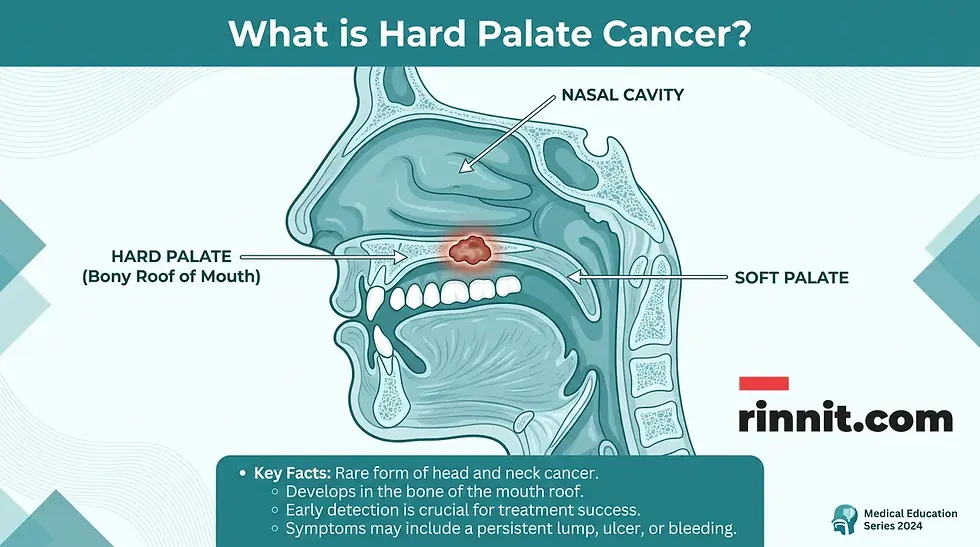
Hard palate cancer is a rare form of oral cancer that appears on the roof of the mouth. The hard palate is the bony structure that separates your oral cavity from your nasal passages [4]. When cells in this area grow uncontrollably, they form a tumor. This condition most commonly includes squamous cell carcinoma, which begins in the flat cells lining the mouth, but it can also involve certain salivary gland cancers [1] [3].
Although oral cancers represent about 3% of all cancer cases in the U.S., hard palate cancer is even less common, making up a small fraction of those cases [1]. Because it occurs in a critical area for speaking and eating, early detection and specialized care are essential for a good outcome.
What Are the Symptoms of Hard Palate Cancer?
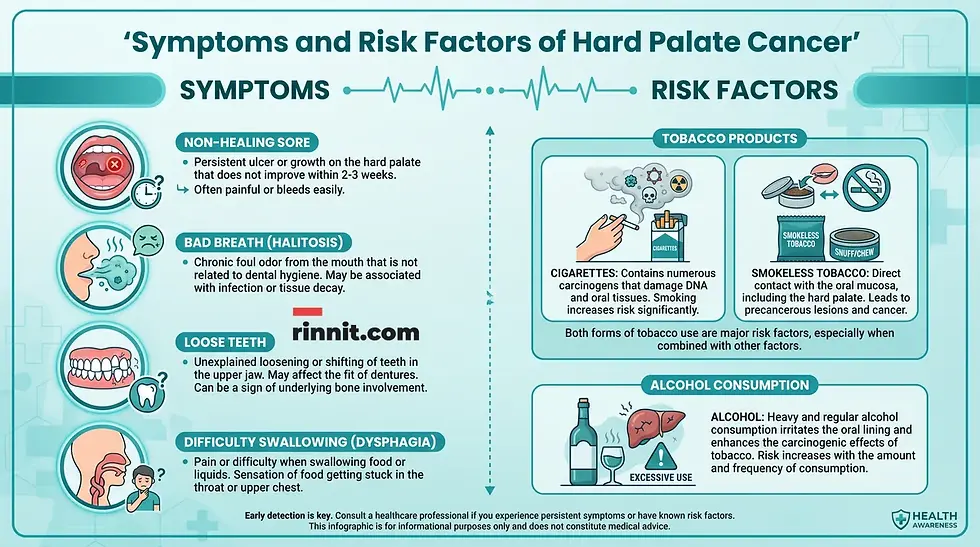
The most recognizable symptom of hard palate cancer is a sore or ulcer on the roof of the mouth that does not go away [1] [2]. Because the hard palate is bony and covered by a thin layer of tissue, changes are often easier to feel with your tongue or see in a mirror.
Other symptoms that may indicate a problem include:
Persistent Bad Breath: Also known as halitosis, which does not improve with brushing.
Dental Changes: Feeling as if your teeth are loose or noticing that dentures no longer fit comfortably [1] [2].
Swallowing Difficulties: A condition called dysphagia, where it feels hard or painful to move food down [1] [4].
Physical Lumps: Noticing a new lump in the neck, which could indicate the cancer has reached the lymph nodes [1].
What Causes Hard Palate Cancer?
While the exact genetic triggers can vary, medical experts have identified clear links between certain lifestyle habits and the development of hard palate cancer. The two most significant risk factors are:
If left untreated, the cancer can spread into the lymph nodes in the neck or move upward into the nasal passages [1]. Once in the lymphatic system, it can travel to distant parts of the body, such as the lungs, in a process called metastasis [1].
How Do Doctors Diagnose Hard Palate Cancer?
Diagnosis begins with a thorough physical examination. A healthcare provider will look inside your mouth and feel the lymph nodes in your neck for any swelling [1] [2]. They will also ask about your history with tobacco and alcohol and how long you have noticed any sores or pain.
Diagnostic Tests
To confirm a diagnosis and determine the extent of the cancer, doctors use several specialized tests:
Test Type | Description | Purpose |
Biopsy | Removing a small sample of tissue for lab analysis. | To see if cancer cells are present and identify the type. |
CT Scan | A series of X-rays that create detailed cross-sections. | To check the tumor size and see if it has spread to the bone. |
PET Scan | An imaging test using a radioactive tracer. | To find out if the cancer has spread to distant organs like the lungs. |
Understanding the Stages of Hard Palate Cancer
Doctors use the TNM system to describe how far the cancer has progressed. “T” refers to the tumor size, “N” indicates if it has reached the lymph nodes, and “M” shows if it has metastasized to other body parts [1] [2].
Stage | Characteristics |
Stage I | The tumor is 2 centimeters or smaller and very shallow. |
Stage II | The tumor has grown larger or deeper but has not reached lymph nodes. |
Stage III | The tumor is large or deep and has spread to nearby lymph nodes. |
Stage IV | The cancer has spread to soft tissues, the nasal cavity, or distant organs. |
How Is Hard Palate Cancer Treated?
Surgery is the primary treatment for hard palate cancer [1] [4]. The goal is to remove the entire tumor while preserving as much function as possible.
Common Surgical Procedures
Maxillectomy: The surgeon removes the tumor from the roof of the mouth. Depending on the size, this may involve removing a small portion or the entire hard palate [1].
Neck Dissection: If the cancer is suspected to have spread, the doctor may remove lymph nodes from the neck to prevent further spread [1] [2].
Reconstruction and Recovery
Because the hard palate separates the mouth from the nose, removing part of it creates a gap. Surgeons use different methods to close this gap:
After surgery, patients often work with speech therapists and nutritionists to regain the ability to swallow and speak clearly [1] [2] [4].

Can Hard Palate Cancer Be Prevented?
While you cannot always prevent cancer, you can significantly lower your risk by making healthy lifestyle choices. Avoiding all forms of tobacco and limiting alcohol consumption are the most effective ways to protect yourself. Regular dental checkups are also vital, as dentists are often the first to notice unusual changes in the mouth [1] [2].
Conclusion
Hard palate cancer is a serious but treatable condition, especially when caught early [1]. While the journey through surgery and recovery can be challenging, modern reconstructive techniques and dedicated therapy help many patients return to a high quality of life. Early detection is your best defense against oral cancer: if you have a sore on the roof of your mouth that won't heal, don't wait to see a healthcare provider.
Frequently Asked Questions
Q: Is hard palate cancer common?
A: No, it is rare, accounting for only 1% to 5% of oral cancers.
Q: What is the first sign of hard palate cancer?
A: The most common first sign is a sore on the roof of the mouth that does not heal.
Q: Can smoking cause this cancer?
A: Yes, tobacco use is a major risk factor linked to hard palate cancer.
Q: Does alcohol increase the risk?
A: Yes, frequent alcohol consumption is a known risk factor.
Q: What is a maxillectomy?
A: It is a surgical procedure to remove a tumor from the roof of the mouth.
Q: How will I eat after surgery?
A: You may use a prosthetic plate or have reconstructive surgery to help you swallow.
Q: Will my speech be affected?
A: Surgery on the palate can affect speech, but speech therapy can help you recover.
Q: Can this cancer spread to the nose?
A: Yes, if left untreated, it can grow into the nasal passages.
Q: What is a palatal plate?
A: It is an acrylic device that fills the gap in the roof of the mouth after surgery.
Q: How do doctors check if the cancer has spread?
A: They use imaging tests like CT scans and PET scans.
Q: What is squamous cell carcinoma?
A: It is a type of cancer that starts in the flat lining cells of the mouth.
Q: Can the cancer come back?
A: Yes, hard palate cancer can recur years after treatment, so regular follow-ups are necessary.
Q: What is halitosis?
A: It is the medical term for persistent bad breath, which can be a symptom of this cancer.
Q: Is a lump in the neck a symptom?
A: Yes, it may mean the cancer has spread to the lymph nodes.
Q: Can a dentist find this cancer?
A: Yes, regular dental exams are a common way these cancers are first detected.
Sources
Cleveland Clinic. Hard Palate Cancer. Cleveland Clinic. Last updated February 27, 2023. https://my.clevelandclinic.org/health/diseases/24789-hard-palate-cancer
National Cancer Institute. Lip and Oral Cavity Cancer Treatment (PDQ®)–Patient Version. National Cancer Institute. Updated May 16, 2025. https://www.cancer.gov/types/head-and-neck/patient/adult/lip-mouth-treatment-pdq
American Cancer Society. Oral Cavity (Mouth) and Oropharyngeal (Throat) Cancer. American Cancer Society. Last revised March 23, 2026. https://www.cancer.org/cancer/oral-cavity-and-oropharyngeal-cancer/about/what-is-oral-cavity-cancer.html
Young A, Okuyemi OT. Malignant Tumors of the Palate. StatPearls [Internet]. Treasure Island (FL): StatPearls Publishing. Last updated January 12, 2023. https://www.ncbi.nlm.nih.gov/books/NBK564515/
Beltramini GA, et al. Is neck dissection needed in squamous-cell carcinoma of the maxillary gingiva, alveolus, and hard palate? A multicentre Italian study of 65 cases and literature review. Oral Oncol. 2012;48(2):97-101. PMID 21993155. https://doi.org/10.1016/j.oraloncology.2011.08.012
Koshkareva Y, et al. Cervical metastasis in squamous cell carcinoma of the hard palate and maxillary alveolus. Ear Nose Throat J. 2016;95(10-11):E6-E11. PMID 27792826. https://doi.org/10.1177/014556131609510-1103
Baba A, et al. Relationships between contrast-enhanced computed tomography features of hard palate cancer and pathological depth of invasion. Oral Surg Oral Med Oral Pathol Oral Radiol. 2022;134(5):649-657. PMID 36064717. https://doi.org/10.1016/j.oooo.2022.07.002
Related Reading
Maxillectomy: Types, Reconstruction and Recovery explains maxillectomy surgery.
Medical disclaimer
The information provided in this article is for educational purposes only and is not intended as medical advice, diagnosis, or treatment. Always seek the advice of your physician or other qualified health provider with any questions you may have regarding a medical condition. Never disregard professional medical advice or delay in seeking it because of something you have read here.



Comments