Dental Impressions: Types, Digital Scans and What to Expect

Updated: 3 days ago
Written and medically reviewed by Dr. Baraa Alnahhal, MD · Last reviewed: November 2026 · How we review
Quick Answer
Dental impressions are molds or digital scans of the teeth and gums that create an exact copy of the mouth. Dentists use them to plan treatment and make custom-fit crowns, bridges, dentures, aligners and mouthguards. They're taken with putty in a tray or with a handheld scanner. Impressions don't hurt, though putty can trigger gagging in some people.
What the research says
Digital scans are as accurate as putty for most work: an overview of 28 systematic reviews found no significant differences in accuracy or fit between digital scans and conventional impressions for crowns, bridges and implant restorations, although conventional impressions did better for full-arch bridges (Kaitatzidou A et al., J Prosthet Dent, 2025) [2]
Evidence on gag-reflex remedies is limited: a Cochrane review of four trials with 328 people found only very low-certainty evidence that acupuncture, acupressure or laser at a wrist point reduces gagging during dental care, so talking with your dentist about practical options remains important (Eachempati P et al., Cochrane Database Syst Rev, 2019) [3]
Key takeaways
Molds or 3D scans that copy your teeth and gums.
Used to make crowns, dentures, aligners, mouthguards and more.
Traditional putty or digital scanning; both are accurate.
Painless, though putty may cause gagging.
Lab work usually takes one to several weeks.
What are dental impressions used for?
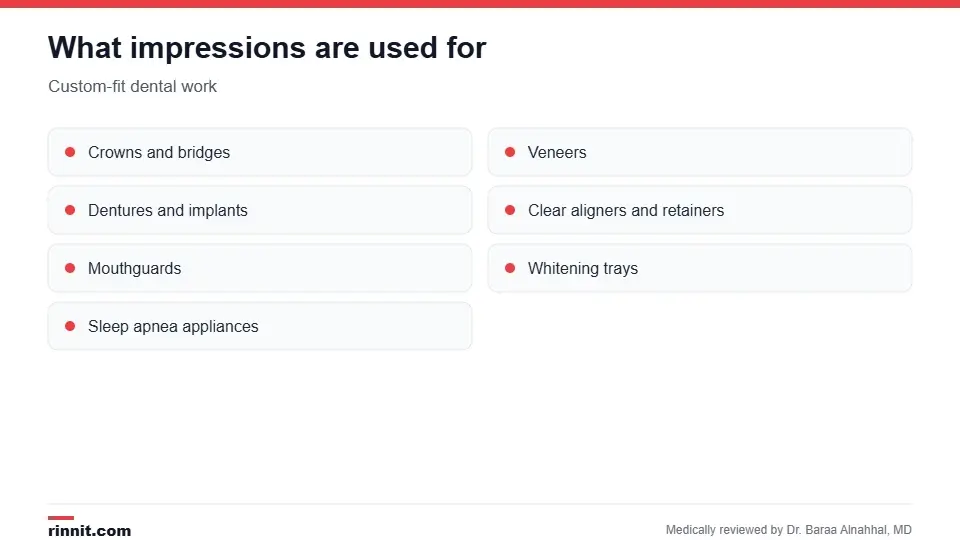
Impressions make custom dental work fit properly.
Restorations: crowns, bridges, veneers, dentures and implant-supported dentures.
Orthodontics: clear aligners and retainers.
Other appliances: mouthguards, whitening trays, fluoride trays and oral appliances for sleep apnea. Sources: [1]
Types of dental impressions
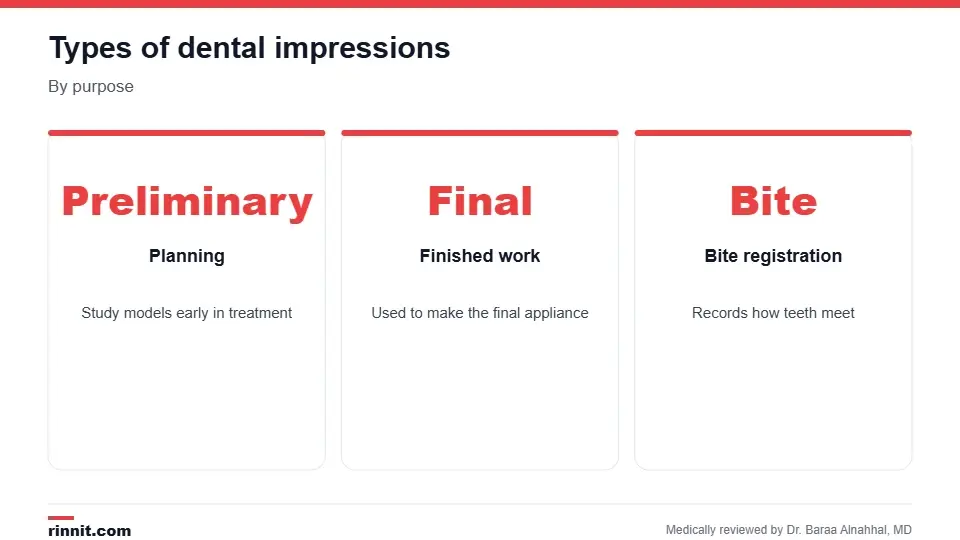
Each impression type has a different purpose.
Type | Purpose |
Preliminary | Early in treatment, to make study models for planning |
Final | To make the finished appliance or restoration |
Bite registration | To record how your upper and lower teeth meet |
Sources: [1]
Traditional vs digital impressions
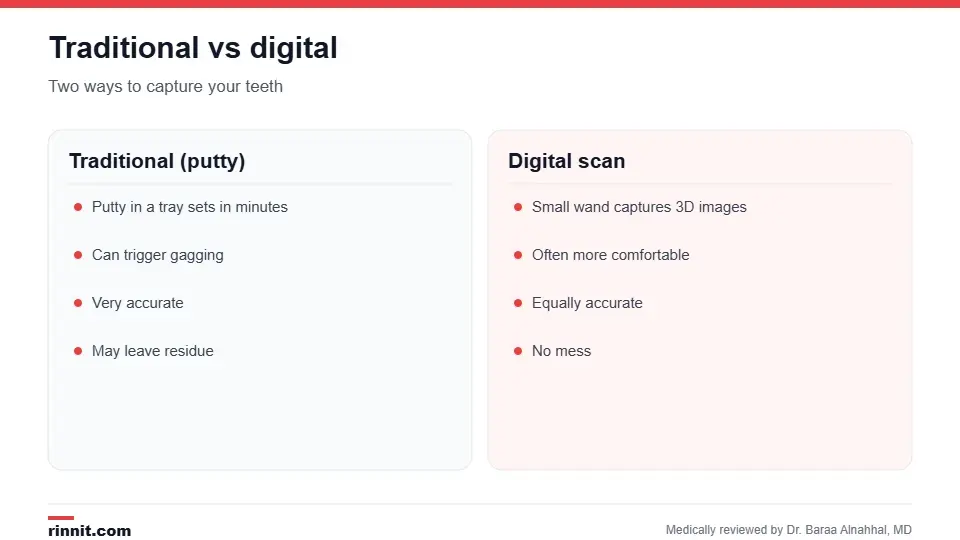
Both methods are accurate.
Factor | Traditional (putty) | Digital scan |
How it's done | Putty such as alginate or PVS in a tray, pressed onto the teeth | A small wand captures images that form a 3D model |
Comfort | Can feel bulky and trigger gagging | Often more comfortable |
Time | A few minutes to set | Quick, often faster |
Accuracy | Very accurate | Equally accurate for most work |
Mess | May leave residue | None |
Traditional impressions are sent to a lab to make a model. Digital scans are sent electronically. Sources: [1, 2]
How do I prepare?
Brush and floss beforehand and avoid sticky foods right before your visit. Tell your dentist if you have a strong gag reflex or dental anxiety so they can help you feel more comfortable. Sources: [1, 3]
What happens during the procedure?
Traditional: your dentist fills a tray with soft putty, places it over your teeth and asks you to hold still for a few minutes while it sets, then removes it.
Digital: your dentist moves a small scanning wand around your teeth while a computer builds a 3D image.
The impression is sent to a dental lab, which makes your appliance in one to several weeks; you may get a temporary crown or bridge in the meantime. Sources: [1]
After the procedure
You may notice a lingering taste or bits of material; rinsing or sipping water helps. There are usually no eating or drinking limits afterward. Good impressions help your appliance fit comfortably and work properly. Sources: [1]
Conclusion
Dental impressions are a quick, painless step that makes custom dental work possible. Whether your dentist uses putty or a digital scanner, an accurate impression is the foundation for a comfortable, well-fitting result.
Keep learning: read about dental restorations and orthodontics.
Frequently asked questions
What is a dental impression?
A mold or digital scan of your teeth and gums.
Do dental impressions hurt?
No, though putty can feel bulky or cause gagging.
How long does an impression take?
A few minutes for putty to set; digital scans are often faster.
Are digital impressions accurate?
Yes, as accurate as traditional impressions for most work.
What materials are used?
Usually alginate or polyvinyl siloxane (PVS) putty.
What if I have a strong gag reflex?
Tell your dentist; a digital scan may be easier.
What are impressions used for?
Crowns, bridges, dentures, aligners, retainers and mouthguards.
How long until my appliance is ready?
Usually one to several weeks.
Can I eat afterward?
Yes, unless your dentist says otherwise.
How should I prepare?
Brush, floss and avoid sticky foods beforehand.
Related Reading
Dentures: Types, Procedure, Care and How Long They Last replacement teeth made from impressions.
Clear Aligners: How Invisible Braces Work, Who They Suit, and What to Expect custom aligners made from scans.
Dental Veneers: Enhancing Your Smile with Custom Restorations thin shells shaped from impressions.
Teeth Retainer: Types, How Long to Wear One, and How to Care for It retainers molded to your teeth.
Dental Restorations: Restoring Oral Health and Function crowns, bridges and other restorations.
References
Cleveland Clinic. Dental Impressions: Purpose & Procedure. Cleveland Clinic. Last updated February 17, 2026. https://my.clevelandclinic.org/health/diagnostics/22671-dental-impressions
Kaitatzidou A, Chalazoniti A, Faggion CM, et al. Digital scans versus conventional impressions in fixed prosthodontics: an overview of systematic reviews. J Prosthet Dent. 2025;134(6):2156-2164. PMID 39627077. https://doi.org/10.1016/j.prosdent.2024.11.002
Eachempati P, Kumbargere Nagraj S, Kiran Kumar Krishanappa S, et al. Management of gag reflex for patients undergoing dental treatment. Cochrane Database Syst Rev. 2019;2019(11):CD011116. PMID 31721146. https://doi.org/10.1002/14651858.CD011116.pub3
Medical disclaimer
This article is for general education only and does not replace advice from a qualified healthcare professional. Talk to your doctor about your own diagnosis and treatment, and seek emergency care right away for severe or sudden symptoms.



Comments