Teeth Retainer: Types, How Long to Wear One, and How to Care for It

Updated: 6 days ago
Written and medically reviewed by Dr. Baraa Alnahhal, MD · Last reviewed: October 2026 · How we review
Quick Answer: What is a teeth retainer?
A teeth retainer is a custom-made device worn over the teeth to hold them in their correct position after braces or clear aligners. Removable types are made of wire or plastic, while fixed types are bonded to the front upper or lower teeth. Most people wear one full-time for at least four to six months, then nightly for life. [1]
What the research says
Fixed and removable retainers each have trade-offs. A review of 47 randomized trials (4,377 participants) rated the evidence as low certainty. In one included trial (84 participants), clear plastic retainers worn full-time had about 3.4 times the risk of retainer failure compared with fixed wires, but about half the risk of gum bleeding, with no clinically meaningful difference in tooth stability. (Martin et al., Cochrane Database of Systematic Reviews, 2023) [2]
Bonded (fixed) retainers often fail over time. A meta-analysis of 34 studies (3,484 participants) found an overall failure rate of about 35%, rising from about 24% in short-term follow-up to about 54% in long-term follow-up. (Aye et al., European Journal of Orthodontics, 2023) [3]
Wearing a removable retainer less than 8 hours a day allowed more crowding. In 28 teenagers whose Hawley retainer wear was tracked with microsensors for 12 months, front-tooth irregularity increased by 2.54 mm in those wearing it under 8 hours a day, versus 1.32 mm in those wearing it 8 hours or more. (Atik et al., Journal of Orofacial Orthopedics, 2025) [4]
Key takeaways
Braces or aligners straighten teeth; a retainer keeps them straight.
Teeth can drift back toward their old position once braces come off.
Retainers are either removable (wire-and-acrylic or clear plastic) or fixed (a thin wire bonded to the front teeth).
Expect full-time wear for at least four to six months, then night-time wear for life.
Clean your retainer at least once a day, and keep it in its case when it is out of your mouth.
If your retainer breaks, gets lost, or stops fitting, contact your dentist or orthodontist promptly. [1]
Teeth retainer at a glance
Feature | Details |
What it is | A custom-made device worn over the teeth after braces or aligners |
Main purpose | Holds teeth in their new, correct position so they don't shift back |
Who fits it | A general dentist or an orthodontist |
Main types | Removable (Hawley, clear plastic/Essix) and fixed (bonded wire) |
Typical wear schedule | Full-time for at least 4–6 months, then nightly for life |
Daily care | Clean at least once a day; store in its case |
Common problems | Soreness, breakage, loss, bad smell, poor fit after missed wear |
Source: [1]
What does a teeth retainer do?
A teeth retainer holds your teeth in the new, correct position that braces or clear aligners achieved. Even after months of treatment, teeth can still move back toward where they started once the braces come off. Wearing a retainer stops that drift. [1]
Think of it as two separate jobs. Braces straighten your teeth. Your retainer keeps them that way — it helps them "retain" their position. [1]
To learn more about how your teeth are built and why they can move, see our guide to teeth anatomy, functions, and care.
What are the different types of teeth retainers?
Teeth retainers come in two main groups: removable retainers you can take out, and fixed (permanent) retainers that stay glued to your teeth. [1]
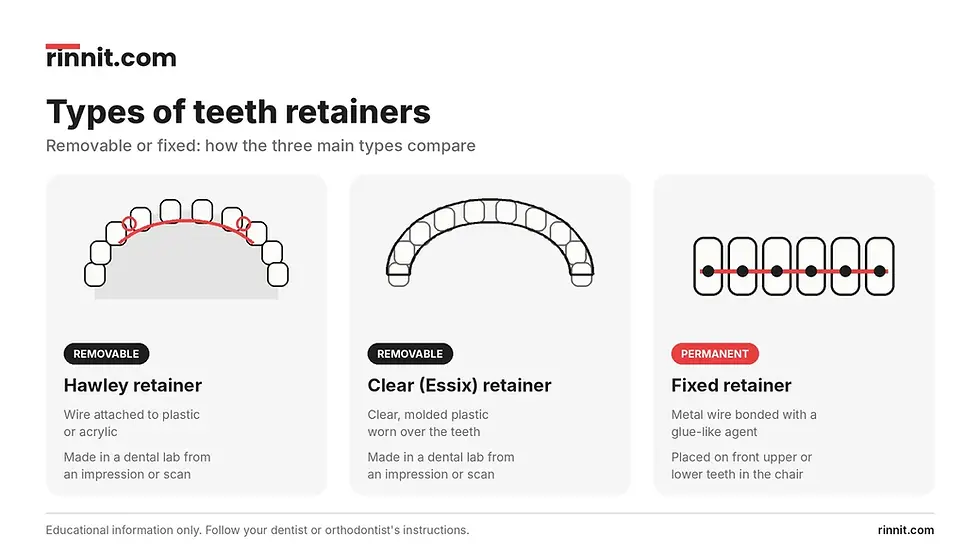
Type | What it is made of | Removable? | How it is made |
Hawley retainer | A wire attached to plastic or acrylic | Yes | From a dental impression or scan, made in a dental lab |
Clear (Essix) retainer | Clear, molded plastic that fits over the teeth | Yes | From a dental impression or scan, made in a dental lab |
Fixed (permanent) retainer | A metal wire attached with a glue-like bonding agent | No | Measured and bonded directly in the dental chair |
Source: [1]
Fixed retainers are placed on the front upper or lower teeth to keep them from shifting. [1] If you finished treatment with aligners, our clear aligners guide explains how that treatment phase works.
How is a teeth retainer fitted?
A teeth retainer is fitted differently depending on whether it is removable or fixed. [1]
Fitting a removable retainer
Taking an impression. Your provider makes a mold of your teeth with dental putty, a soft and flexible material, or captures images with a handheld scanning wand.
Making the retainer. A dental lab uses the mold or images to build your retainer.
Waiting for delivery. You usually wait a week or longer before you receive it. [1]
Fitting a fixed retainer
Measuring. Your provider uses a metal wire to measure the correct placement on your teeth.
Bonding. They glue the wire in place. [1]
The fixed-retainer visit takes longer than taking an impression, but you leave the office with your retainer already in place — there is no lab wait. [1]
How long do you need to wear a teeth retainer?
Most people need to wear a teeth retainer day and night for at least four to six months, then at night for the rest of their life. [1]

Phase | When | How often |
Phase 1 | Right after braces come off | Full-time, day and night |
Duration of Phase 1 | At least 4–6 months | — |
Phase 2 | After the full-time phase | Every night |
Duration of Phase 2 | For life | — |
Source: [1]
Your dentist or orthodontist may adjust this schedule for you, so follow their specific instructions.
Do teeth retainers hurt?
Teeth retainers can cause some soreness at first, usually because the retainer is nudging your teeth into alignment. You may need over-the-counter pain relievers while you adjust. [1]
Once you wear your retainer regularly, your teeth shouldn't hurt. The fit should feel snug yet comfortable. Ask your provider how much soreness to expect and for how long. If discomfort continues, the retainer may need adjusting. [1]
What are the benefits and risks of wearing a teeth retainer?
The main benefit of a teeth retainer is that it keeps your teeth in the aligned position your braces or aligners created, so the results last. [1]
Benefits
Protects the result of your orthodontic treatment over the long term.
Helps your upper and lower teeth keep meeting correctly when your mouth is closed. [1]
Risks
Most risks involve discomfort if your teeth have shifted or your retainer is damaged. You may feel discomfort if: [1]
You forget to wear your retainer for a short time and then start again.
You haven't worn your retainer in a long time and then try to put it back in.
Your retainer breaks or cracks.
Poor cleaning is the other main risk. Bacteria can grow on an unwashed retainer and damage it. These germs can also cause bad breath, gum disease, and cavities. [1]
How do you clean and care for a teeth retainer?
You clean a teeth retainer at least once a day and store it in its case whenever it is out of your mouth. Your dental provider will give you specific cleaning instructions; the general guidelines below apply to most people. [1]

Daily cleaning steps
Clean it every day. Clean your retainer at least once a day.
Clean your teeth first. Brush and floss thoroughly before putting your retainer in. You can floss around a fixed retainer.
Use gentle cleaners. Brush a removable retainer with antibacterial soap and water. Some toothpastes are too harsh and may damage it.
Ask about soaking. An effervescent cleanser may be used if it is safe for your retainer — ask your provider which products to use.
Treat yellowing gently. If your retainer turns yellow, scrub it gently with water, baking soda, and a soft toothbrush. [1]
Retainer care do's and don'ts
Do | Don't |
Take your retainer out when you eat | Chew gum while wearing it |
Put it back in its case when not wearing it | Wrap it in a napkin (easy to throw away by accident) |
Carry it in its case | Put it in a pocket or purse without the case |
Keep it somewhere cool | Leave it in a hot place, like a car or near a stovetop, where it can melt |
Keep it out of reach of pets | Leave it where pets can chew it |
Source: [1]
Why does a removable retainer smell?
A removable retainer smells when bacteria grow on it, just as they grow inside your mouth. The same bacteria that cause bad breath can leave an unpleasant odor on the retainer. [1]
Daily cleaning is the best prevention. If your retainer already smells, scrub it with soap, water, and a soft toothbrush, and ask your dental provider whether you can soak it in a cleanser made for retainers. [1]
Can a teeth retainer straighten teeth?
A teeth retainer cannot straighten teeth; braces or aligners do that job. A retainer can't apply the constant, steady force needed to move teeth into new positions. [1]
There is one exception. If you skipped your retainer for a few weeks and your teeth shifted slightly, wearing it again may nudge them back. You'll likely feel some discomfort as it slowly pushes them into place. This usually works only for small, short-term changes. [1]
What happens to teeth if you don't wear a retainer?
Teeth that go without a retainer will shift and move. Shifting can stop your upper and lower teeth from lining up when your mouth is closed, which is why most dental providers prescribe a retainer after braces come off. [1]
Bite problems such as an overbite or underbite are often what orthodontic treatment corrects in the first place — consistent retainer wear helps protect that correction.
When should you see a dentist about your teeth retainer?
You should see your dentist or orthodontist if your retainer is lost, broken, too tight, or no longer fits. [1]
Situation | Why it matters | What to do |
Retainer lost | Teeth can start shifting back without it | Contact your provider promptly |
Retainer broken or cracked | A broken retainer can poke and irritate your gums or lips | Stop using it and contact your provider |
Retainer too snug or doesn't fit | Your teeth have probably shifted | Your provider needs to adjust it or make a new one |
Ongoing soreness | The retainer may need adjusting | Book a check-up |
Source: [1]
Don't wait. The longer you go without a working retainer, the more your teeth can shift, and the harder it becomes to get a retainer to fit properly. There is nothing you can do at home to make a retainer that no longer fits work again. [1]
Conclusion
A teeth retainer is what makes the time, effort, and cost of braces or aligners last. Braces give you straight teeth; your retainer keeps them straight. Wear it as your provider prescribes — usually full-time for at least four to six months, then every night — clean it daily, keep it in its case, and contact your dentist quickly if it breaks, goes missing, or stops fitting. Making your retainer part of your daily routine is the simplest way to protect your smile for years to come. [1]
Keep learning with Rinnit. Explore our clear, medically reviewed oral health guides — start with gingivitis, periodontitis, and bruxism (teeth grinding) — and bookmark Rinnit.com for new, evidence-based health articles every day.
FAQ
What is a teeth retainer used for?
A teeth retainer is used to keep teeth in their new, correct position after braces or clear aligners. Without one, teeth can move back toward where they started. [1]
How long do I have to wear my retainer each day?
A retainer is usually worn day and night for at least four to six months after braces come off. After that, it is typically worn every night for life. [1]
What is the difference between a fixed and a removable retainer?
A fixed retainer is a metal wire bonded to the front upper or lower teeth with a glue-like agent and stays in place. A removable retainer is either a Hawley retainer (wire attached to plastic or acrylic) or a clear, molded plastic Essix retainer that you take out. [1]
Is it normal for a new retainer to hurt?
Mild soreness is normal at first because the retainer is nudging your teeth into alignment. With regular wear, the retainer should feel snug but comfortable; ongoing pain means it may need adjusting. [1]
How do I clean my retainer?
A removable retainer should be cleaned at least once a day with antibacterial soap, water, and a soft toothbrush. Some toothpastes are too harsh, so ask your provider before using toothpaste or soaking products. [1]
Can I eat with my retainer in?
A removable retainer should be taken out when you eat and put back in its case. You should also avoid chewing gum while wearing it. [1]
What should I do if my retainer no longer fits?
A retainer that feels too snug or no longer fits usually means your teeth have shifted. Contact your dentist or orthodontist, who will need to adjust it or make a new retainer. [1]
Can a retainer fix crooked teeth?
A retainer cannot straighten crooked teeth because it can't apply the steady force needed to move them. It may nudge teeth back only after small, short-term shifts from a few weeks of missed wear. [1]
Why does my retainer smell?
A removable retainer smells when bacteria build up on it, just as they do in your mouth. Scrub it daily with mild soap, water and a soft toothbrush, and ask your dental provider about a retainer cleanser.
What should I do if I lose or break my retainer?
Contact your dentist or orthodontist promptly. Teeth can start to shift without a retainer, so a quick replacement helps protect your results.
Related Reading
Dental Impressions: Types, Digital Scans and What to Expect explains the molds and digital scans used to make custom dental work.
References
Cleveland Clinic. What Is a Teeth Retainer? Cleveland Clinic. Last updated October 22, 2025. https://my.clevelandclinic.org/health/treatments/10899-teeth-retainer
Martin C, Littlewood SJ, Millett DT, et al. Retention procedures for stabilising tooth position after treatment with orthodontic braces. Cochrane Database Syst Rev. 2023;5(5):CD002283. PMID 37219527. https://doi.org/10.1002/14651858.CD002283.pub5
Aye ST, Liu S, Byrne E, et al. The prevalence of the failure of fixed orthodontic bonded retainers: a systematic review and meta-analysis. Eur J Orthod. 2023;45(6):645-661. PMID 37824794. https://doi.org/10.1093/ejo/cjad047
Atik E, Taner T, Aksu M. Is wear time of Hawley retainers measured with microsensors related to mandibular arch stability? J Orofac Orthop. 2025;86(1):49-57. PMID 37731053. https://doi.org/10.1007/s00056-023-00495-x
Disclaimer
This article is for general educational purposes only and does not replace professional dental or medical advice, diagnosis, or treatment. Always follow the instructions of your dentist or orthodontist about your own retainer, and contact them if you have pain, damage, or fit problems.



Comments