Clear Aligners: How Invisible Braces Work, Who They Suit, and What to Expect

Updated: Nov 7
Written and medically reviewed by Dr. Baraa Alnahhal, MD · Last reviewed: October 2026 · How we review
Quick Answer: What are clear aligners?
Clear aligners are clear, custom-made plastic trays that gently move crooked or crowded teeth and treat some mild to moderate bite problems. You wear them 22 to 23 hours a day, remove them to eat, drink and clean your teeth, and switch to a new tray about every two weeks. An orthodontist decides if they suit you. [1]
What the research says
Aligners and braces give similar results in simpler cases. A 2025 review of 15 trials with 1,084 patients found no significant difference in treatment quality or treatment time between aligners and fixed braces when no teeth were removed. In cases that needed tooth extractions, fixed braces gave better results (Alhafi et al., European Journal of Orthodontics, 2025). [2]
Gums tend to stay healthier with aligners. A review of 21 randomized trials (970 people) found lower plaque, gum-inflammation and bleeding scores with aligners than with fixed braces, plus better quality of life at 6 months (Baneshi et al., Journal of Evidence-Based Dental Practice, 2025). [3]
Aligners may take a few months longer. In a randomized trial of 66 adults with simple bite problems, aligner treatment took about 4.8 months longer than braces, but the finished results, and the results 6 months later, were similar (Lin et al., The Angle Orthodontist, 2022). [4]
Key takeaways
Clear aligners are a type of braces: removable plastic trays instead of brackets and wires.
They suit crooked or crowded teeth and some mild to moderate bite problems, not every case.
Wear them 22 to 23 hours a day; take them out only to eat, drink, brush and floss.
You get a new tray about every two weeks.
Mild cases may need up to about nine months; more serious problems take longer.
Pressure or soreness with each new tray usually fades within a few days.
Sharp pain, lasting pain, bleeding or swollen gums, or a loose tray means calling your orthodontist.
How do clear aligners straighten teeth?
Clear aligners straighten teeth by applying gentle pressure that moves them, step by step, toward a planned position. They work the same basic way as metal or ceramic braces. [1]
The difference is how that pressure is delivered. Traditional braces use brackets glued to the teeth and joined by a wire, and they stay in your mouth for the whole treatment. Aligners are trays that fit over your teeth. [1]
Each tray is shaped slightly differently from the last. About every two weeks you move to the next one, which keeps your teeth moving in the right direction. [1]
You may also hear them called invisible braces or tooth aligners.
Who can use clear aligners?
Clear aligners can be used by people with crooked or crowded teeth and by some people with mild to moderate malocclusion, which means the upper and lower teeth don't line up when the mouth closes. [1]
They are not right for everyone. Your orthodontist examines your teeth and bite and decides whether aligners are a good fit for your situation. [1]
If you have a specific bite problem, these guides explain it in more detail:
You can also read a plain-language overview of malocclusion and how it is treated.
Clear aligners vs. braces: which is better?
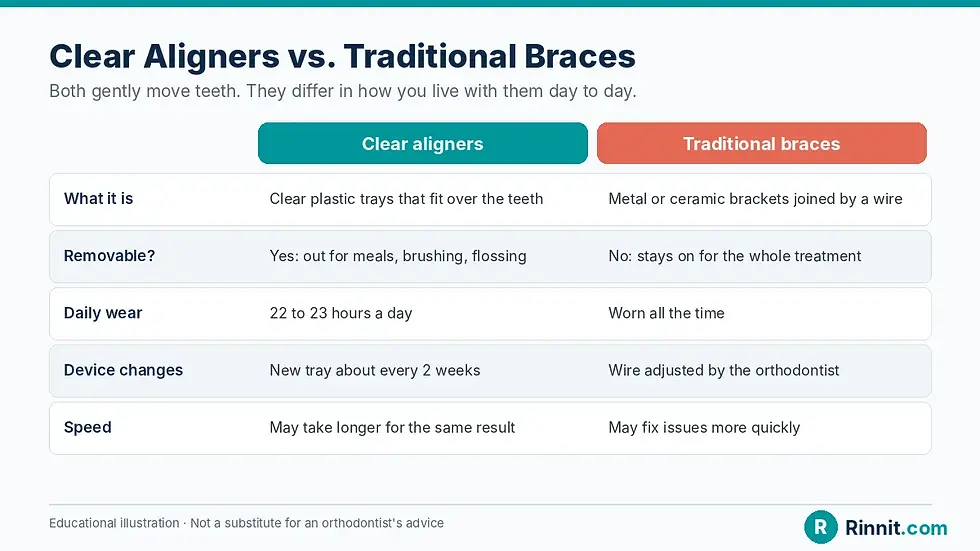
Neither option is better for everyone: clear aligners are easier to live with day to day, while traditional braces may correct some problems faster and handle complex cases better. Both treatments are effective. [1][2]
Feature | Clear aligners | Traditional braces |
What they are | Clear, custom plastic trays | Metal or ceramic brackets and a wire |
Removable? | Yes, for meals, drinks, brushing, flossing | No, stay on throughout treatment |
Food limits | Fewer, because trays come out to eat | Some foods may need to be avoided |
Cleaning routine | Usual brushing and flossing with trays out | May need new tools or routines |
Device changes | New tray about every 2 weeks | Wire adjusted at visits |
Speed | May need more time and more trays | May fix issues more quickly |
What it asks of you | Discipline to wear and store trays correctly | Care around brackets and wire |
Sources: [1][2][4]
The main trade-off is freedom versus speed. Because you take aligners out to eat and clean, there are fewer food limits and no special cleaning tools. With braces, the device stays fixed, which removes the need to remember to wear it. [1]
Research supports this picture. Reviews of trials show similar results in simpler, non-extraction cases, better results with fixed braces when teeth must be removed, and healthier gum scores with aligners. [2][3]
For more on the alternative, see this guide to how traditional braces work.
How are clear aligners made and fitted?
Clear aligners are made from digital photos and scans of your mouth that are turned into a step-by-step tooth movement plan, then built tray by tray in a lab. [1]
The process usually follows five steps: [1]
Scan. Your orthodontist takes digital pictures of your mouth and uses an optical scanner or impression material to make molds of your teeth.
Plan. The pictures and molds are used to map how each tooth will move during treatment.
Make. Lab technicians use this plan to create each tray.
Attach. Tiny attachments are placed on some teeth to help the aligners move them.
Fit. Your first aligner is placed on your teeth.
After that, follow-up visits check that the tray fits well and is working. A new tray generally replaces the old one about every two weeks. [1]

How many hours a day should you wear clear aligners?
You should wear clear aligners for 22 to 23 hours every day, taking them out only for meals and to brush and floss your teeth. [1]
This is the single most important rule. Aligners only work if you wear them as directed and keep them in a safe place when they are out of your mouth. [1]
Daily routine | What to do |
Eating and drinking | Take the trays out |
Brushing and flossing | Take the trays out |
Rest of the day and night | Trays in, about 22 to 23 hours total |
Trays out of the mouth | Store them somewhere safe |
Source: [1]
Do clear aligners hurt?
Clear aligners can be uncomfortable, especially when you start each new tray, but the pressure or soreness usually eases within a few days. [1]
You may notice the feeling when you chew, or when you take the tray out to eat or brush. This is a sign the tray is pressing on your teeth to move them. [1]
How long does clear aligner treatment take?
Clear aligner treatment can take up to about nine months for a few slightly crooked teeth, and several more months for more serious problems. Your orthodontist gives you a timeline for your own case. [1]
None of these treatments is a quick fix. Compared with braces, aligners may need more time and more tray changes to reach the same result. [1] In one trial of adults with simple bite problems, aligner treatment took about 4.8 months longer than braces, with similar final results. [4]
Situation | Typical wear time |
A few slightly crooked teeth | Up to about 9 months |
More serious problems | Several more months |
Your exact case | Set by your orthodontist |
Sources: [1][4]
How can you make wearing clear aligners easier?
You can make clear aligners easier to wear by eating soft foods, using cold on your jaw, and taking pain relievers when needed during the first sore days of each new tray. [1]
Choose soft foods. Soup and soft foods such as scrambled eggs help if chewing feels uncomfortable in the first few days of a new tray.
Use an ice pack. Placing it on your jaw may ease pain and minor swelling.
Take over-the-counter pain relievers as needed, following the label.
Source: [1]

When should you call your orthodontist about clear aligners?
You should call your orthodontist if you have sharp pain, pain that lasts more than a few days, gums that bleed or swell, or a tray that feels loose or doesn't fit. [1]
Warning sign | What it may mean | What to do |
Sharp pain | More than normal tray pressure | Contact your orthodontist |
Pain lasting more than a few days | Soreness not settling as expected | Contact your orthodontist |
Bleeding or swollen gums | Gum irritation or inflammation | Contact your orthodontist |
Loose or poorly fitting tray | Tray may not be working | Contact your orthodontist |
Source: [1]
Bleeding gums can also be a sign of gingivitis, so it is worth getting checked rather than waiting.
Conclusion
Clear aligners are a removable, nearly invisible way to straighten crooked or crowded teeth and correct some mild to moderate bite problems. They work like braces by gently moving teeth, but you take them out to eat, drink and clean, which means fewer food limits and, according to research, healthier gums. [1][3]
The trade-offs are discipline and time. Aligners only work when worn 22 to 23 hours a day, and they may take longer than braces, especially in complex cases. [1][2][4] Crooked or crowded teeth and bite problems can raise the risk of tooth decay and gum disease, so treatment can matter for health, not just appearance. [1]
Thinking about clear aligners? Save or print this guide and bring it to your orthodontist appointment. Use the comparison table to ask how aligners and braces would work for your teeth, how long your treatment would take, and what results you can expect. For more plain-language, research-backed guides, explore our health library.
FAQ
Are clear aligners the same as braces?
Clear aligners are a type of braces. Both gently move teeth, but aligners are removable plastic trays, while traditional braces use fixed brackets and a wire. [1]
How many hours a day do I need to wear clear aligners?
You need to wear them 22 to 23 hours a day, taking them out only to eat, drink, brush and floss. [1]
How often do I get a new aligner tray?
You usually get a new tray about every two weeks. Each one keeps your teeth moving in the planned direction. [1]
Do clear aligners hurt?
They can feel uncomfortable, especially with each new tray. Pressure or soreness usually eases within a few days. [1]
How long does clear aligner treatment take?
A few slightly crooked teeth may need up to about nine months. More serious problems take several more months. [1]
Are clear aligners slower than braces?
They can be. Braces may fix some problems faster, and one trial found aligners took about 4.8 months longer in simple cases, with similar results. [1][4]
Can anyone get clear aligners?
No. They suit crooked or crowded teeth and some mild to moderate bite problems. Your orthodontist decides if they are right for you. [1]
Can I eat with clear aligners in?
No. You take the trays out to eat and drink, then store them somewhere safe. [1]
What helps with aligner soreness?
Soft foods, an ice pack on the jaw, and over-the-counter pain relievers as needed can help in the first few days. [1]
When should I call my orthodontist?
Call for sharp pain, pain lasting more than a few days, bleeding or swollen gums, or a tray that feels loose or doesn't fit. [1]
Related Reading
Dental Impressions: Types, Digital Scans and What to Expect explains the molds and digital scans used to make custom dental work.
References
Cleveland Clinic. Clear Aligners: Purpose & Types. Cleveland Clinic. Last updated September 23, 2026. https://my.clevelandclinic.org/health/treatments/clear-aligners
Alhafi ZM, Hajeer MY, Alam MK, Jaber ST. Quality and stability of orthodontic treatment outcomes with clear aligners versus fixed appliances: a systematic review and meta-analysis. European Journal of Orthodontics. 2025;47(6):cjaf091. PMID 41127933. https://doi.org/10.1093/ejo/cjaf091
Baneshi M, O'Malley L, El-Angbawi A, Thiruvenkatachari B. Effectiveness of clear orthodontic aligners in correcting malocclusions: a systematic review and meta-analysis. Journal of Evidence-Based Dental Practice. 2025;25(1):102081. PMID 39947778. https://doi.org/10.1016/j.jebdp.2024.102081
Lin E, Julien K, Kesterke M, Buschang PH. Differences in finished case quality between Invisalign and traditional fixed appliances. The Angle Orthodontist. 2022;92(2):173-179. PMID 35168256. https://doi.org/10.2319/032921-246.1
Disclaimer
This article is for general education and does not replace advice from a dentist, orthodontist or doctor who knows your health history. Talk to a qualified professional before starting or changing any treatment.



Comments