Orthodontics: Braces, Clear Aligners, Retainers, and What to Expect

Updated: 6 days ago
Written and medically reviewed by Dr. Baraa Alnahhal, MD · Last reviewed: October 2026 · How we review
Quick Answer: What is orthodontics?
Orthodontics is the branch of dentistry that diagnoses and treats malocclusion, or a bad bite, using braces, clear aligners, retainers and palate expanders. Straighter, better-fitting teeth are easier to clean, which lowers the risk of cavities and gum disease. Children should have a first check by age 7, and treatment lasts from under one year to two years or longer. [1]
What the research says
Fixed braces raise the risk of white spots on teeth. A review of 57 studies (9,101 patients) found that 34.2% of orthodontic patients developed new white spot lesions during treatment. People with fixed braces had 7 times higher odds than people with no treatment, and longer treatment was linked to more lesions. (Hussain et al., Orthodontics & Craniofacial Research, 2025) [2]
Clear aligners and braces give similar results in simpler cases. Across 15 trials (1,084 patients), treatment quality and duration did not differ significantly in non-extraction cases. In cases needing tooth extraction, fixed braces gave better results because they control tooth movement more precisely. (Alhafi et al., European Journal of Orthodontics, 2025) [3]
Aligners may mean less early pain and healthier gums. A review of 32 studies found that clear aligner users had lower plaque and gum-inflammation scores and less pain early in treatment than braces users. The authors note the differences were small and mostly seen at the start. (Kaur et al., BDJ Open, 2026) [4]
Key takeaways
Orthodontics corrects how your teeth and jaws fit together, not just how your smile looks. [1]
The main tools are braces, clear aligners, retainers and palate expanders. [1]
A first orthodontic check is recommended no later than age 7, but adults can be treated too. [1]
Treatment takes under a year for some people and two years or longer for others. [1]
Results can last a lifetime if you wear your retainer as directed. [1]
What is an orthodontist?
An orthodontist is a dentist who has completed two to three extra years of training after dental school to focus on bite and tooth alignment. [1]
Orthodontists do not usually place fillings, crowns or bridges. Their work centers on moving teeth and guiding jaw growth. [1]
You do not always need a referral to see one. Your regular dentist can still recommend an orthodontist if you are unsure where to start. [1]
What problems does orthodontics treat?
Orthodontics treats malocclusion, meaning teeth or jaws that do not line up properly when you bite. [1]

Problem | What it means |
Overbite | Upper front teeth stick out over the lower teeth |
Underbite | Lower teeth sit further forward than the upper teeth |
Crowded teeth | There is not enough room in the jaw for every tooth |
Crooked teeth | Teeth tilt out of a straight line |
Rotated teeth | A tooth is turned on its own axis |
Overlapping teeth | One tooth sits partly in front of another |
Impacted teeth | A tooth stays trapped in the gum or jawbone instead of coming in |
How your teeth fit together affects your whole mouth. A better bite can lower your risk of cavities, gum disease and tooth erosion (wear of the enamel). [1]
Learn more about two of these problems in our guides to overjet (buck teeth) and impacted teeth.
Who needs orthodontic treatment, and when?
Almost anyone with a bad bite can benefit from orthodontic treatment, at any age. [1]
For children, a first orthodontic visit is recommended no later than age 7. [1]
Most children do not need treatment at that age. An early check, though, can spot problems worth watching. It may also reduce the need for bigger procedures later. [1]
Healthy teeth come first. If you have serious dental problems, such as extensive tooth decay or gum disease, your dentist should treat these before orthodontic treatment starts. [1]
What are the types of orthodontic treatment?
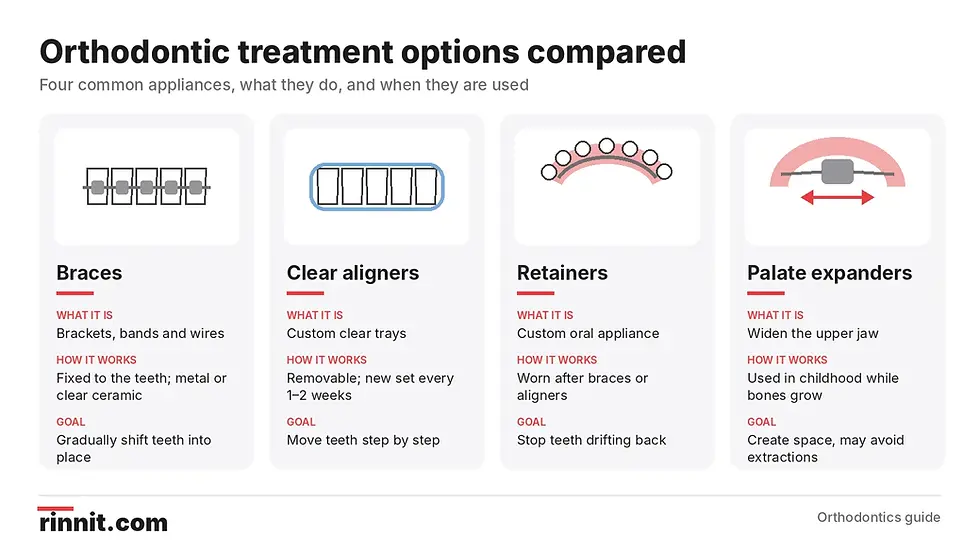
The four main orthodontic appliances are braces, clear aligners, retainers and palate expanders. Each has a different job. [1]
Braces
Braces move teeth gradually using brackets, bands and wires attached to the teeth. [1]
They come in traditional metal or clear (ceramic) versions. [1]
Clear aligners
Clear aligners are a series of custom-made clear trays that fit over your teeth. [1]
You wear each set for one to two weeks before switching to the next. Each new set moves your teeth a little closer to their final position. [1]
Retainers
A retainer is a custom appliance you wear after braces or aligners to stop your teeth drifting back. [1]
Your orthodontist will tell you how often to wear it. [1]
Palate expanders
A palate expander widens the upper jaw. It is used mainly in childhood, while the jawbones are still developing. [1]
Most children do not need one. In the right case, though, an expander can create room for teeth without removing any or needing other procedures. [1]
Orthodontic treatment options at a glance
Appliance | Fixed or removable | Main job | Typical stage |
Braces (metal or ceramic) | Fixed to teeth | Move teeth gradually | Active treatment |
Clear aligners | Removable trays, changed every 1–2 weeks | Move teeth step by step | Active treatment |
Retainers | Custom appliance | Hold teeth in their new place | After treatment |
Palate expanders | Fitted in the upper jaw | Widen the upper jaw to make space | Childhood, while bones grow |
Source: [1]
How long does orthodontic treatment take?
Orthodontic treatment takes under a year for some people and two years or longer for others. [1]
The time depends on how complex your bite problem is and how closely you follow your orthodontist's instructions. [1]

Step | What happens |
1. First visit | Children by age 7; adults whenever they have concerns |
2. Healthy teeth first | Decay and gum disease are treated before appliances go on |
3. Plan and fit | Your orthodontist chooses braces, aligners or an expander |
4. Active treatment | Under 1 year to 2 years or longer |
5. Retention | Wear your retainer as directed to keep results |
Source: [1]
What are the benefits of orthodontics?
The benefits of orthodontics go beyond appearance. They include: [1]
Teeth that are easier to clean
Better chewing and clearer speech
Possible relief from jaw pain linked to TMJ disorders
Lower risk of cavities and gum disease
A healthier, more attractive smile
What are the risks and downsides of orthodontics?
The main downsides of orthodontics are the time it takes and the care it demands. [1]
Downside | What it means for you |
Time | Treatment can last from under a year to two years or more |
Commitment | You need to follow your orthodontist's instructions closely and be patient |
Cavity risk | Food and plaque trapped around appliances can lead to cavities if you don't clean well |
Source: [1]
How do you care for your teeth during orthodontic treatment?
Careful cleaning around your appliance is the most important thing you can do during treatment. [1]
Brackets and wires create extra places for plaque to build up. Without good cleaning, that plaque can cause cavities. [1]
Follow the oral hygiene routine your orthodontist gives you at every stage of treatment. [1] To understand what happens when plaque is left behind, read our guide to tartar on teeth.
How long do orthodontic results last?
Orthodontic results can last a lifetime if you wear your retainer as directed. [1]
If you stop wearing your retainer, your teeth can slowly shift back toward their old position. [1]
When should you see an orthodontist?
You should see an orthodontist any time you are concerned about how your teeth look, feel or work. [1]
Conclusion
Orthodontics is about more than a straight smile. A better bite makes your teeth easier to clean, helps you chew and speak, and lowers your risk of cavities and gum disease. Braces, clear aligners, retainers and palate expanders each play a part, and the right choice depends on your bite and your commitment. Start early for children, treat any decay or gum problems first, and wear your retainer to protect your results for life.
Thinking about braces or aligners? Book a check with an orthodontist to find out which option suits your bite. Then explore more of our plain-language dental guides, starting with Teeth: Anatomy, Essential Functions, and Care and What Is Gum Recession?
FAQ
What is orthodontics?
Orthodontics is the branch of dentistry that diagnoses and treats malocclusion, or a bad bite. It uses appliances such as braces, clear aligners, retainers and palate expanders to move teeth and guide jaw growth.
What is the difference between a dentist and an orthodontist?
An orthodontist is a dentist with two to three extra years of training after dental school in bite and tooth alignment. Orthodontists don't usually do fillings, crowns or bridges.
At what age should a child first see an orthodontist?
A child should have a first orthodontic visit no later than age 7. Most children won't need treatment then, but an early check can spot problems to watch and may reduce the need for bigger procedures later.
Are clear aligners as good as braces?
Clear aligners give results similar to braces in many simpler cases. For more complex cases, such as those needing tooth extraction, fixed braces tend to control tooth movement more precisely. Your orthodontist will recommend the best option for your bite.
How long do you have to wear braces or aligners?
Orthodontic treatment lasts under one year for some people and two years or longer for others. The time depends on how complex the bite problem is and how well you follow your orthodontist's instructions.
Do you need a retainer after braces?
Yes, a retainer is needed after braces or clear aligners to keep teeth from drifting back. Your orthodontist will tell you how often to wear it.
Can adults get orthodontic treatment?
Yes, adults can get orthodontic treatment at any age. Almost anyone with a bad bite can benefit, as long as any tooth decay or gum disease is treated first.
Can braces cause cavities?
Braces can raise the risk of cavities if you don't clean around them well, because plaque collects around brackets and wires. Following your orthodontist's cleaning routine lowers this risk.
Do braces hurt?
Braces can make your teeth sore for a few days after they are put on and after each adjustment. Soft foods and over-the-counter pain relievers usually help.
What foods should you avoid with braces?
Avoid hard, sticky and chewy foods, such as popcorn, nuts, hard candy, caramel and gum. They can break brackets or bend wires.
Related Reading
Teeth Braces: Types, Timeline, Pain Relief and Aftercare Guide covers types of braces, treatment timelines and aftercare.
Clear Aligners: How Invisible Braces Work, Who They Suit, and What to Expect explains how clear aligners straighten teeth and who they suit.
Teeth Retainer: Types, How Long to Wear One, and How to Care for It explains retainer types, how long to wear them and how to clean them.
Widening the Upper Jaw: What to Expect from a Palate Expander describes how a palate expander widens a child's upper jaw.
References
Cleveland Clinic. What Is Orthodontics? Cleveland Clinic. Last updated October 12, 2022. https://my.clevelandclinic.org/health/treatments/24285-orthodontics
Hussain U, Wahab A, Kamran MA, et al. Prevalence, Incidence and Risk Factors of White Spot Lesions Associated With Orthodontic Treatment - A Systematic Review and Meta-Analysis. Orthod Craniofac Res. 2025;28(2):379-399. PMID 39717964. https://doi.org/10.1111/ocr.12888
Alhafi ZM, Hajeer MY, Alam MK, et al. Quality and stability of orthodontic treatment outcomes with clear aligners versus fixed appliances: a systematic review and meta-analysis. Eur J Orthod. 2025;47(6):cjaf091. PMID 41127933. https://doi.org/10.1093/ejo/cjaf091
Kaur K, Quadri SA, Saini RS, et al. Comparative impact of clear aligners versus fixed orthodontic appliances on periodontal health, pain, and quality of life: a systematic review and meta-analysis. BDJ Open. 2026;12(1):60. PMID 42270616. https://doi.org/10.1038/s41405-026-00450-z
Medical disclaimer
This article is for general education only and is not a substitute for professional dental or medical advice, diagnosis or treatment. Always ask your dentist or orthodontist about any questions you have regarding your teeth, bite or treatment options.



Comments