Prosthodontics: What It Is, Treatments and When to See a Prosthodontist

Updated: 2 days ago
Written and medically reviewed by Dr. Baraa Alnahhal, MD · Last reviewed: November 2026 · How we review
Quick Answer
Prosthodontics is the branch of dentistry focused on replacing and restoring damaged or missing teeth with dental prosthetics (artificial teeth). A prosthodontist is a dental specialist with three or four extra years of training after dental school. They make and fit crowns, bridges, dentures, dental implants and veneers, and they treat complex cases such as TMJ disorders.
What the research says
Bridges and implant crowns lasted about 10 years in most people: a systematic review found 10-year survival of 89.2% for conventional tooth-supported bridges, 86.7% for implant-supported bridges and 89.4% for implant-supported single crowns, though implant bridges had more complications (Pjetursson BE et al., Clinical Oral Implants Research, 2007) [2]
Most crowns survived 5 years: a meta-analysis of 67 studies with more than 14,000 crowns found 5-year survival of 94.7% for metal-ceramic crowns and about 96% for several all-ceramic types, while zirconia crowns (92.1%) had more chipping (Sailer I et al., Dental Materials, 2015) [3]
Key takeaways
Prosthodontics focuses on replacing and restoring teeth.
Prosthodontists have three or four extra years of training.
Treatments include crowns, bridges, dentures and implants.
Complex cases may take several visits over months.
Risks are minimal.
What is prosthodontics?
The word comes from "prostho" (replacement) and "dontist" (teeth). General dentists offer many of these treatments, but they often refer complex cases or those needing coordinated care to a prosthodontist. Sources: [1]
Why you might see a prosthodontist

Your general dentist may refer you.
Missing or severely damaged teeth.
Cosmetic concerns about your smile.
TMJ disorder symptoms.
Mouth or facial pain.
Obstructive sleep apnea. Sources: [1]
Areas of prosthodontics

Treatment may combine several areas.
Area | What it includes |
Fixed | |
Removable | |
Implant | Dental implants for single teeth or to support other restorations |
Maxillofacial | Replacements for missing parts of the face or mouth that affect chewing, speaking or swallowing |
Sources: [1]
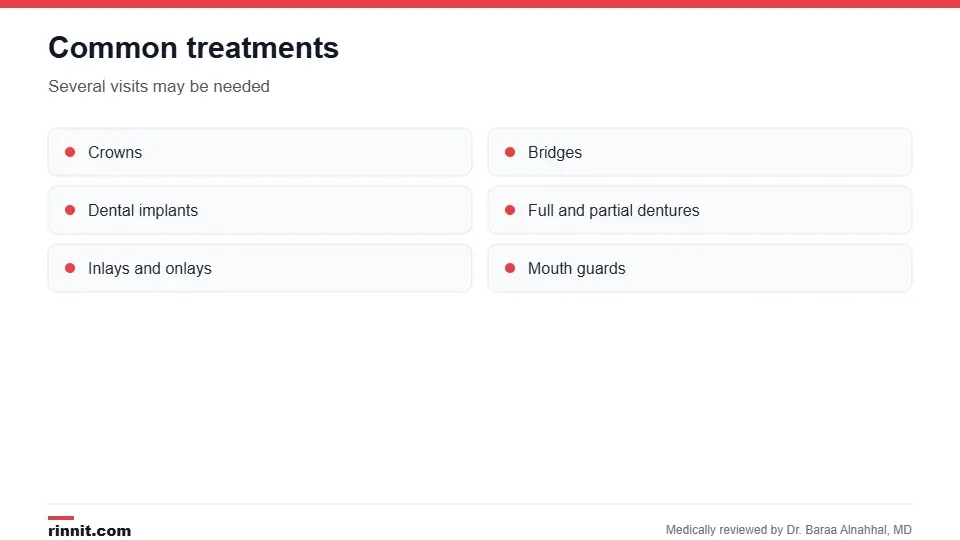
Common treatments
A dental implant is a tiny threaded post that replaces a tooth root.
Crowns.
Bridges.
Dental implants, tiny threaded posts that replace tooth roots.
Full and partial dentures.
Inlays and onlays.
Mouth guards. Sources: [1]
Benefits
Repair badly damaged teeth.
Replace missing teeth.
Improve your bite.
Correct TMJ problems.
Boost confidence in your smile. Sources: [1]
Risks
Risks are minimal. As with any dental procedure, there's a small risk of infection or nerve damage. Sources: [1]
Recovery
Treatment | Recovery |
Crown | Return to normal activity almost right away |
Full dentures on both arches | Rest at home for a few days |
New teeth in general | May take time to adjust; ask for a timeline |
Sources: [1, 2, 3]
When to call your provider
A fever.
Drainage near the treatment site.
Pain or swelling that doesn't improve with medicine. Sources: [1]
Conclusion
Prosthodontists specialize in restoring smiles and function when teeth are damaged or missing. For complex cases, their extra training helps coordinate treatments that last for years.
Keep learning: read about dental implants and dentures.
Frequently asked questions
What is prosthodontics?
The branch of dentistry that replaces and restores damaged or missing teeth.
What does a prosthodontist do?
Makes and fits crowns, bridges, dentures, implants and more.
How is a prosthodontist different from a dentist?
They have three or four more years of training after dental school.
When should I see a prosthodontist?
For missing or badly damaged teeth or complex dental needs.
Can prosthodontists treat TMJ?
Yes, prosthodontic treatment can help correct TMJ problems.
What is a dental implant?
A tiny threaded post that replaces a tooth root.
How long does treatment take?
It can take several visits over many months.
Are there risks?
Minimal; a small risk of infection or nerve damage.
How long do crowns last?
Studies show most crowns last at least 5 years.
What is maxillofacial prosthodontics?
Replacing missing parts of the face or mouth.
Related Reading
Dental Bridges: Types, Procedure and How Long They Last explains dental bridges.
Dental Implants: Types, Procedure, Recovery and Success Rates replacing teeth with implants.
Dentures: Types, Procedure, Care and How Long They Last removable replacement teeth.
Dental Crowns: Types, Procedure and How Long They Last caps that restore damaged teeth.
Dental Veneers: Enhancing Your Smile with Custom Restorations cosmetic tooth covers.
TMJ Disorders: Symptoms, Causes, Diagnosis, Treatment and Self-Care jaw joint problems.
References
Cleveland Clinic. Prosthodontics: Definition, Uses & Types. Cleveland Clinic. Last updated May 19, 2026. https://my.clevelandclinic.org/health/treatments/23904-prosthodontics
Pjetursson BE, Brägger U, Lang NP, et al. Comparison of survival and complication rates of tooth-supported fixed dental prostheses (FDPs) and implant-supported FDPs and single crowns (SCs). Clin Oral Implants Res. 2007;18(Suppl 3):97-113. PMID 17594374. https://doi.org/10.1111/j.1600-0501.2007.01439.x
Sailer I, Makarov NA, Thoma DS, et al. All-ceramic or metal-ceramic tooth-supported fixed dental prostheses (FDPs)? A systematic review of the survival and complication rates. Part I: single crowns (SCs). Dent Mater. 2015;31(6):603-623. PMID 25842099. https://doi.org/10.1016/j.dental.2015.02.011
Medical disclaimer
This article is for general education only and does not replace advice from a qualified healthcare professional. Talk to your doctor about your own diagnosis and treatment, and seek emergency care right away for severe or sudden symptoms.



Comments