Dental Crowns: Types, Procedure and How Long They Last

Updated: 2 days ago
Written and medically reviewed by Dr. Baraa Alnahhal, MD · Last reviewed: November 2026 · How we review
Quick Answer
A dental crown (cap) is a tooth-shaped cover that fits over a damaged, weak or worn tooth to restore its shape, strength and appearance. Crowns also cover dental implants and teeth after a root canal. Getting a crown usually takes two visits. Crowns last 5 to 15 years on average, and some last much longer with good care.
What the research says
Most crowns last at least 5 years: across 64 studies of more than 11,000 crowns, 5-year survival was 98.5% for lithium-disilicate ceramic, 97.1% for metal-ceramic and 96.8% for solid zirconia crowns (Pjetursson BE et al., International Journal of Prosthodontics, 2026) [2]
All-ceramic and metal-ceramic crowns perform similarly: in 67 studies of over 14,000 crowns, 5-year survival was 94.7% for metal-ceramic, 96.6% for reinforced glass-ceramic and 92.1% for zirconia crowns (Sailer I et al., Dental Materials, 2015) [3]
Key takeaways
A crown is a cap that covers and protects a damaged tooth.
Materials include metal, porcelain-fused-to-metal, ceramic and resin.
Most crowns take two visits; same-day crowns are possible.
Crowns last 5 to 15 years on average, often longer.
Brush, floss and avoid very hard foods to protect your crown.
What is a dental crown?
A crown covers the entire visible part of a tooth. It can strengthen a tooth weakened by decay, protect a cracked tooth or improve the look of a stained one. Crowns are mainly restorative, while veneers are mainly cosmetic. Other options include inlays, onlays or removing the tooth and placing an implant. Sources: [1]
Why you might need a crown

Crowns can help a natural tooth last longer.
Strengthen a tooth weakened by decay or a large filling.
Protect a cracked tooth.
Restore a broken or worn-down tooth.
Cover a tooth after a root canal.
Cover a dental implant.
Hold a dental bridge in place.
Cover a badly stained or discolored tooth. Sources: [1]
Types of crowns

Your dentist helps choose the right material.
Type | Pros | Cons |
Metal (gold or alloy) | Strongest; rarely chips; less tooth removed | Metal color; best for hidden back teeth |
Porcelain-fused-to-metal | Strong and tooth-colored | Porcelain can chip and wear opposing teeth |
All-ceramic or zirconia | Most natural look; good for metal allergies; zirconia is very durable | Can cost more |
Same-day (CAD/CAM) | Made in the office in one visit | Not everyone is a candidate |
Resin | Less expensive | More likely to break; often used as temporary crowns |
Sources: [1, 2, 3]
How a crown is placed
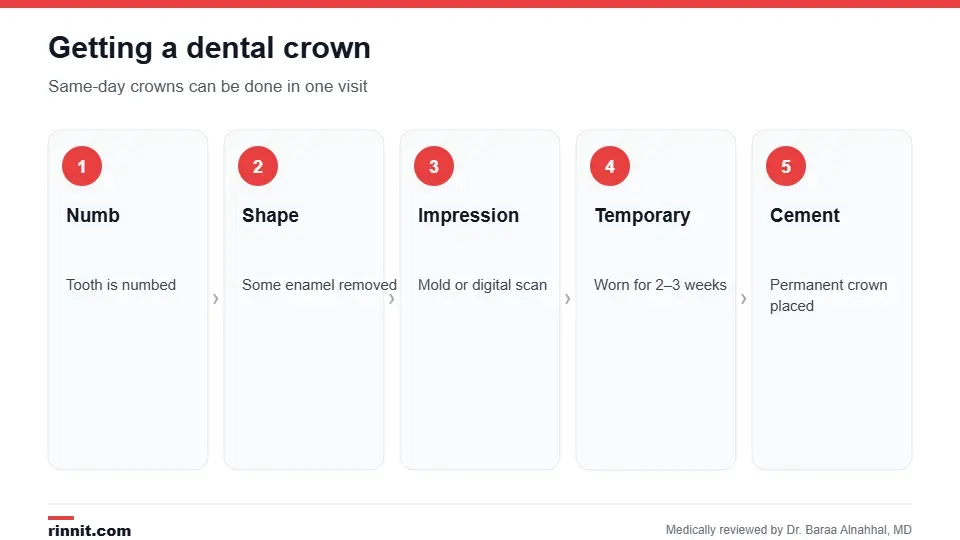
Same-day crowns can be done in one visit.
Your dentist numbs the tooth and removes some enamel to shape it, adding filling material if needed.
An impression or digital scan of the tooth is taken.
A temporary crown protects the tooth while a lab makes the permanent crown, usually in two to three weeks.
At the second visit, the temporary crown is removed and the new crown's fit, shape and color are checked.
The crown is cemented in place. Sources: [1]
Risks
Risk | Notes |
Sensitivity | Common in the first few weeks |
Chipping or breaking | Can happen over time |
Decay under the crown | More likely if the crown doesn't fit well |
Allergic reaction | Rare |
Cost | Crowns can be expensive |
Sources: [1]
Caring for your crown
Brush at least twice a day with fluoride toothpaste and a soft brush.
Floss every day.
Avoid very hard or sticky foods, such as ice, hard nuts, popcorn kernels, taffy and caramels.
Wear a mouth guard if you grind or clench your teeth.
Keep up with regular dental cleanings and exams. Sources: [1]
How long crowns last
Crowns last 5 to 15 years on average, and some last upward of 30 years with proper care. Replace a crown if it shows wear or damage. Sources: [1, 2]
When to call your dentist
Your crown feels loose.
You notice bad breath or a bad taste.
The crown cracks or chips.
A sharp edge bothers your tongue or gums. Sources: [1]
Conclusion
A dental crown can save a damaged tooth and restore your bite and smile. Choosing the right material and caring for it well helps your crown last for many years.
Keep learning: read about dental implants and root canal treatment.
Frequently asked questions
What is a dental crown?
A tooth-shaped cap that covers and protects a damaged tooth.
Is a cap the same as a crown?
Yes.
Does getting a crown hurt?
It shouldn't; the tooth is numbed first.
How many visits does a crown take?
Usually two; same-day crowns take one.
What's the best crown material?
It depends on the tooth; metal is strongest and ceramic looks most natural.
How long do crowns last?
5 to 15 years on average, sometimes much longer.
Is sensitivity normal after a crown?
Yes, for a couple of weeks.
What foods should I avoid?
Very hard or sticky foods like ice, hard nuts and caramels.
What's the difference between a crown and a veneer?
A crown covers the whole tooth; a veneer covers only the front.
What if my crown feels loose?
Call your dentist.
Related Reading
Dental Bridges: Types, Procedure and How Long They Last explains dental bridges.
Prosthodontics: What It Is, Treatments and When to See a Prosthodontist explains prosthodontics and tooth replacement.
Dental Bonding: What It Fixes, Procedure and How Long It Lasts explains cosmetic dental bonding.
Root Canal Treatment a treatment often followed by a crown.
Dental Implants: Types, Procedure, Recovery and Success Rates artificial roots topped with crowns.
Dental Veneers: Enhancing Your Smile with Custom Restorations thin covers for the front of teeth.
Dental Fillings: Types, Procedure and How Long They Last a smaller repair for cavities.
Cosmetic Dentistry: Treatments, Benefits, and How Long Results Last ways to improve your smile.
References
Cleveland Clinic. Dental Crowns: Types, Procedure & Care. Cleveland Clinic. Last updated April 14, 2023. https://my.clevelandclinic.org/health/treatments/10923-dental-crowns
Pjetursson BE, Pitta J, Balet A, et al. A systematic review and meta-analysis evaluating the survival, failure, and complication rates of metal-ceramic, veneered, and monolithic all-ceramic tooth-supported single crowns: part 1. International Journal of Prosthodontics. 2026;39(3):308-324. PMID 41489982. https://doi.org/10.11607/ijp.9633
Sailer I, Makarov NA, Thoma DS, et al. All-ceramic or metal-ceramic tooth-supported fixed dental prostheses (FDPs)? A systematic review of the survival and complication rates. Part I: single crowns (SCs). Dental Materials. 2015;31(6):603-623. PMID 25842099. https://doi.org/10.1016/j.dental.2015.02.011
Medical disclaimer
This article is for general education only and does not replace advice from a qualified healthcare professional. Talk to your doctor about your own diagnosis and treatment, and seek emergency care right away for severe or sudden symptoms.



Comments