Cosmetic Dentistry: Treatments, Benefits, and How Long Results Last

Updated: 6 days ago
Written and medically reviewed by Dr. Baraa Alnahhal, MD · Last reviewed: October 2026 · How we review
Quick Answer: What is cosmetic dentistry?
Cosmetic dentistry is the branch of dentistry focused on improving how your smile looks, bringing balance and symmetry to teeth and gums. Common treatments include teeth whitening, dental bonding, veneers, tooth contouring and gum contouring. Results last from a few months to a lifetime, and insurance usually does not cover these procedures. [1]
What the research says
Ceramic veneers hold up well for about a decade. A review of 29 clinical studies found pooled survival rates of 96.13% for feldspathic, 93.70% for leucite-reinforced and 96.81% for lithium disilicate veneers at 10.4 years, with lithium disilicate showing the fewest long-term complications. (Klein et al., J Esthet Restor Dent, 2025)
Composite bonding on front teeth lasts for years but needs upkeep. Across 6 studies (141 patients, 1,068 composite restorations on worn front teeth), 88% of restorations survived over 2 to 10 years; the authors advise that patients should expect monitoring, repairs or replacements over time. (Aziz et al., Eur J Prosthodont Restor Dent, 2024)
At-home and in-office whitening give similar shade change. In a review of 32 randomized trials, the risk of tooth sensitivity did not differ significantly between the two methods (relative risk 0.82), shade-guide change was similar, and sensitivity felt milder with at-home whitening, though the evidence quality was rated low. (de Geus et al., Oper Dent, 2025)
Key takeaways
Cosmetic dentistry, also called aesthetic dentistry, focuses on how your smile looks.
The five most common options are whitening, bonding, veneers, tooth contouring and gum contouring.
Some treatments are nonsurgical; gum contouring is a surgical procedure.
Results range from six months (whitening) to permanent (contouring).
Insurance usually won't pay, and some results, such as porcelain veneers, may be irreversible.
Keep seeing your general dentist for checkups and cleanings, even after cosmetic work.
What is cosmetic dentistry?
Cosmetic dentistry is the area of dentistry that improves the appearance of your smile. It is also called aesthetic dentistry. [1]
The goal is a smile that looks more even, balanced and symmetrical. That can mean changing the color, shape or size of your teeth, or reshaping your gum line. [1]

Who might consider cosmetic dentistry?
People consider cosmetic dentistry when something about their teeth bothers them. Common reasons include: [1]
Gaps or spaces between teeth
Malocclusion (teeth that don't line up properly)
Teeth with an uneven or unusual shape
Stained or discolored teeth
Wanting a nicer smile is a normal goal. A feature you dislike can lower your confidence, and some people even avoid social situations because of it. [1]
What are the most common cosmetic dentistry treatments?
The most common cosmetic dentistry treatments are teeth whitening, dental bonding, veneers, tooth contouring and gum contouring. Some are nonsurgical; others, like gum contouring, are surgical. [1]
Teeth whitening
Professional teeth whitening lightens the shade of your teeth. When a dentist does it, the change can be dramatic and the process is safe. [1]
Dental bonding
Dental bonding reshapes a tooth to make it longer, wider or more even with its neighbors. It can also hide cracks, hairline cracks (craze lines), stains and other small flaws. [1]
Veneers
Porcelain veneers are thin, strong shells made of medical-grade ceramic. They attach to the front surface of your teeth. Like bonding, they can hide chips, cracks and discoloration. [1]
Tooth contouring
Tooth contouring removes a small amount of enamel to change a tooth's shape. You only have a limited amount of natural enamel, so there is a limit to how much a dentist can take away. [1]
Gum contouring
Extra gum tissue can make a smile look "gummy" or uneven. In gum contouring surgery, the dentist removes the extra tissue and reshapes the gum line so it looks more balanced. [1]
Cosmetic dentistry treatments at a glance
Treatment | What it does | Good to know |
Teeth whitening | Lightens the shade of your teeth | Safe when done professionally |
Dental bonding | Reshapes teeth; hides cracks, craze lines and stains | Can make teeth longer, wider or more even |
Veneers | Thin ceramic shells cover chips, cracks and discoloration | May be irreversible |
Tooth contouring | Removes small amounts of enamel to reshape teeth | Limited by how much enamel you have |
Gum contouring | Removes extra gum tissue to even the gum line | Surgical; may need a couple of days off |
Which cosmetic dentistry treatment matches which concern?
Cosmetic dentistry treatments are matched to the specific flaw you want to fix. This table shows which treatments address each common concern. Your dentist will confirm what suits your teeth. [1]
Your concern | Treatments that can help |
Stained or dull teeth | Whitening, bonding, veneers |
Chips or cracks | Bonding, veneers |
Uneven or misshapen teeth | Bonding, tooth contouring |
"Gummy" or uneven gum line | Gum contouring |
What are the benefits and disadvantages of cosmetic dentistry?
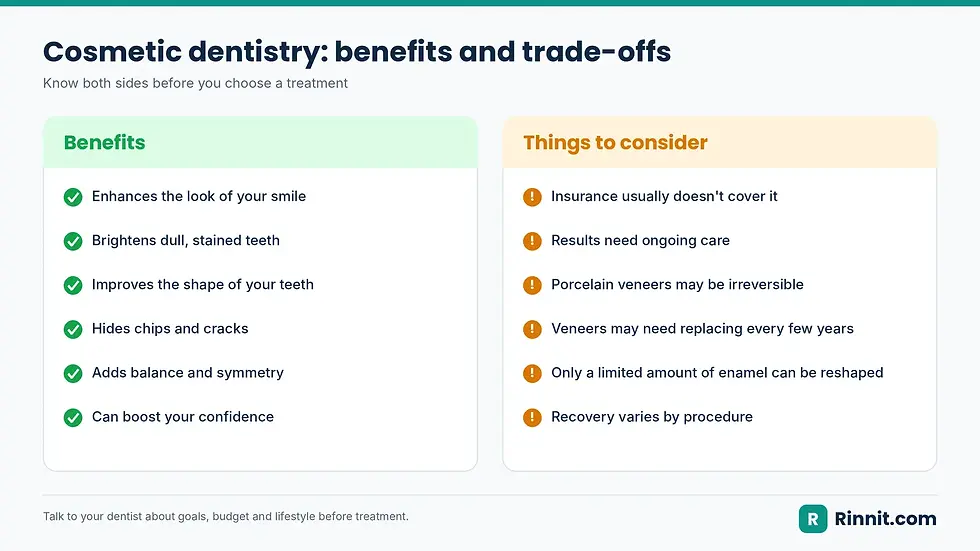
The main benefits of cosmetic dentistry are a brighter, better-shaped and more balanced smile, while the main disadvantages are cost and upkeep. [1]
Benefits — cosmetic dentistry can: [1]
Improve the overall look of your smile
Brighten dull or stained teeth
Improve the shape of your teeth
Hide chips and cracks
Make your smile more balanced and symmetrical
Boost your confidence
Disadvantages to plan for: [1]
Cost: Insurance usually doesn't cover cosmetic procedures, because insurers don't see them as medically necessary.
Upkeep: You'll need to commit to caring for your new smile.
Permanence: Some treatments, such as porcelain veneers, may be irreversible and eventually need replacing, often after 10 years or more.
How long is recovery after cosmetic dentistry?
Recovery after cosmetic dentistry depends on the type of procedure and how many teeth are treated. [1]
Quick options: After bonding on a single tooth, you can usually go back to normal activities right away.
Surgical options: After gum contouring, you may need a couple of days off work.
Your dentist can give you a timeline that fits your plan. [1]
How long does cosmetic dentistry last?
Cosmetic dentistry results last anywhere from a few months to the rest of your life. How long depends on the procedure and how well you care for your teeth and gums. [1]
Treatment | Approximate length of results |
Teeth whitening | 6 months to 3 years |
Dental bonding | 5 to 8 years |
Veneers | 5 to 15 years |
Tooth contouring | Permanent |
Gum contouring | Permanent |

How do you keep cosmetic dentistry results looking good?
Cosmetic dentistry results last longest when you keep up good daily oral hygiene and regular dental visits. [1]
Keep seeing your general dentist for routine checkups and cleanings.
Brush and clean between your teeth at home every day.
Ask your dentist when bonding or veneers may need checking or replacing.
Healthy teeth and gums are the base for any cosmetic result. Learn more about how your teeth are built and cared for and how to prevent cavities and tooth decay.
When should you see a dentist about cosmetic dentistry?
You should see a dentist about cosmetic dentistry any time the look of your smile concerns you. They can explain your options and build a plan around your goals, budget and lifestyle. [1]
If a tooth is damaged by injury or decay rather than just its looks, your dentist may suggest restorative treatment first.
Conclusion
Cosmetic dentistry offers simple and more involved ways to improve your smile, from whitening and bonding to veneers and gum reshaping. Each option fixes different concerns, recovers differently and lasts for a different length of time. Insurance rarely pays, and some choices can't be undone, so it helps to know the trade-offs before you start. The best next step is an honest talk with your dentist about what you want to change.
Bring this to your dentist: Save or share this guide, note the concern you want fixed, and ask which treatment fits your teeth, budget and timeline. For more clear, doctor-reviewed guides on oral health, explore our health library.
FAQ
Does insurance cover cosmetic dentistry?
Usually not. Insurers generally don't consider cosmetic procedures medically necessary, so you'll likely pay out of pocket. [1]
Is cosmetic dentistry permanent?
Some of it is. Tooth contouring and gum contouring are permanent, while whitening lasts about 6 months to 3 years, bonding 5 to 8 years and veneers 5 to 15 years. [1]
Are veneers reversible?
Porcelain veneers may be irreversible, and they eventually need replacing, often after 10 years or more. [1]
Is professional teeth whitening safe?
Yes. Whitening done by a dental professional can lighten the shade of your teeth dramatically and safely. [1]
How long does it take to recover from cosmetic dentistry?
It depends on the procedure. Bonding one tooth usually needs no downtime, while gum contouring may need a couple of days off work. [1]
Do I still need regular dental checkups after cosmetic dentistry?
Yes. Keep seeing your general dentist for checkups and cleanings, and keep up good oral hygiene at home. [1]
Is it vain to want cosmetic dentistry?
No. Disliking part of your smile can affect your confidence, and wanting to improve it is a reasonable goal. [1]
Does cosmetic dentistry hurt?
Most cosmetic treatments cause little or no pain. Numbing medicine is used when needed, and some people have short-term tooth sensitivity, especially after whitening.
What is the difference between dental bonding and veneers?
Bonding uses tooth-colored resin shaped right on the tooth, usually in one visit. Veneers are thin shells made to cover the front of the tooth and usually last longer, but often need some enamel removed.
Can I whiten veneers, crowns or fillings?
No. Whitening products lighten natural teeth only, not veneers, crowns or tooth-colored fillings. If you plan to whiten, do it before getting new restorations so they can be matched to your new shade.
Related Reading
Dental Crowns: Types, Procedure and How Long They Last explains how dental crowns protect damaged teeth.
References
Cleveland Clinic. Cosmetic Dentistry: Purpose, Procedures & Benefits. Cleveland Clinic. Last updated November 6, 2024. https://my.clevelandclinic.org/health/treatments/23914-cosmetic-dentistry
Klein P, Spitznagel FA, Zembic A, et al. Survival and Complication Rates of Feldspathic, Leucite-Reinforced, Lithium Disilicate and Zirconia Ceramic Laminate Veneers: A Systematic Review and Meta-Analysis. J Esthet Restor Dent. 2025;37(3):601-619. PMID 39523553. https://doi.org/10.1111/jerd.13351
Aziz IM, Locke M. Success and Survival of Composite Resin Restorations for the Management of Localized Anterior Tooth Wear: A Systematic Review and Meta-Analysis. Eur J Prosthodont Restor Dent. 2024;32(4):403-414. PMID 39535392. https://doi.org/10.1922/EJPRD_2576Aziz12
de Geus JL, Martins A, Reis A, et al. At-home vs In-office Bleaching: An Updated Systematic Review and Meta-analysis. Oper Dent. 2025;50(4):E47-E69. PMID 40485133. https://doi.org/10.2341/24-078-LIT
Disclaimer
This article is for general education and does not replace advice from your dentist or doctor. Talk to a qualified dental professional before starting any cosmetic treatment.



Comments