Cracked Tooth (Fractured Tooth): Symptoms, Causes, and Treatment Guide

Updated: 3 days ago
Medically reviewed by Dr. Baraa Alnahhal, MD · Last reviewed: October 2026
Quick Answer
A cracked tooth is a break that ranges from a tiny painless hairline to a full split, causing sharp pain when biting and sensitivity to temperature or sweets [1]. Cracks cannot heal on their own and can lead to spreading infection if untreated [1]. Treatment depends on severity and includes bonding, crowns, root canals or extraction; prompt dental care best saves it [1].
What the research says
A full crown protected cracked teeth better than a filling alone. A systematic review and meta-analysis of 27 studies found that, in cracked teeth with healthy (vital) pulp, direct restorations without cuspal coverage had a higher risk of pulpal complications (risk ratio 3.2, 95% CI 1.51 to 6.82) and tooth extraction (risk ratio 8.1, 95% CI 1.05 to 62.5) than full-crown restorations. Cracked teeth that had a root canal without a full crown had an 11.3-fold higher risk of extraction than those with one. For symptom-free cracks, monitoring alone had an 80% success rate at three years. Most included studies were observational (PubMed: Zhang et al., J Dent, 2024) [2].
Lower molars crack most often, and root canal treatment works in most cracked teeth. In a review of 25 years of records from one private endodontic practice covering 2,086 patients with cracked teeth, the most common were mandibular second molars (36%), mandibular first molars (27%), and maxillary first molars (18%). Of 363 teeth eligible for analysis, 296 (82%) were successful at one year after root canal treatment. It was a retrospective, single-practice study (PubMed: Krell & Caplan, J Endod, 2018) [3].
Even after repair, cracks can keep spreading. A review of cracked tooth syndrome noted that restored teeth have a guarded prognosis because of the risk of further crack propagation, although five-year survival was reported at 74.1% to 96.8%. The authors stress that a thorough examination is needed because the extent of the crack is often unknown (PubMed: Gill et al., Eur J Prosthodont Restor Dent, 2021) [4].
What Is a Cracked Tooth?
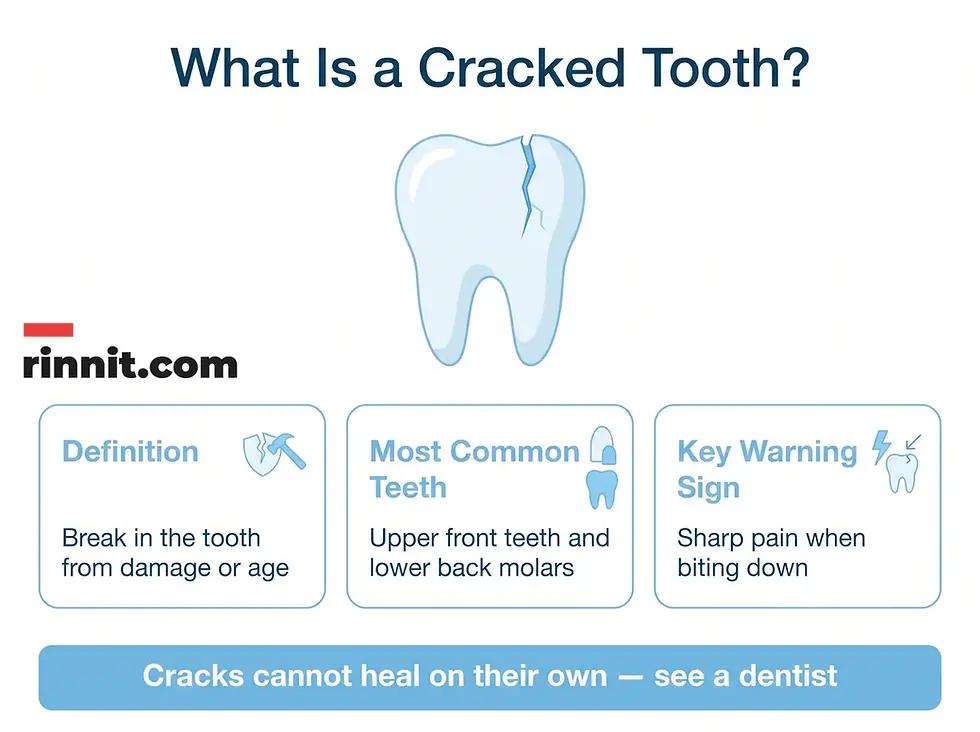
A cracked tooth is what happens when something damages your tooth and creates a small break — a crack or fracture — in it. The crack may be so small that it never affects your tooth. In other cases, the tooth may break into pieces or split apart [1]. A badly cracked tooth can be a dental emergency that needs same-day care.
While any tooth can crack, these breaks happen most often in two places: your upper front teeth (incisors) and the back teeth of your lower jaw (mandibular molars) [1]. The condition is also known as cracked tooth syndrome (CTS) or a fractured tooth. Since teeth have several parts — enamel, dentin, pulp, and root — a crack can occur in any of them.
Key Fact | Detail |
Full name | Cracked tooth (fractured tooth) |
Other names | Cracked tooth syndrome (CTS), fractured tooth |
Most affected teeth | Upper front teeth and lower back molars |
Main causes | Age, hard foods, grinding, dental work, trauma |
Key symptom | Sharp pain when biting down |
Can it heal? | No — cracks cannot heal on their own |
Main treatment | Depends on severity: bonding, crown, veneer, root canal, or extraction |
What are the five types of tooth cracks?
Dentists classify a tooth fracture into one of five categories [1]. The type of crack largely determines both your symptoms and your treatment options.
Type of Crack | What It Is | Typical Pain Level |
Cracked tooth | Vertical crack from the biting surface up to the gum line; may extend into the gum line and root | Pain when biting |
Craze lines | Small, very thin hairline cracks in the tooth enamel | None — these don't hurt |
Fractured cusp | Crack that forms around a dental filling | Usually not very painful |
Split tooth | Crack that splits the tooth into two parts; may run below the gum line | Moderate to severe |
Vertical root fracture | Starts below the gum line and moves toward the surface; may cause no symptoms unless the pulp gets infected | Often silent until infected |

The two least serious types — craze lines and fractured cusps — often need little or no treatment. The more serious types — cracked tooth, split tooth, and vertical root fracture — usually need prompt professional care.
Why can a cracked tooth become serious?
A crack in your tooth is not just a cosmetic problem. It opens the door for bacteria to seep into the tooth pulp and cause a tooth abscess (a dental infection) [1]. If left untreated, that abscess may spread to your jawbone [1]. In more severe cases it can spread further into the facial muscles, tendons, and fat cells of your face and neck [1]. This is why even a seemingly minor crack deserves a dental exam.
What are the symptoms of a cracked tooth?
Cracked teeth do not always cause symptoms [1]. Hairline craze lines, for example, may never produce any pain at all. When symptoms do appear, they tend to follow a recognizable pattern [1].
Symptom | What You Experience |
Biting pain | Sharp pain when you bite down on the tooth |
Temperature sensitivity | Discomfort with hot or cold changes |
Sweet sensitivity | Pain when eating sweet foods |
Swelling | Swelling around the affected tooth |
Chewing pain | Toothache when biting or chewing |
The tricky part is that the pain often comes and goes, which makes cracked teeth easy to overlook — or easy to misdiagnose as a cavity or a gum problem.
Warning Signs of a Dental Infection
Without treatment, a cracked tooth may lead to a tooth abscess, and an abscess can cause more serious health issues. Go to an emergency department right away if swelling spreads in your face or neck or you have trouble swallowing or breathing. Otherwise, seek care quickly if you notice any of these infection symptoms [1].
Infection Sign | Description |
Bad breath (halitosis) | Persistent unpleasant breath |
Ongoing tooth pain | Pain that does not go away |
Fever | Elevated body temperature |
Swollen gums | Inflammation around the tooth |
Swollen lymph nodes | Enlarged nodes in the neck or jaw area |
What causes a cracked tooth and who is at risk?
A cracked tooth usually results from several factors working together over years, with age-related wear among the most common reasons [1]. Understanding what put your tooth at risk also helps you protect the rest of your teeth.
Cause | How It Cracks a Tooth |
Age | Teeth wear down as you get older; people 50 and older are more likely to crack a tooth than younger people |
Hard foods | Biting ice, hard candy, or popcorn kernels |
Dental treatments | A large filling or root canal — especially without a crown — can weaken the tooth |
Bruxism | Grinding or clenching your teeth, often driven by stress, cracks teeth over time |
Dental trauma | A blow to the mouth from a fall, sports injury, or vehicle accident |
Age-related wear is one of the most common reasons cracks develop. As the enamel thins over decades, teeth simply become less able to absorb chewing forces.
How is a cracked tooth diagnosed?
A cracked tooth has no single lab test and may not show on standard X-rays, so dentists combine hands-on techniques and imaging to find it. Dentists use a combination of hands-on techniques and imaging to find and confirm a crack [1].
Diagnostic Step | What the Dentist Does |
Symptom review | Asks about your symptoms and possible causes |
Biting test | Has you bite down on a stick to see if it triggers pain |
Visual exam | Checks the tooth for cracks and other damage |
Gum exam | Looks for gum inflammation, since vertical fractures can irritate gums |
Transillumination | Passes a light through the tooth to illuminate the crack |
Staining dye | Applies a dye to the tooth so the crack is easier to see |
X-rays | Takes dental X-rays to view fractures and related issues such as bone loss |
Cone beam CT | A 3D scan that can show bone loss that may signal a fracture |
Periodontal probe | Uses a tiny measuring tool to find bone loss around the tooth |
Depending on what they find, your dentist may refer you to an endodontist — a specialist who focuses on treating problems of the dental pulp and roots — for additional or different treatment [1].
What are the treatment options for a cracked tooth?
Treatment depends on how much damage the tooth has taken [1]. Not every crack needs a major procedure, and in some cases no treatment is needed at all.
Treatment | How It Works | Best For |
Dental bonding | A tooth-colored resin fills in the cracks | Small cracks |
Dental contouring | Smooths rough edges, adjusts high bite points, and polishes the tooth | Minor fractures |
Dental crown | A porcelain or ceramic cap is fitted over the cracked tooth | Deeper or structural cracks |
Dental veneers | Custom-made shells (porcelain or plastic) fit over the front of the tooth | Front-tooth cracks |
Root canal | Removes infected pulp when a crack reaches the tooth pulp | Cracks with pulp infection |
Tooth extraction | Removes the tooth when a crack severely damages the root and nerves; a bridge or implant can replace it | Severe, unsalvageable cracks |

How Long Does Repair Take?
Fixing a cracked tooth can take anywhere from a single visit to several months, depending on the treatment [1].
Treatment | Typical Timeline |
Dental crown | Sometimes fitted in one day, but often requires multiple appointments |
Tooth extraction with implant | Replacing the tooth with an implant can take months |
Dental veneers | Usually three to four weeks to create the veneer before it can be fitted |
Your dentist or endodontist will explain the repair process so you know what to expect.
Do You Always Need Treatment?
No. You may not need treatment if your crack does not cause infection or pain and does not extend deep or far into the tooth — a typical hairline craze line is a good example [1]. You should still talk to a dentist if you have symptoms or notice a crack, because only an exam can confirm how deep it goes.
How can you care for a cracked tooth at home before your appointment?
You cannot fix a cracked tooth at home — you should always see a dentist if you suspect one [1]. But you can ease your symptoms before your appointment using three simple measures [1].
Home Measure | What It Does |
Ice pack | Placed on the outside of your mouth to prevent swelling |
Salt water rinse | Cleans the tooth and the area around the crack |
NSAIDs | Nonsteroidal anti-inflammatory drugs reduce pain and swelling |
Avoid chewing on the affected side, and steer clear of hard, hot, cold, or sweet foods that trigger pain.
What is the outlook for a cracked tooth?
With prompt treatment, repaired teeth can last for years without causing further issues [1]. There is an important caveat, however: even with treatment, tooth cracks sometimes continue to grow or split [1] [4]. That can eventually result in tooth loss [1]. Regular follow-up care helps your dentist catch any progression early.
How can you reduce your risk of a cracked tooth?
You cannot always prevent a cracked tooth, but three habits meaningfully reduce your chances of getting one [1].
Prevention Step | What to Do |
Oral hygiene | Keep your mouth clean and see a dentist regularly — exams detect even tiny, symptom-free cracks |
Mouth protection | Wear a mouth guard for contact sports (football, basketball, hockey) and fall-risk activities (bike riding, ice skating, gymnastics) |
Avoid hard chewing | Don't chew ice, hard candy, or fingernails, and never use your teeth to rip plastic tags or tough wrapping |
When should you see your dentist about a cracked tooth?
Call your dentist if you have any symptoms of a cracked tooth — a toothache, or pain when you bite down while chewing. Early diagnosis and treatment can help you avoid more serious problems like infection [1]. And if your tooth has cracked badly, with visible pieces or severe pain, treat it as a dental emergency and seek care the same day.
Conclusion
A cracked tooth is a break in the tooth that can range from a painless hairline to a full split, and it strikes most often among adults over 50, hard-food chewers, teeth grinders, and contact-sport players. The hallmark warning sign is sharp pain when biting, often with temperature or sweet sensitivity. Cracks never heal on their own, and untreated ones can let infection spread into the jawbone and facial tissues. The good news is that dentists have a full toolkit — from simple bonding and contouring to crowns, veneers, root canals, and implants — matched to the crack's type and depth. If you feel pain when you bite, do not wait it out.
Get Your Tooth Checked
If you or someone you care about has pain when biting or sensitivity to hot, cold, or sweets, schedule a dental exam to find out whether a crack is the cause.
Frequently Asked Questions
1. What is a cracked tooth in simple terms?
A cracked tooth is a break in the tooth caused by damage such as grinding, biting hard foods, trauma, or age-related wear. It most often affects the upper front teeth and lower back molars. Other names include cracked tooth syndrome and fractured tooth.
2. What does a cracked tooth feel like?
The main signs are sharp pain when you bite down, sensitivity to hot, cold, or sweet foods, swelling around the tooth, and a toothache when chewing. Some cracks, especially hairline craze lines, cause no symptoms at all.
3. Can a cracked tooth heal on its own?
No. A cracked tooth cannot heal, but treatment can save the tooth. Getting the fracture repaired quickly lowers the risk of further damage and infection.
4. What are the five types of tooth cracks?
The five types are: cracked tooth (vertical crack toward the gum line), craze lines (painless hairline cracks in enamel), fractured cusp (crack around a filling), split tooth (tooth split in two), and vertical root fracture (starts below the gum line).
5. Is a cracked tooth serious?
A cracked tooth can be. A crack lets bacteria reach the tooth pulp and cause an abscess. Left untreated, the infection can spread to the jawbone and even into the facial muscles and tissues of the face and neck.
6. What causes teeth to crack?
The most common causes are age-related wear (especially over 50), biting hard foods like ice or popcorn kernels, dental treatments that weaken the tooth, teeth grinding (bruxism), and trauma to the mouth.
7. How does a dentist diagnose a cracked tooth?
Dentists combine a symptom review, a biting test on a stick, a visual exam, a gum exam, transillumination (lighting the tooth), staining dye, dental X-rays, sometimes a cone beam CT scan, and a periodontal probe to find and confirm the crack.
8. How is a cracked tooth fixed?
Treatment depends on the damage. Options include dental bonding to fill small cracks, contouring to smooth minor fractures, a crown to cap deeper cracks, veneers for front teeth, a root canal if the pulp is infected, or extraction with a bridge or implant for severe damage.
9. How long does it take to repair a cracked tooth?
Repair can take a single visit to several months. A crown is sometimes fitted in one day but often takes multiple appointments, veneers take about three to four weeks to create, and an implant after extraction can take months.
10. Do all cracked teeth need treatment?
No. If a crack causes no infection or pain and does not run deep — such as a hairline craze line — it may not need treatment. You should still have a dentist evaluate it, since only an exam can show how deep the crack goes.
11. How can I prevent a cracked tooth?
Practice good oral hygiene with regular dental exams, wear a mouth guard during contact sports and fall-risk activities, and avoid chewing ice, hard candy, fingernails, or using your teeth to tear tough packaging.
Related Reading
Chipped Tooth: What It Is, Why It Happens, and How It's Repaired explains how chipped teeth are repaired and when to see a dentist.
Root Canal Treatment describes the procedure used when a crack reaches the tooth's pulp.
Dental Crowns: Types, Procedure and How Long They Last explains how crowns protect a cracked tooth and what the process involves.
Bruxism: Teeth Grinding Symptoms, Causes, Treatment and Prevention covers teeth grinding, a common cause of cracked teeth, and its treatment.
References
Cleveland Clinic. Cracked Tooth (Fractured Tooth). Cleveland Clinic. April 29, 2024. https://my.clevelandclinic.org/health/diseases/21628-fractured-tooth-cracked-tooth
Zhang S, Xu Y, Ma Y, Zhao W, Jin X, Fu B. The treatment outcomes of cracked teeth: a systematic review and meta-analysis. J Dent. 2024;142:104843. doi:10.1016/j.jdent.2024.104843. PMID: 38272437.
Krell KV, Caplan DJ. 12-month success of cracked teeth treated with orthograde root canal treatment. J Endod. 2018;44(4):543-548. doi:10.1016/j.joen.2017.12.025. PMID: 29429822.
Gill T, Pollard AJ, Baker J, Tredwin C. Cracked tooth syndrome: assessment, prognosis and predictable management strategies. Eur J Prosthodont Restor Dent. 2021;29(4):209-217. doi:10.1922/EJPRD_2232Gill09. PMID: 33770422.
Medical Disclaimer
This article is for informational purposes only and does not constitute medical advice. Always seek the advice of your physician or other qualified health provider with any questions you may have regarding a medical condition. Never disregard professional medical advice or delay in seeking it because of something you have read here.



Comments