Dental Bridges: Types, Procedure and How Long They Last

Updated: 2 days ago
Written and medically reviewed by Dr. Baraa Alnahhal, MD · Last reviewed: November 2026 · How we review
Quick Answer
A dental bridge replaces one or more missing teeth by bridging the gap with crowns that fit over the teeth on each side and artificial teeth that fill the space. Bridges help you chew and speak normally and stop nearby teeth from shifting. A bridge usually takes two visits and typically lasts five to 15 years.
What the research says
Most tooth-supported bridges lasted 5 years: across 40 studies of more than 2,900 bridges, 94.4% of metal-ceramic and 90.4% of zirconia bridges were still in place after 5 years, while some all-ceramic types had more framework fractures (Pjetursson BE et al., Dental Materials, 2015) [2]
Traditional bridges failed least often: pooling six systematic reviews, traditional tooth-supported bridges failed at 1.14% a year over 10 years, compared with 2.20% for cantilever bridges and 4.31% for Maryland (resin-bonded) bridges (Pjetursson BE et al., Journal of Clinical Periodontology, 2012) [3]
Key takeaways
A dental bridge fills the gap left by missing teeth.
It uses crowns on nearby teeth or implants for support.
Types include traditional, cantilever, Maryland and implant-supported.
Getting a bridge usually takes two visits.
Bridges last about five to 15 years.
What is a dental bridge?
A bridge has two parts: abutments, the supporting teeth or implant posts, and pontics, the artificial teeth that fill the gap. Bridges usually replace one to three teeth in a row and can replace up to four if there are healthy teeth on both sides. Dentists sometimes call them "permanent bridges," but they still need replacing when worn or damaged. Sources: [1]
Why you might need one

Replacing missing teeth soon helps protect your bite.
Missing teeth can make it hard to eat or speak.
A bridge improves your smile.
It keeps nearby teeth from shifting into the gap.
It supports your overall oral health. Sources: [1]
Types of dental bridges
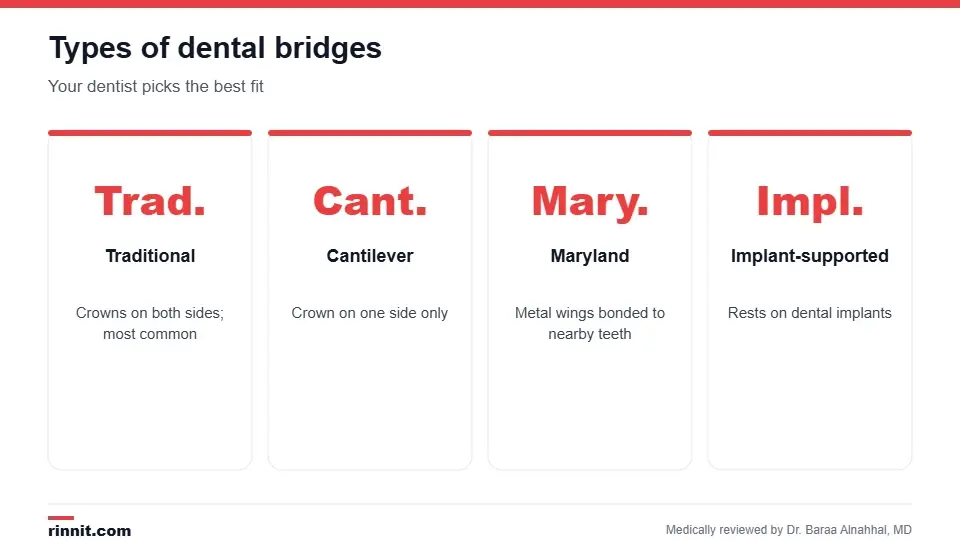
Traditional bridges are the most common type.
Type | How it's supported | Best for |
Traditional | Crowns on both sides of the gap | Most common; needs healthy teeth on both sides |
Cantilever | A crown on one side only | Teeth on only one side; less strong |
Maryland | Metal wings bonded to the backs of nearby teeth | Front teeth |
Implant-supported | Three or more missing teeth in a row |
Your dentist considers your age, how many teeth are missing, the gap size and the health of your teeth and gums. Sources: [1, 3]
Who can get one
Most dentists don't place bridges in people younger than 17 or 18, though a Maryland bridge may be used for a child who lost a permanent tooth. If you need a tooth extraction first, you may wait a few months for your gums and bone to heal. Sources: [1]
What happens during the procedure

Some dentists can make a bridge in one visit with CAD/CAM.
You get local anesthesia.
The support teeth are reshaped by removing some enamel, which can't be undone.
Impressions are sent to a dental lab, which usually takes two to four weeks.
You wear a temporary bridge.
At your second visit, the final bridge is fitted and cemented. Sources: [1]
For implant-supported bridges, implants need three to six months on average to fuse with your jawbone before the bridge is attached. Sources: [1]
Risks
Decay or injury to the support teeth can weaken the bridge.
Weak support teeth can fracture.
Poor cleaning can lead to plaque, gum inflammation or cavities.
It can take time to get used to a bridge. Sources: [1, 2]
Recovery and care
Teeth and gums usually heal in one to two weeks.
Brush and floss daily with a nonabrasive fluoride toothpaste.
Clean under the bridge with floss threaders or small brushes.
Avoid very hard or chewy foods, and don't chew ice, pens or fingernails.
Keep regular dental checkups and cleanings. Sources: [1]
Learn more about oral hygiene. Sources: [1]
Outlook
Bridges last five to 15 years on average, sometimes longer with good care. Implants generally last much longer and help preserve bone. Sources: [1, 2]
When to call your dentist
Your bridge is loose or cracked.
It hurts to chew.
You have tooth sensitivity or sore, bleeding gums. Sources: [1]
Conclusion
A dental bridge is a reliable way to replace missing teeth and restore your bite and smile. Good daily cleaning and regular checkups help your bridge last for many years.
Keep learning: read about dental implants and dental crowns.
Frequently asked questions
What is a dental bridge?
A restoration that replaces missing teeth using crowns and artificial teeth.
What are the types of dental bridges?
Traditional, cantilever, Maryland and implant-supported.
Does getting a bridge hurt?
No. Local anesthesia numbs the area.
How many visits does it take?
Usually two; some dentists can do it in one.
How many teeth can a bridge replace?
Usually one to three, and up to four in a row.
How long do bridges last?
About five to 15 years.
Is a bridge better than an implant?
Bridges cost less, but implants usually last longer.
Can children get bridges?
Usually not before age 17 or 18, with some exceptions.
How do I clean under a bridge?
Use floss threaders or small interproximal brushes.
Can a bridge fall out?
It can loosen; call your dentist if it does.
Related Reading
Dental Implants: Types, Procedure, Recovery and Success Rates replacing teeth with implants.
Dental Crowns: Types, Procedure and How Long They Last caps used to support bridges.
Dentures: Types, Procedure, Care and How Long They Last removable replacement teeth.
Prosthodontics: What It Is, Treatments and When to See a Prosthodontist the dental specialty for tooth replacement.
Understanding Implant-Supported Dentures: A Complete Guide dentures held by implants.
References
Cleveland Clinic. Dental Bridges: Types & Who Needs Them. Cleveland Clinic. Last updated May 24, 2023. https://my.clevelandclinic.org/health/treatments/10921-dental-bridges
Pjetursson BE, Sailer I, Makarov NA, et al. All-ceramic or metal-ceramic tooth-supported fixed dental prostheses (FDPs)? A systematic review of the survival and complication rates. Part II: multiple-unit FDPs. Dent Mater. 2015;31(6):624-639. PMID 25935732. https://doi.org/10.1016/j.dental.2015.02.013
Pjetursson BE, Zwahlen M, Lang NP. Quality of reporting of clinical studies to assess and compare performance of implant-supported restorations. J Clin Periodontol. 2012;39(Suppl 12):139-159. PMID 22533954. https://doi.org/10.1111/j.1600-051X.2011.01828.x
Medical disclaimer
This article is for general education only and does not replace advice from a qualified healthcare professional. Talk to your doctor about your own diagnosis and treatment, and seek emergency care right away for severe or sudden symptoms.



Comments