Dental Implants: Types, Procedure, Recovery and Success Rates

Updated: 2 days ago
Written and medically reviewed by Dr. Baraa Alnahhal, MD · Last reviewed: November 2026 · How we review
Quick Answer
Dental implants are small threaded posts, usually titanium, placed in the jawbone to act as artificial tooth roots. Once the bone fuses with the implant, it supports a crown, bridge or denture that looks and works like natural teeth. The bone takes three to nine months to fuse. With good care, implants can last a lifetime.
What the research says
Most implants last at least 10 years: in 18 studies, 96.4% of modern dental implants were still in place after 10 years, though survival was lower (91.5%) in people 65 and older (Howe MS et al., J Dent, 2019) [2]
Long-term results are strong: in 23 studies of 7,711 implants followed for an average of 13 years, 94.6% survived, with only about 1.3 mm of bone loss around the implant (Moraschini V et al., Int J Oral Maxillofac Surg, 2015) [3]
Key takeaways
Dental implants are artificial tooth roots placed in the jawbone.
They support crowns, bridges or dentures.
The bone takes three to nine months to fuse with the implant.
About 95% of implants last 10 years or more.
Good oral hygiene helps implants last a lifetime.
What are dental implants?
A dental implant has three parts. The post is the artificial root that goes into the jawbone. The abutment is a small connector screwed into the post that sits just above the gums. The restoration is the crown, bridge or denture that you see. Implants are made of titanium or ceramic, both of which the body accepts well. Sources: [1]
Why they're used
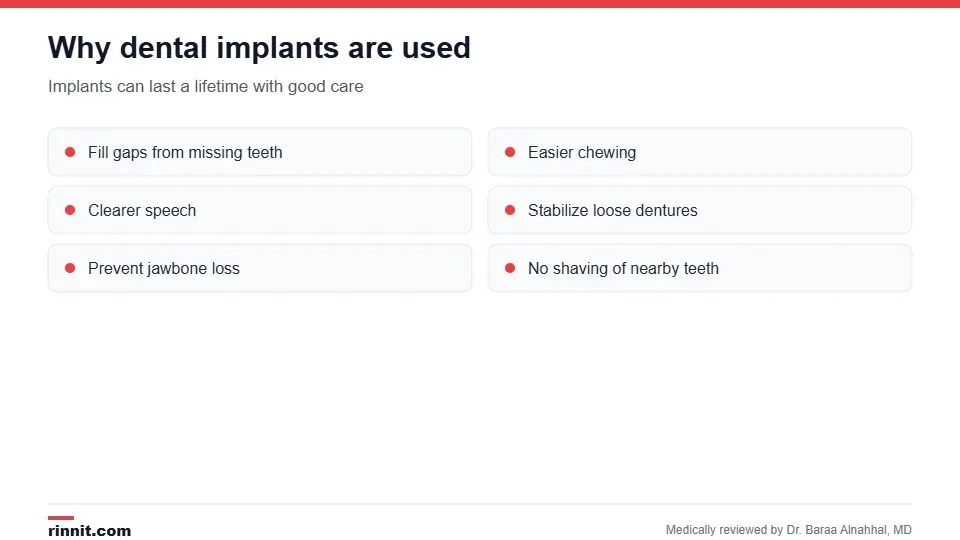
Implants can last a lifetime with good care.
Fill gaps from missing teeth.
Make chewing and speaking easier.
Stabilize loose dentures.
Prevent the jawbone from shrinking after tooth loss.
Unlike a bridge, an implant doesn't require shaving down the healthy teeth next to the gap. Sources: [1]
Types of dental implants
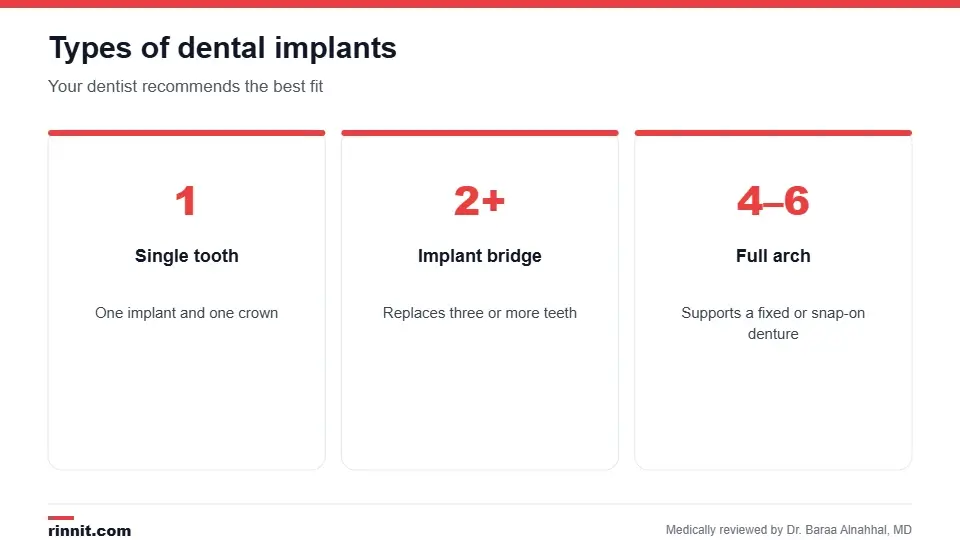
Your dentist recommends the type that fits your needs.
Type | What it replaces | How many implants |
Single-tooth | One missing tooth | One implant and one crown |
Implant bridge | Three or more teeth in a row | Two or more implants |
Full arch | All teeth in the upper or lower jaw | Usually four to six implants with a fixed or snap-on denture |
Sources: [1]
Who's a good candidate
Usually at least 18 years old, with no upper age limit.
Enough healthy jawbone; if not, a bone graft may come first.
Healthy gums and good oral hygiene. Sources: [1]
Factor | Why it matters |
Untreated gum disease or extensive decay | Raises the risk the implant fails |
Severe jawbone loss | Not enough bone to hold the implant |
Uncontrolled diabetes | Slows healing |
Smoking or vaping | Interferes with healing and bone fusion |
Sources: [1]
How implants are placed
Your dentist reviews your health history and takes dental X-rays or scans.
Your gums are numbed; sedation is optional.
A small cut in the gum exposes the bone, and a small hole is drilled.
The implant is placed and the gums are closed with stitches. A temporary tooth may be used for front teeth.
Over three to nine months, the bone fuses to the implant (osseointegration).
The abutment and final crown, bridge or denture are attached, often in a visit of about an hour. Sources: [1]
Risks and recovery
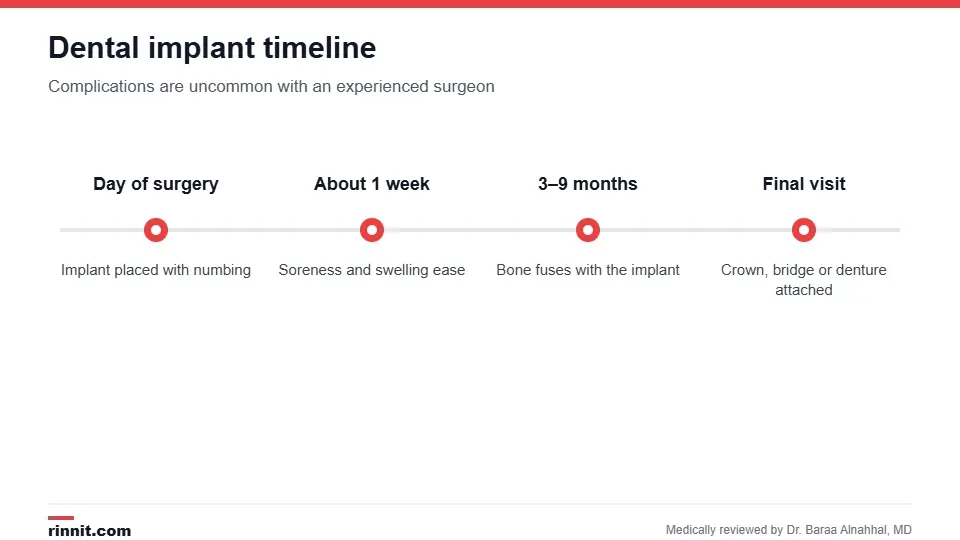
With an experienced surgeon, complications are uncommon.
With an experienced surgeon, the risk of complications is low. Mild soreness and swelling are normal and usually ease with over-the-counter pain relievers. Most people feel like themselves within about a week. Brush, floss and keep regular dental visits to protect your implant. Sources: [1, 2]
How long implants last
Part | Typical lifespan |
Implant post | Can last a lifetime with good care |
Crown or bridge | Around 15 years |
Implant-supported denture | At least 7 years |
Sources: [1, 2, 3]
When to call your dentist
The implant feels loose or wobbly.
Your gums bleed, swell or have pus around the implant.
You have a fever or swollen lymph nodes in your neck. Sources: [1]
Conclusion
Dental implants are a long-lasting, natural-looking way to replace missing teeth and protect your jawbone. Ask your dentist whether you're a good candidate and which type fits your needs.
Keep learning: read about dental veneers and implant-supported dentures.
Frequently asked questions
What is a dental implant?
An artificial tooth root placed in the jawbone to support a crown, bridge or denture.
What are implants made of?
Usually titanium; some are ceramic.
Does getting an implant hurt?
The area is numbed, so you shouldn't feel pain during placement.
How long does the whole process take?
The bone takes three to nine months to fuse before the final tooth is placed.
How long do dental implants last?
The implant can last a lifetime; crowns last around 15 years.
What's the success rate?
About 95% of implants last 10 years or more.
Who can get dental implants?
Adults with healthy gums and enough jawbone.
Can smokers get implants?
Smoking raises the risk of problems; talk to your dentist.
What if I don't have enough bone?
A bone graft may be done first.
Are implants better than a bridge?
Implants don't require shaving neighboring teeth and help preserve bone.
Related Reading
Dental Bridges: Types, Procedure and How Long They Last explains dental bridges.
Prosthodontics: What It Is, Treatments and When to See a Prosthodontist explains prosthodontics and tooth replacement.
Dental Bone Graft: Purpose, Procedure and Healing explains dental bone grafts for rebuilding the jaw.
Dental Crowns: Types, Procedure and How Long They Last explains how dental crowns protect damaged teeth.
Dentures: Types, Procedure, Care and How Long They Last removable replacements for missing teeth.
Understanding Implant-Supported Dentures: A Complete Guide dentures held in place by implants.
Bone Grafting: Types, Procedure, Risks and Recovery a procedure to build up jawbone.
Dental X-Rays: Types, What They Show, Safety and How Often You Need Them imaging used to plan implants.
Dental Veneers: Enhancing Your Smile with Custom Restorations another way to improve your smile.
References
Cleveland Clinic. Dental Implants: Types, Purpose & Benefits. Cleveland Clinic. Last updated June 11, 2026. https://my.clevelandclinic.org/health/treatments/10903-dental-implants
Howe MS, Keys W, Richards D. Long-term (10-year) dental implant survival: a systematic review and sensitivity meta-analysis. J Dent. 2019;84:9-21. PMID 30904559. https://doi.org/10.1016/j.jdent.2019.03.008
Moraschini V, Poubel LA, Ferreira VF, et al. Evaluation of survival and success rates of dental implants reported in longitudinal studies with a follow-up period of at least 10 years: a systematic review. Int J Oral Maxillofac Surg. 2015;44(3):377-388. PMID 25467739. https://doi.org/10.1016/j.ijom.2014.10.023
Medical disclaimer
This article is for general education only and does not replace advice from a qualified healthcare professional. Talk to your doctor about your own diagnosis and treatment, and seek emergency care right away for severe or sudden symptoms.



Comments