Dental X-Rays: Types, What They Show, Safety and How Often You Need Them
Updated: 2 days ago
Written and medically reviewed by Dr. Baraa Alnahhal, MD · Last reviewed: November 2026 · How we review
Quick Answer: What are dental X-rays?
Dental X-rays (radiographs) are images of the teeth and jaws that let a dentist see what a regular exam can't. They help find cavities between teeth, decay under fillings, bone loss, impacted teeth and abscesses. They use a very low dose of radiation, and people with healthy teeth may only need them every six to 18 months. [1]
What the research says
Bitewing X-rays are the standard for finding cavities between teeth. A review of 13 studies used bitewing X-rays as the benchmark for detecting decay between back teeth. A radiation-free light test called near-infrared transillumination matched them closely, with 97% sensitivity and 91% specificity across 6,110 teeth, which may help when radiation should be limited. (Ortiz et al., Journal of Dentistry, 2020) [2]
Computer programs are learning to read dental X-rays. A review of 42 studies on deep learning found that artificial intelligence models classified cavities with 87.6% to 95.4% accuracy on bitewing X-rays and 86.1% to 96.1% on panoramic X-rays, though study quality was mostly low and these tools are meant to assist dentists, not replace them. (Mohammad-Rahimi et al., Journal of Dentistry, 2022) [3]
Key takeaways
Dental X-rays show parts of your mouth your dentist can't see, like tooth roots, jawbone, nerves and sinuses. [1]
The two main groups are intraoral X-rays (sensor inside your mouth) and extraoral X-rays (sensor outside your mouth). [1]
Digital X-rays use 80% to 90% less radiation than traditional film X-rays. [1]
With healthy teeth and gums, you may only need X-rays every six to 18 months. [1]
Dental X-rays are generally considered safe during pregnancy, though dentists usually avoid them unless necessary. [1]
What are dental X-rays?
Dental X-rays, also called radiographs, are images of your teeth and jaws. Dentists use them to see the parts of your mouth that aren't visible during a regular exam, including your jawbone, nerves, sinuses and tooth roots. A dental X-ray machine captures these images during your visit. [1]
What can dental X-rays detect?

Dental X-rays help your dentist find a wide range of oral health problems, including: [1]
Cavities, especially between teeth
Decay under existing fillings
Bone loss in your jaw
Teeth that haven't come in or are impacted
Abscesses (infections at the tooth root or between the gums and teeth)
Cysts and some tumors
Dentists also use X-rays to decide whether you're a candidate for treatments like implants, braces or dentures, and to track healing after procedures like bone grafts or root canals. [1]
How do dental X-rays work?
Like X-rays of other parts of your body, dental X-rays use a tiny amount of radiation to capture images. The beam passes through your soft tissues and creates pictures of your teeth and bones. [1]
X-rays can be traditional (film) or digital (sensors and a computer). Digital X-rays use 80% to 90% less radiation than traditional ones. [1]
Types of dental X-rays

There are two main types: intraoral, where the film or sensor goes inside your mouth, and extraoral, where it stays outside your mouth. [1]
Type | Group | What it shows |
Bitewing | Intraoral | Cavities between teeth and below the gumline |
Periapical | Intraoral | Gum disease, bone loss and cavities near tooth roots |
Occlusal | Intraoral | Problems under your tongue or on the roof of your mouth, like impacted teeth or jaw fractures |
Panoramic | Extraoral | Your entire mouth, including teeth, jaws, nerves, sinuses and bone |
Cephalometric | Extraoral | A side view of your head, often used for orthodontic planning |
Cone beam CT | Extraoral | 3D images of teeth, jaws, nerves and sinuses, often used to plan implants |
Sources: [1]
What happens during a dental X-ray?
A technician may place a lead apron over your chest and wrap a thyroid collar around your neck to protect you from extra radiation.
You sit or stand in front of the X-ray machine.
The technician positions the film or sensor and takes the image.
You stay as still as possible while each image is taken.
Sources: [1]
Are dental X-rays safe?
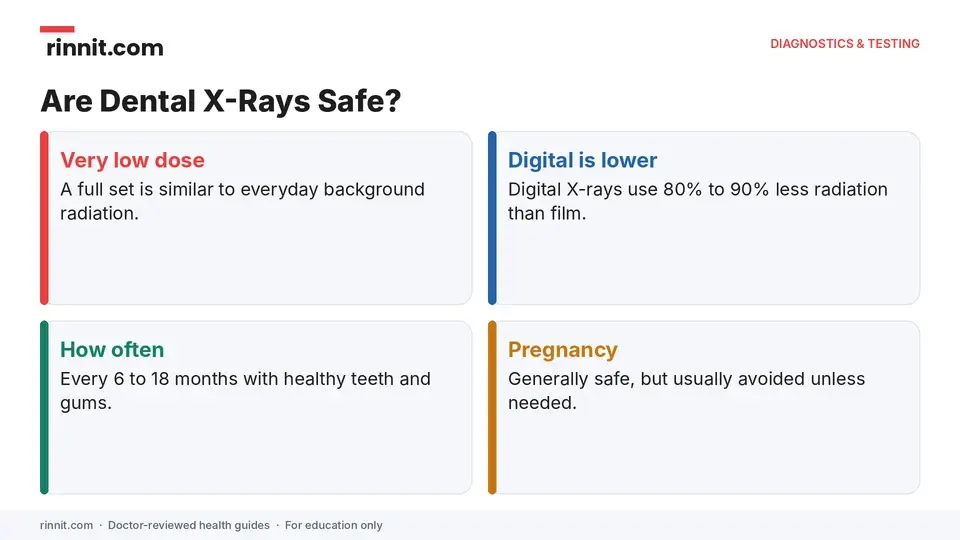
Dental X-rays use very low radiation. A full set exposes you to about the same amount of radiation you get from everyday sources such as: [1]
Building materials like granite or ceramic tile
Flying at high altitudes
Natural background radiation from the sun and Earth
Still, frequent exposure to high doses can be harmful and may raise cancer risk. That's why dentists take X-rays only when they're needed. Your dentist can help you weigh the risks and benefits. [1]
How often do you need dental X-rays?
If your teeth and gums are healthy, you may only need dental X-rays every six to 18 months. If you have gum disease, frequent cavities or other urgent problems, your dentist may recommend them more often. Children may also need them more often, especially while they're losing teeth or if their teeth are crowded. [1]
Can you have dental X-rays while pregnant?
Generally, yes. Dental X-rays are considered safe during pregnancy and breastfeeding. Both the American Dental Association and the American Pregnancy Association agree that the risk to the fetus is minimal. Still, most dentists avoid taking X-rays during pregnancy unless they're really needed. [1]
Can you refuse dental X-rays?
Yes, you have the right to refuse. Keep in mind that many dentists won't go ahead with treatment without them. If you're worried about radiation, talk with your dentist about the risks and benefits. [1]
Can dental X-rays show cancer?
They can reveal some types of oral cancer, especially cancers that affect or spread to the jaw. But they don't catch every form of mouth cancer, so regular oral cancer screenings are still important. [1]
Conclusion
Dental X-rays are an essential part of keeping your teeth and gums healthy. They reveal cavities, bone loss, infections and other problems hidden beneath the surface, and they help your dentist plan treatments and check healing.
The radiation dose is very low, especially with digital X-rays. Ask your dentist how often you need them based on your own risk of cavities and gum disease.
Keep learning: Read our guide to cavities and tooth decay or our explainer on X-rays. For more trusted, doctor-reviewed health guides, visit Rinnit.com.
FAQ
What are dental X-rays?
Images of your teeth and jaws that show parts your dentist can't see during a regular exam.
What can dental X-rays detect?
Cavities, decay under fillings, bone loss, impacted teeth, abscesses, cysts and some tumors.
What are the main types of dental X-rays?
Intraoral X-rays, such as bitewing and periapical, and extraoral X-rays, such as panoramic and cone beam CT.
Are dental X-rays safe?
Yes. They use very low radiation, and dentists take them only when needed.
How much less radiation do digital X-rays use?
Digital X-rays use 80% to 90% less radiation than traditional film X-rays.
How often should I get dental X-rays?
Every six to 18 months if your teeth and gums are healthy, and more often if you have problems.
Can I get dental X-rays while pregnant?
Generally yes, but most dentists avoid them during pregnancy unless they're necessary.
Why do I need a lead apron for dental X-rays?
The apron and thyroid collar protect you from extra radiation.
Can I refuse dental X-rays?
Yes, but many dentists won't start treatment without them.
Can dental X-rays show oral cancer?
They can show some oral cancers, especially those affecting the jaw, but not all of them.
Related Reading
Dental Implants: Types, Procedure, Recovery and Success Rates explains how dental implants replace missing teeth.
Cavities and Tooth Decay: Symptoms, Causes, Diagnosis and Treatment — What You Need to Know explains the tooth decay that bitewing X-rays often find between teeth.
Periodontitis: Why Your Gums Bleed and Recede, the 4-Stage Disease Path, and How Treatment Saves Your Teeth covers the gum disease and bone loss that dental X-rays help track.
Tooth Abscess: Symptoms, Causes, Diagnosis, and Treatment describes the tooth root infection that X-rays can reveal.
Understanding Impacted Teeth: Types, Symptoms, and Care explains teeth that can't break through the gums, which X-rays show clearly.
Wisdom Teeth: Symptoms, Causes, and Treatment covers wisdom tooth problems that panoramic X-rays help plan around.
Oral Cancer: Symptoms, Risk Factors, and Treatment Pathways explains mouth cancer, which some dental X-rays can reveal when it affects the jaw.
References
Cleveland Clinic. Dental X-rays: Purpose & Types. Cleveland Clinic. Last updated August 16, 2025. https://my.clevelandclinic.org/health/diagnostics/11199-dental-x-rays
Ortiz MIG, de Melo Alencar C, De Paula BLF, et al. Accuracy of near-infrared light transillumination (NILT) compared to bitewing radiograph for detection of interproximal caries in the permanent dentition: A systematic review and meta-analysis. J Dent. 2020;98:103351. PMID 32380136. https://doi.org/10.1016/j.jdent.2020.103351
Mohammad-Rahimi H, Motamedian SR, Rohban MH, et al. Deep learning for caries detection: A systematic review. J Dent. 2022;122:104115. PMID 35367318. https://doi.org/10.1016/j.jdent.2022.104115
Medical disclaimer
This article is for general education only and does not replace advice from a qualified healthcare professional. Talk to your doctor about your own diagnosis and treatment, and seek emergency care right away for severe or sudden symptoms.



Comments