Oral Cancer: Symptoms, Risk Factors, and Treatment Pathways

Updated: 3 days ago
Medically reviewed by Dr. Baraa Alnahhal, MD · Last reviewed: October 2026
Editorial note: This article is for general education. If you notice a sore or patch in your mouth that does not heal, see a dentist or doctor.
Quick Answer
Oral cancer is a disease in which malignant cells form in the tissues of the mouth or lips, often appearing as a sore that doesn't heal, a lump, or white and red patches. Tobacco and alcohol are primary risk factors, though 25% of cases occur without them [1]. Treatment may include surgery, radiation or chemotherapy [1].
What the research says
Current smokers had about 3.4 times the risk of oral cancer. A meta-analysis of 115 studies found current versus never smokers had a pooled relative risk of 3.39 (95% CI 2.64–4.35) for oral cancer, and 3.58 for oral and pharyngeal cancer combined. Risk fell by about 50% within 10 years of quitting (Possenti et al., Oncol Rev, 2026) [2]
Simple visual checks can flag most people with disease. In a meta-analysis of 6 screening studies in South and Southeast Asia, community health workers' visual oral exams had 75% sensitivity and 97% specificity for oral cancer and pre-cancerous lesions combined; 8% of people screened were flagged as suspicious (Gurushanth et al., Oral Dis, 2025) [3]
After surgery, radiation was linked to better survival in one early-stage group. In 7 retrospective studies of 522 patients with early-stage, node-negative oral cancer and perineural invasion, 5-year overall survival was 88.1% with postoperative radiotherapy versus 77.3% without. These are retrospective data in a narrow patient group (Rao et al., Cancers, 2025) [4]
According to PubMed, these are meta-analyses of published studies; results describe groups of patients, not individual outcomes.
What Is Oral Cancer?
Oral cancer, also known as mouth cancer, is a broad term for malignant growths that develop in the oral cavity. This includes the lips, the lining of the cheeks, the gums, the front two-thirds of the tongue, the floor of the mouth under the tongue, and the hard palate (the bony roof of the mouth) [1]. It is primarily a disease of the squamous cells, which are flat cells that line the moist surfaces of the mouth [1].
Who Is at Risk?
Statistically, oral cancer affects approximately 11 out of every 100,000 people [1]. It is more common in men than women and is most frequently diagnosed in individuals over the age of 60 [1]. While many cases are linked to specific lifestyle choices, a significant portion of the population develops oral cancer without any known traditional risk factors [1].
What are the warning signs of oral cancer?
Oral cancer symptoms are often subtle and can easily be mistaken for minor mouth irritations or common dental problems. The key distinguishing factor is persistence; if a change in your mouth does not resolve within two weeks, it should be examined by a professional [1].
Common Symptoms
Non-Healing Sores: Ulcers or sores on the lips or inside the mouth that bleed easily and do not heal [1].
Persistent Patches: Flat white or gray patches (leukoplakia) or raised red patches (erythroplakia) that cannot be scraped away [1].
Physical Changes: Rough spots, crusty areas, or thickened lumps in the soft tissues.
Pain and Numbness: Unexplained pain, tenderness, or numbness in the face, neck, or mouth [1].
Functional Difficulty: Trouble chewing, swallowing, speaking, or moving the jaw or tongue [1].
Condition | Appearance | Risk Level |
Leukoplakia | Flat white or gray patches | Pre-cancerous potential |
Erythroplakia | Raised or flat red patches | High risk of malignancy |
Erythroleukoplakia | Mixed red and white patches | High risk of malignancy |
What causes oral cancer, and which lifestyle factors raise the risk?
The exact cause of oral cancer is not always clear, but tobacco use and alcohol are among the major risk factors researchers have identified [1]. Approximately 75% of all oral cancer cases are associated with specific habits or conditions [1].
Primary Risk Factors
Tobacco Use: Smoking cigarettes, cigars, or pipes, as well as using smokeless tobacco (chewing tobacco, snuff, or dip) [1].
Alcohol Consumption: Regular and excessive intake of alcohol significantly increases risk, especially when combined with tobacco use.
Sun Exposure: Prolonged exposure to UV rays without lip protection can lead to cancer of the lips [1].
Viral Infections: Certain strains of the human papillomavirus (HPV) are linked to cancers of the oropharynx.
Family History: A genetic predisposition to head and neck cancers can increase individual risk.

How is oral cancer diagnosed and staged?
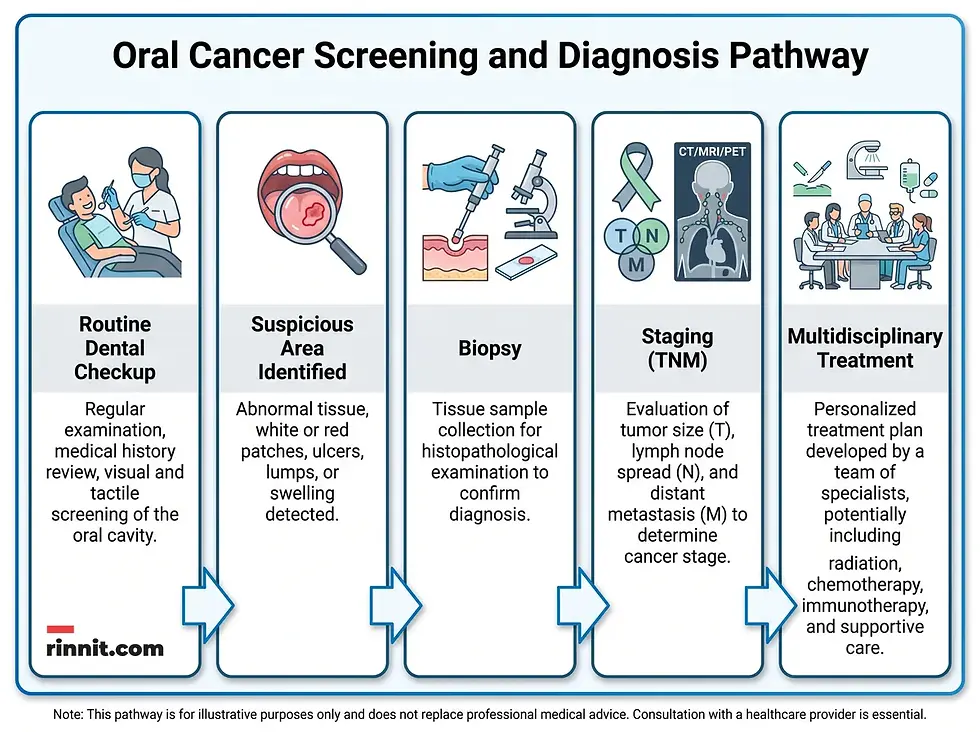
Early detection often occurs during routine dental checkups [1]. If a suspicious area is found, a specialist such as an oral surgeon or an ear, nose, and throat (ENT) doctor will perform a series of diagnostic tests [1].
Diagnostic Tools
Physical Examination: A thorough visual and manual inspection of the mouth, neck, and face [1].
Biopsy: The removal of a small tissue sample (either via scraping or incision) for microscopic analysis [1].
Endoscopy: Using a thin, flexible tube with a camera (endoscope) to view the throat and larynx [1].
Imaging: Tests like CT scans or MRIs to determine if the cancer has spread to nearby tissues or lymph nodes.
The Staging Process (TNM)
Healthcare providers use the TNM system to stage oral cancer, which helps determine the prognosis and treatment plan [1]. T refers to the size of the tumor, N indicates if it has reached the lymph nodes, and M shows if it has metastasized to distant organs [1].
What are the treatment pathways for oral cancer?
Treatment for oral cancer is highly individualized and depends on the stage, location, and the patient's overall health [1]. The primary goal is to remove the cancer while preserving as much oral function as possible.
Standard Treatments
Surgery: The most common approach, involving the removal of the tumor and sometimes nearby lymph nodes (neck dissection) [1]. In advanced cases, parts of the tongue (glossectomy) or jaw (mandibulectomy) may be removed [1].
Radiation Therapy: Using high-energy beams to destroy cancer cells [1], often used after surgery to kill any remaining cells.
Chemotherapy: The use of powerful drugs to kill cancer cells throughout the body, often combined with radiation [1].
Targeted and Immunotherapy: Modern drugs that target specific cancer proteins or help the immune system recognize and attack the disease [1].
How can oral cancer be prevented, and what is the long-term outlook?
Not all oral cancer can be prevented, but quitting tobacco, limiting alcohol and protecting your lips from the sun significantly reduce your risk [1]. Regular dental visits remain the most effective way to ensure early detection and a better prognosis. With a five-year survival rate of approximately 63% [1], early intervention is the most powerful tool in managing oral cancer.
Protect your health by scheduling regular dental checkups and performing monthly self-exams of your mouth [1]. If you notice any sores or patches that last longer than two weeks, contact your healthcare provider immediately for an evaluation [1].
Frequently Asked Questions
1. Is oral cancer painful in the early stages?
Early-stage oral cancer is often painless. This is why it is crucial to pay attention to visual changes like patches or sores, even if they don't hurt.
2. Can a dentist find oral cancer?
Yes. Dentists are trained to recognize the early signs of oral cancer during routine cleanings and exams. Regular visits are essential for early detection.
3. What is the difference between a canker sore and oral cancer?
Canker sores are typically painful and heal within 7 to 10 days. Oral cancer sores are often painless at first and do not heal, lasting for weeks or months.
4. Is oral cancer contagious?
No. Cancer is not contagious. However, HPV, which is a virus that can increase the risk of certain oral cancers, can be transmitted through close contact.
5. Can young people get oral cancer?
While it most commonly affects those over 60, oral cancer can occur at any age. Risk factors like HPV have led to an increase in cases among younger populations.
6. What is leukoplakia?
Leukoplakia refers to flat white or gray patches in the mouth that cannot be scraped off. While often benign, they can be pre-cancerous and should be monitored.
7. How does smoking affect oral cancer risk?
Smoking introduces carcinogens directly to the oral tissues and weakens the immune system's ability to fight off cancerous changes.
8. What is a glossectomy?
A glossectomy is a surgical procedure to remove part or all of the tongue due to cancer. Reconstructive surgery is often performed afterward to help restore function.
9. Does oral cancer always spread to the throat?
Not always, but if left untreated, oral cancer can metastasize to the lymph nodes in the neck and eventually to other parts of the body.
Related Reading
Glossectomy: Types, Surgery and Recovery explains glossectomy surgery for tongue cancer.
Oral Cancer Screening: What to Expect, Methods and How to Self-Check explains the quick exam that looks for early signs of mouth cancer.
Dental X-Rays: Types, What They Show, Safety and How Often You Need Them explains the dental X-ray types your dentist uses to find cavities, bone loss and infections, and how safe they are.
References
Cleveland Clinic. Oral Cancer: Causes, Symptoms & Treatment. Cleveland Clinic. Last updated January 27, 2022. https://my.clevelandclinic.org/health/diseases/11184-oral-cancer
Possenti I, Miotti S, Gallus S, et al. Smoking and oral and pharyngeal cancer: a meta-analysis. Oncol Rev. 2026;19:1672607. PMID: 41640576. https://doi.org/10.3389/or.2025.1672607
Gurushanth K, Sunny SP, Kuriakose MA, et al. Feasibility, reliability, and effectiveness of oral cancer screening in South Asia and Southeast Asian countries: a systematic review and meta-analysis. Oral Dis. 2025;31(5):1490-1502. PMID: 38817091. https://doi.org/10.1111/odi.15001
Rao KN, Sreeram MP, de Bree R, et al. The oncological outcome of postoperative radiotherapy in patients with node-negative early-stage (T1/T2/N0) oral squamous cell carcinoma and perineural invasion: a meta-analysis. Cancers (Basel). 2025;17(5):862. PMID: 40075709. https://doi.org/10.3390/cancers17050862
Medical disclaimer
This article is for informational purposes only and is not a substitute for professional medical advice, diagnosis, or treatment. Always seek the advice of your physician or other qualified health provider with any questions about a medical condition.



Comments