Wisdom Teeth: Symptoms, Causes, and Treatment

Updated: 2 days ago
Medically reviewed by Dr. Baraa Alnahhal, MD. Last reviewed October 13, 2026. This content is for educational purposes and is not medical advice.
Quick Answer
An impacted wisdom tooth is a third molar that cannot emerge normally because there is not enough room, so it stays stuck below the gums or grows at an odd angle. It may cause swollen gums, jaw pain and bad breath, though many cause no symptoms. Problem teeth are removed surgically, while symptom-free teeth may be removed or monitored.
What the research says
There is not enough evidence to say whether trouble-free impacted teeth should come out. A Cochrane review found only two eligible studies: one randomized trial (164 adolescents randomized, 77 analyzed) and one prospective cohort of 416 men followed for 3 to over 25 years. The evidence was low to very low certainty, so the authors concluded it is insufficient to determine whether symptom-free impacted wisdom teeth should be removed or retained, and recommended shared decision-making based on patient values. Very low-certainty evidence suggested retained teeth may raise the long-term risk of gum disease (periodontitis) affecting the neighboring second molar (Ghaeminia et al., Cochrane Database of Systematic Reviews, 2020).
Chlorhexidine lowers the risk of dry socket. In a meta-analysis of 18 randomized trials covering 2,824 third molar extractions, chlorhexidine in any formulation reduced alveolar osteitis (dry socket) (relative risk 0.53; 95% CI 0.45 to 0.62; number needed to treat 8), with no larger share of adverse reactions than placebo (Rodríguez Sánchez et al., Journal of Oral and Maxillofacial Surgery, 2017).
Evidence on the best surgical technique is thin. A Cochrane review of 62 trials with 4,643 participants rated the evidence for every technique comparison as low or very low certainty, so the authors could not make firm recommendations. Placing platelet-rich plasma or platelet-rich fibrin in the socket may reduce dry socket (odds ratio 0.39; 95% CI 0.22 to 0.67; 2 studies, low certainty) (Bailey et al., Cochrane Database of Systematic Reviews, 2020).
Key facts at a glance
Fact | Detail |
What they are | Third molars, the last adult teeth to erupt |
How many | Most people have four: two top, two bottom |
When they arrive | Usually between ages 17 and 26 |
What "impacted" means | The tooth lacks room and stays stuck below the gums or grows at an odd angle |
Typical symptoms | Often none; when infected or damaging other teeth, pain, swollen gums, bad breath, trouble opening the mouth |
Main treatment | Surgical extraction (usually outpatient); monitoring is an option for symptom-free teeth |
What are wisdom teeth, and what does "impacted" mean?
Wisdom teeth are the last of your teeth to appear (erupt) in the mouth. They are the third molars at the back of the mouth, and most people have four of them: two on the top and two on the bottom [1].
Sometimes a wisdom tooth becomes stuck below the surface of the gums and grows at an odd angle, possibly causing problems. This is called an impacted wisdom tooth.
Impacted wisdom teeth don't have enough room to emerge or develop in the usual way. They can cause pain, damage other teeth, and lead to other dental problems. Sometimes they don't cause any problems at all. But because wisdom teeth are hard to clean, they may be more prone to tooth decay and gum disease than other teeth [1].
What are the symptoms of an impacted wisdom tooth?
Impacted wisdom teeth don't always cause symptoms. But when an impacted wisdom tooth becomes infected, damages other teeth, or causes other dental problems, you may notice several warning signs [1].

The most common symptoms include red or swollen gums, tender or bleeding gums, jaw pain, and swelling around the jaw. Some people also develop bad breath, an unpleasant taste in the mouth, or a hard time opening their mouth.
When to see a dentist: See your dentist if you have symptoms in the area behind your last molar that may be related to an impacted wisdom tooth [1].
Why do wisdom teeth become impacted?
Wisdom teeth become impacted because they don't have enough room to come in or develop in the usual way. They usually emerge sometime between the ages of 17 and 26.
Some people have wisdom teeth that emerge behind the second molars without any problems, lining up with the other teeth. But in many cases, the mouth is too crowded for the proper development of third molars, and these crowded third molars become impacted [1].
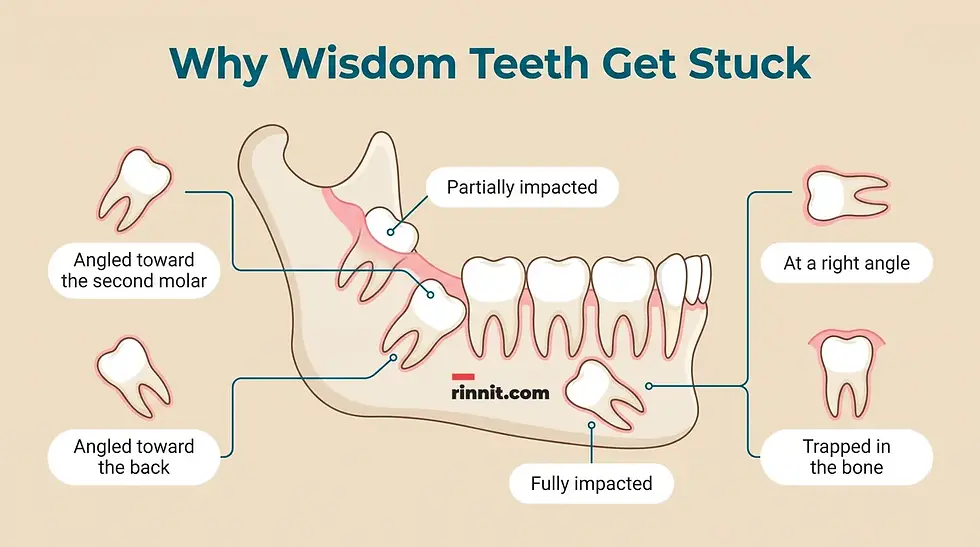
An impacted wisdom tooth may partially emerge so that some of the crown is visible. This is called a partially impacted wisdom tooth. If the tooth never breaks through the gums, it's called a fully impacted wisdom tooth.
Whether partially or fully impacted, the tooth may:
Grow at an angle toward the next tooth (the second molar).
Grow at an angle toward the back of the mouth.
Grow at a right angle to the other teeth, as if it is "lying down" within the jawbone.
Grow straight up or down like other teeth but stay trapped within the jawbone.
What increases the risk?
The main risk factor for impacted wisdom teeth is simple: lack of space or a blockage that keeps the teeth from emerging properly [1].
What complications can impacted wisdom teeth cause?
Impacted wisdom teeth can cause several problems in the mouth, and these complications are the main reason dentists take them seriously [1].
Complication | How it happens |
Damage to other teeth | Pressure against the second molar can damage it or raise infection risk; it may also crowd other teeth and require orthodontic treatment |
Cysts | The sacs where wisdom teeth develop in the jawbone can fill with fluid, forming cysts that damage the jawbone, teeth, and nerves; rarely, a tumor develops (usually benign), requiring removal of tissue and bone |
Decay | Partially impacted teeth are harder to clean, and food and bacteria get trapped easily between the gum and a partially erupted tooth, raising cavity risk |
Gum disease | Hard-to-clean, partially erupted teeth raise the risk of pericoronitis (per-ih-kor-o-NI-tis), a painful inflammatory gum condition |
How is an impacted wisdom tooth diagnosed?
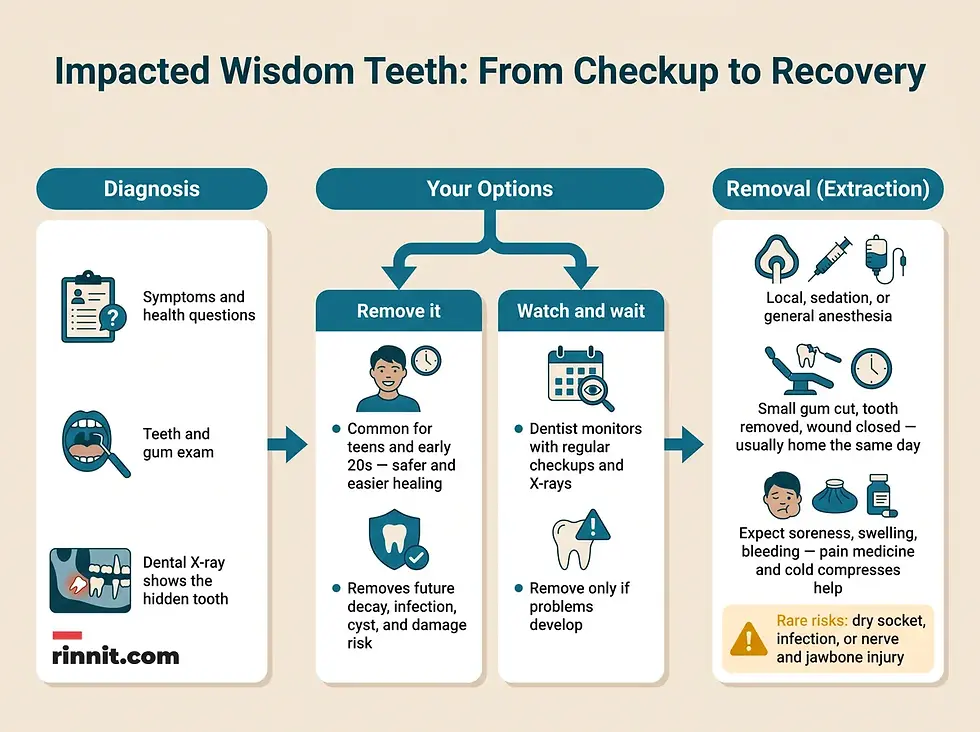
An impacted wisdom tooth is diagnosed by a dentist or oral surgeon who examines your teeth and mouth to see whether it, or another condition, is causing your symptoms. The exam typically includes [2]:
Questions about your dental symptoms and general health.
A check of the condition of your teeth and gums.
Dental X-rays that can show impacted teeth as well as signs of damage to teeth or bone.
How is an impacted wisdom tooth treated?
If your impacted wisdom teeth are hard to treat, or if you have medical conditions that may raise surgical risks, your dentist will likely refer you to an oral surgeon, who can discuss the best course of action [2].
What if the wisdom teeth don't cause symptoms?
Dental specialists genuinely disagree about whether to remove impacted wisdom teeth that aren't causing symptoms. These are called asymptomatic wisdom teeth. Both approaches are reasonable, and your dentist will help you weigh them [2].
Preventive removal. Many dental specialists recommend removing asymptomatic wisdom teeth in the late teens to early twenties, when the risk of complications is low and the procedure is typically safer and better tolerated by younger people. Their reasoning is that:
Symptom-free wisdom teeth may not be free of disease.
Crowded teeth are often hard to reach and clean properly.
Serious wisdom-tooth problems happen less often in younger adults.
The procedure gets harder with age and is more likely to cause problems later.
Watch and wait. Other dentists and oral surgeons recommend a more conservative approach. They note that:
There isn't enough evidence to show that impacted wisdom teeth without problems in young adulthood will cause problems later.
The expense and risks of the procedure may not justify the expected benefit.
Under this approach, your dentist watches your teeth for decay, gum disease, or other problems, and recommends removal only if problems arise.
When is removal (extraction) needed?
Impacted wisdom teeth that cause pain or other dental problems are usually taken out with surgery, also known as extraction. Extraction is usually needed for [2]:
Infection or gum disease involving the wisdom teeth.
Tooth decay in partially erupted wisdom teeth.
Cysts or tumors involving the wisdom teeth.
Wisdom teeth that damage nearby teeth.
Stopping future problems.
Extraction is done mostly as an outpatient procedure, so you'll likely go home the same day. The process involves sedation or anesthesia and then tooth removal:
Sedation or anesthesia. Local anesthesia numbs your mouth, sedation anesthesia lowers your awareness, or general anesthesia puts you to sleep.
Tooth removal. The dentist or oral surgeon makes a cut in your gums, takes out any bone that blocks access to the impacted tooth root, removes the tooth, and closes the wound.
What does recovery look like?
Wisdom tooth extractions may cause some pain and bleeding, as well as swelling of the site or jaw. Some people have trouble opening their mouths wide for a short time due to swelling of the jaw muscles. You'll receive instructions on how to care for the wounds and manage pain and swelling, such as taking pain medicine and using cold compresses [2].
Much less commonly, some people may develop:
Dry socket: a painful exposure of bone if a blood clot doesn't form or comes out of the socket after surgery.
Infection in the socket from bacteria or trapped food particles.
Damage to nearby teeth, nerves, jawbone, or sinuses.
Can you prevent an impacted wisdom tooth?
You can't keep an impaction from occurring. But keeping regular six-month dental appointments for cleaning and checkups allows your dentist to watch the growth and emergence of your wisdom teeth. Regularly updated dental X-rays may show impacted wisdom teeth before any symptoms start [1].
How can you cope with impacted wisdom teeth?
Needing to have a tooth taken out may make you feel worried or anxious, but delaying care can lead to serious and lasting problems. It's important to talk with your dentist about your concerns. It's common to be very nervous, and there's nothing to be embarrassed about [2].
Many dentists offer ways to ease nervousness or anxiety, such as listening to music or watching videos during the procedure, or bringing along a supportive family member or friend. You can also learn relaxation techniques such as deep breathing and imagery. If you have severe anxiety, you'll likely be referred to an oral surgeon, who can provide medicines or sedative techniques to reduce your anxiety and allow the procedure to be completed more comfortably and safely.
How should you prepare for a wisdom teeth appointment?
If you have symptoms that may suggest an impacted wisdom tooth, see your dentist as soon as possible and be ready to answer questions about them. Be ready to answer questions such as [2]:
What symptoms are you having?
When did they begin?
Does anything worsen symptoms, such as chewing toward the back of your mouth?
Have you noticed any bleeding while brushing or flossing?
How do you usually clean your teeth?
Conclusion and next steps
Impacted wisdom teeth are a common dental challenge, but they are also one of the most manageable. Most people sail through their late teens and twenties without ever noticing a problem, while those who develop pain, swelling, or trouble opening their mouth can usually get the affected tooth removed in a routine same-day outpatient procedure.
The one genuinely open question, what to do about wisdom teeth that never cause symptoms, doesn't have a single right answer. That's exactly the conversation to have with your dentist: whether to remove a trouble-free wisdom tooth preventively, or to watch and wait with regular checkups. The decision depends on your age, the position of the teeth, how hard they are to clean, and how you feel about the small surgical risks.
Take action: If you have symptoms behind your last molar, book a dental visit soon. If your last dental X-rays are more than a year old, ask for updated imaging at your next six-month checkup. It's the easiest way to catch an impacted wisdom tooth before it causes trouble.
Frequently asked questions
Is it normal for wisdom teeth to never cause symptoms? Yes. Many impacted wisdom teeth never cause symptoms. The problem is that even symptom-free teeth can quietly develop decay or gum disease because their position makes them hard to clean. Regular checkups with dental X-rays are the best way to keep watch on them [1].
When should wisdom teeth be removed, at what age? Dental specialists who favor preventive removal usually recommend the late teens to early twenties. At that age, the risk of complications is low, healing is faster, and the procedure is better tolerated. The older you are, the harder the extraction becomes and the more likely problems are afterward [2].
What causes wisdom teeth to become impacted? Simply a lack of room. Wisdom teeth usually emerge between ages 17 and 26, and in many people the mouth is too crowded for the third molars to develop normally. The tooth then grows at an angle, lies sideways in the jawbone, or stays trapped in the bone entirely [1].
How do you know if you have an impacted wisdom tooth? Symptoms may include red or swollen gums, tender or bleeding gums, jaw pain, swelling around the jaw, bad breath, an unpleasant taste, or trouble opening your mouth. But only an exam with dental X-rays can confirm whether a wisdom tooth is impacted, and many impacted teeth have no symptoms at all [1] [2].
Does everyone need their wisdom teeth removed? No. Removal is typically needed when a wisdom tooth causes pain, infection, gum disease, decay, cysts, or damage to nearby teeth. For symptom-free teeth, some specialists recommend preventive removal in young adulthood while others recommend watching and waiting. There's no single consensus, so discuss the option with your dentist [2] [5].
Trusted External Resources
Related Reading
Dental X-Rays: Types, What They Show, Safety and How Often You Need Them explains the dental X-ray types your dentist uses to find cavities, bone loss and infections, and how safe they are.
References
Mayo Clinic Staff. Impacted wisdom teeth - Symptoms and causes. Mayo Clinic. February 1, 2024. https://www.mayoclinic.org/diseases-conditions/wisdom-teeth/symptoms-causes/syc-20373808
Mayo Clinic Staff. Impacted wisdom teeth - Diagnosis and treatment. Mayo Clinic. February 1, 2024. https://www.mayoclinic.org/diseases-conditions/wisdom-teeth/diagnosis-treatment/drc-20373813
American Association of Oral and Maxillofacial Surgeons. Wisdom Teeth Management. AAOMS. Last updated September 2026. https://myoms.org/what-we-do/wisdom-teeth-management/
American Dental Association. Wisdom Teeth. MouthHealthy. Accessed October 15, 2026. https://www.mouthhealthy.org/all-topics-a-z/wisdom-teeth/
Ghaeminia H, Nienhuijs ME, Toedtling V, et al. Surgical removal versus retention for the management of asymptomatic disease-free impacted wisdom teeth. Cochrane Database Syst Rev. 2020;5(5):CD003879. PMID 32368796. https://doi.org/10.1002/14651858.CD003879.pub5
Bailey E, Kashbour W, Shah N, et al. Surgical techniques for the removal of mandibular wisdom teeth. Cochrane Database Syst Rev. 2020;7(7):CD004345. PMID 32712962. https://doi.org/10.1002/14651858.CD004345.pub3
Rodríguez Sánchez F, Rodríguez Andrés C, Arteagoitia Calvo I. Does Chlorhexidine Prevent Alveolar Osteitis After Third Molar Extractions? Systematic Review and Meta-Analysis. J Oral Maxillofac Surg. 2017;75(5):901-914. PMID 28189661. https://doi.org/10.1016/j.joms.2017.01.002



Comments