Dental Bone Graft: Purpose, Procedure and Healing

Updated: 2 days ago
Written and medically reviewed by Dr. Baraa Alnahhal, MD · Last reviewed: November 2026 · How we review
Quick Answer
A dental bone graft is a procedure that replaces lost jawbone and adds volume and density to the jaw. Grafting material acts as a scaffold so your own bone can regrow. It's often done after a tooth extraction or before dental implants. Most people report little to no pain. The bone needs at least three months to heal.
What the research says
Grafting after extraction helped preserve bone: in a meta-analysis of 22 trials, filling the socket after a tooth was removed prevented about 1.99 mm of loss in jaw width and 1.72 mm of loss in height compared with extraction alone at 3 to 6 months (Avila-Ortiz G et al., Journal of Clinical Periodontology, 2019) [2]
Animal-bone grafts reduced ridge shrinkage: in a Cochrane review of 16 trials with 426 adults, xenograft socket grafting (in 6 trials with 184 adults) reduced loss of ridge width by 1.18 mm and height by 1.35 mm versus extraction alone, with no clear difference in implant failure (very low certainty) (Atieh MA et al., Cochrane Database of Systematic Reviews, 2021) [3]
Key takeaways
A dental bone graft rebuilds lost jawbone.
It's often done after an extraction or before dental implants.
Graft material can be human, animal, lab-made or your own bone.
Most people report little to no pain.
Full healing takes at least three months.
What is a dental bone graft?
A dental bone graft adds powdered grafting material to areas of bone loss in your jaw. Over time, your own bone grows into it. Providers place about 2.2 million bone grafts every year worldwide. Learn about bone grafting in other parts of the body. Sources: [1]
Why it's done
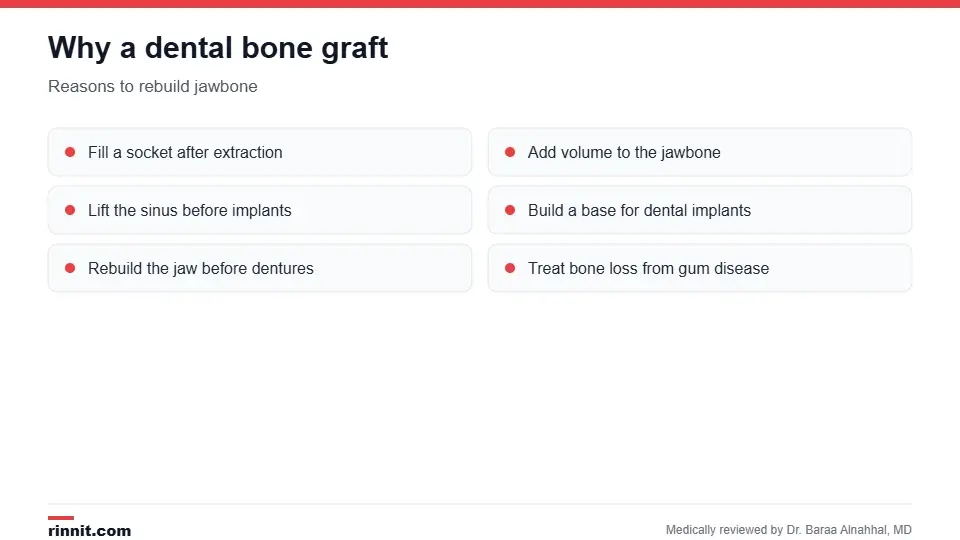
The graft gives your jaw a stronger base.
Fill an empty socket after a tooth extraction.
Widen or add volume to your jawbone.
Lift the sinuses before implants are placed.
Build a foundation for dental implants.
Rebuild the jaw before dentures.
Repair dental trauma or stabilize loose teeth.
Treat bone loss from infections such as gum disease. Sources: [1]
Types of bone grafts
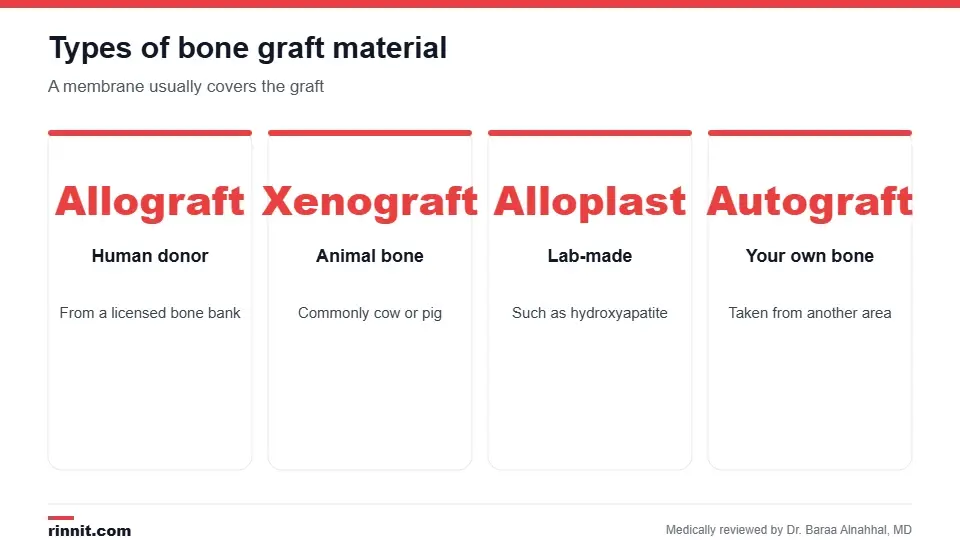
A membrane usually covers the graft.
Type | Source |
Allograft | Human bone from a licensed donor bank |
Xenograft | Animal bone, commonly cow or pig, from a licensed donor bank |
Alloplast | Lab-made substitute, such as hydroxyapatite |
Autogenous | Your own bone from another area of your body |
A membrane covers the graft. Some membranes dissolve on their own, and others are removed at a follow-up visit. Platelet-rich plasma (PRP) from your own blood may also be added. Sources: [1]
What happens during the procedure
Your gums are numbed with local anesthetic, with sedation if you choose.
Your provider makes a small cut in your gums.
The gums are moved away from the jawbone.
The area is cleaned and disinfected.
Grafting material is added.
A membrane covers the graft.
The gums are put back in place.
Stitches close the area. Sources: [1]
Risks
Risk | Notes |
Graft failure | More likely in people who smoke or have certain medical conditions |
Infection | Antibiotics may be prescribed |
Nerve damage | Possible |
Severe bleeding | Possible |
Anesthesia complications | Possible |
Signs of graft failure include pain or swelling that gets worse after the first week, pus or drainage, gum recession and no improvement in bone volume. Success rates are up to 100%, depending on the type of graft. Sources: [1, 3]
Recovery
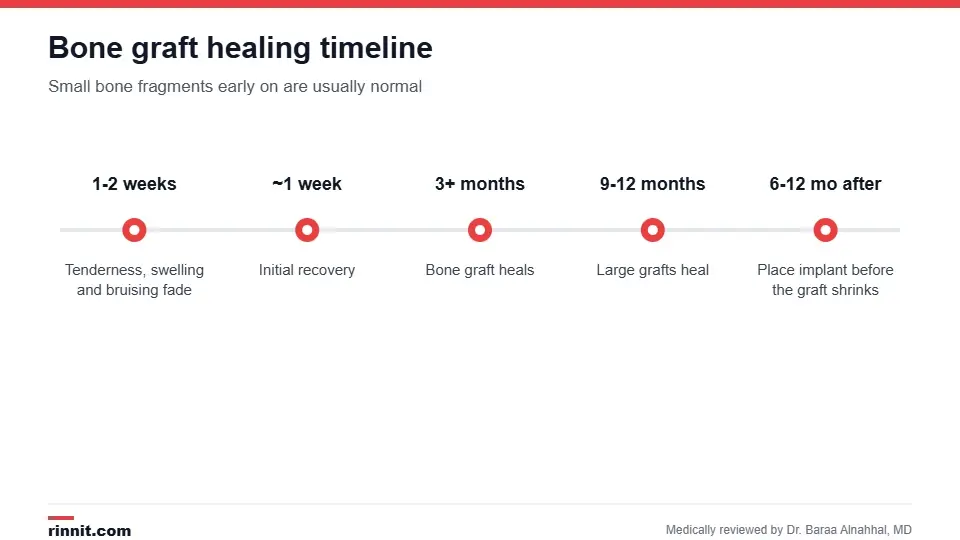
Losing small bone fragments in the first few days is usually normal.
Ice the outside of your jaw and keep your head raised.
Eat soft foods for a few days.
Keep the site clean, and take medicines as prescribed.
Don't drink alcohol for at least two weeks.
Avoid exercise and heavy lifting for at least 48 hours.
Don't spit or swish hard, and don't smoke or vape. Sources: [1]
Results
A bone graft can last a lifetime, but bone that isn't used shrinks over time. If you're getting an implant, it should be placed within six to 12 months after the graft heals. Sources: [1]
When to call your provider
A fever of 101°F (38.3°C) or higher.
Increasing swelling.
Pus around the graft site.
Severe pain.
Losing large bone fragments. Sources: [1]
Conclusion
A dental bone graft rebuilds lost jawbone and prepares your mouth for implants or dentures. Careful aftercare and avoiding smoking give the graft the best chance to succeed.
Keep learning: read about dental implants and tooth extraction.
Frequently asked questions
What is a dental bone graft?
A procedure that replaces lost jawbone and adds volume to your jaw.
Why would I need a bone graft?
To fill a socket after extraction, prepare for implants or treat bone loss.
Does a dental bone graft hurt?
Most people report little to no pain.
What is the graft made of?
Human, animal, lab-made or your own bone.
How long does a bone graft take to heal?
At least three months; large grafts take nine to 12 months.
When can I get an implant?
Usually within six to 12 months after the graft heals.
Is losing small bone pieces normal?
Yes, in the first few days.
Can a bone graft fail?
Yes, especially in people who smoke.
What can I eat after a bone graft?
Soft foods for a few days.
How long does a bone graft last?
It can last a lifetime if the bone is used.
Related Reading
Dental Implants: Types, Procedure, Recovery and Success Rates replacing teeth with implants.
Bone Grafting: Types, Procedure, Risks and Recovery bone grafts in other parts of the body.
Gum Disease Treatment: Restoring Oral Health and Preventing Bone Loss treating gum disease and bone loss.
Dentures: Types, Procedure, Care and How Long They Last removable replacement teeth.
References
Cleveland Clinic. Dental Bone Graft: Process, Purpose & Healing. Cleveland Clinic. Last updated August 6, 2024. https://my.clevelandclinic.org/health/treatments/21727-dental-bone-graft
Avila-Ortiz G, Chambrone L, Vignoletti F. Effect of alveolar ridge preservation interventions following tooth extraction: a systematic review and meta-analysis. Journal of Clinical Periodontology. 2019;46(Suppl 21):195-223. PMID 30623987. https://doi.org/10.1111/jcpe.13057
Atieh MA, Alsabeeha NH, Payne AG, et al. Interventions for replacing missing teeth: alveolar ridge preservation techniques for dental implant site development. Cochrane Database of Systematic Reviews. 2021;4(4):CD010176. PMID 33899930. https://doi.org/10.1002/14651858.CD010176.pub3
Medical disclaimer
This article is for general education only and does not replace advice from a qualified healthcare professional. Talk to your doctor about your own diagnosis and treatment, and seek emergency care right away for severe or sudden symptoms.



Comments